


SMC Insurance
Welcome to SMC.
How may I assist you?

Time Remaining to Avail Tax Benefits
(Under section 80C & 80D)
Get 90 Lakh Health Cover at Just ₹2K


Buy Life Insurance Now!

100% Privacy
Zero Spam

Network
30+ Reliable Insurers

Legacy

Highly rated insurance website
4.1/5

 Instant Renewal.
 No Paperwork.
Plans start at Just ₹6*/day
A car insurance claim in India can be rejected when the driver lacked a valid licence, was under the influence of alcohol or drugs, or the policy had lapsed at the time of the incident. Claims are also denied for undisclosed vehicle modifications, commercial use of a private vehicle, staged accidents, damage under policy exclusions (wear and tear, war, mechanical failure), or unauthorized pre-survey repairs. Under IRDAI's 2024 guidelines, insurers cannot reject claims solely for missing documents or minor delays in intimation where the delay did not worsen the loss. If rejected unfairly, policyholders can escalate to IRDAI's Bima Bharosa portal or the Insurance Ombudsman for disputes up to Rs. 50 lakh.
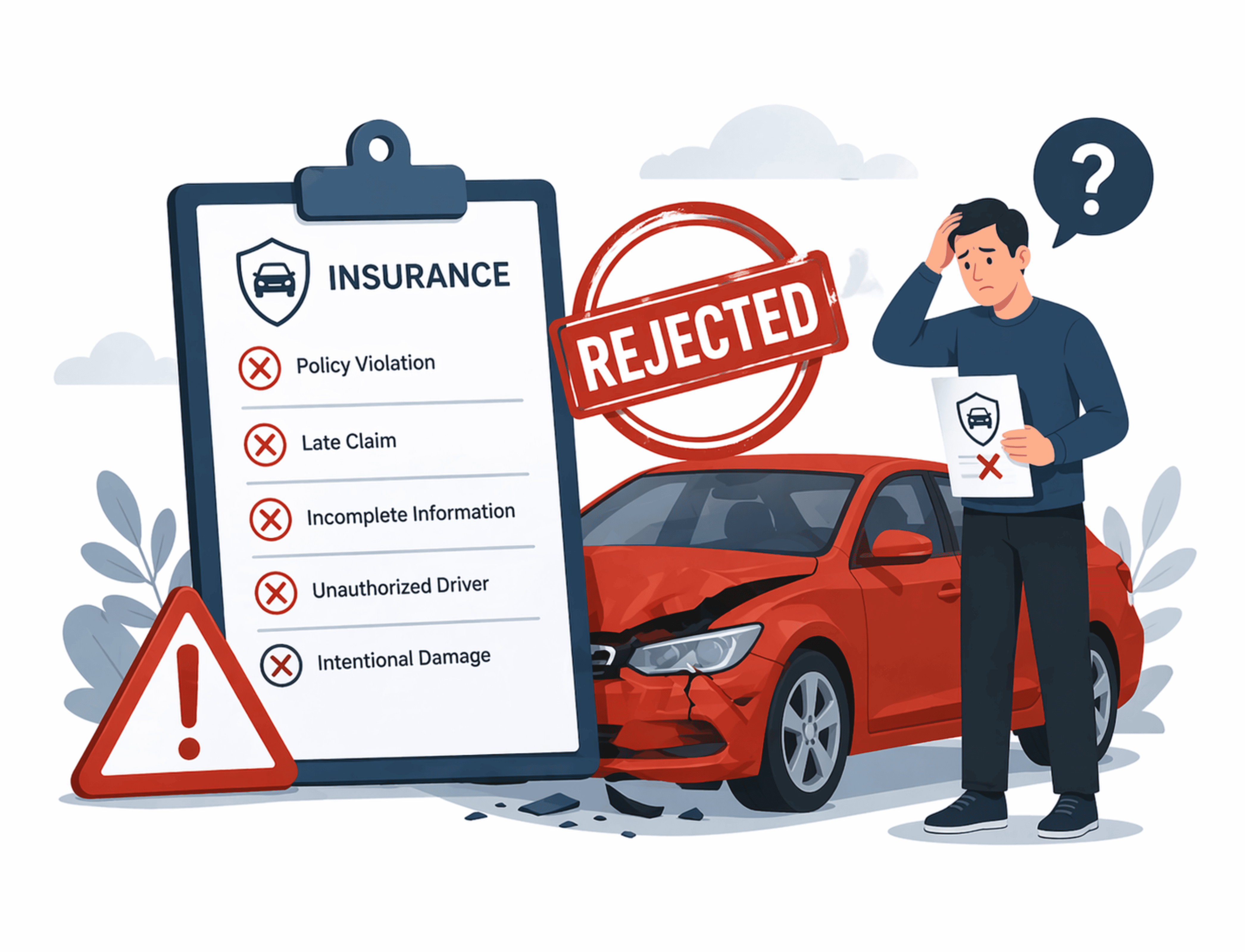
The accident and then the letter from your insurer: claim rejected. This is not a rare situation. Every year, thousands of car insurance claims in India are denied, and most of them catch policyholders completely off guard. The painful part? Many rejections are entirely avoidable. The insurer was not cheating you; you unknowingly broke a condition buried in the fine print.
Car insurance in India is governed by IRDAI (Insurance Regulatory and Development Authority of India), and while IRDAI has tightened rules to protect policyholders, insurers still have clear, legitimate grounds to reject claims. Knowing those grounds before you file (or better, before an accident happens), is the smartest thing you can do when you buy car insurance. This article breaks down every valid reason your car insurance claim can be rejected, what IRDAI says about it, and how to protect yourself.
Let's cut straight to it. These are the situations where your insurer can legally deny your claim and insurers are permitted to reject claims on these grounds, subject to review in grievance or judicial forums.
IRDAI has strengthened policyholder protection by clarifying that:
These changes are aimed at reducing mechanical claim rejections and improving fairness in claim settlement practices.
|
Rejection Reason |
Your Fault? |
Can It Be Appealed? |
Prevention |
|
No valid driving licence |
Yes |
Very unlikely |
Renew DL before expiry |
|
Drunk/drug-impaired driving |
Yes |
No |
Do not drive impaired |
|
Lapsed policy |
Yes |
No |
Set renewal reminders |
|
Commercial use of private car |
Yes |
Unlikely |
Declare correct vehicle use |
|
Undisclosed modifications |
Partially |
Depends on modification type |
Inform insurer after any change |
|
Pre-repair without survey |
Yes |
Partially |
Always notify insurer first |
|
Staged accident or fraud |
Yes |
No; legal action possible |
N/A |
|
Damage under exclusions |
No |
No |
Buy add-ons for expanded coverage |
|
Delayed intimation (avoidable) |
Yes |
Sometimes |
Report within 24–48 hours |
Note: IRDAI's 2024 guidelines clarify that insurers should not reject claims where a breach of policy condition is not relevant to the nature or extent of the loss. For example, a minor delay in intimation that did not worsen the damage is not valid grounds for rejection.
This is where most policyholders don't know their rights and insurers have historically exploited that gap. Claims cannot be rejected if the breach of policy conditions is irrelevant to the loss. Also, delays by the policyholder are not valid grounds for rejection unless they increase the loss.
In its 2024 master circular, IRDAI directed that insurers should request only documents directly relevant to claim assessment. It also clarified that claims should not be rejected if the breach of a condition or requirement is not relevant to the nature or circumstances of the loss. Insurers must now limit their document requirements to only those directly relevant to the claim.
In short: IRDAI has advised insurers not to reject claims solely on technical or procedural grounds where the claim is otherwise valid. If your claim was rejected due to a missing document that was not essential to the claim decision, you can challenge it.
If your claim has been rejected and you believe it is unjust, here's your path forward.
Step 1 — Get the rejection in writing
IRDAI mandates that claim rejections must come with documented justification. If you haven't received a written reason, demand one.
Step 2 — Write to the Grievance Officer
Every insurer has a designated Grievance Redressal Officer. Submit a formal written complaint with your claim details, rejection letter, and supporting documents.
Step 3 — Escalate to IRDAI's Bima Bharosa Portal
If the insurer does not resolve your complaint within 15 days, file a grievance at bimabharosa.irdai.gov.in. IRDAI tracks insurer compliance on grievance redressal.
Step 4 — Approach the Insurance Ombudsman
For disputes up to Rs. 50 lakh, the Insurance Ombudsman offers free, binding arbitration. The office nearest to your residential address handles the case. Contact details are available at cioins.co.in.
Step 5 — Consumer Forum or Civil Court
For larger amounts or if the Ombudsman's decision is unsatisfactory, a consumer forum or civil court remains an option.
Note: IRDAI regulations require insurers to communicate claim rejection decisions in writing, along with the reasons, within a defined timeline after receiving the survey report.
Not sure which car insurance gives you the best protection with the fewest exclusions? Compare comprehensive plans from trusted insurers at SMC Insurance - a quick comparison now can save you a painful rejection later.
A car insurance claim rejection is rarely a surprise if you understand your policy. The most common rejections in India trace back to a handful of decisions: driving without a licence, not renewing the policy on time, failing to declare vehicle changes, or getting repairs done without a surveyor's visit. The law is increasingly on your side. IRDAI has tightened the rules on what constitutes a valid rejection, and policyholders now have a clear grievance path when rejections feel unjust. But the smartest move is upstream: read your policy document, specifically the exclusions and conditions section, before an accident forces you to read it under pressure.
Comprehensive coverage with the right add-ons like zero depreciation, engine protection, consumables cover, etc., closes most of the gaps that lead to partial or full rejections. When you next buy car insurance or renew, treat add-ons not as upsells but as rejection-proofing.
Disclaimer:The information provided on this platform is intended for general awareness and educational purposes. While every effort is made to ensure accuracy, some details may change with policy updates, regulatory revisions, or insurer-specific modifications. Readers should verify current terms and conditions directly with relevant insurers or through professional consultation before making any decision.
All views and analyses presented are based on publicly available data, internal research, and other sources considered reliable at the time of writing. These do not constitute professional advice, recommendations, or guarantees of any product’s performance. Readers are encouraged to assess the information independently and seek qualified guidance suited to their individual requirements. Customers are advised to review official sales brochures, policy documents, and disclosures before proceeding with any purchase or commitment.
Driving without a valid licence remains the most frequently cited reason for car insurance claim rejection in India. This includes an expired licence, driving a vehicle category not authorised by the licence, or a learner's licence holder driving without a qualified supervisor. Since it constitutes both a legal and contractual violation, insurers almost never settle claims under this circumstance, and appeals are rarely successful. Check your licence validity before every long trip, not just when you buy car insurance.
Your own-damage claim can still be rejected if you were in breach of a policy condition — regardless of who caused the accident. For instance, if your policy had lapsed, the insurer can deny your claim even if the other party caused the collision. However, third-party liability claims against you must still be settled by the insurer as mandated by the Motor Vehicles Act, 1988. Own-damage coverage is where most exclusions and conditions apply.
Not always. IRDAI has clarified that delays in claim intimation are not valid rejection grounds unless the delay worsened the loss or gave the insurer less ability to assess the damage. If you were hospitalized or otherwise incapacitated after the accident, document that clearly when you do file. Where delays are genuinely unavoidable, insurers are expected to consider the claim on its merits. That said, it is always best to intimate within 24–48 hours as required by your policy.
Yes, it can be. An undisclosed CNG/LPG kit is a material modification that changes the vehicle's risk profile. If the accident was directly or indirectly related to the modification like a gas leak, the rejection is almost certain. Even if the accident was unrelated, the insurer can use non-disclosure as grounds to deny the claim or void the policy. The solution is straightforward: inform your insurer about any modification, pay the revised premium if applicable, and get it endorsed on the policy document.
First, do not move or repair the vehicle until your insurer is informed. Intimate the insurer within 24 hours — most insurers have a toll-free number and a claims app for this. File an FIR if the accident involved a third party, theft, or significant damage. Take photographs of the damage, the accident site, and any third-party vehicles involved. Keep the original documents like RC, DL, and insurance certificate ready. If you need emergency repairs to make the vehicle safe to tow, document what was done and why before proceeding.
Yes, start with a written complaint to the insurer's Grievance Redressal Officer. If unresolved within 15 days, escalate to IRDAI's Bima Bharosa portal at bimabharosa.irdai.gov.in. For financial disputes up to Rs. 50 lakh, the Insurance Ombudsman offers free and binding arbitration. Consumer courts are an additional option for larger claims or cases where the Ombudsman's ruling feels insufficient. Document everything in writing throughout this process.
Comprehensive car insurance covers significantly more than a third-party only policy including own damage, theft, fire, and natural disasters. But it still carries exclusions and conditions. Claim rejection can happen under a comprehensive policy too if you were driving drunk, without a licence, or with an undisclosed modification. What comprehensive coverage does is reduce the reasons for rejection by expanding what's covered. Add-ons like zero depreciation and engine protection further close the gaps. No policy, however, covers policy condition violations.


SMC Insurance Brokers Pvt. Ltd.
SMC Metro Mall, Near Pratap Nagar Metro Station, Pratap Nagar, New Delhi-110007
Registration No: 289, Registration Code No: IRDAI/DB-272/04/289, Valid till: 27/01/2029, License category: Composite Broker, CIN: U66000DL1995PTC172311
Insurance is the subject matter of solicitation.
Visitors are hereby informed that their information submitted on the website may be shared with insurers.
Product information is authentic and solely based on the information received from the Insurer.

Scan to Download
SMC Insurance App
