


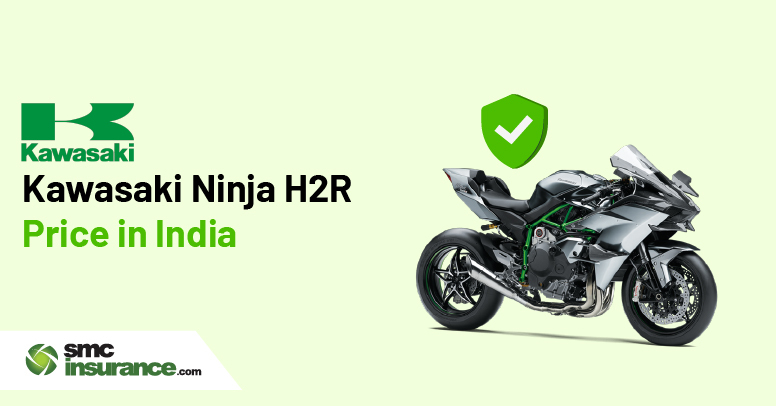

The Kawasaki Ninja H2R is a track-only superbike and is not street legal in India. Its ex-showroom price is around Rs. 79.9 lakh for the standard variant, rising to Rs. 85.49 lakh for the newer Euro 5 variant, while the on-road cost varies by state due to RTO charges, taxes, and insurance. The bike uses a 998 cc supercharged engine producing about 305-326 bhp with ram-air and is built for closed-circuit use only.
Since it cannot be registered for road riding, standard third-party motor insurance under IRDAI rules does not apply, and owners typically rely on specialised track or event-use coverage.
It is a beautiful summer morning. You live near a race track and head out the streets for a walk in your cosy pajamas. The streets are still sleepy, but a sharp roar cuts through the air. Heads turn; hearts skip. Something wild had just passed by in a flash of black and silver. That blur? It is the Kawasaki Ninja H2R, and it moves like it owns the wind.
You may be excitedly asking, "How fast can it really go?" How much does such raw power cost in India in 2026? And if someone actually owns one, what is the smartest way to protect it with the right insurance?
The H2R is the kind of ride that makes even non-bikers stop and stare. It’s rare, it’s loud, and it’s built for those who want speed without compromise. Let’s dive into the latest price, on-road cost, jaw-dropping features, and the best insurance options in the article below.
Kawasaki Ninja H2R Price in India (2026)
Source: Bikewale
The Ninja H2R isn't the kind of bike you see outside a cafe. It's a track-only motorcycle built for extremes, and its price reflects that exclusivity. In 2026, the ex-showroom figure in India stands at about Rs. 79.9 lakh for the standard variant, with the newer Euro 5 variant priced from Rs. 85.49 lakh, more or less the same across most cities, since it ships in as a Complete Built Unit (CBU).
On-road costs tell a different story. Registration fees, RTO charges, and insurance push the number higher, and the final amount changes with each state’s tax structure. For example,
|
City |
Price |
|
Delhi |
Rs. 81.7 lakhs |
|
Mumbai |
Rs. 86.7 lakhs |
|
Bengaluru |
Rs. 90.7 lakhs |
|
Chennai and Hyderabad |
Rs. 87-88 lakhs range |
|
Kolkata |
Rs. 81.2 lakhs |
Note: Final on-road pricing should be confirmed with an authorised dealer due to evolving tax and insurance costs.
Kawasaki Ninja H2R - Latest Updates
Kawasaki hasn’t rolled out any major changes for the H2R recently. The bike still carries the same outrageous design and engineering that shook the motorcycling world when it first arrived. There are no new trims, no detuned versions, just the same carbon-clad monster that delivers performance figures most riders will never fully use. The exclusivity remains as strong as ever, and so does the waiting list for those determined to own one.
Key Specifications & Features
Here’s a look at some of the great features that the bike has in store for you:
|
Specification |
Details |
|
Engine Type |
Supercharged 998 cc inline-four |
|
Power (Standard) |
~305.7 bhp |
|
Power (with Ram-Air) |
~326 bhp |
|
Torque |
165 Nm |
|
Engine Characteristics |
High-revving |
|
Top Speed |
~400 km/h (comparable to aviation speeds rather than typical road use) |
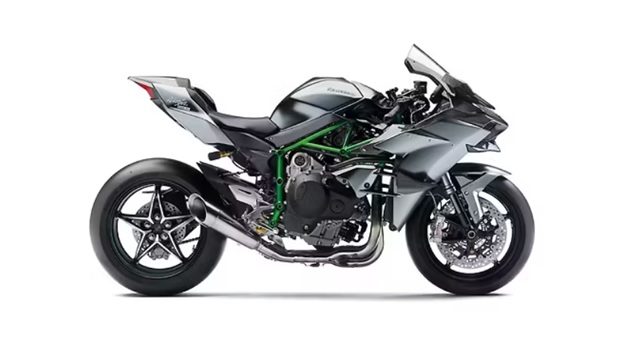
The Ninja H2R weighs approximately 216 kg and uses carbon-fibre aerodynamic elements and winglets for stability at high speeds. A steel trellis frame holds everything together, while the carbon-fiber fairings and aerodynamic winglets keep it stable at insane speeds. Brembo brakes (massive discs and monoblock calipers) bring it all to a halt with authority.
Electronics keep the rider connected to the machine without getting overwhelmed. There is launch control, cornering ABS, a quick-shifter, traction control, and more, all tuned for track performance. And the styling? Aggressive, purposeful, and instantly recognisable. The single-sided swingarm, sharp lines, and dark metallic paint make it look like it’s in motion even when parked.
Kawasaki Ninja H2R Colours
There is really just one look for the H2R in India - Mirror Coated Matte Spark Black. It’s moody, bold, and everything about it feels serious. Be it in photos or in sunlight, it shows off a mirror-like gleam edged with matte texture.
Safety of the Kawasaki Ninja H2R
To be honest, this bike is not typically built for your daily commute, and safety gear shows that. It includes ABS (dual-channel), traction control, a slipper clutch, launch control, and riding modes. You also get a side-stand alarm, hazard lights, pass light, even brake assist. The bike is smarter in the way it helps you manage its brutal power.
Mileage of the Kawasaki Ninja H2R
You would expect hyper-performance for fuel bills, right? The claimed ARAI mileage is around 15-20 kmpl. Some real-world figures show it hovering between 10 to 15 kmpl, which still isn’t bad for a bike tuned for the track.
Pros & Cons of the Kawasaki Ninja H2R
Here’s more information on the advantages and disadvantages of the Kawasaki Ninja H2R:
Pros
The H2R stands alone in a league of its own. You feel that the moment you set eyes on its aggressive frame and carbon-fiber shine. While the Ninja H2R is among the most powerful production motorcycles, its legal use is limited to tracks in India. It handles like a precision bike that is smooth, sharp and hypnotic. And power? It’s mind-blowing.
Cons
But you pay for those thrills. Service centres are rare, and parts are costly. Plus, this bike is strictly for the track. It cannot be legally ridden on public roads in India due to missing homologation components. So, you can’t just speed-ride it out of the showroom.
Why Bike Insurance Matters for the H2R?
When we talk about Kawasaki Ninja H2R, we are talking about a massive investment. In India, any two-wheeler needs at least third-party insurance by law. But for something as extreme as the H2R, you will want peace of mind that goes beyond the basic bike insurance. Bike insurance protects you from legal trouble and shields you from financial hits like accidents, theft, natural disasters, etc.
Note: Since the Kawasaki Ninja H2R is not road legal in India,
it cannot be registered for regular third-party or comprehensive bike insurance as a road vehicle. Owners typically insure such track-only vehicles under specialised event/track policies or transport insurance.
Can You Insure a Kawasaki Ninja H2R in India?
Since the H2R isn't registered as a road vehicle in India, it doesn't go through SMC's standard online quote flow (registration number, RTO selection, and so on) as that process is built for road-registered bikes. Owners typically arrange cover through specialised event/track-day policies or transport/marine-style cover
for the import and storage of the bike, rather than a standard two-wheeler policy.
If you're deciding between a track-only machine like the H2R and something you can actually ride and insure on Indian roads, SMC can help you compare comprehensive bike insurance for street-legal performance bikes like the Kawasaki Ninja ZX-10R or
the H2 (non-R), which can be registered and insured normally.
Summing Up
The Ninja H2R from Kawasaki is a true masterpiece. It is designed for people who have an unquenchable desire for speed and combines raw power with innovative design. Even though it is exclusive due to its exorbitant price and track-only status, it is still a dream bike that attracts attention everywhere. If you're fortunate enough to own one, prudent insurance is essential to protect this beast. The H2R is a great example of both pure adrenaline and engineering genius for people who love thrills or collecting things.
Disclaimer:The information provided on this platform is intended for general awareness and educational purposes. While every effort is made to ensure accuracy, some details may change with policy updates, regulatory revisions, or insurer-specific modifications. Readers should verify current terms and conditions directly with relevant insurers or through professional consultation before making any decision.
All views and analyses presented are based on publicly available data, internal research, and other sources considered reliable at the time of writing. These do not constitute professional advice, recommendations, or guarantees of any product’s performance. Readers are encouraged to assess the information independently and seek qualified guidance suited to their individual requirements. Customers are advised to review official sales brochures, policy documents, and disclosures before proceeding with any purchase or commitment.
FAQs
The on-road price depends on the city. It's around Rs. 81.7 lakh in Delhi, Rs. 86.7 lakh in Mumbai, Rs. 90.7 lakh in Bengaluru, Rs. 87–88 lakh in Chennai and Hyderabad, and around Rs. 81.2 lakh in Kolkata. Prices vary with each state's RTO charges and tax structure; always confirm with an authorised dealer before buying.
No, the H2R is a track-only motorcycle and isn’t approved for public roads in India.
Kawasaki claims it can reach about 400 km/h under optimal conditions.
High import duties, GST, road tax, and limited availability push the price much higher than in other markets.
It has a 998-cc supercharged inline-four engine.
It is offered in a single colour - Mirror Coated Matte Spark Black.
Yes, at 998 cc, it is technically just under 1000 cc.
Yes, the H2R’s top speed far exceeds the BMW S1000RR, which tops out at around 303 km/h.


