


Traffic rules in India for 2026 focus on stricter enforcement, higher fines, and digital monitoring to improve road safety. Key updates include mandatory helmets for riders and pillion passengers, compulsory seat belts for front and rear car occupants, heavy penalties for mobile phone use while driving, stronger action against drunk and wrong-side driving, and tighter checks on pollution and vehicle documents. Traffic rules apply to drivers, riders, pedestrians, and commercial vehicles, with online payment options for traffic challans across most states.
Indian roads follow their own rhythm, somewhere between a chess match and a street festival. One minute everything flows, the next minute someone stops to answer a phone call in the fast lane. Sounds familiar? That daily chaos is exactly why traffic rules in India matter more than most people admit.
In 2026, road rules are no longer easy to brush aside with a smile or a quick excuse. Fines have grown sharper. Cameras watch quietly. Digital challans arrive faster than expected. So what happens when a helmet strap is loose, a seat belt is skipped, or a speed limit feels “flexible”? Who pays the price then? And how many rules do people break without even knowing it?
These laws affect everyone. The office commuter stuck at signals. The biker weaving through traffic. The pedestrian waiting for a safe gap. Even learners getting behind the wheel for the first time. Some updates aim to reduce accidents. Others focus on discipline and fairness. Many people hear bits and pieces but miss the full picture.
Do you know which fines changed this year? Or which rules are now taken very seriously? Scroll down to explore the complete list of traffic rules, updated penalties and new changes for 2026, explained clearly and without confusion.
Overview of Traffic Rules in India
Indian roads are busy by nature. Take a regular weekday morning in Pune. Ramesh rides his scooter to work. He is already late. At a crossing, the signal turns red, but the road looks clear. He slows down anyway. At the same moment, a school van turns in from the left. If Ramesh had rushed through, the outcome could have been very different. Nothing dramatic happens and everyone moves on. That quiet outcome is the point.
Basically, traffic rules in India are built around one basic idea. Shared roads need shared responsibility. When rules are followed, traffic flows better, accidents drop and people get home safely. When rules are ignored, the cost is often paid by someone else.
In Delhi, Meena walks her daughter across a zebra crossing every evening. Some drivers stop. Some do not. The ones who slow down give her time to cross without fear. The ones who rush through force her to wait in the middle of the road. The rule is simple. The difference it makes is not.
Traffic laws are designed to bring balance to roads that carry many types of users at the same time. They help to:
- Improve road safety for drivers and pedestrians
- Reduce serious injuries and fatalities
- Manage traffic movement in crowded areas
- Encourage discipline and predictable behaviour
Who must follow traffic rules?
Traffic rules apply to everyone on the road, not just vehicle owners.
- Two-wheelers
- Cars
- Commercial vehicles
- Pedestrians
Latest Government Updates on Traffic Rules (2025–2026)
Over the last few years, traffic enforcement in India has become stricter. Between 2025 and 2026, authorities have focused on accountability. The aim is simple - to reduce accidents before they happen.
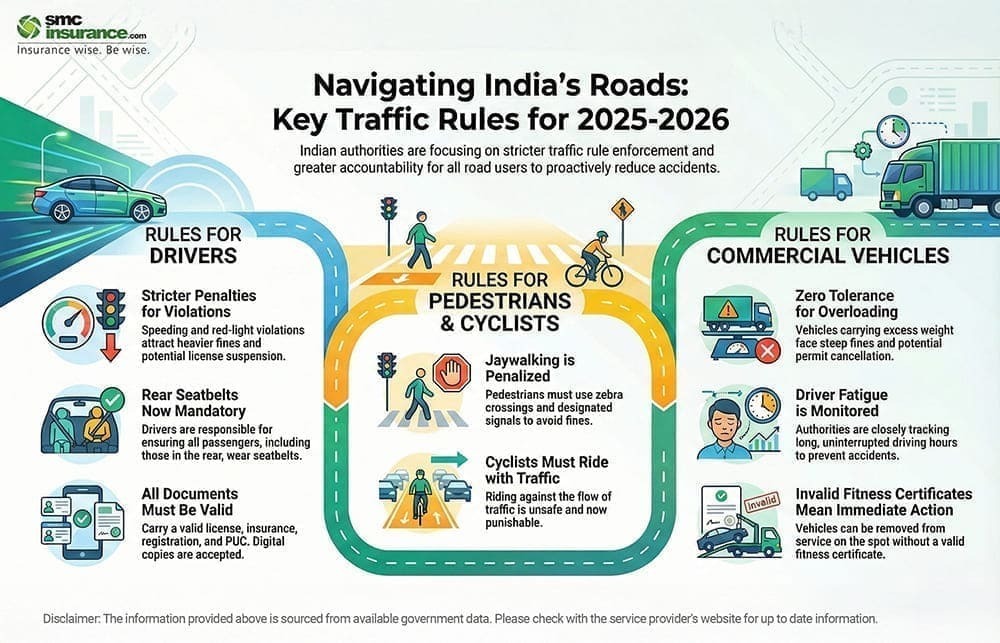
➔ Key Traffic Rules for Drivers
Drivers are now expected to follow rules without shortcuts:
- Red-light violations and speeding attract heavier fines. In repeated cases, licences may be suspended or cancelled.
- Random breathalyser checks have increased, especially at night and on highways. Serious violations can lead to arrest and imprisonment.
- Seatbelt rules now apply strictly to rear-seat passengers as well. The responsibility lies with the driver.
- Using a phone while driving, even briefly, is treated as dangerous behaviour unless a proper hands-free system is used.
- Driving without a valid licence, Motor insurance, registration, or pollution certificate (PUC) can result in fines or vehicle seizure. Digital documents are accepted, but they must be valid.
➔ Key Traffic Rules For Pedestrians and Cyclists
Road safety efforts now include non-motorised road users more actively:
- Jaywalking is being penalised in many cities. Zebra crossings and pedestrian signals must be used.
- Pedestrians crossing during red signals may be fined in certain areas.
- Cyclists are encouraged to wear helmets, use reflectors and ride with traffic flow. Riding against traffic is considered unsafe and punishable.
- Using mobile phones while crossing roads has drawn attention due to rising accident cases involving pedestrians.
➔ Key Traffic Rules for Commercial Vehicles
Commercial vehicles remain a major focus due to their size and risk factor:
- Vehicles carrying excess weight face steep fines and possible permit cancellation.
- Long, uninterrupted driving hours are being monitored more closely to reduce fatigue-related accidents.
- Vehicles without valid fitness certificates or route permits can be removed from service immediately.
- Public transport vehicles must follow seating limits and maintain emergency exits, doors and basic safety equipment
Essential Documents to Carry While Driving
Most traffic stops do not start with a fine. They start with a simple question - “Documents, please.” And in that moment, not having the right papers can turn a normal day into a long one.
In India, every driver is expected to carry a basic set of documents while using the road. These documents prove that both you and your vehicle are legally allowed to be there.
Documents you must have at all times:
|
Document Type |
What it Tells |
|
Driving Licence |
This confirms that you are authorised to drive that particular vehicle type. |
|
Vehicle Registration Certificate (RC) |
The RC shows that the vehicle is registered with the authorities. |
|
Motor Insurance Policy |
At least a third-party insurance policy is mandatory under Indian law. Even a minor accident without insurance can lead to heavy penalties and legal trouble. |
|
Pollution Under Control (PUC) Certificate |
PUC checks ensure your vehicle meets emission standards. |
|
Additional permits for commercial vehicles |
Taxis, trucks and transport vehicles must carry valid route permits and fitness certificates. |
Keeping these documents handy, physically or digitally, saves time. And stress!
Central Government Proposed Updates - Proposed Double Fines for Child Safety Violations
Child safety on Indian roads has become a serious concern. And for good reason. Many accident reports show children getting injured because basic safety rules were ignored. To address this, the Central Government has proposed stricter penalties for child safety violations.
What is likely to change?
The proposal focuses on doubling fines for offences that put children at risk while travelling. This includes:
- Children not wearing helmets on two-wheelers
- More passengers than allowed on bikes or scooters
- Children not using seatbelts in cars
- Unsafe seating arrangements in moving vehicles
The idea is to simply push safer habits. When fines increase, behaviour often changes. And when behaviour changes, lives are protected. Once implemented, these rules will apply across states, with local enforcement agencies responsible for checks.
Latest Traffic Violation Fines in India (2026 List)
Below is a clear, updated table of common traffic violations and their applicable fines in 2026. Actual penalties may vary slightly by state, but these are the nationally enforced limits under the Motor Vehicles Act.
|
Traffic Violation |
Fine Amount (Rs. ) |
|
Driving without licence |
5,000 |
|
Overspeeding |
1,000 - 2,000 |
|
Drunk driving |
10,000 and/or jail |
|
Jumping traffic signal |
1,000 - 5,000 |
|
Riding without helmet |
1,000 and licence suspension |
|
Not wearing seatbelt |
1,000 |
|
Using mobile phone while driving |
5,000 |
|
Driving without insurance |
2,000 |
|
Overloading two-wheelers |
2,000 |
|
Dangerous driving |
5,000 |
|
No Pollution Certificate |
1,000 |
|
Allowing underage driving |
25,000 and jail |
Traffic Rules for Commercial Vehicles
Traffic rules for commercial vehicles are stricter. Authorities now monitor these vehicles more closely because even a small lapse can lead to serious damage.
Key rules commercial drivers must follow:
- Commercial vehicles must carry valid permits, fitness certificates and insurance at all times. Expired paperwork is no longer overlooked.
- Goods vehicles carrying excess weight face heavy fines and possible permit suspension. Overloading affects braking, steering and tyre life. It also damages roads.
- Fatigue causes accidents. Rest breaks and driving hour limits are being enforced more strictly, especially on long routes.
- Faulty brakes, worn tyres, broken lights, or missing reflectors can get a vehicle taken off the road instantly.
- No standing passengers beyond capacity. Functional doors and emergency exits are mandatory. Safety equipment must be in place.
Road Safety Tips for Indian Drivers
Indian roads demand attention. Here are simple, practical safety habits that actually work.
➔ For Car Drivers
- Wear your seatbelt every time. Even in the back seat.
- Stick to speed limits, especially near schools and residential areas.
- Avoid phone use completely while driving. A quick glance is enough to miss something important.
- Slow down at intersections, even when the signal is green.
- And keep your documents and insurance up to date. Platforms like SMC Insurance make this easier by helping drivers compare and manage policies in one place.
➔ For Two-Wheeler Riders
- Helmets save lives.
- Avoid sudden lane changes and weaving through traffic.
- Never overload your bike. It affects balance more than people realise.
- Use indicators to make your intentions clear.
- And stay visible at night with proper lights and reflectors.
➔ For Pedestrians
- Use zebra crossings whenever possible.
- Make eye contact with drivers before crossing.
- Avoid mobile phones while crossing roads.
- Walk on footpaths, not road edges.
Road safety improves when everyone stays alert, not just drivers.
Short Expert Insight
So, why stricter rules now?
Because the old approach was not working. India has seen steady growth in vehicles, but accident numbers remain worrying. Authorities realised that awareness alone was not enough.
So enforcement changed. Today, traffic regulation focuses on digitised challans, wider camera coverage and real penalties that act as deterrents. Helmet checks are routine. Seatbelt rules include rear passengers. Phone use is tracked. Pollution compliance is enforced, not ignored.
Ultimately, the goal is simple - fewer accidents, fewer injuries and fewer families affected.
Summing Up,
Traffic rules in India are now firm, enforced and tied closely to safety. As roads get busier, the focus has shifted to prevention. Stricter fines, digital monitoring and clearer rules are meant to reduce accidents, not increase penalties. Following traffic laws protects lives. Having valid documents and insurance protects finances.
Drive carefully, ride responsibly and walk alert. Stay prepared, because on Indian roads, preparation matters.
Disclaimer:The information provided on this platform is intended for general awareness and educational purposes. While every effort is made to ensure accuracy, some details may change with policy updates, regulatory revisions, or insurer-specific modifications. Readers should verify current terms and conditions directly with relevant insurers or through professional consultation before making any decision.
All views and analyses presented are based on publicly available data, internal research, and other sources considered reliable at the time of writing. These do not constitute professional advice, recommendations, or guarantees of any product’s performance. Readers are encouraged to assess the information independently and seek qualified guidance suited to their individual requirements. Customers are advised to review official sales brochures, policy documents, and disclosures before proceeding with any purchase or commitment.
FAQs
The main focus is on stricter enforcement. Helmet rules, seatbelt compliance for rear passengers, higher fines for phone use while driving, stronger checks on pollution certificates and tighter rules for commercial vehicles.
Yes, using a mobile phone while driving now attracts a higher fine and can be treated as dangerous driving. Hands-free systems are allowed, but distractions are not.
Yes, wrong-side driving is now taken seriously due to its role in fatal accidents. Fines have increased and repeat offenders may face licence suspension.
National Road Safety Month is observed every year in January. It focuses on spreading awareness about safe driving habits, traffic rules and accident prevention across India.
Yes, riding without a helmet continues to attract fines. In some cases, it may also lead to licence suspension.
Yes, helmets are compulsory for both riders and pillion passengers on two-wheelers in most states.
Yes, rear seat belt rules are now enforced more strictly. Fines apply if rear passengers are not wearing seat belts.
Yes, traffic challans can be paid online through official state traffic police portals or the Parivahan website.
Unpaid challans can lead to higher penalties, legal notices, or court summons. In some cases, vehicle documents may be blocked until dues are cleared.
Yes, pedestrians must follow traffic signals, use zebra crossings and avoid unsafe road behaviour. Violations can attract fines in many cities.


