


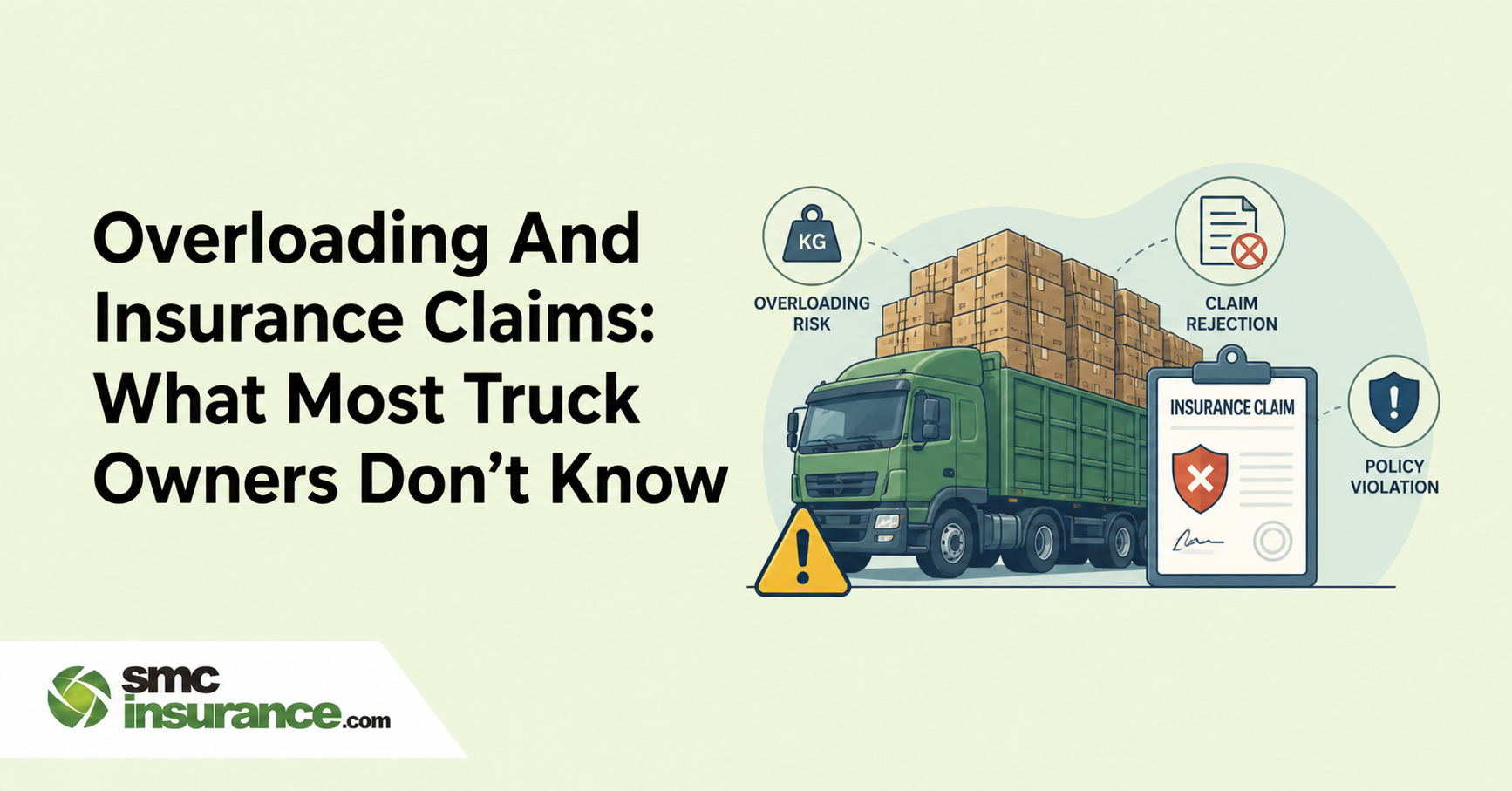

Overloading a commercial vehicle is a fundamental breach of the insurance contract in India. Under the Motor Vehicles Act 2019, the penalty includes Rs. 20,000 plus Rs. 2,000 per tonne of excess load. If an accident occurs while overloaded, insurance companies can legally reject 100% of your Own Damage claim and recover Third-Party compensation from your personal assets. To protect your business, always adhere to the weight limits on your Registration Certificate and maintain valid weighbridge receipts for every trip.
In the competitive world of Indian logistics, the pressure to maximize every trip is immense. Fleet owners and independent operators often view the Gross Vehicle Weight as a suggestion rather than a legal ceiling. You might gain a few thousand rupees in extra freight charges by squeezing in that additional ton of cement or steel, but you are unknowingly gambling with a liability worth lakhs. When a truck is overloaded, it doesn't just face mechanical strain; it undergoes a legal transformation that can be treated as a breach of policy conditions, which may lead to claim reduction or rejection depending on the severity and its link to the accident. A single accident involving an over-capacity load can lead to a rejected claim, leaving you to bear the costs of vehicle repair, third-party life loss and legal penalties out of pocket. By the end of this guide, you will understand the precise legal thresholds for overloading and how to protect your business from total financial collapse.
The Legal Reality of Overloading in India
The Motor Vehicles Act, 1988, is the foundation of road safety in India and recent amendments have made the penalties for exceeding weight limits exceptionally harsh. While most drivers worry about the RTO fine, the real danger lies in the breach of warranty clause found in almost every commercial vehicle insurance policy.
This legal framework exists to ensure that vehicles operate within their engineered safety limits. When you buy commercial insurance, you enter into a contract based on the disclosures of the vehicle's capacity. If a truck designed for 16 tons is carrying 20 tons at the time of an accident, the insurer can argue that the risk they agreed to cover was fundamentally altered.
New Penalties under the Motor Vehicles (Amendment) Act 2019
The cost of being caught with an overloaded vehicle has skyrocketed. It is no longer a minor cost of doing business.
|
Offence Category |
Penalty Structure (Section 194) |
Operational Consequence |
|
Overloading (General) |
Rs. 20,000 upfront fine |
Immediate offloading of excess weight |
|
Per Ton Excess |
Rs. 2,000 per additional ton |
Mandatory delay and labor costs |
|
Refusal to Weigh |
Rs. 40,000 fine |
Possible impounding of the vehicle |
Note: Fines are cumulative. A truck carrying 5 tons extra could face a total fine of Rs. 30,000 plus the logistical nightmare of finding another vehicle to carry the offloaded goods.
How Insurers View Overloading Claims
Insurance companies operate under regulatory oversight of IRDAI, but claim decisions in cases like overloading are governed by policy terms, surveyor reports and judicial precedents. While a minor weight discrepancy might not lead to a total rejection, fundamental breach of policy terms is a different story.
If the overloading is the primary cause of the accident—for instance, if the brakes failed because the load was too heavy for the hydraulic system—the insurer has a very strong case for repudiation. Recent rulings by the Punjab State Consumer Disputes Redressal Commission have clarified that if the overloading is significant, the insurance company is justified in rejecting the claim entirely.
The Nexus Rule in Insurance Repudiation
To reject a claim, the insurer often has to prove a nexus or a direct link between the overloading and the accident. However, courts often examine whether there is a clear causal link (nexus) between overloading and the accident. However, significant overloading can weaken the insured’s position even if direct causation is disputed. If the RC (Registration Certificate) specifies a limit and you exceeded it, you have violated the law.
- Mechanical Failure: Excess weight puts pressure on the chassis, axle and braking system.
- Third-Party Liability: In cases of fatalities, the court may order the owner to pay compensation if the vehicle was illegal (overloaded) at the time.
- OD (Own Damage) Claims: Damage to your own truck is usually the first thing the insurer will refuse to pay for in an overloading scenario.
Essential Load Limits for Common Commercial Vehicles
Understanding the permissible limits for different axle configurations is vital before you buy commercial insurance or send a vehicle on a long-haul route. The Ministry of Road Transport and Highways (MoRTH) revised axle load norms in 2018 to allow for higher capacities, but these are strictly tied to the type of tires and axle technology used.
|
Vehicle Type / Configuration |
Permissible Gross Vehicle Weight (Approx) |
Common Use Case |
|
2-Axle (6-wheeler) |
18.5 Tons |
Local distribution, FMCG |
|
3-Axle (10-wheeler) |
28.5 Tons |
Construction materials, Sand |
|
4-Axle (12-wheeler) |
35 Tons |
Long-haul logistics, Cement |
|
5-Axle (14-wheeler) |
43.5 Tons |
Heavy machinery, Steel coils |
Note: These weights include the weight of the vehicle itself (kerb weight). The actual payload is significantly lower. These limits are based on axle load norms notified by the Ministry of Road Transport and Highways in 2018 and may vary depending on axle configuration and tyre specifications.
Considering a new policy for your fleet?
Don't let a single accident derail your business's financial future. Ensure your vehicles are covered by the right experts. Explore comprehensive commercial insurance options at SMC Insurance.
Why Non-Standard Claims are a High-Risk Strategy
In some instances, if the overloading was marginal (usually less than 10-15% of the permissible limit), insurers may, at their discretion, settle claims on a non-standard basis (often around 75%), particularly in cases of minor breaches.
Relying on this is a dangerous strategy. If the accident resulted in a total loss of the vehicle or a high-value third-party claim, losing 25% of the payout could mean a loss of several lakhs. Furthermore, if the overloading is deemed fundamental (e.g., 50% over the limit), even the non-standard settlement option disappears.
Documentation Needed to Avoid Repudiation
When filing a claim for a commercial vehicle, the insurer will scrutinize every document. Any discrepancy gives them a reason to investigate further.
- Lorry Receipt (LR): This must match the actual weight of the goods.
- Weighbridge Slip (Kanta): Fresh slips from the point of origin are the best proof of compliance.
- Fitness Certificate: A vehicle without a valid fitness certificate is considered not roadworthy, making weight limits irrelevant. This is because the absence of a valid Fitness Certificate can be treated as a serious policy violation and may lead to claim rejection, especially if linked to vehicle roadworthiness.
- Route Permits: Ensure the vehicle is authorized to carry that specific load on that specific route.
Protecting Your Business: A Step-by-Step Compliance Checklist
Avoiding the pitfalls of overloading requires a mix of strict internal policy and the right commercial vehicle insurance coverage.
-
Verification at the Loading Point
Never rely on the client's word regarding weight. Install on-board weighing scales if possible, or mandate a weighbridge stop within the first 5km of the journey. If the weight exceeds the RC limit, the vehicle should not move. -
Driver Training and Accountability
Most drivers are incentivized to carry extra load to save on fuel or time. You must educate them on the legal consequences. A driver's license can be suspended. Repeated violations may lead to penalties, endorsement on driving records, or action under state enforcement rules, depending on severity. -
Choose the Right Add-ons
When you buy commercial insurance, look for specific add-ons like Engine Protector or IMT 23 (which covers specific accessories). While no add-on covers illegal overloading, having a comprehensive policy ensures that if the weight was legal, you get the maximum possible payout. -
Regular Maintenance
Overloading accelerates wear and tear. If you have a history of carrying heavy loads, your braking system and suspension need more frequent checks. An insurer can reject a claim if they find the accident was caused by poor maintenance even if the truck wasn't overloaded at that exact moment.
The Hidden Impact on Resale and Premiums
Overloading doesn't just kill your insurance claim; it kills your vehicle's value. Constant stress on the chassis leads to micro-cracks that are invisible but dangerous.
When you go to renew your commercial vehicle insurance, a history of overloading fines or small claims can lead to a significant hike in your premium. Insurers categorize high-risk operators and may eventually refuse to provide anything beyond the mandatory Third-Party cover. This leaves your expensive asset (the truck) completely unprotected.
Wrapping Up
Operating a transport business in India is a game of thin margins, but overloading is a shortcut that leads to a dead end. The immediate gain of a few extra tons is dwarfed by the risk of a Rs. 30,000 fine and the potential loss of a Rs. 40 lakh insurance claim. To secure your business, you must treat the Gross Vehicle Weight on your RC as an absolute limit. Ensure your documentation is impeccable, your drivers are trained and your insurance is sourced from a reputable provider who understands the nuances of Indian transport laws. True profitability in logistics comes from efficiency and safety, not from breaking the scales.
Disclaimer: The information provided on this platform is intended for general awareness and educational purposes. While every effort is made to ensure accuracy, some details may change with policy updates, regulatory revisions, or insurer-specific modifications. Readers should verify current terms and conditions directly with relevant insurers or through professional consultation before making any decision.
All views and analyses presented are based on publicly available data, internal research and other sources considered reliable at the time of writing. These do not constitute professional advice, recommendations, or guarantees of any product’s performance. Readers are encouraged to assess the information independently and seek qualified guidance suited to their individual requirements. Customers are advised to review official sales brochures, policy documents and disclosures before proceeding with any purchase or commitment.
FAQs
While some insurers may settle the claim on a non-standard basis (paying roughly 75% of the claim), there is no guarantee. If the insurer can prove that the 5% extra weight contributed to a mechanical failure or increased the braking distance that led to the accident, they can legally reject the claim in its entirety.
According to the Motor Vehicles Act, the fine starts with a base penalty of Rs. 20,000. Additionally, you are charged Rs. 2,000 for every ton of excess weight. For example, if you are 3 tons over the limit, your total fine would be Rs. 20,000 + (3 x Rs. 2,000) = Rs. 26,000. You will also be responsible for the cost of offloading the excess goods.
Third-Party insurance is mandatory by law to protect the public. In many cases, the insurer is initially required to pay the third party (the victim). However, if the vehicle was overloaded, the insurer has the right to pay and recover. This means they pay the victim and then sue you, the vehicle owner, to recover the entire amount.
Always check the IDV (Insured Declared Value), the list of exclusions and the limit of liability. Ensure that the policy correctly reflects the Gross Vehicle Weight (GVW) mentioned in your RC. Adding 'Roadside Assistance' and 'Consumables Cover' is also highly recommended for commercial operators to minimize out-of-pocket expenses during minor breakdowns.
Yes, if a vehicle is repeatedly caught overloading, the RTO has the authority to cancel its Fitness Certificate (FC). Operating a vehicle without a valid FC is a serious offence and is one of the most common reasons for total insurance claim rejection in India.


