


SMC Insurance
Welcome to SMC.
How may I assist you?


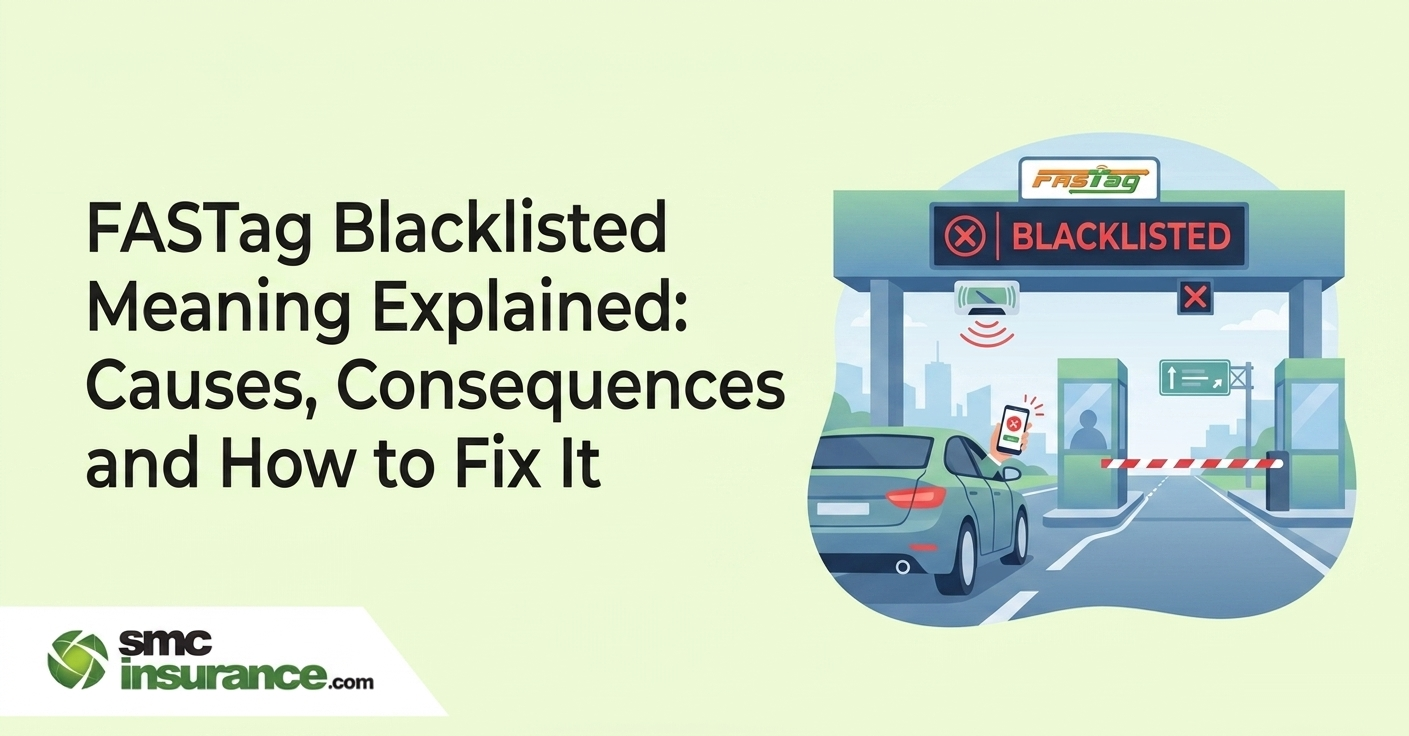
What Does FASTag Blacklisted Mean?
A blacklisted FASTag is a tag that has been suspended by your issuing bank or the NETC system and will not work at toll plazas. It happens due to insufficient balance, expired KYC, improper windshield affixation, suspicious activity, or a law enforcement flag. Driving with a blacklisted tag costs you double the normal toll at every plaza. To fix it, identify the specific reason through your bank's FASTag portal or customer care, resolve the underlying issue (recharge, KYC update, or legal clearance), and request reactivation. Most bank-level blocks can be cleared within a few hours to seven working days depending on the cause.
You are cruising on the highway, reach the toll plaza, and the barrier stays shut. The operator waves you to the cash lane. Your FASTag did not read. You top up the wallet on your phone right there and move on, assuming that solved it. Two days later, the same thing happened again. This time, the operator says your tag is blacklisted.
Most people do not know there is a difference between a low-balance tag and a blacklisted one. A low balance gets fixed the moment you recharge. A blacklisted FASTag stays blocked even if your wallet is full, until you sort out the underlying problem. The cost of not knowing this difference? You pay double the toll at every plaza you cross, delays pile up, and in some cases, you face scrutiny from enforcement agencies.
By the end of this article, you will know exactly what FASTag blacklisted means, why it happens, what it costs you, and the exact steps to get your tag back in working order.
The word gets tossed around at toll plazas, but few people understand what it actually means.
A blacklisted FASTag is one that has been suspended by the issuing bank or the National Electronic Toll Collection (NETC) system. The tag's RFID chip still works, but the system rejects it when a toll scanner reads it. No automatic deduction happens. The vehicle is flagged, and you are sent to a cash lane.
The blacklist is not the same as a blocked or hotlisted tag, though people use the terms interchangeably. Technically, "hotlisted" is the term used in the NETC system for a tag that has been flagged for security or fraud reasons, while "blacklisted" more broadly covers suspension for any reason including insufficient balance, KYC issues, or enforcement flags. Both result in the same outcome at the toll plaza: your tag does not work.
FASTag is managed under the NETC framework run by NPCI (National Payments Corporation of India), and your issuing bank, whether ICICI Bank, SBI, HDFC, Axis, or any other, is responsible for managing your tag's status.
Not all blacklistings happen for the same reason. The fix depends entirely on what caused it in the first place.
Here is where the financial impact becomes very real.
Under the National Highways Fee Rules, 2008, any vehicle entering a FASTag lane with a non-functional or blacklisted tag must pay double the applicable toll fee. NHAI reinforced this with updated guidelines in July 2024, specifically covering vehicles where the FASTag has not been properly affixed or is blacklisted.
At a toll plaza where the standard car rate is, say, Rs. 75, you will pay Rs. 150. Do this across four or five plazas on a single highway trip, and you have paid hundreds of rupees extra. On a route like Delhi-Mumbai or Bengaluru-Chennai, the penalties stack up fast.
Beyond the financial hit, there are other consequences. Toll operators are required to log your vehicle registration number via CCTV when you pass through on a blacklisted tag. That record feeds into the NETC system. Repeated violations can attract additional scrutiny from NHAI and, in some cases, law enforcement agencies.
Driving with a blacklisted FASTag is not a small inconvenience. Treat it like a pending challan: resolve it before your next long-distance trip.
Sorting out a blacklisted FASTag involves knowing exactly who blocked it and why. If you want help protecting your vehicle beyond the highway, compare car insurance plans at SMC Insurance. A valid car insurance policy with the right coverage ensures you are protected on every road, not just at the toll gate.
Before you attempt any fix, confirm the status. Here is how.
Check your status before every long highway trip. A tag that was active last month may not be active today.
The process depends on why your FASTag was blacklisted. Follow the path that matches your situation.
|
Situation |
Documents Needed |
|
KYC update |
Aadhaar, PAN, Vehicle RC, photograph |
|
Identity verification (fraud case) |
Aadhaar or passport, contact details |
|
Law enforcement clearance |
NOC or clearance letter from the agency |
|
Vehicle category correction |
Updated RC, new FASTag application |
Note: Document requirements may vary by issuing bank. Always confirm with your bank's customer care before submitting.
This is a surprisingly common situation. Your wallet shows Rs. 500. The tag still does not work.
The reason is almost always one of the following: your KYC records are expired or incomplete, your tag is not properly affixed to the windshield, there is an enforcement flag on your vehicle, or there is a technical mismatch between the vehicle number registered with your bank and the actual RC.
A sufficient balance only matters if the tag itself is in good standing. The NETC system checks multiple parameters at the toll reader, not just balance. So recharging alone will not fix a blacklist caused by documentation issues or enforcement flags. Always check the specific reason with your bank before assuming a top-up will solve the problem.
Fixing a blacklisted tag wastes time. Preventing it takes five minutes.
A blacklisted FASTag is not just a toll plaza inconvenience. It hits your wallet with double toll charges, creates a digital record of your vehicle at every non-compliant crossing, and in some cases, ties back to deeper legal issues with your vehicle. The key takeaway is simple: a recharge is not always the fix. The right fix depends on the right diagnosis.
Prevention is straightforward: auto-recharge, current documentation, correct tag affixation, and no cross-vehicle usage. Most blacklistings are entirely avoidable with basic account hygiene. And while you are keeping your vehicle documentation in order, make sure your car insurance policy is equally current. A valid third-party insurance policy is mandatory under Indian law, and an expired policy is a challan waiting to happen.
Disclaimer:The information provided on this platform is intended for general awareness and educational purposes. While every effort is made to ensure accuracy, some details may change with policy updates, regulatory revisions, or insurer-specific modifications. Readers should verify current terms and conditions directly with relevant insurers or through professional consultation before making any decision.
All views and analyses presented are based on publicly available data, internal research, and other sources considered reliable at the time of writing. These do not constitute professional advice, recommendations, or guarantees of any product’s performance. Readers are encouraged to assess the information independently and seek qualified guidance suited to their individual requirements. Customers are advised to review official sales brochures, policy documents, and disclosures before proceeding with any purchase or commitment.
A blacklisted FASTag has been suspended by your issuing bank or the NETC system. Even if your wallet has balance, the tag will not work at toll plazas. The system rejects it, and you are required to pay the toll through cash or an alternate mode. Blacklisting happens for specific reasons: insufficient balance, KYC issues, improper affixation, fraudulent activity, or a law enforcement flag on your vehicle. Each reason requires a different resolution. Simply recharging the wallet does not fix a blacklist unless the cause was insufficient balance.
Yes, you can cross the plaza, but you will be directed to a cash lane and charged double the applicable toll fee. Under NHAI's National Highways Fee Rules, 2008, and the updated guidelines issued in July 2024, any vehicle at a FASTag lane with a non-functional or blacklisted tag must pay two times the normal fee. Your vehicle registration number is also recorded via CCTV, creating a permanent log of the non-compliant crossing.
Visit the NPCI website (npci.org.in) and use the "Check Your FASTag Status" tool under the NETC FASTag section. You will need your vehicle registration number or FASTag ID. You can also check through your issuing bank's net banking portal or mobile app, or call your bank's FASTag customer care helpline. The status shown will be "Active," "Inactive," or "Blocked/Blacklisted." If blocked, the bank's customer care can tell you the specific reason.
Sufficient balance is only one of the conditions the NETC system checks. Your tag can be blacklisted for expired or incomplete KYC documents, improper affixation on the windshield, a mismatch between your vehicle number and the account, suspected fraudulent activity, or a flag placed by a law enforcement agency. In all these cases, topping up the wallet will not remove the blacklist. You need to identify the actual reason with your bank and follow the appropriate resolution steps.
It depends on the cause. Balance-related blocks can be resolved within a few hours after recharging and requesting reactivation. KYC-related blocks typically take two to seven working days after document submission. Fraud or suspicious activity flags may take three to five working days after identity verification. Enforcement-related blocks are the slowest to resolve and depend on how quickly the underlying legal matter is cleared by the relevant agency.
Under the National Highways Fee Rules, 2008, you must pay double the applicable toll fee if you pass through a FASTag lane with a non-functional, blacklisted, or non-affixed tag. There is no fixed nationwide rupee amount, as the penalty is a multiple of the toll applicable to your vehicle category at that specific plaza. For example, if the standard fee for a car is Rs. 75, the penalty would be Rs. 150 at that plaza.
In most cases, blacklisting is temporary and can be reversed once the underlying issue is resolved. However, if a tag is linked to serious fraud, forgery, or persistent non-compliance involving enforcement agencies, the issuing bank or NHAI may deactivate the tag permanently. In that situation, you would need to apply for a fresh FASTag after clearing all outstanding matters.

SMC Insurance Brokers Pvt. Ltd.
SMC Metro Mall, Near Pratap Nagar Metro Station, Pratap Nagar, New Delhi-110007
Registration No: 289, Registration Code No: IRDAI/DB-272/04/289, Valid till: 27/01/2029, License category: Composite Broker, CIN: U66000DL1995PTC172311
Insurance is the subject matter of solicitation.
Visitors are hereby informed that their information submitted on the website may be shared with insurers.
Product information is authentic and solely based on the information received from the Insurer.
