


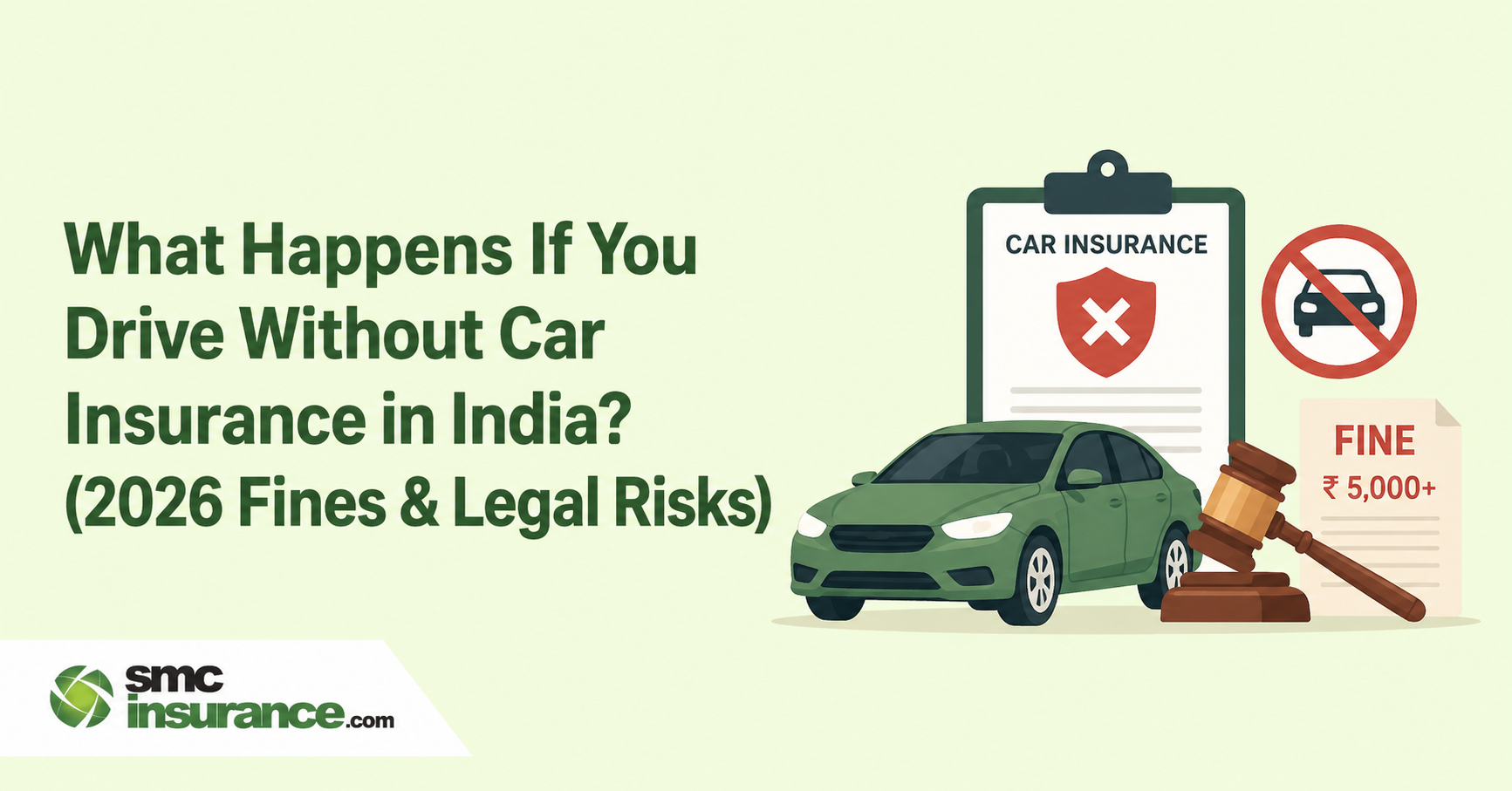
Driving without valid motor insurance in India is a punishable offence under Section 196 of the Motor Vehicles Act, 1988 (as amended by the Motor Vehicles (Amendment) Act, 2019). For a first offence, you face a fine of Rs. 2,000 and/or imprisonment of up to three months. Repeat offenders are penalised Rs. 4,000 and/or the same jail term. If you're uninsured and involved in an accident, you bear full compensation liability out of pocket, which can run into lakhs. The fix is simple: renew your third-party cover before it lapses.
Your car insurance expired last Tuesday. You meant to renew it. You didn't. Now you're at a traffic signal and a traffic cop is walking towards your vehicle, tablet in hand. That's not a hypothetical. Across India's metros, e-challan systems powered by ANPR cameras now flag uninsured vehicles in real time. Government and industry data indicate that a significant proportion of registered vehicles in India remain uninsured, particularly among two-wheelers. That's more than half the vehicles on the road running without cover.
Some owners genuinely forget to renew. Others assume nothing will happen. A few think third-party car insurance is optional. None of these positions hold up legally or financially, once you're caught. This article tells you exactly what the law says, what the fines are in 2026, what happens when an accident occurs without insurance and how to make sure you never face that traffic cop unprepared.
Is Driving Without Car Insurance Actually Illegal in India?
Yes, unambiguously. Section 146 of the Motor Vehicles Act, 1988, makes it mandatory for every motor vehicle used in a public place to carry a valid third-party insurance policy. The rule covers cars, two-wheelers, commercial vehicles and everything in between. The requirement applies to all vehicles used in public places, with limited statutory exceptions such as certain government-owned vehicles under specific conditions defined in the Act.
The legal framework is straightforward. You must have minimum third-party insurance before your vehicle moves on any road, lane, or public space. Whether you drive 2 km to the market or 200 km to another city doesn't change that obligation. Even if you allow someone else to drive your car, the insurance requirement still applies and the owner is legally responsible.
The penalty for violating this is prescribed under Section 196 of the same Act.
What Is the Fine for Driving Without Car Insurance in 2026?
The numbers are clear and verified by both the Press Information Bureau and the Motor Vehicles Act, 1988 as amended in 2019.
|
Offence |
Fine |
Imprisonment |
|
First offence (no valid insurance) |
Rs. 2,000 |
Up to 3 months, or both |
|
Repeat offence (caught again) |
Rs. 4,000 |
Up to 3 months, or both |
Note: These penalties apply equally to cars, bikes, scooters and all motor vehicles. The fine alone may seem manageable, but repeat offences can invite court proceedings. In cities like Delhi, Bengaluru and Hyderabad, e-challans are now auto-generated through traffic camera integrations — meaning you may receive notice via SMS without ever being stopped physically.
The challan mentions your vehicle number, violation code, date, time and the amount due. Payment can be made online at the Parivahan e-challan portal.
Thinking of sorting out your car insurance right now? That's the right call. Compare plans, get instant quotes and buy car insurance or renew your policy in minutes at SMC Insurance. Don't let a Rs. 2,000 fine be the reason you finally get covered.
Useful Guide:
What Actually Happens When You're Caught: Step by Step
The enforcement process follows a consistent sequence across most states, with some variation in execution.
- Document check: The traffic officer or e-challan system checks your vehicle registration, driving licence, Pollution Under Control (PUC) certificate and insurance status.
- Challan issued: If insurance is missing or expired, a challan is issued — either on the spot or electronically via SMS.
- Payment window: You're given a timeframe to pay the penalty through the Parivahan portal or your state traffic police website.
- Vehicle detention: In some states, especially where multiple documents are absent simultaneously, enforcement authorities may detain the vehicle, particularly where multiple violations are involved, as per applicable state enforcement procedures.
- Court summons (repeat offenders): Second and third violations may result in a court summons, not just a challan. This adds legal costs, time and risk to your record.
Storing your policy document on DigiLocker means an officer can verify it digitally on the spot, which avoids disputes and delays. Most insurers also allow instant policy download via their apps.
What Happens If You're Uninsured and an Accident Occurs?
This is where the consequences stop being inconvenient and start being catastrophic. A Rs. 2,000 fine is an irritant. Paying compensation for a road accident victim out of your own pocket can wipe out years of savings.
Personal liability: Without third-party insurance, you are personally responsible for all compensation (medical expenses, hospitalisation, loss of income and in the worst cases, death compensation) to the victim. Courts can award amounts running into tens of lakhs in serious cases.
No insurer to step in: The entire point of third-party car insurance is that your insurer pays the victim's claim. Without a valid policy, there is no insurer. Claims will be adjudicated by the Motor Accidents Claims Tribunal and in the absence of insurance coverage, the liability may fall directly on the vehicle owner or driver.
Your own vehicle is unprotected: Unless you also held a comprehensive own-damage policy (which also requires the base third-party cover to be valid), your vehicle's repair costs come entirely from your pocket after an accident.
Claims cannot be filed: Insurers explicitly deny claims for incidents that occur during a policy lapse period. Even if you had a comprehensive policy that expired a week before the accident, the claim is invalid.
|
Situation |
With Valid Insurance |
Without Valid Insurance |
|
Third-party injury |
Insurer pays compensation |
You pay from your pocket |
|
Third-party death |
Insurer covers claim |
Full personal liability |
|
Own vehicle damage |
Covered (if comprehensive) |
Not covered |
|
Legal proceedings |
Insurer assists |
You face tribunal alone |
|
Police fine |
Rs. 2,000 / Rs. 4,000 |
Same fine + civil liability |
Note: Compensation amounts in accident cases are determined by Motor Accidents Claims Tribunals and depend on the nature of injury, victim's income and other factors. There is no fixed cap for all cases.
How to Check If Your Car Insurance Is Still Active?
Before assuming your policy is valid, confirm it. These are the fastest ways to check:
- Parivahan portal: Visit the Parivahan portal and click on "Know Your Vehicle Details". You will then have to enter your registration number. Insurance status appears within seconds.
- Your insurer's app or website: Log in and check the policy validity date.
- DigiLocker: If you've linked your policy here, the expiry date is visible at a glance.
- Renewal SMS or email: Most insurers send reminders 30 and 15 days before expiry. Check your inbox.
If the policy has already lapsed, renew immediately. Most insurers issue policies instantly online. Carry both a digital copy (on DigiLocker or the insurer's app) and a printed copy in the vehicle.
Should You Buy Only Third-Party or Go Comprehensive?
Third-party car insurance is the legal minimum. It protects others on the road if you cause an accident — but it does nothing for your own vehicle's repair costs.
A comprehensive policy adds own-damage cover, which pays for repairs to your car after accidents, theft, fire, or natural disasters. For newer or higher-value vehicles, the difference in annual premium is often small relative to the coverage benefit.
|
Type |
Covers Third-Party Damage |
Covers Own Vehicle |
Legally Mandatory |
|
Third-party only |
Yes |
No |
Yes |
|
Comprehensive |
Yes |
Yes |
No (but advisable) |
|
Standalone own-damage |
No |
Yes |
No |
Note: Standalone own-damage policies are only valid when paired with an active third-party policy. Purchasing car insurance in a bundled comprehensive plan is often more economical than buying two separate policies.
Must-Read Guides From SMC
Disclaimer:The information provided on this platform is intended for general awareness and educational purposes. While every effort is made to ensure accuracy, some details may change with policy updates, regulatory revisions, or insurer-specific modifications. Readers should verify current terms and conditions directly with relevant insurers or through professional consultation before making any decision.
All views and analyses presented are based on publicly available data, internal research, and other sources considered reliable at the time of writing. These do not constitute professional advice, recommendations, or guarantees of any product’s performance. Readers are encouraged to assess the information independently and seek qualified guidance suited to their individual requirements. Customers are advised to review official sales brochures, policy documents, and disclosures before proceeding with any purchase or commitment.
Wrapping Up,
The fine for driving without car insurance - Rs. 2,000 for a first offence and Rs. 4,000 for repeat violations, is the smallest part of the risk. What the fine doesn't capture is the lakhs in out-of-pocket liability you face if you're in an accident without cover, the court appearances that can follow repeat violations, or the very real possibility of vehicle impoundment in states with stricter enforcement.
The good news is that renewing or purchasing car insurance today takes minutes. Policies are issued digitally and documents can be accessed through recognised platforms such as DigiLocker or the mParivahan app, subject to insurer integration. For most private cars, third-party premiums are affordable; a comprehensive plan adds meaningful protection at a reasonable step-up in cost.
Check your policy expiry date today. If it's within 30 days, renew it now. If it's already lapsed, renew it before your next trip. No journey is worth the financial and legal exposure of driving uninsured.
Disclaimer:The information provided on this platform is intended for general awareness and educational purposes. While every effort is made to ensure accuracy, some details may change with policy updates, regulatory revisions, or insurer-specific modifications. Readers should verify current terms and conditions directly with relevant insurers or through professional consultation before making any decision.
All views and analyses presented are based on publicly available data, internal research, and other sources considered reliable at the time of writing. These do not constitute professional advice, recommendations, or guarantees of any product’s performance. Readers are encouraged to assess the information independently and seek qualified guidance suited to their individual requirements. Customers are advised to review official sales brochures, policy documents, and disclosures before proceeding with any purchase or commitment.
FAQs
Under Section 196 of the Motor Vehicles Act, 1988 (as amended in 2019), the fine for a first offence is Rs. 2,000, with imprisonment of up to three months or both. For repeat offenders, the fine rises to Rs. 4,000 with the same imprisonment risk. These penalties apply uniformly across all vehicle types (cars, two-wheelers, commercial vehicles) and are enforceable through both manual traffic checks and automated e-challan systems. The law makes no distinction based on how far you've driven or how old the vehicle is.
It is strictly mandatory under Indian law. Section 146 of the Motor Vehicles Act, 1988 requires every vehicle used in any public place to carry a valid third-party insurance policy. Driving or allowing someone else to drive without this cover is a punishable criminal offence, not just a traffic rule violation. The provision is designed to ensure that accident victims receive compensation even when the at-fault driver lacks personal financial resources.
You bear full financial and legal liability. Without a valid policy, there is no insurer to pay compensation to the injured party or cover any death claims. The Motor Accidents Claims Tribunal can hold you personally liable for amounts that often run into lakhs, depending on the severity of the accident. Your own vehicle's repair costs are also unrecoverable unless you had a separate standalone own-damage policy, which itself would be invalid without a base third-party cover in force. Courts and tribunals do not accept policy lapse as a mitigating circumstance.
Yes, the government has explicitly recognised DigiLocker and the m-Parivahan app as valid digital repositories for vehicle documents, including insurance certificates. Traffic officers across most states are equipped to verify digital copies. Storing your policy on DigiLocker also protects against claims that you weren't carrying the document, since the record is timestamped and linked to your Aadhaar or vehicle registration.
In most cases, yes. Most insurers issue third-party and comprehensive policies digitally, with instant email delivery and DigiLocker integration. The policy typically becomes effective from the date and time of issuance. However, some insurers impose a brief waiting period for own-damage claims (usually 24-48 hours) on newly purchased policies. Always read the policy document carefully and carry proof of the purchase date if there's any gap between your old policy's expiry and the new one's commencement.
Yes, the penalties under Section 196 of the Motor Vehicles Act apply equally to all motor vehicles, including two-wheelers. The fine is Rs. 2,000 for a first offence and Rs. 4,000 for subsequent violations. That said, two-wheelers bear a disproportionate share of the uninsured vehicle problem in India; the General Insurance Council has noted that most uninsured vehicles on Indian roads are two-wheelers. Third-party premiums for bikes are among the lowest of any vehicle category, making non-renewal a particularly avoidable risk.
Once an e-challan is issued (either physically by an officer or electronically via camera-based enforcement) you'll typically receive an SMS with the challan number and violation details. To pay: visit the designated Parivahan portal, enter your vehicle number or challan number, verify the details and pay online using UPI, net banking, or card. Save the payment receipt. If you believe the challan was issued in error (your policy was actually valid), you can upload proof on the same portal or contest it at the issuing traffic office directly.


