


A VIP or fancy number plate in India is a special vehicle registration number chosen by the owner instead of being randomly assigned. In 2026, VIP number plate prices start from around Rs. 1,000 for basic fancy numbers. Through official RTO auctions, elite single-digit or repeating numbers regularly cross Rs. 25 lakh in high-demand states; on the private resale market, exceptional plates have fetched over Rs. 2 crore.
Fancy numbers are allotted through the official Parivahan portal via online auctions or fixed-fee allotment, depending on the state. The final price depends on the number category, bidding competition and location. Booking is legal, transparent and open to private vehicle owners (light motor vehicles and two-wheelers). Commercial vehicles are generally not eligible under the national Parivahan system, though state-specific rules may vary.
Fancy numbers do not affect road tax or insurance premiums, but they can be retained or transferred by following RTO rules.
A number plate with more swagger than a Bollywood cameo can turn a quiet driveway into center stage. In a country where small details carry big statements, a VIP number can feel like a lucky charm, a status badge, or just a little treat for the heart. What draws you to a fancy registration? Is it a favorite date or a lucky sequence?
Whatever the reason, these fancy number plates can cost as much as a luxury splurge. Some buyers chase symmetry, some chase meaning and some simply enjoy the thrill of owning a number that stands out in traffic. How do you decide what feels worth the price?
This guide walks through VIP number plate prices in India for 2026, the full cost list, how premium categories work and how to book one online without confusion. Curious to dive deeper and find the right fit for your budget and style? Read on in the article below.
What Is a VIP or Fancy Number Plate?
A VIP or fancy number plate is a vehicle number that someone chooses, not one that gets assigned by chance. It usually looks clean, short, or familiar at first glance. Sometimes it repeats. Sometimes it carries meaning. And sometimes, it just feels right to the owner.
In India, these numbers are part of the official registration system. They are issued by the RTO through a government process. There is nothing informal or under-the-table about it. You pick the number, place a bid or pay the listed price and once approved, it becomes part of your vehicle’s identity.
- Some examples of fancy or VIP Number Plates include:
- Repeated Single Digits like 0001, 0003, 0007, 0009
- Double Repeating Numbers like 1111, 2222, 4444, 9999
- Sequential Numbers like 1234, 2345, 4567, 7890
- Palindrome or Mirror Numbers like 1001, 1221, 2112, 8008
- Lucky or Belief-Based Numbers like 0786, 1088, 7860, 999
People go for fancy numbers for different reasons. Some like the attention. Some believe certain numbers bring good luck. Others want something that is easy to remember or matches a business brand. And yes, for a few, it is also about status.
A VIP number plate does not change the vehicle itself. But it does change how the vehicle is seen.
Famous Faces - Famous Numbers
India's biggest stars splurge on what goes on the plate. Driven by numerology, birthdays, astrology, or pure personal flair, these numbers have become as iconic as the celebrities themselves. Here are 10 of the most talked-about fancy plates in the country.
|
No |
Celebrity |
Field |
Fancy Number |
Vehicle |
|
1 |
Amitabh Bachchan |
Actor |
0002 / 1010 |
Rolls-Royce Phantom |
|
2 |
Shah Rukh Khan |
Actor |
0555 |
BMW 7 Series, Range Rover |
|
3 |
Virat Kohli |
Cricketer |
1818 |
Audi R8, Range Rover Vogue |
|
4 |
MS Dhoni |
Cricketer |
0007 |
Mercedes-AMG G63 (Rs. 3Cr+) |
|
5 |
Mukesh Ambani |
Industrialist |
9999 |
Multiple luxury vehicles |
|
6 |
Sanjay Dutt |
Actor |
4545 |
Rolls-Royce Ghost, Ferrari 599 |
|
7 |
Ranbir Kapoor |
Actor |
0008 / 8000 |
Mercedes G63 AMG, Audi R8 |
|
8 |
Ranveer Singh |
Actor |
6969 |
Lamborghini Urus, Jaguar XJ-L |
|
9 |
Shahid Kapoor |
Actor |
7000 / 700 |
Range Rover, Harley-Davidson |
|
10 |
Mammootty |
Actor |
0369 |
Land Rover Defender, Polo GTI |
How Much Does a Fancy Number Plate Cost?
There is no single price for a fancy number plate in India. And that is usually the first surprise.Some people pay a few thousand rupees and walk away happy. Others bid for days and end up paying more than the cost of the vehicle itself. The gap is wide because fancy numbers are priced on demand, not logic.
And demand changes with the number, the state and sometimes even the mood of the auction.
VIP Number Plate Price: Category-Wise Explanation
Category
Typical Examples
Pattern Type
Starting Price (Approx.)
Common Final Price Range
Basic Fancy Numbers
1001, 1212, 2323, 5050
Simple repetition or easy pattern
Rs. 1,000
Rs. 1,000 to Rs. 10,000
Mid-Range Fancy Numbers
0786, 0111, 1234, 333
Lucky numbers, short repeats, clean sequences
Rs. 25,000
Rs. 25,000 to Rs. 1 lakh
Premium Repeating Numbers
1111, 2222, 7777, 9999
Four identical digits
Rs. 1 lakh
Rs. 3 lakh to Rs. 10 lakh
Single-Digit Numbers
0001, 0002, 0003 to 0009
Unique single digit per series
Rs. 5 lakh and above (varies by state)
Rs. 20 lakh+ in high-demand regions
|
Category |
Typical Examples |
Pattern Type |
Starting Price (Approx.) |
Common Final Price Range |
|
Basic Fancy Numbers |
1001, 1212, 2323, 5050 |
Simple repetition or easy pattern |
Rs. 1,000 |
Rs. 1,000 to Rs. 10,000 |
|
Mid-Range Fancy Numbers |
0786, 0111, 1234, 333 |
Lucky numbers, short repeats, clean sequences |
Rs. 25,000 |
Rs. 25,000 to Rs. 1 lakh |
|
Premium Repeating Numbers |
1111, 2222, 7777, 9999 |
Four identical digits |
Rs. 1 lakh |
Rs. 3 lakh to Rs. 10 lakh |
|
Single-Digit Numbers |
0001, 0002, 0003 to 0009 |
Unique single digit per series |
Rs. 5 lakh and above (varies by state) |
Rs. 20 lakh+ in high-demand regions |
Indicative Base/Reserve Prices by State (Elite / 0001-tier numbers)M
|
State |
Reserve Price Range (Elite Category) |
|
Delhi |
Rs. 5,00,000 – Rs. 10,00,000 |
|
Maharashtra |
Rs. 4,00,000 – Rs. 8,00,000 |
|
Karnataka |
Rs. 3,00,000 – Rs. 6,00,000 |
|
Uttar Pradesh |
Rs. 2,00,000 – Rs. 5,00,000 |
|
Tamil Nadu |
Rs. 2,00,000 (entry fee Rs. 2,000 under new e-bidding rules) |
|
Haryana |
Rs. 50,000 – Rs. 3,00,000 |
Note: These are indicative base/reserve prices, not final auction outcomes, final prices depend on live bidding. Always confirm the current reserve price for your RTO on fancy.parivahan.gov.in before bidding.
What Is the BF XXXVIII Number Plate Price?
“BF XXXVIII” or “BF-38” is gaining popularity when related to fancy and VIP vehicle registration numbers. However, the term itself does not represent a separate nationwide VIP number category with a fixed price.
The cost of a fancy registration number depends on the applicable state transport department, RTO, number category, reserve price and, where applicable, the final e-auction bid. A series or registration identifier by itself does not determine the price of the number.
If you are searching for a specific BF XXXVIII registration number, check whether the number is available for your state and RTO on the official Parivahan Fancy Number portal. The applicable reserve price or auction details shown there should be treated as the current price information.
Important: Do not rely on generic online price lists for BF XXXVIII. Fancy number prices can differ substantially between states, RTOs and number categories.
State-Wise Price Ranges and Recent Auction Trends (2024–2026)
Fancy number prices are not uniform across India. Location matters more than most people expect.
|
State Category |
Specific States |
Market Competition |
Premium Repeating Numbers |
Single- Digit Numbers |
Good-Looking Sequences |
Price Behavior |
|
High- Competition States |
Delhi, Maharashtra, Karnataka, Tamil Nadu |
Very strong |
Regularly exceed Rs. 5 lakh |
Often reach 8-figure amounts |
Typically priced high due to active bidding |
Prices escalate quickly due to aggressive competition |
|
Mid-Sized States |
Examples vary by region |
Moderate |
Usually Rs. 1 lakh to Rs. 3 lakh |
High but generally below top-tier states |
Mostly under Rs. 50,000 |
Prices remain relatively stable |
|
Smaller States & Union Territories |
Smaller northeastern states, UTs, low-density regions |
Low |
Often close to base price |
Rarely reach very high figures |
Close to reserve price |
Prices stay near minimum or base rates |
Between 2024 and early 2026, one trend has stayed consistent. Demand keeps rising. Online auctions have made access easier and more buyers are willing to bid instead of settling for random numbers. Electric vehicles have added another layer of interest, especially for clean, modern-looking numbers.
Key Characteristics of VIP or Fancy Number Plates
Let’s take a look at the key characteristics of VIP/Fancy number plates one-by-one:
- First, they are not common. Only a limited set of numbers in each series are marked as fancy. Once taken, they are gone.
- Second, they come at a price. Regular numbers are free with registration. Fancy numbers are not. The cost depends on demand and popular numbers can go very high during auctions.
- Third, they are fully legal. These numbers are allotted through official portals linked to transport authorities. No middlemen. No grey area.
- Fourth, they stand out easily. Short numbers, repeated digits, or clean patterns catch the eye without effort.
- And finally, they need to be handled carefully. If you plan to keep the number while changing vehicles, there are rules and timelines to follow. Miss those and the number may be lost.
Important Note:
HSRP Compliance is Mandatory: Once allotted, your fancy number must be displayed on a High-Security Registration Plate (HSRP). It is the tamper-proof plate with a hologram sticker and unique 10-digit PIN. Non-HSRP or non-compliant plates (custom fonts, stickers, unauthorised colours) can attract fines under Section 177 of the Motor Vehicles Act, 1988 — the amount varies by state and is generally in the Rs. 1,000 to Rs. 10,000 range (for example,
Maharashtra's 2026 enforcement drive fines Rs. 1,000 per violation), regardless of whether the number itself was legally allotted.
Fancy Registration Numbers Owned by Indian Celebrities
Celebrities have played a quiet but powerful role in making VIP numbers aspirational. Over the years, several well-known figures have chosen distinctive registration numbers that match their image or personal beliefs.
- Shah Rukh Khan is known for using the number 555 on many of his vehicles, a number he has spoken about fondly.
- Salman Khan has often opted for repeating number patterns, keeping things bold and unmistakable.
- Virat Kohli has been associated with numbers that reflect personal milestones rather than flashy patterns.
- Mukesh Ambani reportedly owns vehicles with highly sought-after low-digit numbers, reflecting both rarity and stature.
When people see these numbers up close, on social media or in real life, it normalises the idea of paying extra for a registration number. It no longer feels unusual. It feels intentional.
Types of VIP or Fancy Number Plates in India
Fancy numbers come in many forms. Some are valued for how they look. Others for what they mean. Here are the most common types you will see on Indian roads.
- Single-Digit Numbers
Numbers like 1, 3, or 9 are considered premium because they are extremely rare. These almost always attract heavy bidding and are usually picked up by collectors or high-profile buyers.
- Repeating Numbers
This includes plates such as 0001, 1111, 4444, or 9999. They are simple, bold and easy to spot from a distance. That simplicity is exactly what drives demand.
- Sequential Numbers
Plates like 1234 or 2345 appeal to people who like balance and order. They feel neat and intentional, even if they are less flashy than repeating numbers.
- Lucky or Belief-Based Numbers
Many buyers choose numbers based on personal belief. For some, 7 feels fortunate. For others, 8 represents growth or success. These numbers may not always look fancy, but they matter deeply to the owner.
- Date-Based Numbers
Birthdays, anniversaries, or other personal milestones often show up on number plates. These combinations may look ordinary to outsiders, but they carry emotional value.
- Pattern or Custom Numbers
Some people prefer patterns like 1010, 2020, or numbers that reflect initials or business branding. Their price depends on how unique the combination is and how many others want it.
Different Colors in Vehicle Number Plates
In India, a number plate’s color is not about style. It quietly tells a story about how the vehicle is used. Before spending money on a fancy number, this part matters more than most people realise.
|
Colour Code |
Purpose |
|
White background with black numbers |
This is what most private vehicle owners have. Cars and two-wheelers used for personal travel fall under this category. If you are buying a VIP number for your own car or bike, this is the plate it will sit on. |
|
Yellow background with black numbers |
These plates belong to commercial vehicles. Taxis, goods carriers and ride-hailing cars use them. Fancy numbers are allowed here too, but only if the vehicle is registered for commercial use from day one. |
|
Black background with yellow numbers |
These are used by self-drive rental vehicles. The vehicle earns money, but it is not run as a taxi. Think long-term rentals or app-based self-drive services. |
|
Green background for electric vehicles |
Electric vehicles come with green plates. Private EVs have white numbers, while commercial EVs have yellow ones. Fancy numbers are very much allowed here and interest has grown as EV adoption increases. |
|
Red background with white numbers |
This is a temporary registration plate. It is valid only for a short period after purchase. Fancy numbers are never assigned at this stage. |
|
Blue background with white numbers |
These plates are used by foreign embassies and diplomatic missions. Their numbers follow a separate system and are not available for public booking. |
The number may be fancy, but the color must always match the vehicle’s purpose. There is no flexibility on that.
How to Book a Fancy Number Online Through Parivahan?
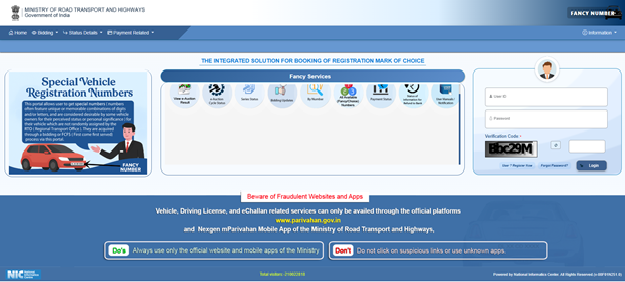
Gone are the days of RTO queues and middlemen. The official Parivahan Fancy Number Portal (fancy.parivahan.gov.in) lets any vehicle owner claim their ideal VIP number. And this is done entirely online, fully transparent and scam-free, if you stick to the official platform.
Step 1 Register on the Parivahan Portal
Visit fancy.parivahan.gov.in and create an account using your mobile number and email. Verify with OTP. Once logged in, select your state and the relevant RTO. Navigate to 'Available Numbers' where the system shows real-time availability with colour-coded status: Available (green), In Auction (amber), or Taken (red). Browse the list to find your preferred number. The availability updates regularly, so if a number is not open today, it may appear in a future auction cycle.
Step 2 Pay the Registration Fee & Enter the Auction
Select your preferred number. Pay the non-refundable registration fee along with the Earnest Money Deposit (EMD — typically Rs. 10,000 to Rs. 50,000, refundable only if you lose the auction). This locks you into the bidding cycle. The registration window stays open for 3 days, followed by a 2-day live bidding phase. Track bids in real time via the Live Auction tab. Premium numbers (Categories 1–4) advance in increments of Rs. 10,000 per bid; standard numbers in Rs. 1,000 steps. Auction results are posted on the same day the bidding ends, with notifications via SMS and email.
Timeline:
- Day 1–3: Registration & EMD payment
- Day 4–5: Live bidding
- Day 6: Results via SMS/email
- Day 7–11: Balance payment (within 5 days of result)
Step 3 Collect Allotment Letter & Complete RTO Registration
Once you win, pay the remaining balance online within 5 days. Download your official allotment letter that is valid for 90 days. Visit your local RTO with the allotment letter plus the following documents: Form 20, PUC certificate, sales invoice, valid ID proof, address proof and vehicle insurance. The RTO officially assigns your number and issues the HSRP (High Security Registration Plate). Your fancy number is now legally yours for the vehicle's lifetime. Note: non-HSRP plates or custom fonts can attract fines of up to Rs. 5,000 under the Motor Vehicles Act.
Important: Register your vehicle within 90 days of allotment or the number lapses back to the auction pool.
Note: Always book exclusively through fancy.parivahan.gov.in. Avoid third-party apps, brokers, or payment links shared via WhatsApp or social media — multiple scam incidents were reported in 2025.
How Fancy Numbers Are Allotted in India?
Fancy numbers are not picked casually at the RTO desk. There is a clear process behind them. In India, these numbers are allotted through four main routes.
- e-Auction Through the Parivahan Fancy Number Portal
This is the most common method today. The process runs through the official portal under Parivahan. You start by creating an account using your mobile number. After logging in, you can view the list of available fancy numbers for your state and vehicle type. Once you select a number, you pay a registration fee to enter the auction.
The auction cycle runs over 5 days in total — the first 3 days are for registration, followed by a 2-day live bidding window. During the bidding phase, participants can place or revise bids. Once the cycle ends, bidding stops instantly. When the cycle ends, the highest bidder wins the number. After winning, the remaining amount must be paid within the given deadline. If the payment is missed, the number is cancelled and put back into the pool.
- Fixed-Fee Allotment in Some States
In some states, certain fancy numbers are offered at fixed prices instead of auctions. These numbers fall under predefined slabs. For example, numbers like 0007 or 0786 may have a set cost. You pay the amount and the number is allotted directly, without bidding.
This route is simpler, but availability is limited. The most in-demand numbers usually still go to auction.
- Reserved or Special Government Numbers
Some numbers are never open for public booking. These include protocol numbers reserved for senior government officials, constitutional authorities, or specific departments. They do not appear on auction portals and cannot be purchased. No matter how high the demand, these numbers stay reserved.
- Transfer and Re-Assignment of Fancy Numbers
Fancy numbers are linked to the owner more than the vehicle. -
- If you sell your vehicle and want to keep the number, you can apply for retention and later assign it to another vehicle. There are fees involved and timelines must be followed closely.
- If the rules are not met, the number can be cancelled or reassigned.
Latest Government and RTO Updates (2024–2026)
The fancy number space has changed quite a bit over the last two years. And most of it points in one direction. More transparency. More bidding. More money flowing into state coffers.
The biggest shift continues to be through the official Parivahan Fancy Number portal. This is now the primary place where live e-auction cycles, bidding status, and final results are published. Anyone can log in, track ongoing auctions, and even see how much a number finally sold for. That visibility has made the process cleaner and far more competitive.
Tamil Nadu has also been moving steadily toward full e-bidding for fancy numbers. Tamil Nadu has formally completed this transition. Through an amendment to the Tamil Nadu Motor Vehicles Rules, 1989, notified by the Home (Transport) Department on October 18, 2025, the state has replaced its manual first-come-first-served process with an e-bidding mechanism. Under the revised rules, the entry fee has been raised from Rs. 1,000 to Rs. 2,000. Bids must be placed in multiples of Rs. 500. Winning bidders must pay within 48 hours and the registered vehicle must be produced at the RTO within 30 days of reserving the number - a significantly tighter timeline than the 90-day window under the national Parivahan system.
The goal is simple. Reduce discretion, increase transparency and ensure the state captures fair market value. Early reports suggest better revenue and fewer disputes at the RTO level.
And the numbers back this up:
Between 2025 and 2026, several record-breaking auctions made headlines:
- In Noida (December 2025), the number UP16FH 0001 sold for Rs. 27.5 lakh to a private company (the highest ever recorded at the Gautam Buddh Nagar RTO) in a fully digital auction on the official Parivahan portal.
- Pune RTO collections from fancy number auctions have set new records consistently. In FY 2024-25, the Pune RTO earned Rs. 59.36 crore from fancy number allotments. Between January and November 2025 alone, this figure reached Rs. 71.53 crore — and for the full FY 2025-26, the Pune RTO earned Rs. 73.76 crore from 56,172 choice number reservations, its highest ever.
- Chandigarh has seen some of the highest individual auction prices in India. In August 2025, the number CH01-DA-0001 sold for Rs. 36.43 lakh (the highest single fancy number auction price recorded at that RTO). A subsequent auction for CH01-DC-0001 fetched Rs. 31.35 lakh. In the same auction cycle, 0009 sold for Rs. 20.72 lakh and 0007 for Rs. 16.13 lakh, generating Rs. 2.96 crore in a single auction event. That Chandigarh record didn't last long. In March 2026, the number CH01-DD-0001 fetched Rs. 53.88 lakh in a fresh e-auction - the highest price ever paid for a vehicle registration number at an official RTO auction in India, surpassing the CH01-DA-0001 record by over Rs. 17 lakh. The three-day auction (March 4–6, 2026) generated Rs. 4.49 crore from 591 numbers sold, itself a record for a single RLA auction cycle.
Two even bigger figures have since made headlines, though both come with a caveat worth noting:
- In January 2026, the vintage plate DDC 0001 (previously owned by Big Boy Toyz founder Jatin Ahuja) sold for Rs. 2.08 crore at a private collectibles auction, making it the highest price ever paid for an Indian registration number. Unlike the RTO auctions above, this was a secondary-market resale between private individuals, not a fresh government allotment.
- Separately, in Haryana's official e-auction, HR88B8888 attracted a record bid of Rs. 1.17 crore in November 2025, but the winning bidder failed to pay within the deadline, the deposit was forfeited, and the number went back for re-auction, so the bid was never completed. The number was eventually re-auctioned and sold for a comparatively modest Rs. 26.7 lakh.
These are not isolated cases. They reflect growing awareness and willingness to bid openly through official platforms.
In short, fancy numbers are no longer a niche interest. They are now a structured, revenue-generating system with clear rules and public outcomes.
How Auction Pricing Works and Why Final Prices Vary?
Fancy number auctions look simple on the surface. But a few rules quietly decide how high the price can go.
➔ How to Check Availability of a Fancy Number
Availability is shown directly on the portal. Numbers are listed by RTO and series. If a number is already taken or reserved, it will not appear. Some numbers return to the pool if previous winners fail to pay on time. That is why checking regularly helps.
- Reserve Price and Bid Increments
Every fancy number comes with a reserve price. This is the minimum amount set by the transport authority. Auctions do not allow random jumps. Bids increase in fixed steps, usually in multiples decided by the category of the number. This keeps bidding structured but still competitive.
- Bid Window and Auction Cycles
Auctions run in cycles, usually lasting five days (5 days total, split as 3 days for registration + 2 days for bidding). During this time, bidders can place new bids or increase existing ones. There is no limit on how many times you revise a bid, as long as the window stays open. Once the cycle ends, bidding stops instantly. The highest bidder at that moment wins.
- Payment Rules and Forfeiture
Winning the auction does not end the process. The remaining amount must be paid within the deadline shown on the portal. Miss it and the allotment is cancelled. The registration fee may also be forfeited, depending on the case. The number then goes back into the next auction cycle.
➔ Processing Time for Getting the Fancy Number Plate
After full payment, the allotment letter is issued almost immediately. Actual number plate installation happens during vehicle registration or re-assignment at the RTO.
In most cases, the entire process fits comfortably within a few weeks, provided documents are in order.
➔ How Auction Mechanics Affect the Final Price
Final prices depend on timing and competition. If two or more bidders want the same number badly, prices rise fast. If interest is low, numbers sometimes close to their reserve price.
State demand, vehicle trends and even festive seasons influence bidding behavior. That is why the same number may sell for very different amounts in different cities.
Insurance and Tax Implications of a VIP Number Plate
A fancy number looks premium, but it does not change how insurance or road tax is calculated. This is where many people overthink things.
Motor insurance is always based on the vehicle. Its engine capacity, model, age, fuel type and Insured Declared Value. The number plate, no matter how expensive, does not increase or reduce your insurance premium.
But there is a practical angle to keep in mind:
- If your vehicle has a high-value fancy number, insurers may expect accurate paperwork. The registration certificate must clearly reflect the allotted number. Any mismatch can slow down claims later.
- Road tax works the same way. It is paid on the vehicle cost and category, not on the number. Even if you spent several lakhs on a VIP number, road tax does not change.
- That said, a premium vehicle with a premium number deserves proper
coverage. At SMC Insurance, we help you compare motor insurance plans from leading insurers so everything stays aligned.
The number, the vehicle and the paperwork.
One thing worth double-checking: your car or bike insurance policy's Registration Certificate (RC) details must exactly match your allotted fancy number. If you retain a number across a vehicle change, or if there's a delay between winning the auction and updating your RC, make sure your insurer's records are updated too. A mismatch between the RC and the policy schedule is a common reason claims get delayed at the very moment you need them fastest. If you're due for a renewal or comparing quotes for a car sporting a new VIP number,
compare motor insurance plans on SMC Insurance before you finalise.
How to Transfer or Sell a VIP Number Plate?
Yes, VIP numbers can be transferred or sold. But only if you follow the rules closely. First, the number belongs to the owner, not permanently to the vehicle. That is why transfer is even possible.
- If you are selling your vehicle but want to keep the fancy number, you must apply for number retention. The number is temporarily parked with the RTO. You then have a fixed time window, usually a few months, to assign it to another vehicle registered in your name.
- If you are selling the number itself to another person, the process is stricter. Direct sale is not allowed in most cases. The number usually has to be surrendered and then re-allotted through official channels. This prevents unofficial trading.
There are transfer fees involved and in some cases, applicable taxes. The exact amount depends on the state and the type of transfer. Miss deadlines or skip steps and the number can be cancelled without refund. That part catches many people off guard.
Safety, Fraud and Best Practices
Let’s look in detail:
- One common risk is fake agents promising guaranteed VIP numbers. If someone claims they can bypass auctions or get you a reserved number, that is your signal to step away. For instance, in July 2025, Kochi City Cyber Police arrested two men from Varanasi (and identified a 16-year-old relative of one accused as the app's developer) for running a nationwide fraud using a fake 'Parivahan' app. Victims were tricked into downloading malicious APK files via WhatsApp under the pretext of paying pending vehicle traffic fines/challans. One Ernakulam-based victim lost Rs. 85,000, and police recovered vehicle data belonging to over 2,700 vehicles across five states (Kerala, Gujarat, Karnataka, Tamil Nadu and West Bengal) from the accused's devices.
- Always use official portals and government channels. Payments should be made only through authorised platforms. Never transfer money to personal accounts.
- Another mistake people make is bidding emotionally. Auctions move fast and it is easy to overshoot your budget. Set a clear limit before bidding. Walk away if the price crosses it.
- Keep digital copies of everything. Allotment letters, payment receipts and confirmation emails matter later during registration or transfer.
- And finally, align everything. The vehicle registration, the number allotment and the insurance policy should all reflect the same details. That consistency saves time, stress and money later.
Why Do People Pay for VIP or Fancy Number Plates?
At first glance, paying lakhs for a number plate sounds excessive. But talk to owners, and the reasons are rarely shallow. Some people want control. They do not like randomness, even in something as small as a registration number.
Others see it as identity. A clean or repeating number becomes part of how the vehicle is recognised. Almost like a signature. For many, belief plays a role. Lucky numbers, dates, or patterns tied to success stories hold emotional weight. And emotion often outweighs logic in buying decisions.
There is also the visibility factor. A fancy number stands out quietly. It does not shout, but it gets noticed. And then there is resale value. While not guaranteed, premium numbers often retain demand. In some cases, they outlive the vehicle itself.
In the end, a VIP number is not about need. It is about choice. And people are willing to pay when that choice feels personal.
A premium number draws attention. But long-term peace of mind
comes from proper protection. At SMC Insurance
, we help you compare motor insurance plans from leading insurers so everything
behind that number stays secure. Because once the novelty fades, coverage is what really matters.
A Premium Number Deserves Premium Protection
A fancy number plate can add emotional and resale value to a vehicle, but it adds zero protection against theft, accidents, or third-party liability. That's what your motor insurance policy is for. If you've just spent several lakhs on a VIP number, it's worth reviewing your Insured Declared Value (IDV) and add-on covers (like zero depreciation or engine protection) rather than assuming a fancier plate somehow means better coverage. SMC Insurance lets you compare motor insurance plans across insurers side by side, so the vehicle behind that expensive number is as well-protected as the number itself.
Wrapping Up,
VIP number plates are no longer rare or confusing. The system is open, online, and rule-based. Anyone can apply, bid, and own a fancy number if they follow the process and stay within budget.
Prices vary widely. Some numbers cost very little. Others break records. What matters is understanding how auctions work, knowing the rules around transfer and payment, and using only official channels.
Disclaimer:The information provided on this platform is intended for general awareness and educational purposes. While every effort is made to ensure accuracy, some details may change with policy updates, regulatory revisions, or insurer-specific modifications. Readers should verify current terms and conditions directly with relevant insurers or through professional consultation before making any decision.
All views and analyses presented are based on publicly available data, internal research, and other sources considered reliable at the time of writing. These do not constitute professional advice, recommendations, or guarantees of any product’s performance. Readers are encouraged to assess the information independently and seek qualified guidance suited to their individual requirements. Customers are advised to review official sales brochures, policy documents, and disclosures before proceeding with any purchase or commitment.
FAQs
It is a vehicle registration number chosen by the owner instead of being randomly assigned. These numbers are usually easy to remember, repeated, or meaningful.
It helps personalise the vehicle. For some, it is about belief or identity. For others, it is about visibility or status.
Prices start from a few thousand rupees and can go up to several lakhs or more. The final cost depends on demand, number type, and state.
You can book and bid through the official fancy number section of the Parivahan. You need to register, select a number, and participate in bidding or pay a fixed fee where applicable.
Yes, auctions are conducted by government authorities through official portals. As long as you use the correct platform, the process is legal and transparent.
Yes, in many cases. You can retain the number and assign it to another vehicle within a specified time, following RTO rules and paying the required fees.
No, insurance premium is based on the vehicle, not the registration number.
The allotment is cancelled. The number goes back into the auction pool, and the registration fee may be forfeited.
Single-digit numbers and repeating numbers like 0001 or 1111 usually attract the highest bids.
Auction results are published on the official fancy number portal after each bidding cycle ends.
The non-refundable registration fee (typically Rs. 1,000 or Rs. 10,000 depending on category) is not returned. However, the reserve price/EMD paid by unsuccessful bidders is generally refunded. Specific outcomes depend on the reason for cancellation and state rules.
Yes, 7777 is considered a VIP or fancy number and is usually sold through auction due to high demand.
Yes, every allotted fancy number must be displayed on a High-Security Registration Plate (HSRP) with its tamper-proof hologram and unique 10-digit PIN. Custom fonts, stickers, or non-HSRP plates can attract fines even if the number itself was legally won.
BF XXXVIII is not, by itself, a separate nationwide VIP number category. If “BF XXXVIII” refers to a particular registration series or identifier in an RTO system, the price and eligibility of an individual number will depend on the applicable state transport department's rules, number category and auction or reserve price. Check the official Parivahan Fancy Number portal for the current availability and applicable price.


