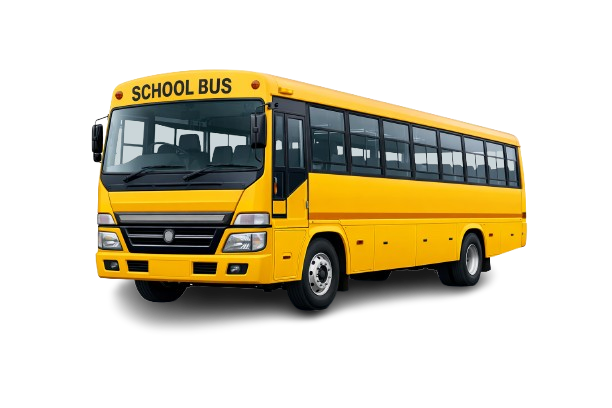
A school bus accident is not just a traffic incident. It is a
legal, financial and reputational event for the institution involved. If the bus is uninsured or underinsured when an
accident happens, the school management faces unlimited third-party liability, potential criminal proceedings under the
Motor Vehicles Act, 1988 and the cost of repairs entirely from its own pocket. Schools that operate buses without
comprehensive coverage routinely find this out at the worst possible time.
The problem is not that schools are unaware insurance exists. Most school
bus operators hold a third-party policy because the law requires it. What they often lack is a proper understanding of what that
policy actually covers, what it leaves out and which additional endorsements make the difference when a claim is filed. For
institutions transporting hundreds of children every day, the gap between a basic policy and the right policy can run into crores.
This guide covers everything that matters: how school bus insurance works in India, what IRDAI regulations say, how premiums are calculated, what add-ons are worth buying and the five most common reasons claims fail. By the end, you will have a
clear picture of exactly what coverage your school bus needs and where most policies fall short.
What is School Bus Insurance and Who Needs It?
School bus insurance is not a product category on its own. Under Indian motor insurance regulations, it falls under commercial vehicle insurance, specifically the passenger-carrying vehicle (PCV) sub-class. Any bus or van used to transport students to and from school, or for school-related trips, must have at minimum a valid third-party liability policy. This requirement comes directly from Section 146 of the Motor Vehicles Act, 1988, which makes it
illegal to drive any vehicle on a public road without insurance.
The definition matters for one important reason: a vehicle registered as a private car cannot be used as a school bus. If a school van or bus is not registered as a commercial vehicle with a contract carriage permit from the Regional Transport Office, no commercial vehicle insurance policy will apply. This is one of the most common
compliance gaps we see with smaller schools and transport contractors.
Schools that operate their own fleet, third-party transport contractors running buses on behalf of schools and parent-teacher societies operating shared transport arrangements all need school bus insurance.
The registration must reflect the actual use of the vehicle.
What Qualifies as a School Bus Under IRDAI Rules?
The IRDAI's exposure draft for motor third-party premium rates makes the definition specific. A school bus, for premium purposes, is a bus registered in the name of the school and used only for transporting students to and from school or on school-related trips. This matters because only buses meeting this definition are eligible for the 15% discount on third-party premiums proposed by MoRTH. Buses operated by a contractor and not registered directly in the school's name do not
qualify for this classification, even if they exclusively serve a school's students.
Types of School Bus Insurance Policies Available in India
There are two types of motor insurance a school bus can hold: a third-party liability only policy and a comprehensive (package) policy. Each covers a fundamentally different set of risks and the decision between
them should be driven by the value of the vehicle and the risk appetite of the institution.
Third-Party Liability Insurance(Mandatory)
This covers legal liability to third parties for injury, death, or property damage caused by the insured vehicle. If your school bus strikes another vehicle or injures a pedestrian, this policy pays the compensation awarded by the court or the Motor Accident Claims Tribunal (MACT). The liability for death or bodily injury is unlimited, meaning there is no cap
on what the insurer must pay. Property damage is covered up to Rs. 7.5 lakh per the India Motor Tariff. The premium for a third-party policy is fixed by IRDAI and does not vary across insurers. You cannot negotiate it or get a better rate by shopping around. What varies is only the service,
cashless network and claim settlement quality.
Comprehensive Policy (Package Policy)
A comprehensive policy covers everything in the third-party policy plus own-damage cover, meaning loss or damage to the insured vehicle itself due to accidents, fire, theft, flood, earthquake and other specified perils. For a school that owns a bus worth Rs. 20 lakh or more, running without own-damage cover is a significant financial risk. Repair costs after a serious accident can easily run to several
lakhs and the school bears that cost entirely if only a third-party policy is in place. Comprehensive cover also makes it possible to add endorsements and add-ons, including the critical
passenger cover that most schools overlook.
School Bus Insurance Premium: What You Can Expect to Pay
Premium for school buses depends on two components: the third-party premium, which is regulated and fixed by IRDAI and the own-damage premium, which is determined by the
insurer based on the vehicle's Insured Declared Value (IDV), age and chosen add-ons.
Third-Party Premium Rates
Third-party premiums for passenger-carrying vehicles are set based on seating capacity. For buses registered as educational institution vehicles, a 15% discount on the base TP premium has been proposed by MoRTH. All premiums are subject to 18% GST in addition to the base rate. The table below reflects indicative ranges
derived from IRDAI proposals; always verify current notified rates at the time of purchase.
Vehicle Category
Base TP Premium (Approx.)
15% Educational Discount
Net TP Premium
Passenger carrying vehicle (up to 17 seats)
Rs. 4,800 - Rs. 6,000
Rs. 720 - Rs. 900
Rs. 4,080 - Rs. 5,100
Passenger carrying vehicle (18 to 36 seats)
Rs. 7,000 - Rs. 10,000
Rs. 1,050 - Rs. 1,500
Rs. 5,950 - Rs. 8,500
Passenger carrying vehicle (above 36 seats)
Rs. 11,000 - Rs. 15,000
Rs. 1,650 - Rs. 2,250
Rs. 9,350 - Rs. 12,750
Note: Figures are indicative estimates based on MoRTH proposals and insurer data. Final premiums depend on current notified rates, vehicle registration year, state and insurer. Add 18% GST to all amounts. The 15% discount applies only to buses registered in the school's name and
used exclusively for student transport. Verify applicable rates at the time of purchase.
Comprehensive Policy: What Drives the Total Cost
For a comprehensive policy, own-damage premium is calculated on the IDV of
the vehicle. IDV is the manufacturer's listed price minus depreciation according to IRDAI-approved rates. A 5-year-old school bus
originally costing Rs. 25 lakh might have an IDV of Rs. 12-15 lakh depending on the depreciation applied. The OD premium is
typically between 2% and 4% of IDV for commercial vehicles. Add the TP component, GST and any endorsements and a first-year comprehensive
policy on a standard school bus commonly lands in the Rs. 25,000 to Rs. 50,000 range.
The No Claim Bonus (NCB) reduces the own-damage portion of the premium each claim-free year, starting at 20% and rising to 50% over five years. Schools running
well-maintained fleets with clean records can achieve meaningful savings on renewal.
Unsure if your school bus policy covers what it should? Our advisors at
SMC Insurance can review your existing coverage, check whether the 15% educational discount is being applied and
identify any critical gaps in your current policy before the next renewal.
Critical Add-Ons and Endorsements That Schools Must Not Skip
This is where most schools get their insurance wrong. They buy a
third-party policy or a basic comprehensive policy and consider the job done. The coverage that actually protects the children on
the bus requires specific endorsements and none of them come included as standard.
Passenger Cover (IMT Endorsement)
The children travelling in the school bus are not automatically
covered under a standard motor insurance policy. Third-party liability only covers injury to people outside the bus.
Students inside the vehicle need a separate passenger cover endorsement under the India Motor Tariff framework, which
provides compensation in the event of accidental death or bodily injury to the passengers. For a school transporting
30 students twice daily, this endorsement is non-negotiable. The additional premium is modest compared to the exposure
it covers.
Paid Driver Cover (IMT 28)
If your bus driver or cleaner is injured in an accident, the
employer has a legal liability under the Workmen's Compensation Act, 1923. IMT 28 covers this liability for a nominal
additional premium. Schools that employ paid drivers and do not carry this endorsement are exposed to compensation
claims that may not be covered elsewhere.
Zero Depreciation Cover
Under a standard comprehensive policy, claim payouts for replaced
parts are reduced by a depreciation amount based on the age of the part and material. On a bus with high-value body panels,
glass and tyres, this depreciation deduction can reduce a Rs. 3 lakh repair bill to a Rs. 1.8 lakh settlement. Zero
depreciation eliminates this deduction and provides full replacement cost. It is available on vehicles up to a certain
age limit (usually five years) and adds roughly 15-25% to the OD premium.
Roadside Assistance (RSA)
A broken-down school bus with children on board on a highway at
7 AM is an operational nightmare. Roadside assistance cover provides 24x7 towing, on-the-spot repair coordination and
in some policies, an alternative vehicle arrangement. For schools with long daily routes, this is a practical
necessity rather than an optional extra.
Engine Protection Cover
During monsoons, flooded underpasses are a reality across Indian
cities. If a bus drives through a waterlogged area and the engine suffers hydrostatic lock, standard comprehensive
policies exclude this as a consequential damage. Engine protection cover fills this gap. For schools operating in
flood-prone areas of Mumbai, Chennai, Kolkata, or other coastal cities, this add-on is directly relevant.
Legal Requirements and Compliance for School Buses in India
Insurance is just one of several legal requirements a school bus must comply with. Insurers check these documents during claim processing and any gap in
compliance can result in a claim being rejected even when the policy is valid.
Contract Carriage Permit A school bus must hold a valid contract carriage permit issued under Section 74 of the Motor Vehicles Act, 1988. This permit allows the vehicle to carry passengers on a contract basis along a fixed route for an institution. Operating without a valid
permit is an offence and can lead to both penalty and claim rejection.
Vehicle Fitness Certificate Every commercial vehicle in India must hold a valid Fitness Certificate (FC) issued by the RTO. For commercial vehicles under 8 years old, the FC is valid for two years; for those over 8 years, it must be renewed annually. Driving a commercial vehicle with an expired FC can attract fines of Rs. 2,000 to Rs. 5,000 for a first offence and up to Rs. 10,000 for repeat violations. More critically from an insurance standpoint, insurers are within their rights to reject claims if the vehicle lacked a valid FC at the time of the accident. Schools
running older buses particularly need to track this carefully.
Driver's Licence Requirements The driver must hold a valid commercial vehicle driving licence. A standard private car licence is not sufficient to legally drive a school bus. If a claim is filed and the investigation reveals the driver held only a light motor vehicle (LMV) licence for a bus requiring a heavy motor vehicle (HMV) licence, the claim will be repudiated. Schools that hire casual or substitute drivers without
checking licence validity are routinely caught by this.
Pollution Under Control (PUC) Certificate A valid PUC certificate is required at all times. While this does not directly affect insurance coverage in all cases, it is part of the compliance record that regulators and
insurers examine during post-accident investigations.
Document
Validity / Renewal Frequency
Consequence of Lapse
Commercial Vehicle Insurance
Annual (or as per policy term)
Illegal to operate; claim rejection
Fitness Certificate (FC)
2 years (under 8 yrs); 1 year (over 8 yrs)
Fine + claim denial possible
Contract Carriage Permit
5 years (varies by state)
Vehicle seizure; operation halt
PUC Certificate
Every 6 months (for older vehicles)
Fine; compliance violation
Vehicle Registration Certificate (RC)
Commercial vehicles: every 2-5 years
Cannot renew insurance without valid RC
Driver's Commercial Licence (HMV/LMV)
Renewed before expiry
Claim repudiation if expired at time of accident
Note: Document validity periods shown are under Central Motor Vehicles Rules, 1989. State RTO requirements may vary. Schools should track
expiry dates across all documents for every vehicle in their fleet.
How to File a School Bus Insurance Claim
Claims on commercial vehicles work on essentially the same process as private vehicle claims but with stricter documentation requirements. Given that a school bus accident often involves multiple injured parties,
the claims process can become complicated quickly if the institution is not prepared.
Step 1
Secure the Scene and Report to Police In any accident involving injury to a third party or passengers, report the incident to the nearest police station immediately. A First Information Report (FIR) or an accident report is a mandatory supporting
document for the claim. Do not delay this even if all parties agree to settle informally.
Step 2
Intimate the Insurer Within 24 to 48 Hours Call the insurer's claims helpline and log the accident. Most insurers require intimation within 24 to 48 hours of the incident. Late reporting is one of the most common grounds for partial or complete claim rejection. Provide the
policy number, vehicle registration, date, time and location of the accident.
Step 3
Do Not Move or Repair the Vehicle Without Surveyor Approval The insurer will appoint a licensed
surveyor to inspect the damage. Do not start repairs before the surveyor completes the assessment, unless the insurer provides written consent. Premature repairs are another
common reason for disputes during claims.
Step 4
Gather All Required Documents
Insurance policy certificate and cover note
Vehicle Registration Certificate (RC)
Valid Fitness Certificate
Valid Contract Carriage Permit
Driver's licence (commercial vehicle)
FIR or accident report from police
Photographs of the accident scene and vehicle damage
Repair estimates from authorised workshop
Medical reports if passengers or third parties were injured
For passenger injury claims under the endorsement, additional
documents include hospital records, discharge summaries and proof of identity of the passenger.
Step 5
Work with the Surveyor and Follow Up Once the survey is complete, the insurer will communicate the claim settlement amount. If repairs are at a cashless garage in the insurer's network, payment goes directly to the garage. For non-network garages, the school pays and submits bills for
reimbursement. Always keep copies of all repair invoices and payment receipts.
Why School Bus Insurance Claims Get Rejected: The Five Most Common Reasons
Most claim rejections are preventable. They do not arise from complex legal disputes. They arise from small operational oversights
that become significant the moment an accident happens.
1. Expired Fitness Certificate at the Time of the Accident If the bus was operating with an expired FC when the accident occurred, the insurer has grounds to deny the own-damage portion of the claim. Some insurers contest third-party liability coverage as well in such cases, arguing that operating an unfit vehicle constitutes negligence. Schools that do not track FC expiry dates across their fleet are particularly vulnerable. An annual compliance calendar that alerts management 30 days
before each document's expiry date is the simplest fix.
2. Driver Licence Mismatch If the driver was operating the bus with a licence that does not cover the vehicle class, the claim will be repudiated. This happens most often with substitute or casual drivers hired on short notice. The school is responsible for verifying that every person who drives its buses holds an appropriate commercial vehicle
licence with no endorsements or suspension on record.
3. Policy Lapse A gap in coverage, even of a single day, means there is no insurer obligation during that period. Schools managing multiple buses across different renewal dates sometimes miss a renewal. This is one of the most straightforward problems to solve with a proper fleet insurance management
system and yet it remains a persistent cause of claim failures.
4. Incorrect Vehicle Use Declaration If the policy was issued for the bus to operate within a city limit and the accident happened on an intercity route outside that limit, the insurer can dispute the claim. Always ensure the policy accurately reflects the
actual routes and usage of the vehicle.
5. Absence of Passenger Cover Endorsement Families of injured students often assume the school bus insurance will compensate them for the children's injuries. Without a passenger cover endorsement, it will not. The school is then exposed to legal claims from parents with no insurance backing. In our experience, this is the single most common coverage gap in school bus insurance and it causes
enormous difficulty when accidents occur.
How to Reduce School Bus Insurance Premiums
Without Compromising Coverage?
Schools running multiple buses can negotiate fleet discounts with insurers when insuring all vehicles under a single policy or
with a single insurer. Fleet policies also simplify renewals and claims management.
Maintaining a clean claims record is the most effective long-term cost-reduction strategy. The NCB on own-damage premiums reaches 50% after five consecutive claim-free
years, which on a fleet of 10 buses can represent substantial annual savings.
Electric school buses attract a 15% discount on third-party premiums in addition to any educational institution discount, making the total TP cost reduction 15% for electric buses registered to educational institutions. As schools progressively shift to
CNG and electric fleets, the insurance cost advantage adds up over time.
Voluntary deductibles reduce the own-damage premium at the cost of bearing a portion of each claim out of pocket. Schools with good maintenance records and careful drivers sometimes opt for this to bring premiums down.
It works best when the school has adequate reserves to absorb a moderate claim.
Working with a qualified insurance broker rather than buying directly can ensure the right endorsements are included from the start. A missed passenger cover add-on might save Rs. 3,000 at
purchase but cost Rs. 30 lakh in uninsured liability after an accident.
Summing Up,
School bus insurance is not a commodity purchase, but it is easy to get wrong.
The vehicle is carrying children and the exposure the school holds goes well beyond the cost of the bus itself. A standard third-party
policy meets the legal minimum but leaves students unprotected, drivers uncovered for employer liability and the vehicle itself exposed
to repair costs after every accident. The right school bus insurance starts with a comprehensive policy, adds passenger cover for every
seat on the bus, includes IMT 28 for the paid driver and is supported by a clean compliance file covering the fitness certificate, permit
and driver licence. For institutions running multiple buses, talk to an insurance broker about fleet policies. The administrative
simplicity and potential cost savings are real and unlike managing several separate renewals, a single fleet policy is far easier to
track and manage.
The claims that get rejected are almost always preventable. Expired fitness
certificates, driver licence mismatches, policy lapses, incorrect use declarations and missing passenger cover are the usual culprits.
Premium is not the best lens through which to evaluate school bus insurance — the right question is whether the policy will respond
when something goes wrong. Going through this checklist once before you buy or renew your policy takes about ten
minutes and can save you a great deal of grief later.
Disclaimer: The information provided on this platform is intended for general awareness and educational purposes. While every effort is made to ensure accuracy, some details may change with policy updates, regulatory revisions, or insurer-specific modifications. Readers should verify current terms and conditions directly with relevant insurers or through professional consultation before making any decision.
All views and analyses presented are based on publicly available data, internal research and other sources considered reliable at the time of writing. These do not constitute professional advice, recommendations, or guarantees of any product's performance. Readers are encouraged to assess the information independently and seek qualified guidance suited to their individual requirements. Customers are advised to review official sales brochures, policy documents and disclosures before proceeding with any purchase or commitment.
The company is wonderful insurance platform providing multiple policies under 1 roof. Experience in purchasing the policy is very good. Experts guides you very well
Annu Gour Annu Pune, April 07, 2025
Easy Renewal process
The process to renew my 2-wheeler policy is indeed very quick and easy. Got it done in just 10 minutes. Thanks.
Bipin Singh Mumbai, April 06, 2025
Quick Response
I thought let me renew my two wheeler policy with SMC and see the experience. The experience was good and simple, the only gap which I felt was that the details of the vehicle did not come up after mentioning the vehicle number.
Yes, under Section 146 of the Motor Vehicles Act, 1988, every vehicle plying on a public road must have at minimum a valid third-party insurance policy. A school bus is classified as a commercial passenger-carrying vehicle and operating it without insurance is a criminal offence that can result in fines and vehicle seizure. The school management and bus operator are both liable.
No, a standard motor insurance policy, whether third-party or comprehensive, does not automatically cover passengers inside the vehicle. To protect students, the school must add a passenger cover endorsement to the policy. Without this, the insurer has no obligation to pay compensation to injured students or their families and the school faces those claims with no insurance backing.
MoRTH proposed a 15% discount on the base third-party premium for buses belonging to educational institutions. To qualify, the bus must be registered in the school's name and used exclusively for transporting students to and from school or on school-related activities. If the bus is registered to a transport contractor, even if it only serves your school, it likely does not qualify for this discount. Verify this with your insurer or broker at the time of purchase.
The insurer can repudiate the claim. A valid commercial vehicle licence is a policy condition and driving without one voids the insurer's obligation to pay own-damage costs and, in some cases, third-party costs. The school or operator then bears all repair costs and third-party liability personally. This is why checking the licence validity of every driver before each school year and when hiring casual substitutes is a non-negotiable compliance step.
Yes, fleet insurance allows multiple commercial vehicles to be covered under a single policy, which simplifies administration and sometimes attracts volume discounts from insurers. Schools managing five or more buses should explore fleet policies rather than managing individual renewals for each vehicle. Fleet policies also provide a consolidated view of endorsements and coverage levels across the entire transport operation.
The standard documents required are the policy certificate, vehicle Registration Certificate, valid Fitness Certificate, contract carriage permit, driver's commercial licence, FIR or police accident report, photographs of damage and repair estimates. For passenger injury claims under the endorsement, hospital records and proof of the passenger's identity are additionally required. Missing any document can delay or block claim settlement.
The premium has two parts. The third-party premium is fixed by IRDAI and
based on the seating capacity of the vehicle, with a 15% discount for qualifying educational institution buses.
The own-damage premium is calculated as a percentage of the Insured Declared Value (IDV), which is the current
market value of the bus after depreciation. IDV falls each year as the vehicle ages, which lowers the
own-damage premium but also lowers the maximum claim payout. Add-ons and endorsements increase the
total premium. GST at 18% applies to the total.





 Instant Renewal.
 No Paperwork.