


SMC Insurance
Welcome to SMC.
How may I assist you?

Time Remaining to Avail Tax Benefits
(Under section 80C & 80D)
Get 90 Lakh Health Cover at Just ₹2K


Buy Life Insurance Now!

100% Privacy
Zero Spam

Network
30+ Reliable Insurers

Legacy

Highly rated insurance website
4.1/5

 Review Smart
 Save Time
Your vehicle's PUC Details for
PUC Number:
Expiry Date:
Days Remaining:
Your vehicle's PUC Details for
PUC Number:
Expiry Date:
PUC Status:
Your vehicle's PUC Details for
Sorry web couldn't retrieve PUC details for the provided registration number
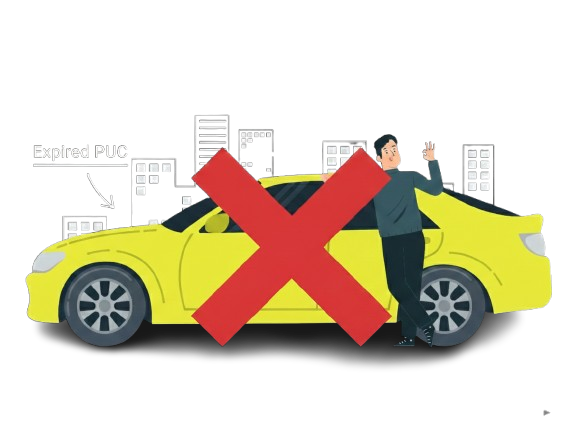
No, an expired PUC certificate does not automatically void your motor insurance claim in India. As per IRDAI guidelines and court rulings, insurers cannot reject a claim solely because your PUC expired unless they prove that the accident occurred due to emission-related mechanical failure or illegal vehicle condition. However, driving without a valid PUC is a traffic offence and may lead to fines under the Motor Vehicles Act.
Before going deeper, it is important to understand what a valid PUC certificate is and why it matters for both legal compliance and insurance eligibility.
A Pollution Under Control (PUC) certificate confirms that your vehicle’s emissions comply with government-approved limits. It is mandatory under the Motor Vehicles Act, 1988, for all petrol, diesel, and CNG vehicles in India.
A valid PUC certificate serves three key purposes:
However, many vehicle owners worry whether an expired PUC can lead to claim rejection. Let’s examine the truth based on IRDAI rules and real claim scenarios.
The short answer: No, not automatically.
The Insurance Regulatory and Development Authority of India (IRDAI), in a circular dated 26 August 2020, clarified that not holding a valid PUC certificate is not a valid reason for denying any claim under a motor insurance policy. This clarification followed an earlier IRDAI circular dated 20 August 2020 (issued per Supreme Court directions), which required insurers to collect a valid PUC certificate from policyholders at the time of policy renewal and not as a condition for settling accident claims. An earlier circular (Ref: IRDA/NL/CIR/MISC/104/07/2018,
dated 6 July 2018) similarly required general insurers to verify PUC status only at renewal.
Your insurance claim will usually be approved if:
For example:
If another vehicle hits your parked car, your claim remains valid
even if your PUC expired.
➔ If the Accident Happened Due to Poor Vehicle Condition Linked to Emissions
If your vehicle failed emission norms and this mechanical condition contributed to the accident, the insurer may reject the claim.
Example:
Your vehicle engine stalled in the middle of traffic due to poor maintenance and emission-related engine failure, leading to a collision. The insurer may argue that you operated the vehicle in an unroadworthy condition.
Reason for rejection:
Violation of policy condition requiring vehicle maintenance in roadworthy condition.
➔ If the Vehicle Was Declared Unroadworthy by Authorities
Insurance policies require that your vehicle must comply with legal requirements under the Motor Vehicles Act.
If authorities classify your vehicle as unfit or illegal due to severe emission violations, insurers may reject claims.
Example:
Your vehicle fails emission standards and authorities issue notices restricting its usage, but you continue driving and meet with an accident.
➔ If There Is Proven Negligence or Illegal Use of Vehicle
Insurance companies can reject claims if they prove negligence or illegal operation of the vehicle.
Driving without valid mandatory documents such as:
may strengthen the insurer’s argument of negligence — but PUC alone is rarely sufficient.
➔ If Policy Terms Specifically Require Legal Compliance
Motor insurance policies include a clause stating that the vehicle must comply with legal requirements.
If the insurer proves that violation of emission norms contributed directly to the accident, they may deny the claim.
➔ If Fraud or Misrepresentation Is Involved
Claims may be rejected if:
Expired PUC combined with fraudulent activity increases rejection risk.
Under Section 190(2) of the Motor Vehicles Act, 1988 (as amended by the Motor Vehicles (Amendment) Act, 2019, effective 1 September 2019), driving a vehicle that violates prescribed road safety, noise, or air-pollution standards is punishable for a first offence with imprisonment up to three months, a fine up to Rs. 10,000, or both, along with disqualification from holding a licence for three months. A second or subsequent offence can attract imprisonment up to six months, a fine up to Rs. 10,000, or both. Some states apply lower on-the-spot fines (Rs. 1,000 for a first offence, Rs. 2,000 for repeat offences) at
enforcement discretion, so the amount actually charged can vary by state.
|
Scenario |
Claim Outcome |
|
Another vehicle hits your car |
Claim approved |
|
Natural disaster damage |
Claim approved |
|
Theft of vehicle |
Claim approved |
|
Minor accident unrelated to emissions |
Claim approved |
|
Third-party liability claim |
Claim approved |
Insurance companies must prove:
Without this proof, claim rejection is not legally valid.
Several consumer court rulings in India have supported
policyholders in such cases.
A viral claim circulated on social media stating that accident insurance claims would not be honoured if a vehicle's PUC certificate was invalid on the date of the accident, with some versions falsely attributing this to a Supreme Court-approved IRDAI order effective November 2022. The Press Information Bureau's Fact Check unit officially labelled this claim #Fake, confirming that holding a valid PUC
certificate is not mandatory to claim accident insurance under a motor insurance policy.
Since 18 December 2025, Delhi has enforced a “No PUC, No Fuel” policy: petrol pumps across the city are barred from dispensing fuel to any vehicle without a valid Pollution Under Control Certificate, monitored through ANPR cameras and voice-alert systems at fuel stations. This makes it considerably harder to keep driving on an expired PUC without noticing which indirectly reduces the odds of an accident occurring while your PUC has lapsed. It doesn't change the insurance claim rules described above, but it's a strong reason to renew
promptly rather than relying on the fact that a lapsed PUC alone won't void a claim.
You no longer need to dig through your glove compartment to find your PUC certificate. The Parivahan portal and platforms like SMC Insurance let you verify your PUC status instantly.
➔ Method 1 — SMC Insurance PUC Checker:
No OTP. No login. No extra steps.
➔ Method 2 — Parivahan Portal:
➔ Method 3 — From SMCInsurance Get Instant PUC Status on SMS:
Please SMS your vehicle registration number (e.g. MH01AB1234) to 9650171172 to receive your PUC status directly on your phone.
An expired PUC certificate alone is not a valid reason for claim rejection. However, if the insurer proves that your vehicle’s emission-related mechanical condition contributed to the accident or violated legal requirements, they may reject or dispute the claim. Maintaining a valid PUC certificate helps avoid disputes, penalties, and claim complications.
Disclaimer:The information provided on this platform is intended for general awareness and educational purposes. While every effort is made to ensure accuracy, some details may change with policy updates, regulatory revisions, or insurer-specific modifications. Readers should verify current terms and conditions directly with relevant insurers or through professional consultation before making any decision.
All views and analyses presented are based on publicly available data, internal research, and other sources considered reliable at the time of writing. These do not constitute professional advice, recommendations, or guarantees of any product’s performance. Readers are encouraged to assess the information independently and seek qualified guidance suited to their individual requirements. Customers are advised to review official sales brochures, policy documents, and disclosures before proceeding with any purchase or commitment.


SMC Insurance Brokers Pvt. Ltd.
SMC Metro Mall, Near Pratap Nagar Metro Station, Pratap Nagar, New Delhi-110007
Registration No: 289, Registration Code No: IRDAI/DB-272/04/289, Valid till: 27/01/2029, License category: Composite Broker, CIN: U66000DL1995PTC172311
Insurance is the subject matter of solicitation.
Visitors are hereby informed that their information submitted on the website may be shared with insurers.
Product information is authentic and solely based on the information received from the Insurer.

Scan to Download
SMC Insurance App
