


SMC Insurance
Welcome to SMC.
How may I assist you?

Time Remaining to Avail Tax Benefits
(Under section 80C & 80D)
Get 90 Lakh Health Cover at Just ₹2K


Buy Life Insurance Now!

100% Privacy
Zero Spam

Network
30+ Reliable Insurers

Legacy

Highly rated insurance website
4.1/5

 Review Smart
 Save Time
Your vehicle's PUC Details for
PUC Number:
Expiry Date:
Days Remaining:
Your vehicle's PUC Details for
PUC Number:
Expiry Date:
PUC Status:
Your vehicle's PUC Details for
Sorry web couldn't retrieve PUC details for the provided registration number
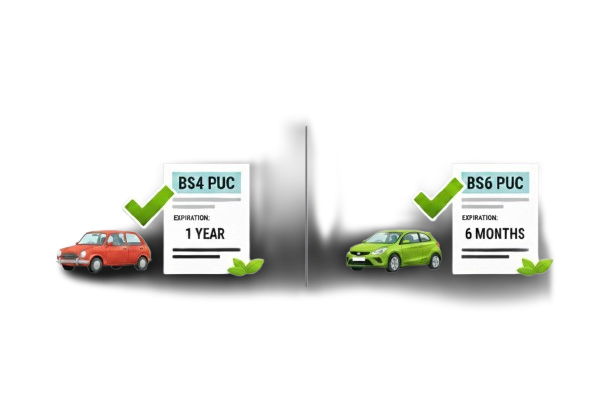
A newly registered BS6 vehicle gets a first PUC certificate valid for one year. After that first year, every renewal is valid for six months and this does not revert to an annual cycle. The 6-month rule applies nationwide, costs ₹60-₹100 per test, and helps maintain India's air quality standards under the new BS6 emission norms.
Bought a new car after April 2023? You might have noticed something different when you went for your first PUC certificate renewal. Unlike older BS4 vehicles that enjoyed a full year between pollution checks, your BS6 vehicle demands attention every six months during the first two years. This change has left many vehicle owners confused, frustrated, and searching for answers.
The shift from BS4 to BS6 emission standards brought cleaner engines, but it also introduced stricter monitoring requirements. The Ministry of Road Transport and Highways implemented these revised PUC timelines in 2023 to align with the advanced emission control technology in BS6 vehicles. The frequent testing ensures that catalytic converters, oxygen sensors, and particulate filters continue working at peak efficiency.
This comprehensive guide explains the exact differences between BS6 and BS4 PUC validity periods, why the government introduced the 6-month rule, how much you'll pay, and what happens if you miss the deadline. Whether you drive a petrol hatchback or a diesel SUV, understanding these regulations helps you avoid penalties while contributing to cleaner air in Indian cities.
This table summarizes all key differences for quick reference:
|
Parameter |
BS4 Vehicles |
BS6 Vehicles |
|
First PUC Due |
1 year from registration |
6 months from registration (if registered after April 1, 2023) |
|
Validity (Year 1-2) |
12 months |
6 months (if registered after April 1, 2023) |
|
Validity (After 2 Years) |
12 months |
12 months |
|
Testing Frequency (First 2 Years) |
Once per year |
Twice per year |
|
Cost per Test |
₹60-₹100 |
₹60-₹100 |
|
Annual Cost (First 2 Years) |
₹60-₹100 |
₹120-₹200 |
|
Emission Testing Method |
Gas analyzer/smoke meter |
Gas analyzer/smoke meter (stricter limits) |
|
CO Limit (Petrol) |
0.5% |
0.3% |
|
Smoke Opacity (Diesel) |
72 HSU |
50 HSU |
|
Digital Certificate |
Available |
Available |
|
Penalty for Non-compliance |
₹10,000 first offense |
₹10,000 first offense |
The pollution under control certificate validity depends entirely on your vehicle's emission standard and age. The rules changed significantly when BS6 norms became mandatory across India from April 1, 2020.
Vehicles manufactured under BS4 emission norms follow a straightforward validity schedule. New BS4 vehicles received a 1-year exemption from the registration date. After the first year, owners needed PUC renewal every 12 months without exception.
Example: A Maruti Swift manufactured in February 2020 (BS4 standard) required its first PUC test in February 2021, then annually in February 2022, 2023, and so on. The pattern remained consistent throughout the vehicle's lifetime, making compliance easy to remember.
This annual cycle applied regardless of whether the vehicle ran on petrol, diesel, or CNG. The testing measured carbon monoxide levels for petrol vehicles and smoke opacity for diesel vehicles using standardized equipment at authorized centers.
The government revised PUC validity rules for BS6 vehicles through a notification dated March 28, 2023. The new framework introduces a two-phase approach based on vehicle age.
Phase 1: First Two Years (6-Month Validity)
BS6 vehicles registered after April 1, 2023, must obtain their first PUC certificate within 6 months of registration. After the initial test, renewals continue every 6 months until the vehicle completes two years from the registration date.
Timeline breakdown for a vehicle registered on May 15, 2023:
Phase 2: After Two Years (Annual Validity)
Once your BS6 vehicle crosses the 2-year mark from registration, it transitions to the standard annual PUC cycle. From the third year onwards, you need renewal only once every 12 months, matching the schedule of BS4 vehicles.
Continuing the above example, after May 15, 2025, the next PUC would be due in May 2026,
then May 2027, and annually thereafter. This simplified schedule continues for the vehicle's entire operational life.
The Ministry of Road Transport and Highways has proposed extending PUCC validity for BS-VI private vehicles up to six years old to three years, instead of the current one year. BS-VI vehicles aged 6–10 years would renew annually and those over 10 years every six months. Under the same draft, BS-IV vehicles would need to renew every six months, and BS-I/II/III vehicles every three months. This is a draft notification only; existing rules remain in force until it is formally notified.
The stricter monitoring schedule stems from the sophisticated emission control technology in BS6 engines. These systems require more frequent verification during the critical break-in period when components settle and calibrate.
Technical Reasons Behind Frequent Testing
PUC validity rules are nationally regulated. However, enforcement intensity varies across cities. Below is a simplified reference table:
|
City/State |
BS4 Renewal |
BS6 Renewal |
Notes |
|
Delhi NCR |
3 months |
6 months (1 year initial) |
Strict e-challans |
|
Mumbai (Maharashtra) |
6 months |
6 months |
SMS reminders |
|
Chennai (Tamil Nadu) |
6 months |
6 months |
Physical slips some areas |
|
Bangalore (Karnataka) |
12 months (post-2019) |
12 months |
RTO software check |
|
Kolkata (West Bengal) |
6 months |
6 months |
Standard rules |
|
Hyderabad (Telangana) |
6 months |
6 months |
Fuel station centers |
Important Note:
While validity duration is uniform, metro cities like Delhi often conduct stricter enforcement drives due to pollution concerns.
The testing fee remains identical for both BS4 and BS6 vehicles despite the different validity periods. State governments regulate PUC charges, leading to minor regional variations.
Current Fee Structure Across Major States
As of February 2026, authorized PUC centers charge between ₹60 and ₹100 per test depending on the state and vehicle type. Petrol vehicle testing typically costs less than diesel testing due to simpler equipment requirements.
State-wise PUC charges:
CNG vehicles usually follow petrol vehicle pricing since they undergo similar carbon monoxide testing. Electric vehicles receive exemption from PUC requirements entirely, as they produce zero tailpipe emissions.
Annual Cost Impact: What You'll Actually Pay
The 6-month validity creates a higher annual cost for BS6 vehicle owners during the first two years. However, the total expense remains modest compared to other vehicle running costs.
BS6 vehicle (first 2 years):
BS4 vehicle (any age):
BS6 owners spend approximately double during the first 24 months, then revert to the same annual cost as BS4 vehicles. This additional ₹120-₹200 over two years averages just ₹5-₹8 per month, a negligible addition to fuel, insurance, and maintenance expenses.
Obtaining a PUC certificate takes less than 10 minutes at authorized centers. The process remains identical for BS4 and BS6 vehicles, though testing parameters differ slightly.
Finding Authorized PUC Centers Near You
State transport departments authorize petrol pumps, service stations, and standalone testing facilities to issue PUC certificates. Look for centers displaying the official PUC certification board with the state transport logo.
Most fuel stations in urban areas offer PUC testing. The Parivahan Sewa portal (parivahan.gov.in) lists authorized centers by district, though this database updates irregularly. GPS apps like Google Maps show nearby PUC centers when you search for "pollution certificate near me."
Avoid unauthorized vendors offering cheaper certificates without actual testing. These fake certificates carry no legal validity and result in penalties during police checks or vehicle fitness inspections.
For Petrol/CNG Vehicles:
The technician inserts a probe into your exhaust pipe while the engine runs at idle. The gas analyzer measures carbon monoxide and hydrocarbon levels. BS6 petrol vehicles must show CO below 0.3% and HC below 200 ppm to pass. The test takes 3-5 minutes.
For Diesel Vehicles:
Diesel testing measures smoke opacity using a smoke meter. The technician accelerates your engine to maximum RPM three times while the device measures exhaust darkness. BS6 diesel vehicles must maintain opacity below 50 HSU (Hartridge Smoke Units). Testing completes within 5-7 minutes.
If your vehicle fails, the center provides a failure report listing the reasons. You must repair the emission system and return for retesting. Most centers offer free retesting within 7 days if you perform repairs at their facility.
You need minimal documentation for PUC certificate issuance:
The center enters your vehicle details into their computerized system, which connects to the state transport department's database. After successful testing, you receive a printed certificate valid for either 6 months (new BS6) or 12 months (BS4/old BS6).
Many states now issue digital PUC certificates through SMS and email. These electronic certificates hold the same legal validity as printed versions and stay accessible through the mParivahan mobile app.
The Motor Vehicles Act, 1988 mandates valid PUC certificates for all vehicles on public roads. Section 190(2) authorizes traffic police to impose penalties for non-compliance.
Current Penalty Structure in 2026
The amended Motor Vehicles Act increased PUC violation penalties significantly in September 2019. First-time offenders face a fine of ₹10,000 for driving without a valid pollution certificate. Repeat violations within the same calendar year attract compounding charges.
Penalty breakdown:
Some states implemented challan compounding schemes where immediate payment reduces the fine by 50%. However, this discount applies only to specific violations and varies by jurisdiction.
Note: As of December 2025, petrol pumps across Delhi stop dispensing fuel to
vehicles without a valid PUC certificate, enforced via ANPR cameras and Delhi Police.
Driving without valid PUC affects more than just traffic fines. Insurance companies can reject claims if your PUC certificate expired at the accident time. It's important to note that while a valid PUC certificate is not a prerequisite for settling insurance claims, the IRDAI mandates that insurance companies ensure the vehicle has a valid PUC certificate at the time of policy renewal. Most comprehensive policies include clauses requiring all statutory documents, including PUC, to remain current.
Vehicle registration renewal also requires valid PUC submission. When your RC comes up for renewal after 15 years, RTOs demand proof of current PUC compliance. Missing this creates delays in the renewal process and may require rectification fees.
Commercial vehicle operators face additional risks. Transport authorities can suspend permits for fleet owners whose vehicles repeatedly operate without valid PUC certificates. This suspension affects business operations and requires legal appeals for restoration.
Several situations create confusion around PUC validity for BS6 vehicles. Understanding these edge cases prevents compliance issues.
BS6 Vehicles Registered Before April 1, 2023
For BS6 vehicles registered after April 1, 2023, the initial PUC certificate is valid for one year. Subsequent renewals are required every six months. If you bought a BS6 vehicle between April 2020 and March 2023, your PUC validity follows the old schedule with annual renewals from the start.
Example: A Hyundai Creta BS6 registered in January 2022 needs annual PUC renewal. The owner's first PUC was due in January 2023, second in January 2024, third in January 2025, and continues yearly. This vehicle never faces the 6-month requirement despite being BS6 compliant.
Check your RC book to confirm registration date. The cutoff date matters more than the purchase date or manufacturing date when determining PUC validity rules.
PUC validity continues uninterrupted when you sell or transfer a BS6 vehicle. The 6-month schedule remains tied to the original registration date, not the ownership transfer date.
Example: You sell your BS6 vehicle registered in June 2024 to a new owner in December 2024. The vehicle already has PUC certificates from December 2024. The new owner must renew in June 2025 (12 months from registration), then December 2025 (18 months), following the original schedule.
The RTO transfer process requires a valid PUC certificate at the time of transfer. Both seller and buyer should verify PUC status before initiating ownership change to avoid processing delays.
Moving to a different state with your BS6 vehicle does not reset the PUC timeline. The 6-month validity schedule persists based on the original registration date, regardless of state boundaries.
However, when you re-register the vehicle in the new state (required if you establish permanent residence), the PUC validity continues from the original registration date, not the re-registration date. States maintain uniform PUC rules under central government directives.
Commercial vehicles moving interstate for business need PUC compliance in both home state and operating states. Cross-border checks frequently verify PUC validity, making current certificates essential for truck and taxi operators.
Understanding the rules theoretically differs from implementing them practically. These frequent errors cost owners time and money.
The Ministry of Road Transport and Highways continues refining emission testing protocols as vehicle technology advances. Several changes appear likely in the coming years.
The transition from BS4 to BS6 emission standards brought significant changes to pollution certificate validity in India. BS6 vehicles registered after April 1, 2023, require PUC renewal every 6 months during their first two years instead of the annual schedule that BS4 vehicles follow. This stricter requirement ensures that advanced emission control systems—including catalytic converters, oxygen sensors, and particulate filters—function properly during the critical break-in period.
Looking ahead, the government plans to integrate automated testing systems and telematics-based monitoring, potentially eliminating physical PUC center visits for newer vehicles. However, until these systems roll out nationwide, maintaining current PUC compliance remains mandatory for all petrol, diesel, and CNG vehicles regardless of emission standard.
Set calendar reminders after receiving each PUC certificate, download the mParivahan app for digital certificate access, and complete renewals within 1-2 weeks of expiry to maximize validity. These simple steps ensure continuous compliance while contributing to India's air quality improvement objectives under the National Clean Air Programme.
Disclaimer:The information provided on this platform is intended for general awareness and educational purposes. While every effort is made to ensure accuracy, some details may change with policy updates, regulatory revisions, or insurer-specific modifications. Readers should verify current terms and conditions directly with relevant insurers or through professional consultation before making any decision.
All views and analyses presented are based on publicly available data, internal research, and other sources considered reliable at the time of writing. These do not constitute professional advice, recommendations, or guarantees of any product’s performance. Readers are encouraged to assess the information independently and seek qualified guidance suited to their individual requirements. Customers are advised to review official sales brochures, policy documents, and disclosures before proceeding with any purchase or commitment.
No. Only BS6 vehicles registered after April 1, 2023, require 6-month PUC renewal for the first two years. BS6 vehicles registered between April 2020 and March 2023 follow annual PUC renewal from the beginning. After completing two years from registration, all BS6 vehicles transition to annual renewal.
No. PUC renewal requires physical emission testing at authorized centers. However, many states issue digital certificates via SMS and email after testing. You can access these digital certificates through the mParivahan app or DigiLocker, which hold the same legal validity as printed certificates.
The testing center provides a failure report explaining why your vehicle did not meet emission standards. Common reasons include faulty catalytic converters, oxygen sensor malfunctions, or fuel system issues. You must repair the problems and return for retesting. Most centers offer free retesting within 7 days if you complete repairs at their facility. Driving without a valid PUC after failure carries the same ₹10,000 penalty.
PUC validity depends on both emission standard and registration date. For BS6 vehicles registered after April 1, 2023, the first two years require 6-month renewals. After two years, all vehicles get annual validity. The manufacturing date does not matter; only the registration date determines your PUC schedule.
Yes, but the new certificate's validity starts from the testing date, not from your current certificate's expiry date. If you renew 2 months early, you lose those 2 months of coverage. The optimal approach involves getting renewal within 1-2 weeks of expiry to maximize validity while maintaining continuous coverage.
Yes. Electric vehicles produce zero tailpipe emissions and receive complete exemption from PUC certification requirements. Battery electric vehicles and hydrogen fuel cell vehicles do not need pollution certificates at any point during their operational life.
You need your vehicle's registration certificate (original or digital from mParivahan/DigiLocker), previous PUC certificate if applicable, and valid ID proof for record keeping. The testing process takes 5-10 minutes once you provide these documents.
PUC testing costs ₹60-₹100 per test depending on your state and vehicle type. This fee remains identical for both BS4 and BS6 vehicles. The only difference is frequency: BS6 owners (first 2 years) spend ₹120-₹200 annually for two tests, while BS4 owners spend ₹60-₹100 annually for one test.
The 6-month PUC schedule continues based on the original registration date, not the ownership transfer date. The new owner inherits the existing PUC timeline and must follow the same 6-month renewal pattern until the vehicle completes two years from its original registration date.
Yes. PUC certificates issued by authorized centers in any Indian state remain valid nationwide. You can get PUC testing done in Maharashtra and drive in Karnataka without issues. However, the certificate must remain current according to the validity period (6 months or 12 months) regardless of which state issued it.


SMC Insurance Brokers Pvt. Ltd.
SMC Metro Mall, Near Pratap Nagar Metro Station, Pratap Nagar, New Delhi-110007
Registration No: 289, Registration Code No: IRDAI/DB-272/04/289, Valid till: 27/01/2029, License category: Composite Broker, CIN: U66000DL1995PTC172311
Insurance is the subject matter of solicitation.
Visitors are hereby informed that their information submitted on the website may be shared with insurers.
Product information is authentic and solely based on the information received from the Insurer.

Scan to Download
SMC Insurance App
