


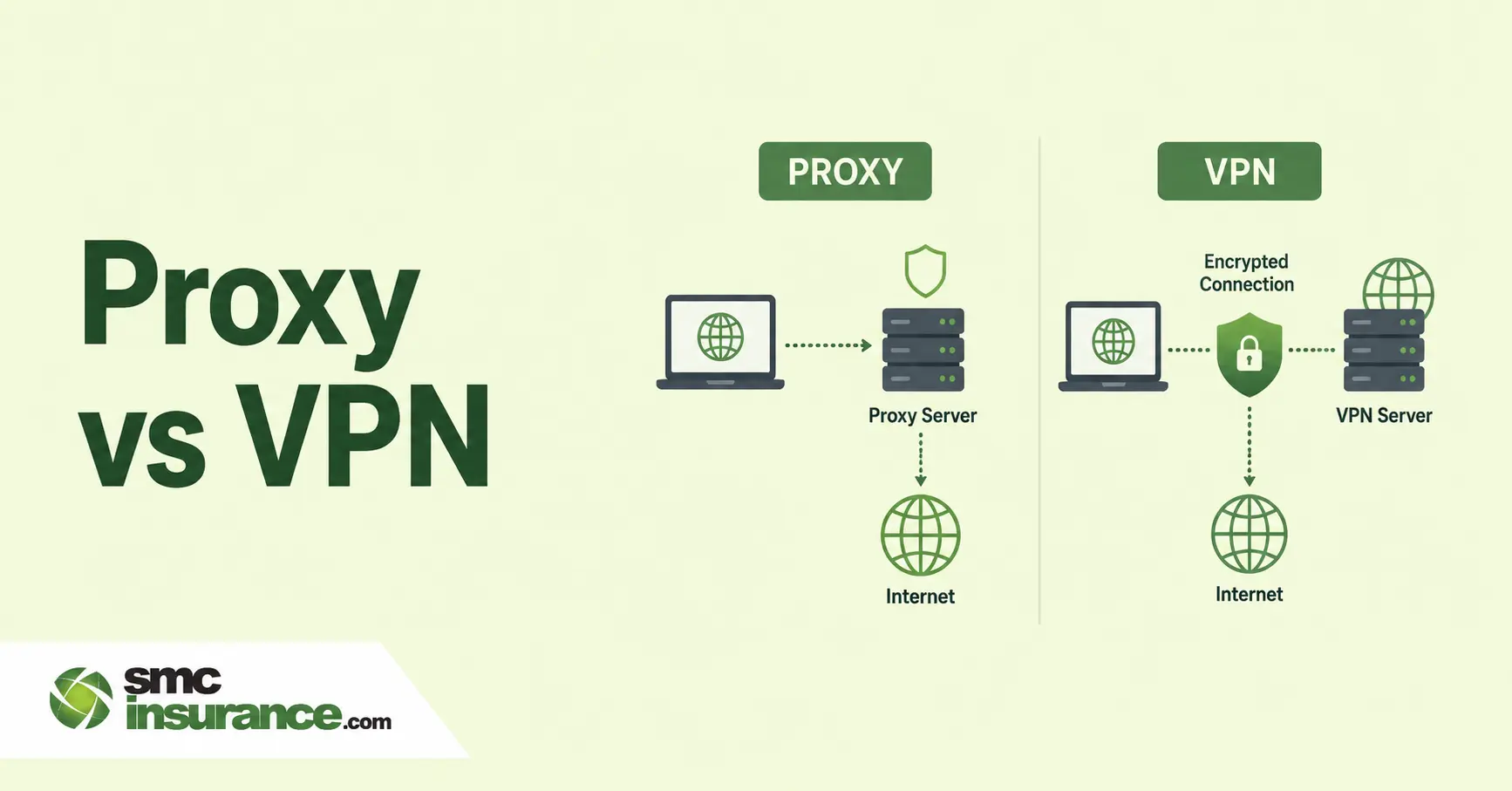
A proxy hides your IP address but leaves your data unencrypted, making it fast and fine for low-stakes tasks like unblocking content. A VPN hides your IP address and encrypts your entire connection, making it the better choice for banking, remote work, and public Wi-Fi. Choose a proxy for speed and appearance, choose a VPN for real security, and pair either one with cyber insurance if you are a business, since neither tool covers the cost of a breach that gets through anyway.
You are on the office Wi-Fi, trying to check a website that is blocked, and someone tells you to just use a proxy. Ten minutes later, a colleague insists a VPN would have done the job better and kept your data safe too. Both of them are right, and both of them are also missing half the picture. A proxy and a VPN both change how your device talks to the internet, but they do it in very different ways, and picking the wrong one can leave you exposed at exactly the moment you need protection. This guide breaks down the proxy vs VPN debate in plain terms, so by the end you will know exactly which one fits your situation, whether that is casual browsing, remote work, or handling sensitive business data.
Table of Contents
- Proxy vs VPN: Key Differences
- What Is a Proxy Server?
- What Is a VPN?
- How Do Proxies and VPNs Help With Cybersecurity?
- How Does Cyber Security Insurance Relate to VPNs and Proxies?
- Proxy vs VPN: Security and Encryption
- Proxy vs VPN: Privacy and Anonymity
- Proxy vs VPN: Which Is Faster?
- Proxy vs VPN for Businesses
- When Should You Use a Proxy?
- When Should You Use a VPN?
- Proxy vs VPN for Streaming, Gaming, Browsing, and Work
- Can You Use a Proxy and VPN Together?
- Proxy vs VPN: Which One Do You Need?
- How to Choose a VPN or Proxy Provider
- Common Proxy vs VPN Misconceptions
Proxy vs VPN: Key Differences
At the simplest level, a proxy reroutes your traffic through another server to hide your IP address, while a VPN does that and also wraps your entire connection in encryption. That one difference, encryption, changes everything else about how the two behave.
Aspect |
Proxy |
VPN |
IP masking | Yes, hides your real IP | Yes, hides your real IP |
Encryption | Usually none | Full encryption of all traffic |
Coverage | Works app by app, often just the browser | Covers the entire device |
Speed | Generally faster, less overhead | Slightly slower due to encryption |
Best for | Quick geo-unblocking, web scraping | Banking, remote work, sensitive data |
Setup | Configured per browser or app | Installed once, protects everything |
Note: Speed and security differences depend heavily on the specific provider and server load. Free proxies and free VPNs tend to underperform paid ones on both counts.
A short note before we go deeper: the table above is a starting point, not the full story. The real difference shows up once you look at how each one actually works under the hood.
What Is a Proxy Server?
A proxy server sits between your device and the websites you visit. When you send a request, it goes to the proxy first, the proxy forwards it to the destination, and the response comes back through the same route. To the website, the request looks like it came from the proxy's IP address, not yours.
Key Features
Proxies are built around a few core traits. They swap out your visible IP address for their own, they usually apply only to the specific app or browser you configure them in, and they rarely touch encryption at all. Some also cache frequently visited pages, which is why a proxy can occasionally load a site faster than a direct connection would.
Best Use Cases for Proxy
Proxies earn their keep in situations where speed matters more than airtight security. Businesses use them to filter
employee internet access, marketers use them to check how a website looks in a different country, and developers use them heavily in web scraping projects where dozens of requests need to look like they are coming from different locations. If you just need to peek around a geo-block for a few minutes, a
proxy usually gets the job done without any real setup.
Main Types of Proxy Servers
Not all proxies work the same way, and the type you pick changes what you actually get.
- Forward proxy: Sits in front of a group of users inside a network, commonly used by offices to control what employees can access.
- Transparent proxy: Applied without the user noticing, often deployed by schools or workplaces for content filtering.
- Anonymous proxy: Focused on hiding your identity from the sites you visit, though it still reveals that a proxy is in use.
- High anonymity proxy: Goes a step further by also hiding the fact that you are using a proxy at all.
- Residential proxy: Routes traffic through a real home IP address, making it harder for websites to detect and block.
- Data center proxy: Runs from a commercial server, fast and cheap, but easier for sites to flag as suspicious.
How It Works
Your request leaves your device and lands on the proxy server first. The proxy checks its rules, decides whether to allow the request, and then fetches the page on your behalf. The website sees the proxy's IP, not yours, and sends its response back the same way. None of this involves encrypting the actual content of your traffic.
Advantages and Disadvantages of Proxy A proxy is cheap, quick to set up, and light on your connection speed, which makes it a practical tool for narrow, specific tasks. On the flip side, most proxies leave your data unencrypted, so anyone monitoring the network between you and the proxy, including your ISP on an unsecured connection, can still see what you are doing. Free proxies in particular carry a real risk, since some log and resell user data to cover their own costs.
What Is a VPN?
A VPN, or virtual private network, builds an encrypted tunnel between your device and a remote server. Every byte of data traveling through that tunnel is scrambled, so even if someone intercepts it, they cannot read it without the encryption key.
Key Features
The defining trait of a VPN is full-device encryption rather than app-specific rerouting. Once connected, every piece of software on your device, from your browser to your email client to background apps, sends its traffic through the encrypted tunnel. A VPN also masks your IP address the same way a proxy does, but it adds a second layer that a proxy simply does not have.
Best Use Cases for VPN A VPN makes the most sense whenever the data itself matters, not just the location it appears to come from. Remote employees logging into company systems, anyone banking or shopping on public Wi-Fi at a café or airport, and businesses moving sensitive files between offices all lean on VPNs for a reason. If a breach of that data would cost you money, your job, or your customers' trust, encryption stops being optional.
Main Types of VPN
VPNs come in a handful of configurations depending on who is connecting and why.
- Remote access VPN: Lets an individual connect securely to a private network from anywhere, the standard setup for work-from-home employees.
- Site-to-site VPN: Links two or more office networks together, common among businesses with multiple branches.
- SSL/TLS VPN: Provides encrypted access to specific web applications without a full network connection.
- Client-to-server VPN: Sets up a direct, secure link between one device and a central server.
How It Works You install VPN software on your device and connect to a server run by the provider. That software encrypts your data before it leaves your device, sends it through the tunnel to the VPN server, and the server then forwards your request to the internet. Return traffic follows the same encrypted path back.
Advantages and Disadvantages of VPN
The obvious win is security. A properly configured VPN protects your data from your ISP, from anyone snooping on public Wi-Fi, and from most forms of casual interception. The trade-off is a small dip in speed, since encrypting and decrypting data takes processing time, and a slightly steeper setup than a proxy, since you are installing software rather than just changing a browser setting. Choosing a provider with a strict no-logs policy also matters, since a VPN that keeps detailed records defeats part of the purpose.
How Do Proxies and VPNs Help With Cybersecurity?
Both tools reduce your exposure, just at different depths. A proxy hides where you are coming from, which blocks basic location-based tracking and some forms of IP-based attacks. A VPN goes further by encrypting the content itself, which protects against packet sniffing, man-in-the-middle attacks on public networks, and ISP-level data harvesting. Neither one, though, is a complete cybersecurity solution on its own. They do not stop phishing emails, they do not patch software vulnerabilities, and they will not save you if you hand over your password on a fake login page.
How Does Cyber Security Insurance Relate to VPNs and Proxies?
Here is the part most guides skip. A VPN or a proxy reduces the odds of an incident, but it does not cover what happens after one, and Indian businesses are learning this the hard way. The average cost of a data breach in India climbed to an all-time high of roughly ₹220 million in 2025, up 13% from the year before, according to IBM's Cost of a Data Breach Report. No encryption tunnel absorbs a bill of that size.
In our experience talking to small and mid-sized businesses, the ones that treat a VPN as their entire cybersecurity plan are usually the ones caught off guard when a breach still happens despite the encrypted connection. A cyber insurance policy is not a replacement for a VPN or a proxy. It is what steps in when the technical controls fail anyway, covering costs like data recovery, legal fees, regulatory penalties, and the notification expenses that pile up after an incident. Think of the VPN as the lock on your door and cyber insurance as what pays for the damage if someone still gets in.
Businesses that want to understand why this pairing matters can read more in our piece on the importance of cyber insurance in India, which walks through how ransomware and data breach costs are actually recovered in practice.
Worried that a data breach could cost your business more than your IT budget can absorb? A cyber insurance policy from SMC Insurance is built to cover exactly that gap. Visit SMC Insurance to see how a policy fits around the tools you already use.
Proxy vs VPN: Security and Encryption
This is the single biggest fork in the road between the two. A proxy, in almost every common setup, does not encrypt your traffic at all. It changes your visible IP address, nothing more. A VPN encrypts everything from the moment it leaves your device until it reaches the VPN server, using protocols like OpenVPN or WireGuard that are genuinely difficult to break. If your main concern is someone reading your data mid-transit, a proxy simply cannot compete here.
Proxy vs VPN: Privacy and Anonymity
Both tools hide your IP address from the websites you visit, but privacy runs deeper than that one number. A proxy provider can usually see your unencrypted traffic passing through its servers, and depending on the provider, that data might be logged or sold. A VPN, especially one with a verified no-logs policy, keeps your ISP blind to your activity and makes it far harder for any single party to build a complete picture of what you are doing online. Neither tool makes you invisible, but a VPN gets you noticeably closer.
Proxy vs VPN: Which Is Faster?
Proxies generally win on raw speed, mainly because they skip the encryption step entirely. That makes them a reasonable pick for quick tasks like checking region-locked content or running scraping scripts where every millisecond adds up. A VPN's encryption overhead used to mean a real speed hit, but modern protocols have narrowed that gap considerably. With a well-optimized VPN and a nearby server, most users will not notice much of a difference during everyday browsing.
Proxy vs VPN for Businesses
Company use cases split further depending on exactly what the business is trying to protect.
- Remote Employees: A VPN is the standard here, since it gives remote staff encrypted access to internal systems as if they were sitting in the office, without exposing company data to whatever network they happen to be connecting from.
- Public Wi-Fi: Coffee shop and airport Wi-Fi networks are notoriously easy to eavesdrop on. A VPN's encryption is the practical answer, while a proxy leaves the connection itself wide open even if your IP address is hidden.
- Web Applications: For teams accessing specific cloud tools rather than a full internal network, an SSL VPN often makes more sense than a full-tunnel VPN, since it secures just the application traffic without routing everything else through the company server.
- Network Access: Businesses managing who can reach internal resources typically combine a VPN with access controls, so encrypted entry is only half the job; controlling what that entry actually permits is the other half.
- Web Scraping and Market Research: This is proxy territory. Rotating residential or data center proxies let research teams pull large volumes of public data without getting blocked, and encryption is rarely the priority in this use case.
- Secure Business Communications: Email, file transfers, and internal messaging between offices usually run over a site-to-site VPN, keeping sensitive correspondence encrypted end to end between locations.
When Should You Use a Proxy?
A proxy makes sense when your main goal is changing your apparent location or filtering traffic, and the data involved is not particularly sensitive. Checking how a website appears in another country, running web scraping tools, or setting up basic content filtering on a shared network are all good fits. If you are handling anything you would not want a stranger reading over your shoulder, a proxy alone is not enough.
When Should You Use a VPN?
Reach for a VPN whenever the data matters as much as the location. Banking, shopping, logging into work systems, or simply using Wi-Fi you do not control are all situations where encryption earns its keep. You see this most clearly with people working from cafes or co-working spaces on a regular basis, where the same public network gets reused by dozens of strangers every day.
Proxy vs VPN for Streaming, Gaming, Browsing, and Work
Activity |
Better Choice |
Why |
Streaming geo-blocked content | Proxy or VPN | Both unblock content; VPN adds protection against ISP throttling |
Online gaming | Proxy (with caution) | Lower latency, but no protection against DDoS attacks |
Everyday browsing | Either, VPN preferred | VPN protects search history and location from your ISP |
Remote work | VPN | Encryption is non-negotiable for company data |
Note: Streaming platforms actively detect and block both proxies and VPNs, so results vary by provider and can change without notice.
Can You Use a Proxy and VPN Together?
Technically yes, and some advanced users do stack the two for layered anonymity. In practice, running a proxy through a VPN connection adds latency without much real security benefit for most people, since the VPN's encryption already covers the ground a proxy would. Unless you have a specific technical reason, like needing a proxy's location-spoofing on top of a VPN's encryption for a niche workflow, one tool used well beats two tools used poorly.
Proxy vs VPN: Which One Do You Need?
If you had to pick just one question to answer, it would be this: does the data itself need protecting, or just the appearance of where it is coming from? Answer that honestly and the choice mostly makes itself. A proxy is a tool for appearances. A VPN is a tool for security. Most everyday users end up needing the VPN more often than they think, simply because so much of daily life now runs through public or semi-public networks.
How to Choose a VPN or Proxy Provider
A few checks apply regardless of which one you are buying. Look for a clear, published no-logs policy and check whether it has actually been independently audited, since plenty of providers claim "no logs" without proof. Confirm the encryption protocol for VPNs, WireGuard and OpenVPN are currently the trusted standards, and check server locations if you need a specific country's IP. Read the fine print on data retention too, since a provider based in one jurisdiction may still be compelled to hand over records under local law.
Common Proxy vs VPN Misconceptions
A few myths keep circulating that are worth clearing up. Free tools are not automatically safe just because they are free, many free proxies and some free VPNs fund themselves by logging and selling user data. A VPN does not make you completely anonymous either, your VPN provider can typically still see your activity even if websites cannot. And using either tool does not grant you legal immunity for what you do online. What you access still matters, regardless of what is hiding your IP address while you do it.
Summing Up
A proxy and a VPN both solve the same surface problem, hiding your real IP address, but they solve it at very different depths. A proxy is fast, simple, and fine for low-stakes tasks like checking geo-blocked content or scraping public data. A VPN encrypts everything, making it the right call whenever real data, whether personal or business, is on the line. Neither one is a complete cybersecurity strategy by itself, and neither one covers you financially if a breach happens anyway. For individuals, the decision usually comes down to how sensitive the task is. For businesses, it comes down to pairing the right technical tool with a safety net that catches what the tool cannot prevent, which is exactly where cyber insurance fits into the picture. Match the tool to the task, and treat insurance as the backup plan rather than an afterthought.
Disclaimer: The information provided on this platform is intended for general awareness and educational purposes. While every effort is made to ensure accuracy, some details may change with policy updates, regulatory revisions, or insurer-specific modifications. Readers should verify current terms and conditions directly with relevant insurers or through professional consultation before making any decision.
All views and analyses presented are based on publicly available data, internal research, and other sources considered reliable at the time of writing. These do not constitute professional advice, recommendations, or guarantees of any product’s performance. Readers are encouraged to assess the information independently and seek qualified guidance suited to their individual requirements. Customers are advised to review official sales brochures, policy documents, and disclosures before proceeding with any purchase or commitment.
FAQs
No, using a proxy is legal in India. The same applies to VPNs, since there is no blanket ban on either technology for individual use. What you do while using one, such as accessing content blocked under Section 69A of the IT Act, can still carry legal risk.
For most purposes involving sensitive data, yes. A VPN encrypts your entire connection while a proxy typically does not, making the VPN the safer default whenever real security matters rather than just location spoofing.
Both do. The difference is what happens after that: a proxy stops at hiding your IP, while a VPN also encrypts the data itself so it cannot be read even if intercepted.
A VPN is the safer choice on public Wi-Fi networks, since its encryption protects your data from other people on the same network, something a proxy cannot do.
Proxies usually have little to no impact on speed since they skip encryption. VPNs can introduce a small slowdown due to encryption overhead, though modern protocols keep this difference minor for most users.
Yes, though for most people it adds complexity without meaningful extra benefit, since a VPN's encryption already covers what a standalone proxy provides in terms of hiding your location.
Many can, particularly streaming platforms that maintain active blocklists of known VPN and proxy IP ranges. Detection rates vary by provider and change frequently as both sides adapt.
No, cyber insurance is not a substitute for a VPN, proxy, or any other technical safeguard. It works alongside these tools, covering the financial fallout, like recovery costs and legal fees, if a breach happens despite your precautions.


