


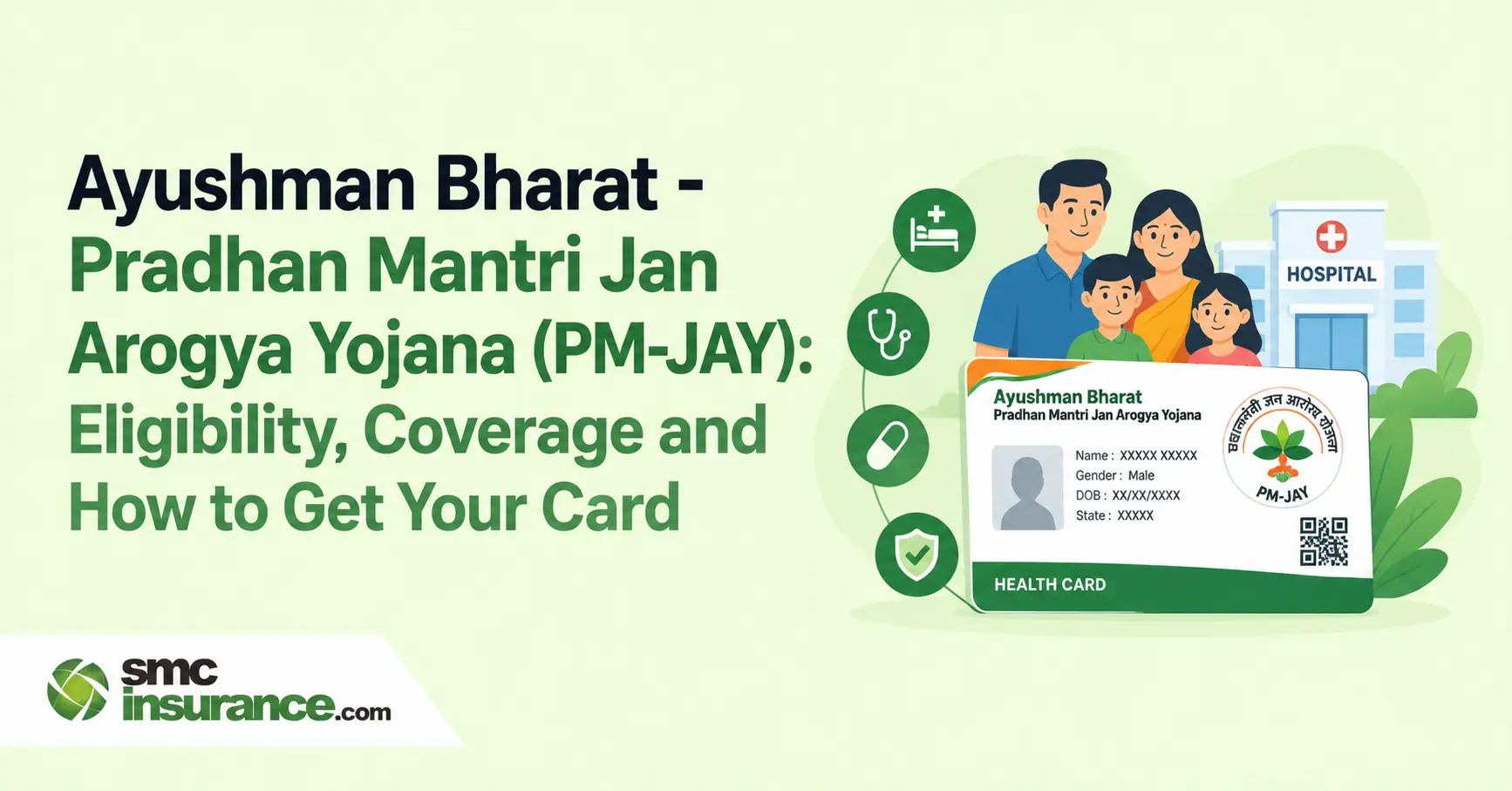
Ayushman Bharat PM-JAY provides eligible families with cashless health cover of up to Rs. 5 lakh per family per year for secondary and tertiary hospitalisation at empanelled public and private hospitals. The core beneficiary base is drawn from SECC 2011 criteria, with additional categories such as ASHAs, Anganwadi Workers and Anganwadi Helpers and their families also covered under subsequent expansions. Since October 2024, all Indian citizens aged 70 years and above are eligible irrespective of socio-economic status under Ayushman Vay Vandana. PM-JAY is now operational across all 36 States and Union Territories. Eligibility and enrolment can be checked through the official NHA beneficiary portal or Ayushman App. Check your status free at beneficiary.nha.gov.in or the Ayushman App and apply using Aadhaar e-KYC with no paperwork or fee involved.
Table of Contents
- What Is Ayushman Bharat PM-JAY?
- Key Features of Ayushman Bharat PM-JAY
- Who Is Eligible for Ayushman Bharat PM-JAY?
- What Benefits Are Covered Under PM-JAY?
- What Is Not Covered Under Ayushman Bharat PM-JAY?
- How to Check Ayushman Bharat PM-JAY Eligibility
- How to Apply and Get an Ayushman Card?
- How to Use an Ayushman Card at a Hospital
- How to Find an Ayushman Bharat Empanelled Hospital
- Is Ayushman Bharat PM-JAY Available Across India?
- Ayushman Bharat vs Private Health Insurance
- Ayushman Bharat PM-JAY vs Ayushman Bharat Digital Mission (ABDM)
- Common Problems With Ayushman Card or PM-JAY
- What to Do If an Empanelled Hospital Refuses Cashless Treatment
What Is Ayushman Bharat PM-JAY?
A medical emergency rarely waits for a good month. A hospitalisation bill of two or three lakh rupees can wipe out years of savings for a family that earns by the day and for millions of Indian households, that fear used to decide whether a relative even walked into a hospital. Ayushman Bharat Pradhan Mantri Jan Arogya Yojana, known simply as PM-JAY, was built to remove that fear.
Ayushman Bharat Pradhan Mantri Jan Arogya Yojana (AB PM-JAY), commonly known as PM-JAY, is a publicly funded health assurance scheme launched on 23 September 2018. It provides health cover of up to Rs. 5 lakh per family per year for secondary and tertiary care hospitalisation at empanelled public and private hospitals. The scheme's core beneficiary base covers around 12 crore economically vulnerable families, while subsequent expansions have added other beneficiary groups, including ASHA workers, Anganwadi Workers and Anganwadi Helpers and their families, as well as all citizens aged 70 years and above irrespective of socio-economic status. By the end of this article, you will know exactly who qualifies, what the card covers and does not and the precise steps to get one, verified against the National Health Authority's own records.
PM-JAY is the insurance arm of the Ayushman Bharat mission, launched by Prime Minister Narendra Modi on 23 September 2018 from Ranchi, Jharkhand. It sits alongside the scheme's other pillar, the network of Ayushman Arogya Mandirs (formerly Health and Wellness Centres) that handle primary care closer to home. PM-JAY itself focuses on the expensive part, secondary and tertiary hospitalisation and it replaced the older Rashtriya Swasthya Bima Yojana, which capped cover at just Rs 30,000 a family. PM-JAY raised that ceiling nearly seventeen times over.
The core PM-JAY beneficiary base covers around 12 crore economically vulnerable families. The government has subsequently expanded the scheme to include approximately 37 lakh families of ASHAs, Anganwadi Workers and Anganwadi Helpers, as well as all senior citizens aged 70 years and above irrespective of socio-economic status. States and Union Territories can also expand their beneficiary base by converging their own health assurance schemes with PM-JAY. It is entirely funded by the Central and State governments in a cost sharing arrangement, so beneficiaries never pay a premium. Nationwide portability is one of its more underrated features. A migrant worker from Bihar admitted in a Mumbai hospital can use the same card, with no separate registration needed in the new state.
Key Features of Ayushman Bharat PM-JAY
- Rs 5 lakh family floater cover that any member can use, jointly or individually, with no cap on family size or age.
- No premium, no enrollment fee. The scheme is entitlement based rather than purchased.
- Pre-existing diseases are covered from day one, unlike most private health policies that impose a waiting period.
- Cashless and paperless treatment at the point of care, across both government and empanelled private hospitals.
- Pre and post hospitalisation cover, including three days before admission and fifteen days after discharge for related diagnostics and medicines.
- Around 1,961 treatment packages spanning 27 medical specialities, from cardiology and oncology to orthopaedics and neonatal care.
- Nationwide portability, so treatment is not restricted to the beneficiary's home state.
Our advisors at SMC often meet customers who assume a government scheme this generous must involve a long list of conditions. In practice, once a family's name shows up in the beneficiary database, using the card at an empanelled hospital is closer to a formality than a negotiation.
Who Is Eligible for Ayushman Bharat PM-JAY?
Eligibility Under the Existing PM-JAY Beneficiary Framework
Eligibility for the general population is drawn from SECC 2011 data and it works differently for rural and urban households.
- Rural households qualify automatically if they fall under destitution, manual scavenging, or bonded labour categories, or if they meet at least one of these deprivation criteria: a single kucha room, no adult member aged 16 to 59, no adult male member in that age band, a disabled member with no able bodied adult in the house, belonging to an SC or ST household, or deriving most income from landless manual labour.
- Urban households are identified by occupation. Eleven worker categories qualify, including ragpickers, domestic workers, street vendors, construction labourers, sanitation workers, home based artisans, transport workers and small shop assistants, among others.
Some states also run their own beneficiary databases layered on top of SECC data, so it is worth checking your specific state's PM-JAY portal if the central eligibility check shows no match. There is no age limit or restriction on family size once a household qualifies.
PM-JAY Eligibility for Senior Citizens Aged 70 and Above
In September 2024, the Union Cabinet approved a significant expansion: every Indian citizen aged 70 and above now qualifies for PM-JAY, irrespective of income or SECC status, under a scheme called Ayushman Vay Vandana. Senior citizens belonging to a family already covered under PM-JAY get an additional Rs 5 lakh top up cover reserved just for themselves, separate from the family's existing pool. Those from families outside the SECC net get an individual Rs 5 lakh cover of their own and they enrol directly through the Ayushman App using Aadhaar e-KYC.
One catch worth flagging to elderly customers: seniors already enrolled in CGHS, ECHS or Ayushman CAPF have to choose between their existing scheme and PM-JAY. They cannot hold both simultaneously. Seniors with a private health policy, on the other hand, can keep it running alongside PM-JAY without any conflict, which is a detail our advisors get asked about fairly often when reviewing a retiree's existing cover.
What Benefits Are Covered Under PM-JAY?
The cover is comprehensive by design and it bundles nearly every cost tied to a hospitalisation into a single package rate, so there is no separate billing for individual items. Covered expenses include:
- Medical examination, consultation and treatment
- Pre-hospitalisation expenses for up to three days
- Medicines, consumables and implants where applicable
- Intensive and non-intensive care, including ICU charges
- Diagnostic and laboratory investigations
- Accommodation and food during the hospital stay
- Complications arising during treatment
- Post-hospitalisation follow up care for fifteen days after discharge
Because pricing is fixed by the National Health Authority through its Health Benefit Package list, a hospital cannot charge a PM-JAY patient more than the listed package rate for a covered procedure, which is one of the scheme's stronger consumer protections.
What Is Not Covered Under Ayushman Bharat PM-JAY?
PM-JAY is broad, but it is not unlimited. Based on the NHA's own exclusion policy, the following are generally kept out of the cover:
- Outpatient (OPD) consultations and stand-alone diagnostic tests done outside a hospital admission
- Cosmetic procedures, including anti-ageing treatments, tattoo removal and purely aesthetic surgery
- Fertility treatments and assisted reproduction, unless listed in the official package list
- Routine or cosmetic dental work, such as fillings or root canals, unless caused by trauma or a tumour needing hospitalisation
- Vaccination and immunisation
- Drug rehabilitation treatment
- Organ transplants, in most package configurations
The practical impact of this list is that PM-JAY works best for the medical emergencies it was designed around: surgeries, cancer care, cardiac procedures and serious illness requiring admission. It was never meant to substitute for a wellness or OPD-heavy health plan.
How to Check Ayushman Bharat PM-JAY Eligibility
Checking eligibility takes a few minutes and costs nothing.
- Visit beneficiary.nha.gov.in, the official NHA beneficiary portal, or download the Ayushman App from the Play Store.
- Log in with your mobile number and verify with the OTP sent to it. Any working number can be used to log in, it does not need to already be linked to the scheme.
- Select your state, district and the scheme (PM-JAY).
- Search using any one of these: Aadhaar number, ration card or family ID, PMJAY ID, or your name along with location details.
- If your family qualifies, the portal displays each member's name and card status: not generated, pending approval, or already approved.
If a name search shows nothing, try Aadhaar or ration card based search before assuming you are not covered, since a name match can sometimes miss records that other identifiers catch.
How to Apply and Get an Ayushman Card?
Documents Required for Ayushman Card
- Aadhaar card, mandatory for e-KYC, with a linked and working mobile number
- Ration card or family ID, to locate your household record
- A recent photograph, captured during the e-KYC step
- Proof of age for the 70+ Vay Vandana enrolment route
No income certificate and no fee are required for the standard online process.
How to Get an Ayushman Card Online?
- Log in at beneficiary.nha.gov.in or the Ayushman App as described above.
- Locate your family record and check the status against your name.
- Where the status reads "Identified" but "Card Not Generated," click the e-KYC option next to your name.
- Choose an authentication mode, Aadhaar OTP is the simplest, though fingerprint and face authentication are also available.
- Once e-KYC clears, download the card as a PDF, ready to use at any empanelled hospital.


How to Get an Ayushman Card Through an Offline Facility
Anyone who is not comfortable with the online steps can walk into the nearest Common Service Centre (CSC) or an empanelled hospital's Ayushman help desk, carrying Aadhaar and a ration card. The operator or hospital's Pradhan Mantri Arogya Mitra completes the search and e-KYC on your behalf and the card is issued the same way.
How Eligible Beneficiaries Can Get an Ayushman Card
For families already identified under SECC data, the process is essentially the eligibility check followed by e-KYC, there is no separate application form to fill or approval to wait on beyond the verification step itself.
How Senior Citizens Aged 70+ Can Enrol
Seniors follow the same portal or app, selecting the Vay Vandana enrolment option instead of the regular family search. Self registration is built into the flow and anyone who prefers assistance can get the card made at a CSC or an empanelled hospital instead.
Documents Checklist for Ayushman Card at a Glance
Document |
Purpose |
Mandatory? |
Aadhaar card | Identity verification and e-KYC | Yes |
Registered mobile number | OTP login and updates | Yes |
Ration card or family ID | Locating your household record in SECC data | Usually, for family search |
Recent photograph | Captured during e-KYC for the card | Yes |
Proof of age (for 70+ applicants) | Confirming eligibility under Vay Vandana | Yes, for senior citizen enrolment |
Note: Requirements can vary slightly by state, since some states supplement SECC data with their own beneficiary lists. Confirm document needs with your local CSC or the PM-JAY helpline before visiting in person.
How to Use an Ayushman Card at a Hospital
Having the card is only half the process, using it correctly at the hospital matters just as much. Start by confirming the hospital is currently empanelled under PM-JAY, since not every hospital that once participated stays on the list permanently. Carry your Aadhaar and the Ayushman card, physical or on your phone, along with any referral or prescription you already have. At the hospital, head straight to the PM-JAY or Ayushman help desk, usually staffed by a Pradhan Mantri Arogya Mitra whose entire job is to walk beneficiaries through this process.
The desk will run a fresh beneficiary verification or e-KYC if it has not already been done, matching your identity against the scheme's database. For most procedures, the hospital then raises a treatment or package authorisation request with the state health agency before admission and this pre-authorisation step is where a lot of the back office work happens, largely invisible to the patient. Once the applicable treatment is authorised, the empanelled hospital provides the covered treatment on a cashless basis under the relevant Health Benefit Package. The package is bundled and includes the applicable costs associated with the covered treatment. Beneficiaries may still have to pay for services or items that fall outside the approved package or scheme coverage. After discharge, the fifteen day post-hospitalisation benefit continues to apply for related follow-up care and medicines, so keep your discharge summary safe since some hospitals ask for it during that window.
How to Find an Ayushman Bharat Empanelled Hospital
The official hospital locator sits on the PM-JAY portal (pmjay.gov.in) under the "Find Hospital" tool, where you can filter by state, district and speciality. The Ayushman App carries the same locator, useful if you need to check options while already at a hospital or on the move. For anyone without smartphone access, the national helpline number 14555 can share the nearest empanelled hospitals for a given district over the phone, in multiple regional languages.
Is Ayushman Bharat PM-JAY Available Across India?
As of 2026, AB PM-JAY is operational across all 36 States and Union Territories. West Bengal became the 36th State/UT to implement the scheme on 8 June 2026 following the signing of an MoU between the National Health Authority and the Government of West Bengal. This completed pan-India implementation of AB PM-JAY. Beneficiaries can use the scheme's portability feature at empanelled hospitals across the country, subject to the applicable scheme and state arrangements.
Ayushman Bharat vs Private Health Insurance
PM-JAY and a private health insurance policy solve overlapping but different problems and understanding where PM-JAY stops is often more useful than knowing where it starts.
Aspect |
Ayushman Bharat PM-JAY |
Private Health Insurance |
Premium | No premium for eligible beneficiaries | Premium payable according to policy terms |
Sum insured | Rs. 5 lakh per eligible family per year, subject to applicable beneficiary category | Varies by policy |
Eligibility | Defined beneficiary categories, including SECC-based households and 70+ citizens | Depends on insurer/product eligibility |
Pre-existing diseases | Covered from day one under PM-JAY | Waiting period can apply, up to 36 months under current IRDAI rules |
Hospital network | Empanelled PM-JAY hospitals | Network depends on insurer and policy |
OPD/dental/wellness | Not generally part of the core PM-JAY hospitalisation benefit | Depends on policy and add-ons |
Portability | PM-JAY benefits are portable across empanelled hospitals nationally | Health insurance portability is governed by IRDAI rules and insurer/product terms |
Note: Sum insured and waiting period terms for private policies vary by insurer and plan; always check the specific policy wording before comparing.
A pattern our advisors see often: a family covered under PM-JAY still comes in asking about a private top up policy, usually after a hospitalisation that came close to exhausting the Rs 5 lakh limit, or because the nearest empanelled hospital for a specific speciality was further away than they would have liked. PM-JAY is a strong floor, not necessarily a ceiling and for many households the two work best together rather than as substitutes.
If your family's PM-JAY cover feels tight against rising treatment costs, or if you simply want OPD and wellness benefits it does not include, SMC Insurance can help you compare affordable top up and individual health plans that work alongside your existing government cover.
Ayushman Bharat PM-JAY vs Ayushman Bharat Digital Mission (ABDM)
These two get confused often enough that it deserves its own section. PM-JAY is the insurance scheme, the Rs 5 lakh hospitalisation cover discussed throughout this article. ABDM, launched in September 2021, is something else entirely: a digital health infrastructure project that gives every citizen an ABHA ID, a 14-digit health account number that links and stores medical records like prescriptions and discharge summaries across hospitals, with the citizen's consent controlling who can access them.
You do not need an ABHA ID to use your Ayushman card, the two systems are not mandatorily linked as of now. ABDM is a digital health infrastructure initiative, while PM-JAY is a publicly funded health assurance scheme. ABHA can be used to link and view health records across participating healthcare facilities, with consent management built into the digital health ecosystem. An ABHA ID is not the same as an Ayushman card, and having one does not by itself establish eligibility for PM-JAY. Think of PM-JAY as the wallet that pays your hospital bill.
Common Problems With Ayushman Card or PM-JAY
A few recurring issues show up often enough to flag in advance:
- Name not found during search: Try every search method (Aadhaar, ration card, family ID, name plus location) before assuming ineligibility, since one identifier sometimes fails to match where another succeeds.
- e-KYC failures: Mismatched Aadhaar details, an unlinked mobile number, or a poor biometric scan are the usual causes and visiting a CSC to correct Aadhaar records first often resolves this.
- Hospital says it is not empanelled: When it is not empanelled, despite appearing on an outdated list somewhere online. Always verify current empanelment on the official portal or by calling 14555, since hospital participation does change over time.
- Package or pre-authorisation delays: Some procedures need prior approval from the state health agency, which can take time; asking the hospital's PMJAY desk for a status update usually clarifies where things stand.
- Confusion between PM-JAY and state top up schemes: In states like Delhi that run additional cover on top of the central scheme, leading to unclear claim limits.
What to Do If an Empanelled Hospital Refuses Cashless Treatment
This is one of the more stressful situations a beneficiary can face, so it helps to have a clear, calm sequence of steps rather than an argument at the admission desk.
- Ask for the specific reason for refusal, in writing if possible. Hospitals sometimes cite package limits, documentation gaps, or a claim that the treatment falls outside the covered list and knowing the exact reason tells you which step to take next.
- Confirm the hospital's current empanelment status yourself, through the PM-JAY portal or by calling 14555, rather than relying only on what the hospital staff tells you.
- Contact the PM-JAY grievance mechanism immediately. The national helpline (14555 or 1800 111 565) is available 24x7 and grievances can also be filed online through the official portal at cgrms.pmjay.gov.in. A three-tier committee structure, at the national, state and district level, is required to act on any grievance within 30 days.
- Keep all relevant documents ready, including your Ayushman card, Aadhaar, any prescription or referral and a written note of what the hospital told you and when.
- If the issue is genuinely eligibility or package related, rather than a hospital simply declining service, the grievance process can still help clarify your status or escalate a legitimate denial for review.
The National Health Authority's own guidelines are unambiguous on this point: an empanelled hospital is not permitted to deny cashless services to an eligible PM-JAY beneficiary for a covered procedure. If you believe that is happening to you or someone you are helping, do not hesitate to call the helpline on the spot, the grievance system exists precisely for moments like this.
Summing Up
Ayushman Bharat PM-JAY provides eligible beneficiaries with cashless secondary and tertiary hospitalisation cover of up to Rs. 5 lakh per family per year at empanelled hospitals. Its beneficiary base has expanded beyond the original SECC 2011 framework, including coverage for certain additional worker categories and all citizens aged 70 years and above irrespective of socio-economic status. As of 2026, the scheme is operational across all 36 States and Union Territories. Eligibility, enrolment and hospital empanelment should be checked through the current NHA systems because beneficiary categories and state-level arrangements can change. And if PM-JAY leaves a gap for your household, whether that is OPD care, a higher sum insured, or treatment outside the empanelled network, pairing it with the right private health plan is usually the simplest way to close it.
Disclaimer: The information provided on this platform is intended for general awareness and educational purposes. While every effort is made to ensure accuracy, some details may change with policy updates, regulatory revisions, or insurer-specific modifications. Readers should verify current terms and conditions directly with relevant insurers or through professional consultation before making any decision.
All views and analyses presented are based on publicly available data, internal research and other sources considered reliable at the time of writing. These do not constitute professional advice, recommendations, or guarantees of any product’s performance. Readers are encouraged to assess the information independently and seek qualified guidance suited to their individual requirements. Customers are advised to review official sales brochures, policy documents and disclosures before proceeding with any purchase or commitment.
FAQs
Eligibility under the core PM-JAY framework is based on defined beneficiary categories, primarily derived from SECC 2011 data. The scheme has also been expanded to include approximately 37 lakh families of ASHAs, Anganwadi Workers and Anganwadi Helpers and their families. In addition, every Indian citizen aged 70 years and above is eligible irrespective of socio-economic status under Ayushman Vay Vandana. States and Union Territories may also expand coverage through their own converged schemes.
PM-JAY offers a family floater cover of Rs 5 lakh per year, usable by one or all family members together, for secondary and tertiary hospitalisation at empanelled hospitals.
Eligible beneficiaries do not pay a premium for PM-JAY coverage. For the 70+ senior citizen enrolment route, NHA states that Aadhaar is the only document required for enrolment and Aadhaar-based e-KYC is mandatory. Document requirements for other beneficiary categories can vary according to the applicable enrolment process.
Yes, senior citizens aged 70 years and above who already have private health insurance or are covered under the Employees' State Insurance scheme can still avail PM-JAY. Those already covered under certain government health schemes such as CGHS, ECHS or Ayushman CAPF can choose between their existing scheme and AB PM-JAY.
Yes, from the very first day of enrolment, which is a meaningful advantage over most private health insurance policies that impose a waiting period of two to four years.
As of 2026, yes. West Bengal's rollout in August 2026 completed nationwide coverage, following Delhi's implementation in April 2025.
Try all available search options (Aadhaar, ration card, family ID, name and location) on beneficiary.nha.gov.in and if nothing matches, contact your local CSC or the 14555 helpline to check whether your state uses a supplementary database.
PM-JAY does not automatically extend beyond Rs 5 lakh a year. Families who want a larger safety net often add an individual or top up private health insurance plan alongside their PM-JAY cover for that reason.


