


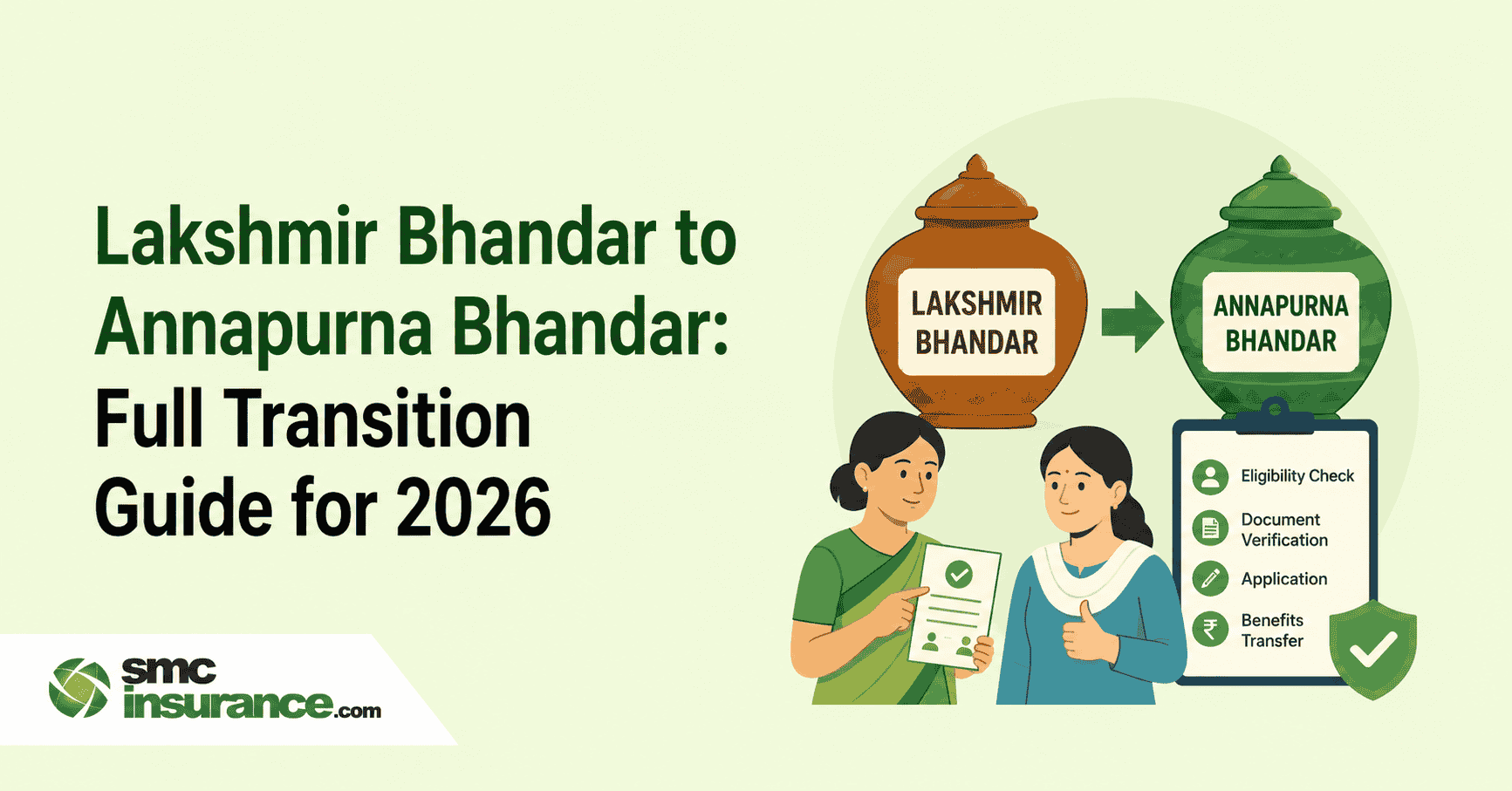
Annapurna Bhandar replaces Lakshmir Bhandar in West Bengal, raising the monthly payment to a flat Rs. 3,000 for eligible women aged 25 to 60. Around 1.3 crore verified beneficiaries have been found eligible under Annapurna Yojana and are being migrated or enrolled after verification. Existing Lakshmir Bhandar beneficiaries who satisfy the revised eligibility criteria generally do not need to submit a fresh application unless they are flagged during verification. New applicants have until 25 August 2026 to apply, either online at socialsecurity.wb.gov.in or offline at their local block or municipal office. Income taxpayers, government employees and pensioners remain ineligible under both schemes.
If you or someone in your family has been receiving money under Lakshmir Bhandar every month, that payment now carries a new name and a bigger number attached to it. The Annapurna Bhandar scheme has replaced Lakshmir Bhandar in West Bengal and the monthly financial assistance under Lakshmir Bhandar has been replaced by a uniform Rs. 3,000 monthly benefit under Annapurna Yojana for eligible women. That is a real change to a household's monthly budget and it comes with new eligibility rules, a fresh verification drive and a bank account check that not everyone will pass automatically. By the end of this guide, you will know exactly where you stand, what you need to do before 25 August 2026 and how to confirm your money is actually reaching your account.
- What Is Changing: Lakshmir Bhandar to Annapurna Bhandar, Explained
- Why the Scheme Was Replaced, Not Just Renamed
- Annapurna Bhandar Eligibility Criteria
- Lakshmir Bhandar vs Annapurna Bhandar: What Actually Changed
- Will Existing Lakshmir Bhandar Beneficiaries Be Migrated Automatically?
- Documents Required for New Applicants
- How to Apply: Step-by-Step
- How to Check If Your Bank Account Is Correctly Linked to Aadhaar
- Checking Your Application or Payment Status
- Key Dates for the Annapurna Bhandar Transition
- What This Means for Household Budgeting
What Is Changing: Lakshmir Bhandar to Annapurna Bhandar, Explained
West Bengal's new government, led by Chief Minister Suvendu Adhikari after the BJP's landslide win in the 2026 assembly election, approved the Annapurna Bhandar scheme at its very first cabinet meeting on 11 May 2026. An official notification followed on 19 May 2026 from the Department of Women & Child Development and Social Welfare and the scheme went live from 1 June 2026, with a formal launch at Nabanna on 3 June. The first round of payments, Rs. 3,000 each, reached more than 28 lakh women's bank accounts that same day.
Annapurna Bhandar was earlier floated during the election campaign under the name Matri Shakti Bharosa Scheme, part of the BJP's "Bhoroshar Shopoth" manifesto promises. Once the party formed the government, that campaign promise turned into an actual welfare programme with a notification number, a nodal department and a disbursement schedule. Lakshmir Bhandar, launched by the previous Trinamool Congress government in August 2021, continues to run in parallel only until the migration of existing beneficiaries is complete.
Why the Scheme Was Replaced, Not Just Renamed
Lakshmir Bhandar paid women differently depending on caste category, with general category women getting a lower amount than SC/ST beneficiaries. Annapurna Bhandar removes that distinction entirely and pays every eligible woman the same Rs. 3,000, regardless of social category. The new government has also built in a much stricter verification layer, tying eligibility to the Special Intensive Revision of electoral rolls that ran through late 2025 and early 2026, Aadhaar-linked bank validation and a fresh family-level data collection exercise.
This is worth sitting with for a moment. A scheme that once relied largely on self-declared applications now runs through voter roll checks, income tax records and bank seeding status before a single rupee moves. That is a meaningfully different administrative machine, even though the end result, money in a woman's account, looks similar on the surface.
Annapurna Bhandar Eligibility Criteria
To qualify for the Rs. 3,000 monthly benefit, an applicant must meet all of the following conditions:
- Be a woman and a permanent resident of West Bengal
- Fall between 25 and 60 years of age
- Hold an Aadhaar-linked bank account in her own name for receiving the Direct Benefit Transfer
Who Cannot Receive Annapurna Bhandar Benefits?
The government has also listed clear exclusions and applying despite falling into one of these categories will only
delay or reject your application:
- Income taxpayers who file an ITR
- Permanent or retired government employees drawing a regular salary or pension from central government, state government, panchayats, municipalities, or statutory bodies
- Teaching or non-teaching staff at government-aided educational institutions in West Bengal
- Voters marked dead, shifted, deleted, or absentee during the SIR 2026 exercise, unless their case is still pending adjudication before a tribunal
Lakshmir Bhandar vs Annapurna Bhandar: What Actually Changed
|
Particulars |
Lakshmir Bhandar |
Annapurna Bhandar |
|
Monthly amount |
Rs. 1,000–Rs. 1,700 depending on category (reports vary slightly on exact slabs) |
Flat Rs. 3,000 for all eligible women |
|
Category-based payout |
Yes, general and SC/ST women received different amounts |
No, uniform amount regardless of category |
|
Age eligibility |
25–60 years |
25–60 years |
|
Verification |
Largely self-declared at enrolment |
Aadhaar-bank seeding, electoral roll screening, family data collection |
|
Transfer mode |
Direct Benefit Transfer |
Direct Benefit Transfer |
|
Additional benefit |
None |
Free travel for women on state-run buses from 1 June 2026 |
|
Status as of mid-2026 |
Being phased out, existing beneficiaries migrating |
Active, first payments credited 3 June 2026 |
Note: Figures for Lakshmir Bhandar's exact payout slabs differ slightly across public sources; the range above reflects the most commonly reported figures. Always confirm your specific slab through the official portal before making financial decisions based on it.
A short segue before the next part: knowing the numbers is one thing, but knowing whether you personally get migrated automatically is the question that actually matters to most existing beneficiaries.
Will Existing Lakshmir Bhandar Beneficiaries Be Migrated Automatically?
Yes, mostly. After verification, the government announced that about 1.3 crore women were found eligible, while approximately 26 lakh applications were rejected during the scrutiny process. Eligible Lakshmir Bhandar beneficiaries are being migrated without submitting a fresh application in most cases.
If you fall outside the excluded categories listed earlier, you do not need to reapply. Your Lakshmir Bhandar payment continues until the migration to Annapurna Bhandar is fully processed for your account, at which point the amount steps up to Rs. 3,000.
Documents Required for New Applicants
Women who were not previously enrolled under Lakshmir Bhandar and want to apply fresh will need:
- Aadhaar card
- Voter ID card
- Residence proof
- Bank passbook or account statement showing an Aadhaar-linked account
- Passport-size photographs
How to Apply: Step-by-Step
The application window runs for 90 days, from 27 May to 25 August 2026 and both online and offline routes are open.
Offline (currently active):
Step 1: Visit your nearest Block Development Office, municipal office, or a Janakalyan Shibir camp (these run across the state from 15 to 17 June 2026 and further camps may follow).
Step 2: Collect the application form in English, Bengali, or Hindi, or download it from the official portal.
Step 3: Fill in family identity details, ration card information, income and profession details and bank account particulars.
Step 4: Submit the form with self-attested documents and collect your acknowledgement receipt.
Online:
Step 1: Visit the official Social Security portal at socialsecurity.wb.gov.in, managed by the Department of Women & Child Development and Social Welfare, Government of West Bengal.
Step 2: Register or log in using your mobile number and OTP.
Step 3: Complete the application form and upload scanned documents.
Step 4: Submit and note down your application reference number for tracking.
Something we at SMC keep hearing from families in West Bengal who call us about unrelated bank or KYC issues is how many of them are unsure whether their Aadhaar is actually seeded to the account they think it is. That single mismatch is the most common reason a DBT payment fails and it is worth sorting out before you assume your migration has gone through cleanly.
Once you have applied or confirmed migration, the next real cost to think about is what happens if the money simply does not land and that comes down almost entirely to your Aadhaar-bank seeding status.
If your family also relies on West Bengal's state health cover alongside this cash benefit, it helps to understand how the West Bengal Health Scheme fits into your overall support system, since the two are managed by different departments but often affect the same households.
We can help you make sense of how a scheme like this fits into your broader household finances. Talk to an SMC advisor about organising your family's savings, insurance and government benefits so nothing falls through the cracks.
How to Check If Your Bank Account Is Correctly Linked to Aadhaar
DBT payments under Annapurna Bhandar go only to the bank account currently seeded with your Aadhaar number, not necessarily the account you last used for Lakshmir Bhandar if you have since switched banks.
Step 1: Go to the official NPCI website.
Step 2: Under the Customer section, select Bharat Aadhaar Seeding Enabler (BASE).
Step 3: Click Aadhaar Mapped Status, enter your Aadhaar number and the captcha and verify with the OTP sent to your registered mobile number.
Step 4: The screen will show the bank currently linked to your Aadhaar for DBT purposes.
If the account shown is wrong, closed, or inactive, you can update it through the same BASE portal under Aadhaar Seeding/Deseeding, choosing fresh seeding, a move within the same bank, or a move to a new bank altogether. You will need your new account number, an OTP confirmation and a few minutes of patience, since the update does not always reflect instantly.
Checking Your Application or Payment Status
You can track where your application stands through either official platform:
- Online: Visit socialsecurity.wb.gov.in, log in with your mobile number and OTP and use the Track Application Status option to check by application ID, Aadhaar number, or registered mobile number.
- Offline: Visit your local block or municipal office with your acknowledgement receipt.
The beneficiary list itself is published at block, panchayat and booth level and it gets refreshed roughly every seven days as more verifications clear. If you believe you were wrongly left off the list, you can raise an objection at your local office and eligible women who were missed the first time around can still reapply within the 90-day window.
Key Dates for the Annapurna Bhandar Transition
|
Event |
Date |
|
First cabinet meeting, scheme approved |
11 May 2026 |
|
Official government notification issued |
19 May 2026 |
|
Application forms released (offline) |
27 May 2026 |
|
Scheme officially effective |
1 June 2026 |
|
Formal launch and first DBT credited |
3 June 2026 |
|
Janakalyan Shibir camps for form submission |
15–17 June 2026 |
|
Application window closes |
25 August 2026 |
Note: Dates reflect the government's announced schedule as of mid-2026. Camp schedules and portal availability can shift, so check the official portal close to any deadline that affects you.
What This Means for Household Budgeting
An extra Rs. 1,300 to Rs. 2,000 a month, on top of what a family was already receiving, is not a small shift for households running tight monthly budgets. Some women will use it for groceries and school fees, others for medical costs that keep creeping up. If you are the one managing the household accounts and this increase gives you a bit of breathing room, it is also a reasonable moment to look at whether that extra amount could work harder for you through a simple, low-risk savings option like the Post Office Monthly Income Scheme , rather than letting it sit idle in the account it lands in.
Women outside West Bengal who are pregnant or nursing and looking for a comparable central government cash benefit may also want to look at the Pradhan Mantri Matru Vandana Yojana, which runs on a similar direct transfer model but is tied to childbirth rather than a flat monthly welfare payout.
Summing Up
Lakshmir Bhandar has not vanished overnight. It is being wound down carefully while Annapurna Bhandar takes over and most existing beneficiaries will see their payment simply increase without lifting a finger. The people who do need to act are new applicants who were never enrolled before, anyone whose Aadhaar seeding is out of date and anyone flagged during the SIR 2026 verification who still has a pending case to resolve.
Lakshmir Bhandar has not vanished overnight. It is being wound down carefully while Annapurna Bhandar takes over and most existing beneficiaries will see their payment simply increase without lifting a finger. The people who do need to act are new applicants who were never enrolled before, anyone whose Aadhaar seeding is out of date and anyone flagged during the SIR 2026 verification who still has a pending case to resolve. Given the 25 August 2026 deadline, the sensible move is to check your Aadhaar-bank link now, confirm your name on the beneficiary list at your local office and keep your acknowledgement receipt safe until the Rs. 3,000 actually shows up in your account.
Disclaimer: The information provided on this platform is intended for general awareness and educational purposes. While every effort is made to ensure accuracy, some details may change with policy updates, regulatory revisions, or government-specific modifications. Readers should verify current terms and conditions directly with relevant government departments or through professional consultation before making any decision.
All views and analyses presented are based on publicly available data, internal research and other sources considered reliable at the time of writing. These do not constitute professional advice, recommendations, or guarantees of any scheme's continuation. Readers are encouraged to assess the information independently and seek qualified guidance suited to their individual requirements. Applicants are advised to review official notifications and portal disclosures before proceeding with any application or commitment.
FAQs
Not yet. Lakshmir Bhandar continues to run for existing beneficiaries until their migration to Annapurna Bhandar is fully processed. The government has said no woman will see a gap in payments during this transition, though the amount only rises to Rs. 3,000 once the migration for that specific account is complete.
No, in most cases. Around 2 crore of the 2.20 crore existing beneficiaries are being auto-migrated without a fresh application. You only need to apply again if you were flagged during verification, marked as an absentee or duplicate elector, or previously excluded for another reason.
The scheme covers women between 25 and 60 years of age, the same bracket that applied under Lakshmir Bhandar. Women outside this age range are not eligible under either scheme.
No, women who file an income tax return are explicitly excluded from Annapurna Bhandar, along with permanent or retired government employees and staff at government-aided educational institutions.
Check your Aadhaar-bank seeding status through the NPCI BASE portal. If the account shown is inactive, closed, or different from what you expected, update it through the same portal's seeding option before the next payment cycle.
No, the only official portal for this scheme is socialsecurity.wb.gov.in, run by the Department of Women & Child Development and Social Welfare, Government of West Bengal. Be cautious of similarly named private websites and never share your Aadhaar OTP with anyone claiming to process your application over the phone.
No, they are entirely different programmes. Rajasthan's Annapurna Bhandar, launched in 2015, is a public-private partnership that subsidises daily essentials at fair price shops. West Bengal's Annapurna Bhandar is a direct monthly cash transfer to women.


