


You get a contractor's bill for Rs 45,000 and you are not sure whether to cut 1% or 2% before you pay. Your landlord asks why this year's rent credit is higher than last year's. Your bank sends an SMS about interest being paid "after TDS," and you have no idea what threshold triggered it. This is what happens when TDS rules change mid-year and nobody sends out a memo. For FY 2026-27, referred to as Tax Year 2026-27 under the Income-tax Act, 2025, the TDS framework continues to use broadly the same rates and monetary thresholds, but the statutory framework has been reorganised. From 1 April 2026, TDS provisions that were earlier spread across sections such as 192 to 194T of the Income-tax Act, 1961 are consolidated primarily under sections 392 and 393 of the Income-tax Act, 2025. The Income Tax Department has clarified that the change is largely structural and does not by itself alter the applicable TDS rates or thresholds. This guide walks through the TDS rates chart FY 2025-26 section by section, tells you exactly which numbers moved and gives you a downloadable-style reference you can act on the same day you read it.
Table of Contents
- What Changed for TDS From 1 April 2026?
- What Is TDS and Why the FY 2025-26 Chart Looks Different This Year
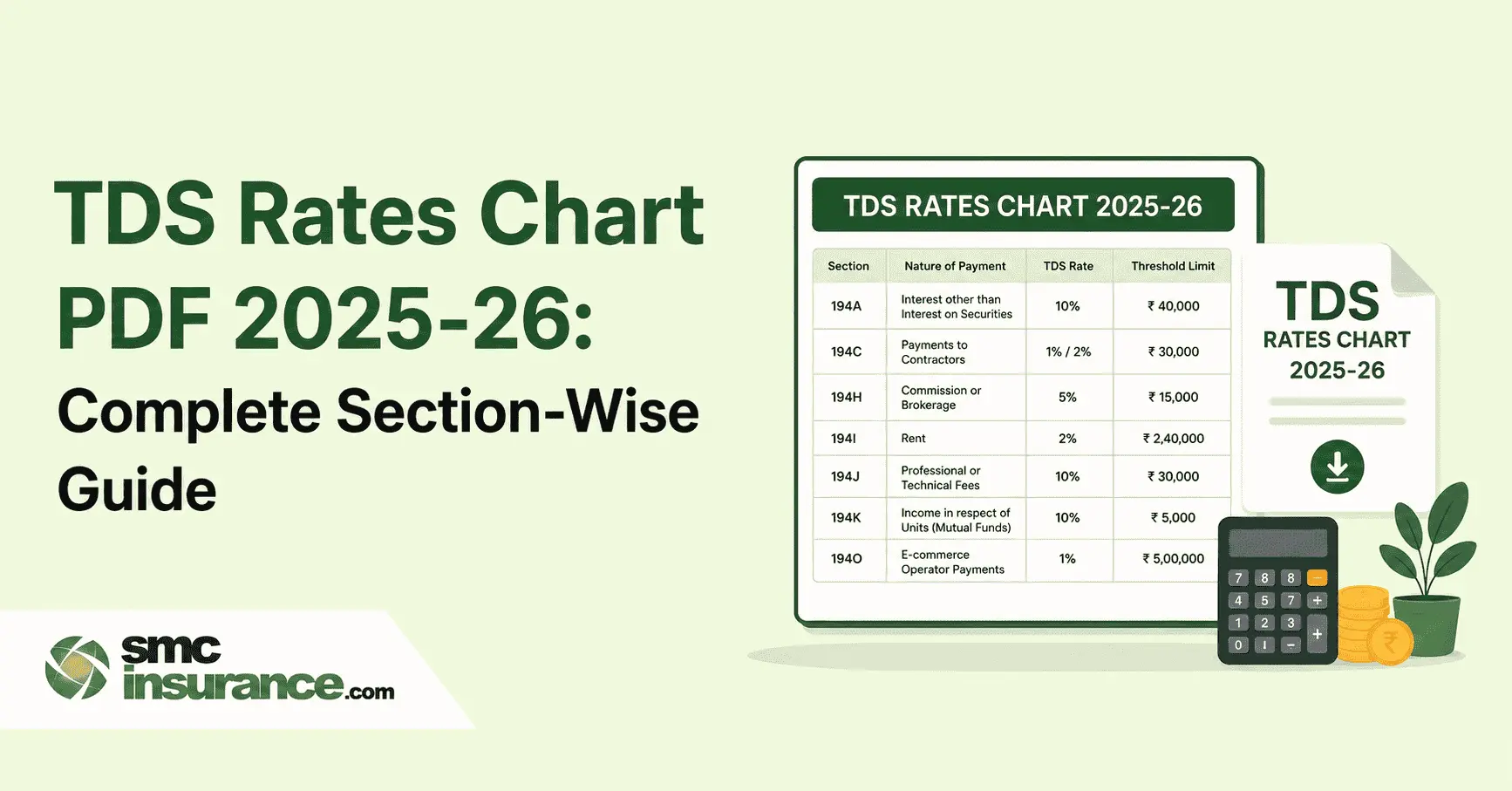
- TDS Rate Chart FY 2025-26 (AY 2026-27) at a Glance
- Section 192: TDS on Salary
- Section 192A: TDS on EPF Withdrawal
- Section 194A: TDS on Interest Income
- Section 194C: TDS on Contractor Payments
- Section 194H: TDS on Commission or Brokerage
- Section 194-I and 194-IB: TDS on Rent
- Section 194J: TDS on Professional and Technical Services
- Section 194-IA: TDS on Purchase of Immovable Property
- Section 194Q: TDS on Purchase of Goods
- Section 194S: TDS on Virtual Digital Assets
- Section 195: TDS on Payments to Non-Residents
- TDS Due Dates and Compliance Calendar for FY 2025-26
- What Happens If PAN Is Not Provided? (Section 206AA)
- Key Changes in TDS Rules for FY 2025-26
- TDS Rates FY 2025-26 vs FY 2024-25
What Changed for TDS From 1 April 2026?
The Income-tax Act, 2025 applies to TDS obligations arising from 1 April 2026. For payments or credits where the earliest of payment or credit occurred on or before 31 March 2026, the Income-tax Act, 1961 continues to govern the TDS obligation. For payments or credits from 1 April 2026 onwards, the corresponding provisions of the Income-tax Act, 2025 apply.
The Income Tax Department has clarified that the new Act does not make a broad policy change to TDS rates or monetary thresholds. Instead, the provisions have been consolidated and presented in a simplified format. For example, salary TDS is now covered under Section 392, while TDS on many other payments is consolidated under Section 393.
This distinction matters when filing TDS statements. From 1 April 2026, deductors should use the relevant provision under the new Act rather than continuing to quote old section numbers such as 194C or 194J for new transactions.
What Is TDS and Why the FY 2025-26 Chart Looks Different This Year
Tax Deducted at Source is the government's way of collecting tax in installments rather than waiting for you to file a return and pay everything at once. Whoever pays you, an employer, a bank, a tenant, a client, cuts a fixed percentage before the money reaches you and deposits that amount with the Income Tax Department against your PAN. You can claim credit for it later while filing your ITR.
Your total TDS for the year eventually gets reconciled against your final tax liability once you know which income tax slab for FY 2025-26 you fall into. For FY 2025-26 (AY 2026-27), the TDS mechanism itself hasn't changed, but a good number of the entry points have. Budget 2025 raised the threshold at which TDS kicks in in several places, salary, professional fees, rent and bank interest among them, so smaller transactions that used to attract deduction now escape it. That is genuinely useful for salaried people, freelancers, senior citizens and small landlords, but it also means the TDS rates chart for FY 2025-26 needs a fresh read rather than a copy-paste from last year. Employers, businesses and professionals responsible for deducting tax should always cross-check the applicable section and threshold against the current Income Tax Department notifications before deducting, since a wrongly applied rate creates compliance headaches for both sides.
TDS Rate Chart FY 2025-26 (AY 2026-27) at a Glance
Here is the master table covering the sections you are most likely to run into, along with the threshold that decides whether TDS applies at all.
Section |
Nature of Payment |
TDS Threshold for FY 2025-26 |
TDS Rate |
192 | Salary | Taxable salary exceeding the applicable exemption limit | As per applicable income-tax slab rates |
192A | Taxable premature withdrawal of accumulated EPF balance | Rs. 50,000 | 10% |
193 | Interest on securities | Rs. 10,000 in specified cases | 10% |
194 | Dividend paid by a domestic company | Rs. 10,000 | 10% |
194A | Interest other than interest on securities, including bank/post office/co-operative bank interest | Rs. 50,000 for others, Rs. 1,00,000 for senior citizens; Rs. 10,000 in other specified cases | 10% |
194B | Lottery, crossword puzzles, card games, gambling, betting and other specified winnings | Rs. 10,000 per single transaction | 30% |
194BA | Net winnings from online games | No minimum threshold | 30% |
194BB | Winnings from horse races | Rs. 10,000 | 30% |
194C | Payments to contractors/sub-contractors | Rs. 30,000 for a single payment or Rs. 1,00,000 in aggregate during the financial year | 1% for individual/HUF payee; 2% for other payees |
194D | Insurance commission | Rs. 20,000 | 2% |
194DA | Taxable sum paid under a life insurance policy | Rs. 1,00,000 | 2% |
194G | Commission on sale of lottery tickets | Rs. 20,000 | 2% |
194H | Commission or brokerage | Rs. 20,000 | 2% |
194-I | Rent of land, building, furniture or fittings | Rs. 50,000 per month or part of a month | 10% |
194-I | Rent of plant, machinery or equipment | Rs. 50,000 per month or part of a month | 2% |
194-IA | Purchase/transfer of immovable property other than agricultural land | Rs. 50 lakh | 1% |
194-IB | Rent paid by an individual/HUF not liable to tax audit | Rs. 50,000 per month or part of a month | 2% |
194J | Professional services | Rs. 50,000 | 10% |
194J | Technical services, call centre services and specified film royalty | Rs. 50,000 | 2% |
194Q | Purchase of goods by specified buyers | Rs. 50 lakh | 0.1% on amount exceeding Rs. 50 lakh |
194S | Transfer of Virtual Digital Assets | Rs. 50,000 for specified persons; Rs. 10,000 for other persons | 1% |
194T | Salary, remuneration, commission, bonus or interest paid to a partner by a firm | Rs. 20,000 in aggregate during the financial year | 10% |
195 | Certain payments to non-residents | No single threshold | Depends on nature of income and applicable provisions/DTAA |
Note: These figures apply to resident payees with a valid PAN under the Income Tax Act, 1961, for FY 2025-26. Non-resident payments, surcharge and cess follow separate rules and the exact threshold or condition attached to each section should always be checked before you deduct, since a single missed proviso can change the number.
Section 192: TDS on Salary
TDS on salary is not a flat percentage the way most other sections are. Your employer estimates your total taxable income for the year, factors in the tax regime you have chosen, applies eligible deductions and exemptions and then spreads the resulting tax liability across your monthly pay cheques. That is why two people earning the same CTC can see very different TDS on their payslips depending on whether they picked the old regime with HRA and 80C claims or the new regime with fewer deductions but lower slab rates.
Employers are expected to collect your investment declarations early in the year and revise the estimate if your income or investments change mid-year. If you switch jobs, remember to hand your new employer Form 12B so the combined salary is taxed correctly instead of both employers applying the basic exemption limit separately.
Section 192A: TDS on EPF Withdrawal
If you withdraw your Employee Provident Fund balance before completing five years of continuous service and the amount exceeds Rs 50,000, the EPFO deducts 10% TDS provided your PAN is linked. Skip the PAN and that rate jumps sharply. Withdrawals below Rs 50,000 escape TDS altogether and so does any withdrawal triggered by ill health, the employer shutting down, or reasons genuinely outside your control.
If your total income for the year stays below the taxable limit, you can submit Form 15G, or Form 15H if you are a senior citizen, to avoid this deduction in the first place rather than claiming a refund later. For the full withdrawal process and the exemptions that apply beyond the TDS angle, see our detailed EPF withdrawal rules guide.
Section 194A: TDS on Interest Income
This is the section that touches almost every fixed deposit holder and senior citizen in the country, which is exactly why Budget 2025 revised it. The general threshold on bank and post office interest moved up from Rs 40,000 to Rs 50,000 and the senior citizen threshold jumped from Rs 50,000 to a full Rs 1,00,000. For interest covered by Section 194A where the payer is other than a bank, cooperative bank or post office, the threshold is Rs 10,000 for the financial year.
The rate itself stays at 10% once you cross the threshold and 20% if you have not furnished your PAN. If your total annual income is below the taxable slab, Form 15G (for those under 60) or Form 15H (for senior citizens) submitted at the start of the year stops the bank from deducting anything in the first place, which is cleaner than waiting to claim a refund at ITR time.
Section 194C: TDS on Contractor Payments
Anyone hiring a contractor, be it for civil work, transport, catering or annual maintenance, needs to track two separate thresholds here. A single payment exceeding Rs 30,000 attracts TDS and so does the aggregate of several smaller payments to the same contractor once the total for the year crosses Rs 1,00,000, even if no individual payment breached Rs 30,000 on its own.
The rate depends on who you are paying. Contracts with an individual or a Hindu Undivided Family attract 1%, while payments to a partnership firm, company or any other entity attract 2%. A typical example: a small business pays a local transporter Rs 25,000 in April and another Rs 28,000 in July. Neither payment alone crosses Rs 30,000, but the running total of Rs 53,000 is still below Rs 1,00,000, so no TDS applies yet. Once cumulative payments to that transporter for the year cross Rs 1,00,000, TDS becomes payable and typically on the full aggregate, not just the excess.
Section 194H: TDS on Commission or Brokerage
Commission paid to agents, distributors or brokers attracts 2% TDS once the payment to a single payee crosses Rs 20,000 in the financial year. This covers a wide net, including real estate brokerage, sales commission and referral fees, but it excludes insurance commission, which sits separately under Section 194D and brokerage on securities transactions handled through a stock exchange.
We often see agents and small distributors surprised by this one because commission tends to arrive in irregular installments through the year rather than as one lump sum and it is easy to lose track of the running total until the payer's accounts team flags it.
Section 194-I and 194-IB: TDS on Rent
Rent is where FY 2025-26 brought the single biggest relief for ordinary taxpayers. For Tax Year 2026-27, TDS on rent is generally triggered when rent exceeds Rs. 50,000 for a month or part of a month. For specified persons, the rate is 2% for machinery, plant or equipment and 10% for land, buildings, furniture or fittings. Rent paid by a person other than a specified person is subject to 2% TDS once the Rs 50,000 monthly threshold is crossed. Below that, no TDS applies at all.
If you are an individual or HUF tenant not subject to tax audit, Section 194-IB applies instead and here the rate itself was cut from 5% to 2% and the Rs 50,000-a-month threshold continues. So a salaried professional renting a flat for Rs 55,000 a month now deducts 2% just once a year, at the time of the last rent payment or when the tenancy ends and deposits it using Form 26QC rather than obtaining a TAN. A surprising number of tenants paying Rs 60,000 to Rs 80,000 a month in metro cities are still unaware this obligation exists and the liability rests with the tenant, not the landlord.
Note: The table above and the section notes reflect the rates and thresholds notified under the Income Tax Act, 1961 for FY 2025-26 as amended by the Finance Act, 2025. Always verify the applicable rate against the current TRACES or Income Tax Department notification before deducting, since conditions such as PAN availability, deductee category and payment purpose can change the outcome.
Getting these numbers wrong, whether on a rent deduction, a life insurance payout, or a contractor bill, tends to surface at the worst possible time, usually when you are filing your return or settling a claim. If your finances involve insurance payouts, commission income or a mix of taxable investments, it helps to have someone check the full picture rather than treating each TDS line item in isolation. That is a conversation you can start anytime with a quick chat with SMC Insurance.
Section 194J: TDS on Professional and Technical Services
Section 194J covers fees paid to doctors, chartered accountants, lawyers, engineers, architects and consultants for professional services and it covers technical services, call centre payments and royalty on the distribution of cinematographic films under a separate rate. Budget 2025 raised the threshold from Rs 30,000 to Rs 50,000, which means a company paying its CA firm Rs 45,000 for the year no longer needs to deduct anything, where it would have last year.
Professional services attract 10% TDS, while technical services and film royalty attract 2%. The distinction matters more than people expect. A software company paying another registered firm for a development project usually falls under the technical services bucket at 2%, while paying an independent freelance consultant who applies personal professional judgement usually falls under the professional services bucket at 10%. When in doubt, it is worth getting this classification confirmed rather than guessing, since misclassifying it can trigger a short-deduction notice later.
Section 194-IA: TDS on Purchase of Immovable Property
Buying a flat, plot or commercial property (agricultural land is excluded) for Rs 50 lakh or more requires the buyer to deduct 1% TDS before paying the seller. For transactions governed by the Income-tax Act, 2025, Form 141 is the consolidated challan-cum-statement used for specified TDS transactions, including applicable TDS on transfer of property. No TAN is required for this, just your and the seller's PAN.
One detail buyers frequently miss: the Rs 50 lakh threshold applies to the total sale consideration, not to each instalment. If you buy a property worth Rs 70 lakh and pay in eight instalments, TDS at 1% is due on every single instalment from the first payment onward, not only after the running total crosses Rs 50 lakh. Missing or mistyping the seller's PAN pushes the rate from 1% straight to 20% under Section 206AA, so it is worth double-checking before you file Form 26QB.
Section 194Q: TDS on Purchase of Goods
If your business had turnover exceeding Rs 10 crore in the previous financial year and you buy goods worth more than Rs 50 lakh from a single resident seller in the current year, you deduct 0.1% TDS on the amount exceeding that threshold under Section 194Q. Section 206C(1H), which imposed TCS on the sale of goods above the specified threshold, is not applicable from 1 April 2025. Where the buyer satisfies the conditions for Section 194Q, the buyer-side TDS provision continues to apply, while the corresponding seller-side TCS provision under Section 206C(1H) no longer applies.
Section 194S: TDS on Virtual Digital Assets
Crypto and other virtual digital asset transfers attract 1% TDS under Section 194S, deducted by the exchange or the buyer, depending on how the trade is routed. The threshold is Rs 50,000 a year for specified persons, broadly those with business turnover or professional receipts above the audit limits and Rs 10,000 for everyone else.
This TDS is deducted on the transaction value regardless of whether you made a profit or a loss on that particular trade and it is separate from the flat 30% tax that applies to actual gains from virtual digital assets under Section 115BBH. Many retail traders assume small crypto transactions fly under the radar; Indian exchanges are legally required to deduct this TDS and report it, so it shows up in your Form 26AS whether you expect it or not.
Section 195: TDS on Payments to Non-Residents
Section 195 does not carry a single fixed rate the way domestic sections do and that is intentional. It applies to any payment to a non-resident that is chargeable to tax in India, interest, royalty, fees for technical services, capital gains and more and the applicable rate depends on the specific nature of that income under the Act, read together with any Double Taxation Avoidance Agreement India has with the payee's country of residence.
In practice, this means the payer needs to work out the character of the income first, check the domestic rate under the Act, then compare it against the treaty rate and apply whichever is more beneficial to the non-resident, provided the necessary tax residency certificate and Form 10F are in place. Given how easily this goes wrong, payments under Section 195 are usually the ones businesses get a CA to sign off on before remitting.
TDS Due Dates and Compliance Calendar for FY 2025-26
Deducting the right amount is only half the job. The tax then has to be deposited and reported on time, or the penalties stack up quickly.
Compliance |
Current Tax Year 2026-27 |
Q1 TDS statement, Apr-Jun | 31 July 2026 |
Q2, Jul-Sep | 31 October 2026 |
Q3, Oct-Dec | 31 January 2027 |
Q4, Jan-Mar | 31 May 2027 |
Miss a return deadline and Section 234E charges Rs 200 for every day of delay, capped at the TDS amount for that quarter. Section 271H can add a further penalty of Rs 10,000 to Rs 1,00,000 for late or incorrect filing. Deduct late and interest runs at 1% a month; deposit late after deducting on time and it runs at 1.5% a month, calculated from the date of deduction to the date of actual payment. Beyond the money, a delayed return also means your deductee cannot see the credit in their Form 26AS or claim it while filing their own return, which creates a second round of complaints you could have avoided.
What Happens If PAN Is Not Provided? (Section 206AA)
Section 206AA exists to push people toward furnishing a valid PAN. If the deductee fails to do so, tax must be deducted at the higher of twice the rate specified under the relevant section, 20%, or the rate otherwise applicable under the Act, whichever works out highest. For a payment that would normally attract 1% or 2% TDS, this can mean the effective rate jumps to 20%, a difference significant enough to make chasing down a missing PAN worth the effort before you process a large payment.
Key Changes in TDS Rules for FY 2025-26
A few changes from Budget 2025 are worth flagging together, since they affect a wide range of taxpayers at once. Sections 206AB and 206CCA, which used to mandate a higher TDS or TCS rate for anyone who had not filed their income tax return, have been removed with effect from April 1, 2025. Deductors no longer need to verify a payee's filing status before applying the standard rate, which meaningfully cuts compliance work on both sides.
A new Section 194T also came into force from April 1, 2025, requiring partnership firms and LLPs to deduct 10% TDS on salary, remuneration, commission, bonus or interest paid to a partner once the total for the year crosses Rs 20,000. Partners who were used to receiving these payments without any deduction need to build this into their cash flow planning now. Separately, the TDS rate on income from securitisation trusts under Section 194LBC was cut sharply, from 25% and 30% down to a flat 10%, reflecting how much more organised that sector has become.
TDS Rates FY 2025-26 vs FY 2024-25
Not every section moved. The rates on lottery winnings, contractor payments, professional fees and most rent categories stayed exactly where they were. What changed for FY 2025-26 is mostly the entry point, the threshold below which no TDS applies at all, rather than the percentage itself. Rent under Section 194-I saw the biggest jump, from Rs 2.4 lakh to Rs 6 lakh a year. Professional fees under Section 194J moved from Rs 30,000 to Rs 50,000. Bank interest under Section 194A moved up for both general taxpayers and senior citizens. It would be a stretch to say every TDS provision changed this year; the honest picture is that a handful of frequently used sections got meaningfully more generous, while the rest carried over unchanged.
Summing Up
The basic TDS mechanism remains familiar in Tax Year 2026-27, but the legal framework has moved to the Income-tax Act, 2025. Rates and monetary thresholds have largely been retained, while the provisions have been consolidated under new section numbers and the compliance forms have been reorganised. For payments or credits from 1 April 2026, deductors should check the relevant provision under the new Act and use the applicable 2026 forms rather than relying solely on the section numbers and forms used under the Income-tax Act, 1961.
What has changed is where that cut begins. Rent, professional fees and bank interest thresholds moved up meaningfully this year, which means more small transactions escape deduction altogether and two compliance headaches, the 206AB non-filer check and overlapping TCS on goods, have been removed entirely. If you are on the paying end, the safest habit is to check the current threshold and rate against the specific section before you process a payment, rather than relying on memory from last year. If you are on the receiving end, keep your PAN updated everywhere and file Form 15G or 15H early if your income does not cross the taxable limit. When TDS interacts with insurance payouts, maturity proceeds or commission income, a quick check with someone who knows both the tax and insurance side saves far more time than it costs.
Disclaimer: The information provided on this platform is intended for general awareness and educational purposes. While every effort is made to ensure accuracy, some details may change with policy updates, regulatory revisions, or insurer-specific modifications. Readers should verify current terms and conditions directly with relevant insurers or through professional consultation before making any decision.
All views and analyses presented are based on publicly available data, internal research, and other sources considered reliable at the time of writing. These do not constitute professional advice, recommendations, or guarantees of any product’s performance. Readers are encouraged to assess the information independently and seek qualified guidance suited to their individual requirements. Customers are advised to review official sales brochures, policy documents, and disclosures before proceeding with any purchase or commitment.
FAQs
Rates range from 0.1% on the purchase of goods under Section 194Q to 30% on lottery and online gaming winnings. Salary under Section 192 follows slab rates rather than a fixed percentage. Most professional fees, rent and contractor payments fall in the 1% to 10% band, depending on the section and nature of the payee.
The Income Tax Department publishes authoritative section-wise rates on its official TDS rates page, while TRACES maintains year-wise tables of TDS and surcharge rates. Cross-check any third-party chart, including this one, against those official sources before relying on it for a large deduction.
The rate is 1% for payments to individual or HUF contractors and 2% for payments to any other entity, once a single payment exceeds Rs 30,000 or the annual aggregate to that contractor crosses Rs 1,00,000.
The rate is 10% for professional services such as legal, medical, accounting and consulting fees, and 2% for technical services, call centre payments and film distribution royalty. The threshold for FY 2025-26 is Rs 50,000 a year.
The rate is 10% under Section 194A once interest crosses Rs 50,000 in a year for regular depositors, or Rs 1,00,000 for senior citizens. Submitting Form 15G or 15H in advance can prevent the deduction if your total income is below the taxable limit.
The rate is 10% on rent for land, building, furniture or fittings and 2% on rent for plant and machinery, once annual rent crosses Rs 6,00,000 under Section 194-I. Individual and HUF tenants not subject to tax audit deduct 2% under Section 194-IB once monthly rent crosses Rs 50,000.
The rate is 1% under Section 194-IA when the total sale consideration of an immovable property, excluding agricultural land, is Rs 50 lakh or more. For transactions governed by the Income-tax Act, 2025, Form 141 is the consolidated challan-cum-statement used for specified TDS transactions, including applicable TDS on transfer of property.
Under Section 206AA, tax is deducted at the higher of twice the applicable rate, 20%, or the standard rate under the Act, whichever works out to the highest figure.
Yes. Under Section 192, TDS is deducted monthly by the employer based on your estimated annual tax liability after considering the tax regime you have chosen and the deductions you have declared.
TDS is an advance, interim deduction made at the time of payment, calculated using fixed percentages or estimated slab rates. Your actual income tax liability is computed when you file your return, factoring in total income, deductions and exemptions for the full year. TDS already deducted is adjusted against that final liability and any excess is refunded.
FY 2025-26 is governed by the Income-tax Act, 1961. From 1 April 2026, the Income-tax Act, 2025 applies to relevant payments or credits, and the corresponding period is referred to as Tax Year 2026-27. The Income Tax Department has stated that the new Act largely retains existing TDS rates and monetary thresholds while reorganising the provisions and compliance framework.
For transactions governed by the Income-tax Act, 2025, the earlier TDS provisions have been consolidated under Section 393. The Income Tax Department has advised deductors to quote the relevant new section and table item for transactions from 1 April 2026 rather than using the old section numbers.
For TDS statements governed by the Income-tax Act, 2025, Form 140 corresponds to the earlier Form 26Q for resident non-salary payments. The Income Tax Department has introduced new form numbers under the Income-tax Rules, 2026.
Form 141 is a consolidated challan-cum-statement for specified TDS transactions under Section 393(1) of the Income-tax Act, 2025. It consolidates reporting that was earlier handled through separate forms such as Forms 26QB, 26QC, 26QD and 26QE.


