


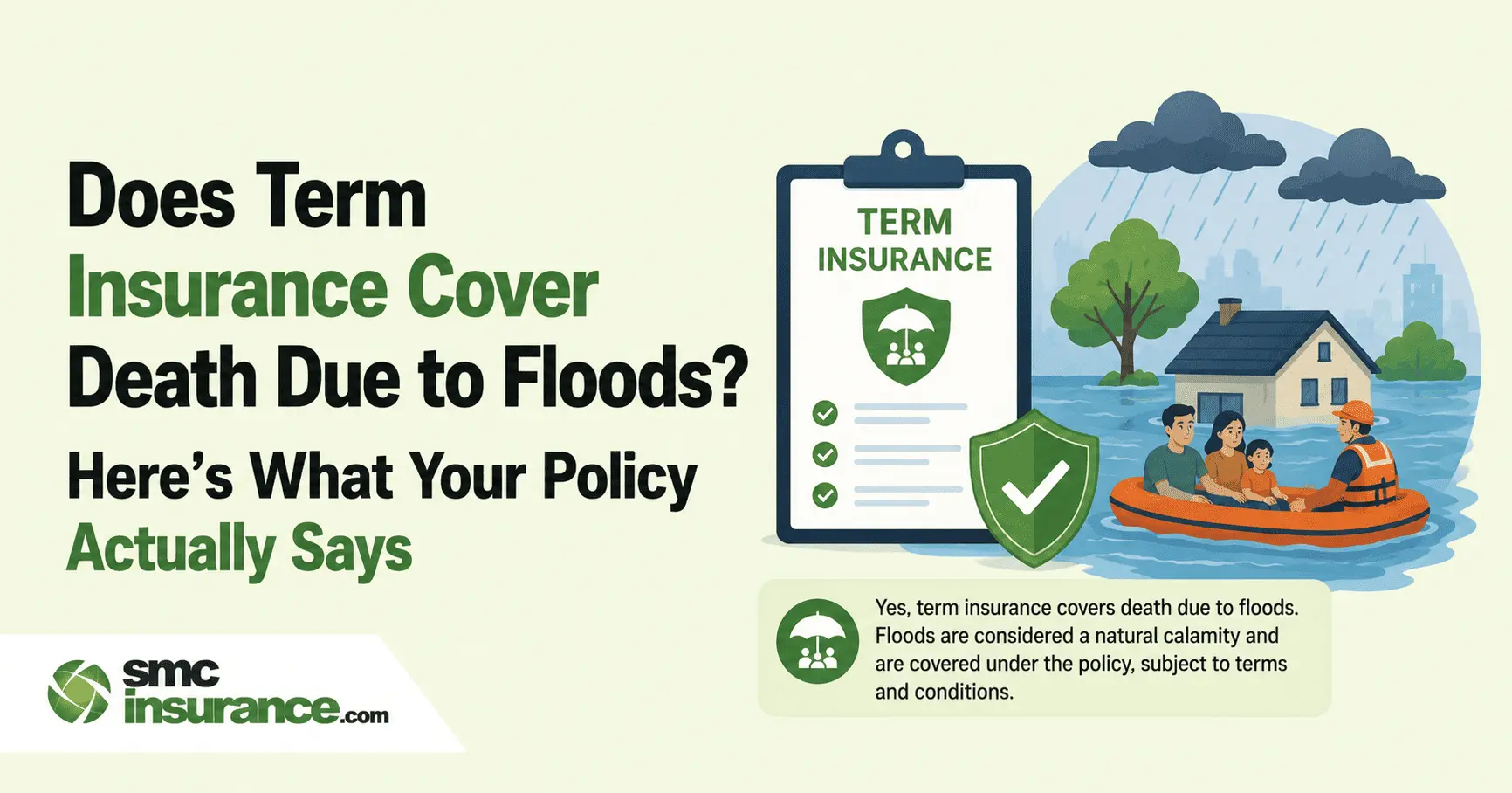

Yes, term insurance generally covers death caused by floods and other natural calamities, provided the policy is active and the death falls within the terms of the policy. Natural disaster is not, by itself, a standard reason to deny the base death benefit. However, exclusions, waiting periods and other conditions can vary by product, so the policy wording should always be checked. A suicide clause is common across term insurance policies, generally applying when suicide occurs within 12 months of policy commencement or revival. The payout in such cases depends on the policy terms and may be a specified refund of premiums rather than the full death benefit. Other exclusions may also apply to particular policies or riders.Natural calamity is generally not treated as an exclusion from the base death benefit simply because the death occurred during a flood or other disaster. However, the exact exclusions in the policy wording should be checked, particularly for riders and optional benefits. If the policy was in force when the death occurred and there is no applicable exclusion or valid ground for repudiation, a flood-related death can be claimed under the base life cover. Accurate disclosures at the time of purchase or revival are also important.
Every monsoon, the same story plays out somewhere in India. A river breaks its banks, a family loses their home overnight, and somewhere in the chaos, someone doesn't make it out. The 2025 monsoon highlighted the scale of flood and rain-related risks in India. According to the India Meteorological Department, heavy rainfall, floods, cloudbursts and landslides claimed more than 1,370 lives across the country during 2025. If you hold a term plan, or you're the nominee of someone who did, the question that follows a tragedy like this is brutally practical: will the insurer actually pay out, or will natural disaster become the fine print that gets a claim rejected? The short answer is reassuring, but the details matter more than the headline, so let's get into what your policy really promises.
Table of Contents
What Term Insurance Actually Excludes
A lot of the confusion around this topic comes from people mixing up term insurance with property or motor insurance, where "act of God" clauses genuinely do carve out exceptions. Life insurance doesn't work that way. It's built around the certainty that everyone dies eventually, so the contract focuses on when and how the death happened rather than the specific external cause.
The clearest proof of this comes from Saral Jeevan Bima, the standardised term plan that every life insurer in India is required to sell under an IRDAI mandate. IRDAI's standard Saral Jeevan Bima guidelines provide for a suicide clause as the product's exclusion. However, Saral Jeevan Bima also has a 45-day waiting period from commencement of risk. During this period, death due to an accident is covered, while death from other causes results in the applicable premium refund rather than the sum assured. These standard-product rules should not be assumed to apply identically to every term plan in the market. Saral Jeevan Bima provides a useful benchmark because its core terms are standardised by IRDAI. Other term plans can have different product features, waiting periods, exclusions and rider conditions, so the individual policy wording remains the final reference for a claim.
Even outside Saral Jeevan Bima, the base death benefit on flagship term plans from major insurers follows the same pattern. Some exclusions are product-specific, while others apply specifically to riders or optional benefits. For example, accidental death riders can have separate exclusions relating to war, hazardous activities, aviation and self-inflicted injury. The base policy may have its own terms, so the policy wording should be checked before assuming that an exclusion applies only to a rider.
Before we go further, knowing what's excluded is only half the picture. It also helps to understand why some people believe otherwise, and that's where riders and add-ons come in.
Why the "Natural Disaster" Confusion Exists in the First Place
The mix-up usually traces back to riders, not the base policy. Accidental death benefit riders, which pay an additional amount on top of the base sum assured if death results from an accident, often carry their own exclusion list. These can include participation in adventure sports, being under the influence of alcohol, or death during a declared war. None of these riders exclude natural disasters either, but their exclusion lists are longer and more detailed than the base policy's, and people sometimes assume the same restrictions apply to the whole plan. They don't. If a rider claim gets rejected for a technical reason, the base death benefit still pays out.
Coverage Component |
What It Pays For |
Flood Death Covered? |
Typical Exclusions |
Base term life cover |
Death benefit payable when the insured dies during the policy term, subject to policy terms |
Generally yes, subject to the policy's terms and any applicable waiting period or exclusion |
Suicide clause, waiting period where applicable, and other product-specific conditions |
Accidental death benefit rider |
Extra payout if death is accidental |
Generally yes, where the death satisfies the rider's definition of accidental death and none of its exclusions apply |
War, adventure sports, intoxication, aviation (non-passenger) |
Critical illness rider |
Lump sum on diagnosis of listed illness |
Not applicable, this rider isn't triggered by death |
Waiting period, pre-existing conditions not disclosed |
Waiver of premium rider |
Future premiums waived on disability or critical illness |
Not applicable to death claims |
Self-inflicted injury, non-disclosure |
Note: Exact rider terms vary by insurer and product. Always check the policy wording for the specific rider you've purchased, since brochures are indicative and the contract document is what governs a claim.
What Counts as a Flood Death for Claim Purposes
For a flood-related death, the insurer will assess the cause and circumstances of death along with the policy terms and supporting documents. The death may result from drowning, injuries, electrocution, a collapse, a road accident or another cause, and the documents required can depend on how the death occurred.
Drowning is the most direct cause, but flood-related deaths in India are just as often the result of electrocution from submerged wiring, being crushed under a collapsing structure, landslides triggered by saturated soil, or road accidents on flooded or washed-out roads. Some deaths happen days after the water recedes, from waterborne diseases like leptospirosis or dengue that spread through flood-affected areas. None of these change the outcome. A term policy pays on the fact of death occurring while the policy is in force, not on a specific approved list of causes.
Documents Your Family Will Need to File a Flood Death Claim
This is the part that actually determines how smoothly a claim moves, far more than the cause of death itself. Deaths caused by drowning, injuries, electrocution, structural collapse or other accidents may require additional documentation because they can be treated as unnatural or accidental deaths. The exact requirements depend on the circumstances and the insurer's claim process.
Document |
When It May Be Required |
Death certificate |
Standard proof of death |
Claim form |
Required to initiate the claim |
Policy details / policy document |
Helps establish the policy and claim details |
Nominee's KYC and bank details |
Required for identity verification and payment |
FIR / police report |
May be required for accidental or unnatural deaths |
Panchnama / inquest report |
May be requested depending on the circumstances |
Post-mortem report |
May be required where a post-mortem is conducted or relevant to the death |
Final police investigation report |
May be requested in certain accidental or unnatural death claims |
Medical records |
May be requested where relevant to the cause of death |
Note: A body recovered after a flood may not always undergo a formal post-mortem, especially in mass-casualty situations. In exceptional circumstances such as a natural calamity, some documents may be difficult to obtain. The insurer may have provisions for handling such cases. For example, ICICI Prudential's policy wording allows the company, at its discretion, to conduct an investigation and subsequently settle the claim where documents cannot be provided because of circumstances such as a natural calamity. The exact process depends on the policy and insurer.
How to Actually File the Claim
The process itself doesn't change because the cause of death was a natural disaster, but knowing the sequence saves a grieving family a lot of back and forth.
- Inform the insurer immediately
A phone call or an email to the insurer's claims desk starts the clock. Most insurers accept intimation even before every document is ready. - Collect the death certificate first
Obtain the death certificate or other officially recognised proof of death issued by the relevant authority. In disaster situations, the timing and documentation process can vary depending on identification and local administrative procedures. - Get the FIR or panchnama from the local police station
Where the death involved drowning, injury, electrocution, a road accident, structural collapse or another circumstance requiring police investigation, obtain the relevant FIR, inquest or panchnama documents if issued. - Submit the claim form along with all supporting documents
Submit the documents requested by the insurer as early as possible. If additional documents are required, the insurer should communicate the requirement as part of the claim process. - Track the claim against IRDAI's settlement timeline
Under IRDAI's 2024 Master Circular on Protection of Policyholders' Interests, a death claim that does not warrant investigation should be settled within 15 days of claim intimation. A death claim that warrants investigation should be settled within 45 days of claim intimation. If the insurer misses the prescribed timeline, the claimant is entitled to interest at the bank rate plus 2%, calculated from the date of claim intimation until payment.
If you're unsure what counts as a complete document set for your specific insurer, our detailed guide on what's needed to claim term insurance breaks down the checklist for every type of death claim, not just accidental ones.
Term insurance only works as a safety net if the cover amount and the insurer's track record are both solid before disaster strikes, not after. That's the conversation worth having with an advisor now, while you can still compare plans calmly instead of scrambling during a crisis.
Talk to an SMC Insurance advisor to check whether your existing term cover, or a new one, genuinely protects your family against every real-world scenario, floods included.
What Could Actually Get a Flood Death Claim Rejected
Since the cause of death almost never matters, rejections in these cases come down to a small set of issues that have nothing to do with the flood itself.
- Non-disclosure at the time of purchase
If the applicant hid a serious pre-existing illness or lied about occupation or income, the insurer can investigate and reject the claim, especially within the first three years, under Section 45 of the Insurance Act. - Lapsed policy
If premiums stopped and the grace period expired before the flood, there's no active cover to claim against. This is genuinely the most common reason families lose out, and it has nothing to do with disasters. - Suicide within the first year
Extremely rare in flood contexts, but technically still the one universal exclusion. - Missing or inconsistent documentation
Not a rejection so much as a prolonged delay, but in practical terms it feels the same to a waiting family.
In our experience helping families through claim season, the cases that drag on are almost never about whether floods are covered. They're about a lapsed premium from two years ago, or a nominee detail that was never updated after a marriage or a move. Getting those basics right does more for your family's protection than any amount of reading the exclusion clause.
Summing Up
Floods are frightening precisely because they're sudden and indiscriminate, but your term insurance policy doesn't treat that death any differently from one caused by illness or a road accident. IRDAI's own rules for the standard Saral Jeevan Bima product confirm that suicide is the only exclusion that matters, and every major insurer's base term plan follows the same logic. What actually decides whether your family gets paid, and how fast, is whether the policy was active, whether the original disclosures were honest, and whether the documentation, especially the FIR and post-mortem report for unnatural deaths, is submitted correctly. If you're evaluating a new policy or reviewing an old one, it's worth checking both the cover amount and the insurer's claim settlement record rather than worrying about disaster-specific exclusions that, for the most part, simply don't exist in Indian term insurance.
Disclaimer: The information provided on this platform is intended for general awareness and educational purposes. While every effort is made to ensure accuracy, some details may change with policy updates, regulatory revisions, or insurer-specific modifications. Readers should verify current terms and conditions directly with relevant insurers or through professional consultation before making any decision.
All views and analyses presented are based on publicly available data, internal research, and other sources considered reliable at the time of writing. These do not constitute professional advice, recommendations, or guarantees of any product’s performance. Readers are encouraged to assess the information independently and seek qualified guidance suited to their individual requirements. Customers are advised to review official sales brochures, policy documents, and disclosures before proceeding with any purchase or commitment.
FAQs
Yes, term insurance generally covers death caused by floods and other natural calamities when the policy is in force and the claim falls within its terms. A flood is not, by itself, a standard reason to deny the base death benefit. However, waiting periods, exclusions and other conditions can vary by policy.
No, term insurance covers death from any cause, including natural disasters, without needing a special rider. Riders like accidental death benefit add an extra payout on top of the base cover, but they aren't required for the base sum assured to pay out on a flood death.
Since flood deaths are usually classified as unnatural deaths, the nominee will typically need the death certificate, FIR or panchnama, post-mortem report where one was conducted, the original policy document, and standard KYC proof, in addition to the claim form.
Not necessarily. In mass-casualty flood situations, a formal post-mortem isn't always possible. Insurers generally accept the death certificate along with local disaster management or municipal records in place of a post-mortem, though it's best to confirm this directly with the claims team.
Under IRDAI's 2024 Master Circular, death claims that don't require investigation must be settled within 15 days of intimation, and those needing investigation must close within 45 days. Delays beyond this attract mandatory interest.
Yes, term insurance covers death by illness regardless of when or why the illness was contracted, so a death caused by a flood-related disease outbreak is covered the same way any natural death is.
No, unlike property or motor insurance, life insurance in India doesn't carry acts of God exclusions. The IRDAI's guidelines for the standard term product explicitly state that suicide is the only exclusion permitted, and private insurers' base term plans follow the same principle.


