


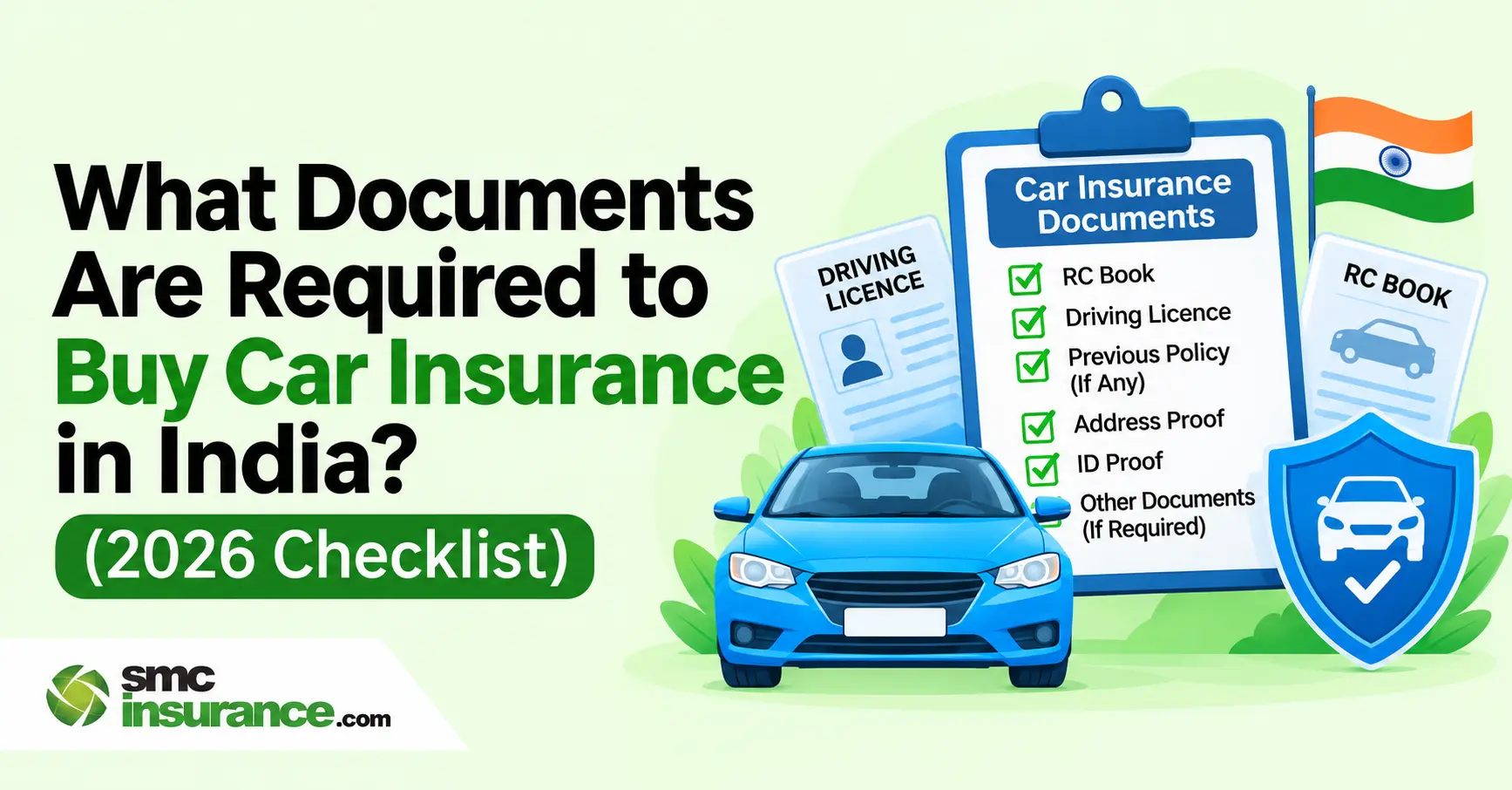
To buy car insurance in India, you need one KYC proof (Aadhaar, passport or voter ID) with PAN or Form 60, the car’s RC and your driving licence details. New cars also need the dealer invoice. Renewals need the old policy number and a valid PUC and used cars need Forms 29 and 30 within 14 days.
Table of Contents
The dealer wants the policy before handing over the keys and suddenly you are searching cupboards for papers you last saw two years ago. Getting the documents required for car insurance wrong costs real time, because a name that differs between your Aadhaar and RC can stall a policy for days and driving uninsured meanwhile risks a Rs. 2,000 fine on a first offence. If you plan to buy car insurance online, though, most of the paperwork is just numbers typed into a form. Below is the 2026 checklist and how it shifts between a new car and a used one.
Core Documents Required for Car Insurance in India
Four items cover nearly every purchase, so locate these first. KYC has been compulsory for motor insurance since 1 January 2023, when IRDAI extended it to all general insurance. Aadhaar, a passport, voter ID or a driving licence works as identity and address proof and PAN or Form 60 is needed alongside. With Aadhaar e-KYC, an OTP on your linked mobile completes the check without uploads.
- KYC documents: An accepted identity and address proof, such as Aadhaar, passport, voter ID or driving licence, along with PAN or Form 60 wherever applicable.
- Registration Certificate (RC): Provides vehicle registration and ownership details, including the chassis and engine numbers. For a new car awaiting registration, the insurer may use temporary registration or dealer-provided vehicle details.
- Driving licence: Keep your licence information available, particularly when purchasing owner-driver personal accident cover or if the insurer requests it.
- Photograph: Required only when the insurer's KYC process calls for one.
Digital copies work fine here, since an RC and licence stored in DigiLocker or the mParivahan app are legally at par with physical documents.
Documents Required for Car Insurance Based on Your Situation
Your situation decides the rest of the pile and the table shows where each one differs.
Situation |
Keep ready |
New car | Dealer invoice or vehicle details, temporary/permanent registration details when available, KYC documents and licence details if requested |
Used car (new owner) | Existing RC, ownership-transfer application or updated RC, Forms 29 and 30 as applicable, seller's insurance policy and buyer's KYC documents |
Renewal | Previous policy details, vehicle registration details, valid PUC certificate where applicable and updated KYC information if requested |
Expired policy | Previous policy and vehicle details, KYC information and photographs or video inspection if required by the insurer |
Note: Requirements vary by insurer and policy type, so confirm at checkout.
Used-car buyers should act promptly to transfer the insurance policy into their name. Under Section 157 of the Motor Vehicles Act, third-party insurance protection is deemed to transfer with vehicle ownership. Following the reported 2026 amendment, the new owner has 30 days from the transfer date to apply to the insurer for updating the policy details. Own-damage protection does not automatically transfer in the same way, so buyers should obtain the insurer's endorsement before relying on it.
PUC is the other paper that trips people up. Insurers should not renew without a valid certificate under a 2017 Supreme Court direction, though IRDAI clarified in 2020 that a missing PUC alone cannot justify rejecting a claim.
What Missing Paperwork Costs You in Real Money
A gap in your documents shows up in two places and each has a number attached.
Driving without valid third-party insurance is an offence under the Motor Vehicles Act, with a fine of Rs. 2,000 for the first offence and Rs. 4,000 for a subsequent offence. An expired policy can also affect your No Claim Bonus (NCB). Under the standard NCB structure, eligible policyholders receive discounts ranging from 20% after one claim-free year to 50% after five consecutive claim-free years. If the policy is not renewed within 90 days of expiry, the accumulated NCB is generally lost. For example, on an eligible own-damage premium of Rs. 12,000 before NCB, a 50% discount saves Rs. 6,000. Losing that benefit could increase the own-damage premium by the same amount, assuming all other pricing factors remain unchanged. Our guide to lowering your car insurance premium shows how that discount builds.
Policy expiring and half the papers missing? Compare plans at www.smcinsurance.com, keep this checklist open alongside and finish in one sitting instead of three.
How to Buy Car Insurance Online With Your Documents Ready
This order saves the most time.
- Keep your RC and driving licence details accessible, using DigiLocker or an accepted digital document service where available.
- Keep your KYC information and PAN or Form 60 ready, and complete verification through the method supported by your insurer.
- Match the owner's name, registration number, chassis number and engine number against the vehicle records before submitting the application.
- For a car insurance renewal, locate the previous policy details and check PUC validity. For a used car, collect the seller's insurance policy and the documents required for ownership transfer.
Wrapping Up,
The documents required for car insurance come down to one KYC proof with PAN or Form 60, your RC and your driving licence, plus a few extras that depend on the car’s history. Digital copies and an Aadhaar OTP are enough for most purchases. The costly mistakes are about timing, namely missing the 14-day transfer window on a used car or letting a policy lapse beyond 90 days. Spend ten minutes gathering the papers first, then finish the purchase in one go.
Disclaimer: The information provided on this platform is intended for general awareness and educational purposes. While every effort is made to ensure accuracy, some details may change with policy updates, regulatory revisions, or insurer-specific modifications. Readers should verify current terms and conditions directly with relevant insurers or through professional consultation before making any decision.
All views and analyses presented are based on publicly available data, internal research and other sources considered reliable at the time of writing. These do not constitute professional advice, recommendations, or guarantees of any product’s performance. Readers are encouraged to assess the information independently and seek qualified guidance suited to their individual requirements. Customers are advised to review official sales brochures, policy documents and disclosures before proceeding with any purchase or commitment.
FAQs
You generally need KYC information, PAN or Form 60 wherever applicable, and your vehicle registration details. Insurers may request additional documents depending on whether you are buying insurance for a new car, renewing an existing policy or transferring ownership of a used vehicle.
Not always. Some insurers can verify customer and vehicle details digitally without requiring separate uploads. However, additional documents may be needed if online verification is unsuccessful or the insurer requests further information.
PAN details may be required as part of the insurer's KYC process. Where permitted under the applicable rules, customers who do not have a PAN can provide Form 60 instead. The insurer may also require other accepted identity and address verification documents.
Keep the existing insurance policy, vehicle RC, buyer's KYC documents and ownership-transfer records ready. The insurer may also request additional documents before endorsing the policy in the new owner's name. Third-party cover is deemed to transfer with ownership, while own-damage cover requires separate attention and insurer approval.
Keep your previous policy details, RC, KYC information and valid PUC certificate ready. Depending on the insurer and the duration of the lapse, photographs or vehicle inspection may also be required. Renewing within 90 days of expiry generally helps preserve your accumulated No Claim Bonus.


