


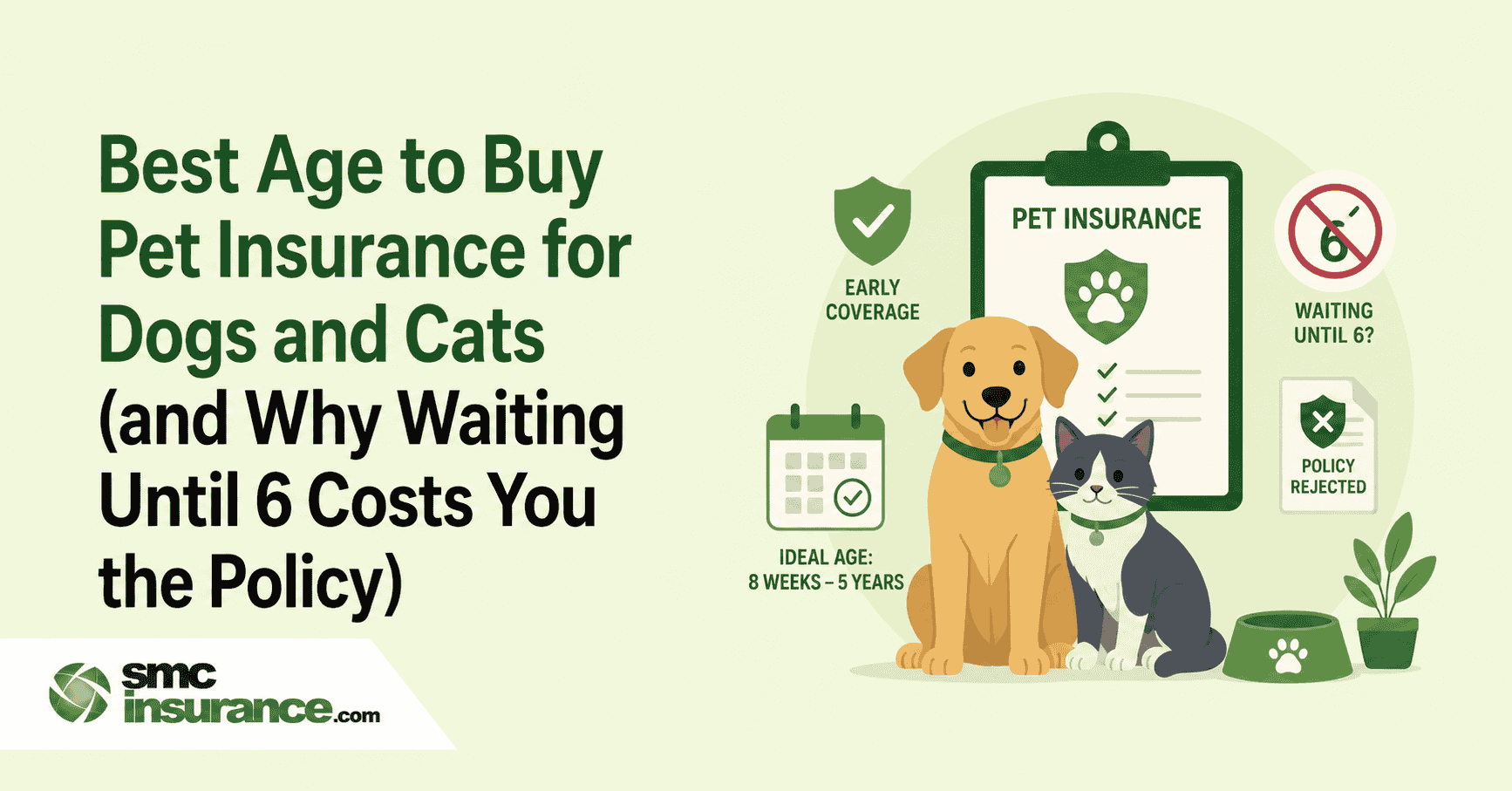

For most pet insurance products currently available in India, buying a policy when your pet is between 8 weeks and 6 months old offers the widest eligibility, lower premiums and reduces the likelihood of pre-existing condition exclusions. However, the minimum and maximum entry ages vary by insurer and product. Buying this early locks in the lowest premiums, avoids pre-existing condition exclusions and keeps every insurer's doors open to you. Most insurers stop accepting new applicants once a pet crosses 6 to 8 years, so every year of delay narrows your options and raises your cost. If your pet is already older, senior plans exist up to 10 to 12 years, but expect co-payments and tighter medical checks.
Your Labrador just turned four, has never had a health scare and you keep telling yourself there is no rush. Then a friend's seven-year-old dog needs a Rs. 90,000 ligament surgery and the insurer's first question is not about the surgery. It is about when the policy was bought. If you are wondering about the best age to buy pet insurance for your dog or cat, the honest answer is earlier than you think, because most Indian insurers quietly shut the door once a pet crosses six to eight years old. This article breaks down exactly when to buy, what age bands do to your premium and why the pet parents who wait the longest end up paying the most, or not getting covered at all.
Table of Contents
- Why Age Decides Whether You Get Covered, Not Just What You Pay
- The Best Age to Insure a Puppy or Kitten
- What Actually Happens When You Wait Until Your Pet Turns 6
- Breed Changes the Calculus More Than Most People Realise
- Is It Too Late If Your Pet Is Already 8 or 10?
- How to Buy Pet Insurance at the Right Age: A Quick Walkthrough
Why Age Decides Whether You Get Covered, Not Just What You Pay
Most people shop for pet insurance the way they shop for a phone case, as an afterthought bought only once something goes wrong. Insurers do not work that way. Every pet insurance policy in India is underwritten around one central fact: insurers generally use a pet's age as one of the key underwriting factors because older pets are statistically more likely to develop illnesses requiring veterinary treatment. A two-year-old Indie is statistically far less likely to need a Rs. 60,000 surgery than an eight-year-old one and insurers price and structure their policies around that reality from day one.
This is why age in pet insurance behaves differently from age in human health insurance. With human policies, you can usually still buy cover at 55 or 60, just at a steeper premium. With pets, many insurers stop accepting new applications altogether once the animal crosses a certain age, regardless of how much you are willing to pay. Waiting is not just expensive here. It can mean the product simply stops being available to you.
The Best Age to Insure a Puppy or Kitten
The best window to buy pet insurance is between 8 weeks and 6 months of age, right after your puppy or kitten has had its first round of core vaccinations. In our conversations with pet parents at SMC, this is the single most common regret we hear: people wait to see if the pet is "generally healthy" before insuring it, not realising that this waiting period is exactly when the policy would have been cheapest and least restrictive.
Buying this early gives you two advantages that are impossible to get back later. First, since your pet has no medical history yet, there is nothing for the insurer to flag as a pre-existing condition, which is the single biggest exclusion in every pet policy sold in India. Second, younger pets qualify for the lowest premium tier and the widest choice of insurers, since you are not yet fighting age-based loading or a shrinking list of companies willing to underwrite an older animal.
What Actually Happens When You Wait Until Your Pet Turns 6
Six is the quiet tipping point in Indian pet insurance and it rarely gets mentioned outside the policy wording. Several insurers set their maximum entry age between 5 and 8 years, which means a healthy six-year-old dog might still qualify today, but the window is visibly closing. Two things happen simultaneously once your pet crosses this threshold and both work against you.
The first is cost. Premiums are banded by age and every insurer's higher band charges more for the same sum insured, since claim probability rises sharply in a pet's later years. The second, more damaging effect is medical scrutiny. Older pets are frequently asked for a veterinary fitness certificate before the insurer issues a policy and any condition detected during that check, even something minor like early arthritis, gets excluded as pre-existing for the life of the policy. A dog insured at age two carries no such baggage into its senior years, because the illness never had a chance to predate the cover.
|
Age Band |
Typical Availability |
What Changes for You |
|
8 weeks – 6 months |
Eligible for most insurers offering early enrolment |
Widest choice of insurers, lower premiums and a greater chance of securing cover before any medical conditions develop. Most insurers require age-appropriate vaccinations before issuing the policy. |
|
6 months – 3 years |
Broad eligibility across most available products |
Premiums generally remain competitive. Documentation is usually straightforward, although vaccination records and proof of ownership are commonly required. |
|
3 – 6 years |
Still eligible with many insurers |
Premiums may increase depending on the insurer's age slabs. Some insurers may request a veterinary health examination or fitness certificate before issuing the policy. |
|
6 – 8 years |
Eligibility becomes more insurer-specific |
Several products approach or reach their maximum entry age in this range. Depending on the insurer and your pet's health, additional underwriting, medical evaluation or policy conditions may apply. |
|
Above 8 years |
Limited availability for new policies |
Some insurers no longer accept new applications after 8 years, while a few products currently allow entry up to 10 years, subject to underwriting. Maintaining continuous renewal becomes particularly important if your pet was insured earlier. |
Note: Age bands and maximum entry age vary by insurer and by breed. Giant breeds like Great Danes and Mastiffs often face lower age caps than smaller breeds because of shorter life expectancy. Always confirm current entry-age rules directly with the insurer before assuming eligibility.
That table is really a countdown clock. Every year you delay moving your pet one row down and every row down means either a smaller set of insurers willing to cover you or a policy that costs meaningfully more for the identical benefits a younger pet would get.
If your dog or cat has already crossed into the middle age bands, it helps to first understand what a typical premium actually looks like at that stage. Our detailed breakdown of how much dog insurance costs in India and what cat insurance costs by age and breed walks through the exact premium ranges insurers quote today.
Vet bills do not wait for the "right time" to happen and neither should your decision to insure. If you have been putting off buying a policy because your pet seems fine right now, that is precisely the moment insurers want you to apply, since a healthy pet with no claims history is the easiest and cheapest one to underwrite. Get a quote through SMC Insurance before your pet's next birthday pushes it into a costlier age band.
Breed Changes the Calculus More Than Most People Realise
Age is not the only variable and treating every pet the same way is where a lot of pet parents go wrong. A Labrador and a Great Dane age very differently and insurers price them accordingly. Giant and large breeds have shorter life expectancies and a higher lifetime incidence of orthopaedic and cardiac issues, so their entry-age window closes earlier, sometimes as low as four or five years. Small and indigenous breeds tend to stay insurable for longer and usually carry lower base premiums throughout.
This matters most for anyone who owns a large-breed puppy right now. If you have a six-month-old St. Bernard or Rottweiler, the standard advice to "insure before six" does not fully apply to you, because your effective deadline is likely much earlier. It is worth checking your specific breed's age cap with the insurer rather than assuming the general timeline applies.
Is It Too Late If Your Pet Is Already 8 or 10?
Not entirely, but the product changes shape. A handful of insurers now offer senior pet plans that accept dogs and cats up to 10 or 12 years old, though these come with trade-offs that younger-pet policies do not carry. Expect a mandatory fitness certificate from a registered vet, a co-payment of roughly 20 to 30 percent on every claim and a real chance that any condition already showing up in the vet's report gets permanently excluded.
The honest way to think about a senior policy is as a partial safety net rather than full protection. It still helps with sudden accidents and new illnesses that appear after the policy starts, but it will not step in for anything your vet can already point to on day one. If your pet is in this age bracket, our guide on how insurers in India actually handle pre-existing conditions is worth reading before you sign anything, since this is where senior applicants lose the most money in denied claims.
How to Buy Pet Insurance at the Right Age: A Quick Walkthrough
1. Check your pet's current age band against the insurer's entry-age chart before applying, since even a few weeks can matter if your pet is close to a threshold.
2. Gather vaccination records and, for pets above three years, be ready to arrange a vet fitness certificate, usually valid only if issued within 30 days of purchase.
3. Compare sum insured options rather than defaulting to the cheapest plan. A lower sum insured on a young, healthy pet is a false economy once real surgery costs come in.
4. Read the waiting period clause carefully. Most Indian pet policies apply a 15 to 30 day waiting period before illness cover begins, so a policy bought during a crisis will not help with that crisis.
5. Confirm renewal terms for life, not just the entry age. A good policy bought young should guarantee renewal into your pet's senior years without a fresh medical review.
For a broader sense of how the entire process works end to end, our walkthrough on how pet insurance works in India covers documentation and claims in more detail.
Summing Up
The best age to buy pet insurance for a dog or cat is as early as possible, ideally within the first six months of bringing them home and the reasoning is simple once you see it laid out. Younger pets get access to more insurers, lower premiums and a policy free of pre-existing condition exclusions, because there is no medical history yet to exclude.
Every year you wait narrows that window and by the time a pet crosses six to eight years old, several insurers stop accepting new applications outright. If your pet is already past that stage, senior plans exist, but expect co-payments and tighter exclusions. The real decision in front of you is not whether pet insurance is worth it. It is whether you are buying it while your pet is still cheap and easy to insure, or after that window has already started closing.
Disclaimer: The information provided on this platform is intended for general awareness and educational purposes. While every effort is made to ensure accuracy, some details may change with policy updates, regulatory revisions, or insurer-specific modifications. Readers should verify current terms and conditions directly with the relevant insurer or through professional consultation before making any decision.
All views and analyses presented are based on publicly available data, internal research and other sources considered reliable at the time of writing. These do not constitute professional advice, recommendations, or guarantees of coverage or claim approval. Readers are encouraged to assess the information independently and seek qualified guidance suited to their pet's individual requirements. Applicants are advised to review official policy wordings and insurer disclosures before proceeding with any application or commitment.
FAQs
Between 8 weeks and 6 months is ideal, right after the first vaccination cycle. This is when premiums are lowest and there is no medical history for insurers to exclude, giving you the broadest coverage from day one.
Yes, most insurers cap new entries between 6 and 8 years, though this varies by company and breed. A few offer senior plans up to 10 or 12 years, usually with co-payment clauses and stricter medical screening.
Yes, significantly. Insurers price policies in age bands and each band carries a higher premium than the one before it. Beyond the cost, older pets are also more likely to face vet-certificate requirements and pre-existing condition exclusions.
It depends on the insurer and breed. Some will still accept the application at a higher premium and with a fitness certificate, while others will decline new entries past their cut-off age entirely. Check individual insurer limits before assuming you are covered.
Yes, giant and large breeds like Great Danes or Mastiffs often have earlier entry-age cut-offs, sometimes as low as four or five years, because of their shorter life expectancy. Smaller and indigenous breeds usually stay insurable for longer.
No, pre-existing conditions, meaning anything diagnosed before the policy start date, are excluded by nearly every insurer in India. This is exactly why buying early, before any condition develops, matters so much.
Most policies apply a 15 to 30 day waiting period before illness claims are accepted, though accident cover often starts sooner. This makes buying insurance in advance far more useful than buying it reactively during a health scare.


