A quick look at a Pollution Under Control certificate can feel like checking the pulse of your vehicle. One small slip of paper tells a story about how clean your engine runs and how healthy the air around you stays. Yet the moment someone asks for it at a fuel station, a little doubt creeps in. Is it still valid? Is it stored somewhere safe? Have you faced that shuffle through old files while a line of honking vehicles grows behind you?
Online checks smooth out that tension. A few taps show the exact status of your PUC, almost like turning on a light in a dim room. What if you could confirm everything before stepping out of your home? What if you could avoid penalties and keep your vehicle record spotless without breaking stride in your day?
This small habit helps you stay on the right side of the law and keeps our shared roads cleaner. Curious how the process works and how fast you can get the details? The steps below walk you through it with ease.
What Is a PUC Certificate?
Every vehicle on Indian roads needs a Pollution Under Control (PUC) certificate. It’s proof that your car or bike is not pouring out too much smoke or harmful gases into the air. Think of it as a clean bill of health for your vehicle’s emissions. If your vehicle passes the emissions test at an authorised centre, the government issues this certificate.
A PUC certificate covers all kinds of vehicles. Two-wheelers, cars, trucks and even bigger vehicles must have it. For new vehicles, the first certificate usually lasts about one year. After that, you need to get your vehicle tested and renewed around every six months. Those frequent checks help keep harmful gases in check and ensure cleaner air around us.
You might have seen a small sticker on your windscreen at a petrol pump or service centre. That’s often your PUC test result. Along with the certificate number, registration details and expiry date, it shows how your vehicle performed in the emissions test. So, it’s a record of how earth-friendly your ride truly is.
Why Checking Your PUC Status Regularly Matters
Here are a few reasons:
The law in India makes a PUC certificate mandatory for all vehicles. Driving without one isn’t just risky for the air we breathe, it’s legally risky too. Traffic police can stop your vehicle and hand you a challan if your PUC is expired or missing. In many cities, the fine for an invalid PUC can be steep, and enforcement has been getting stricter.
Enforcement officers and new systems are linking databases and issuing fines far more often than before. In some regions, authorities are even using CCTV and automatic checks to spot vehicles with expired PUC certificates on the road.
Checking your certificate online helps you spot expiry dates before a traffic stop does. And once you’re aware of the expiry, you can plan your next emission test instead of scrambling at the last moment. It’s a simple step that keeps your journeys smooth.
If you’re renewing your motor insurance, a valid PUC often matters. Many insurers require proof of a current PUC before renewing policies. Skipping this check could delay your insurance renewal or even affect claim settlements later. Taking a moment to confirm your PUC status ahead of time removes that stress.
Beyond rules and penalties, there’s a deeper reason to care about your PUC certificate. Every vehicle that passes the emissions test contributes less to air pollution. Cleaner air means healthier lungs for everyone. That includes your family, your neighbours and you.
Latest PUC Regulations and Enforcement Updates
Government and city authorities are tightening up how they enforce PUC norms:
Across the country, more stringent checks and campaigns are underway. Some cities now require that all petrol pumps have authorised PUC testing centres to make the test more accessible. Penalties for not having a valid certificate are also rising, and authorities can refuse entry to highly polluting vehicles at city borders during pollution alerts.
- In Ahmedabad, civic bodies have started issuing electronic challans for vehicles without valid PUC certificates by linking CCTV systems with the national transport database. This means you don’t just see a fine at a traffic stop. You could get one even if you drive past a camera on a busy road without a valid certificate.
- Data from enforcement agencies also tells a clear story. Tens of thousands of vehicles are being ticketed for missing PUC certificates during routine checks, especially during peak pollution seasons. In one major city, nearly 47,000 vehicles were flagged in just a few weeks when pollution controls were tightened.
- The government has also collected hundreds of crores in penalties over the past years because many vehicle owners overlooked this simple compliance requirement. That money highlights how serious enforcement has become nationwide.
PUC Validity Rules in India (Updated)
PUC rules have stayed mostly steady over the years, but enforcement has grown sharper. The validity period depends on how old your vehicle is and how it performs during the test.
For a brand-new vehicle, the first PUC certificate usually stays valid for one year. After that, every certificate you receive is valid for a shorter period, often around six months. If your vehicle shows higher emissions during a test, the validity may be even shorter because the system flags it for closer monitoring.
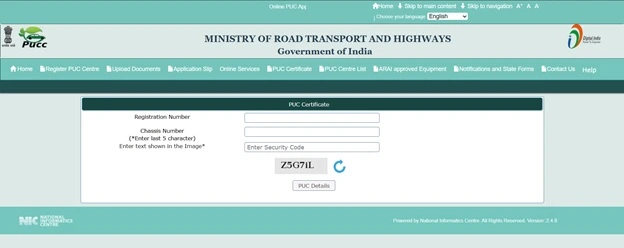
Government portals also link PUC records directly with your vehicle registration, which means officers can check your status in seconds. Many states now run automated drives where the system alerts authorities if a vehicle’s PUC has expired. It creates consistency and keeps vehicles on the road cleaner and more accountable.
The rule is simple. Keep your certificate valid at all times. If the expiry date slips past, the vehicle is considered non-compliant, and that may lead to fines or issues during insurance renewals. It only takes a quick check to stay on the right side of the law.
How to Check Your Vehicle’s PUC Certificate Online?
You don’t need to visit a centre just to verify your PUC status. A quick online check does the job. And if you use SMC’s platform, the process becomes even simpler because everything sits in one place.
- Through the SMC App
The SMC Insurance app Android version/IOS version lets you view your vehicle records in a clean, easy-to-follow layout:
-
- Once you install the app, open the dashboard.
- Scroll down to find the option “Get Instant PUC Status”.
- Enter your vehicle registration number and click on “Get Status”.
- The system pulls details from the transport database and displays the PUC status along with the expiry date.
- It feels effortless, and it helps you plan your renewal without searching through paperwork.
Download SMC Insurance App:
your pocket-sized insurance genius!
Want more smart ways to simplify your Vehicle Insurance journey?
The SMC Insurance app gives you expert guidance on everything INSURANCE
- Through the SMC Website
If you prefer using a browser, the SMC Insurance website offers the same convenience:
-
- Visit the site, scroll down to find the option of finding the PUC Status.
- You can send your registration number as an SMS to 9650171172.
- The team fetches your certificate information and sends it to you.
And since SMC partners with several leading insurers, the website also guides you through any compliance steps needed for a smooth policy experience.
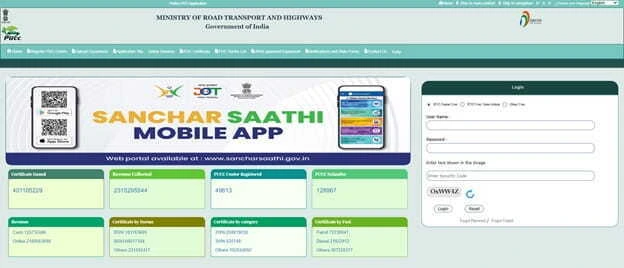
How to Check PUC Online Through Parivahan?
If you want to check your PUC status directly through the government system, the Parivahan portal makes it simple. The steps are short, and once you try it, you can repeat it anytime without trouble.
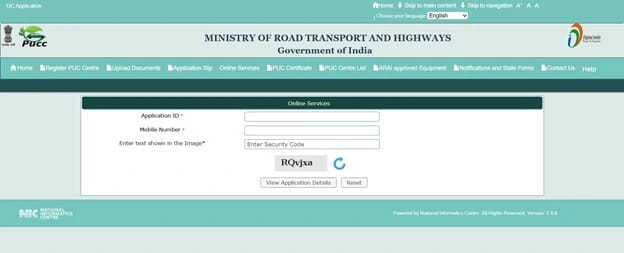
- Start by visiting the Parivahan PUC section.
- You’ll see a field asking for your vehicle registration number.
- Type it in, add the captcha code and submit the details.
- The portal then pulls your PUC record from the national database. You’ll see your certificate number, the test date, the expiry date, and the emission readings recorded during your last test.
This method works well when you need official confirmation, especially before heading out on a long drive or renewing your insurance. And since Parivahan updates records in real time, the results you see are always current. It gives you a quick sense of where you stand and whether it’s time to schedule your next test.
PUC Form - Sample Screenshot
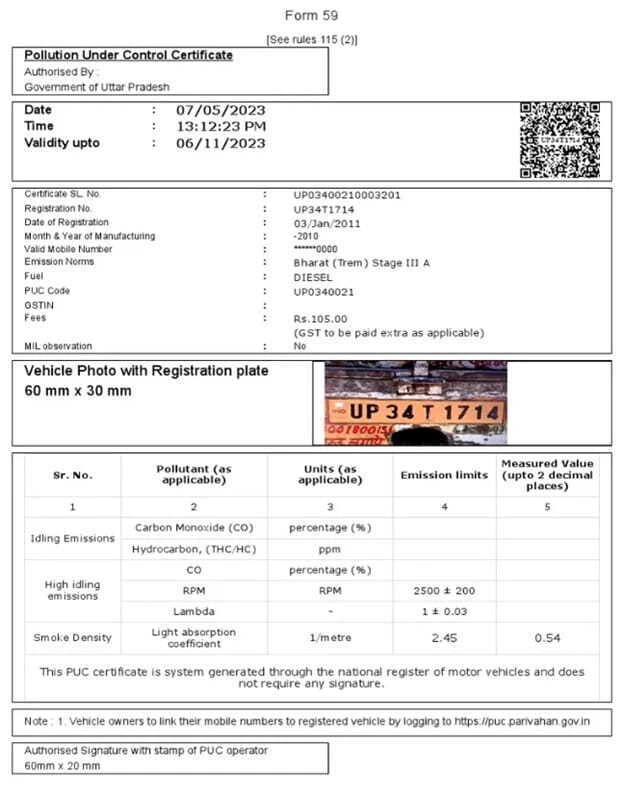
A standard PUC certificate shows your emission readings, your vehicle’s basic details, the date of the test, and the expiry date. Different centres may use slightly different layouts, but the core information stays the same because all centres follow the same Parivahan rules. Below is a sample screenshot for easy reference:
PUC Certificate Fees
PUC testing is regulated, so the cost stays low and predictable across most states. You don’t have to negotiate or guess. The rates are usually displayed at authorised centres.
Here’s what you can expect in most cities:
- Petrol vehicles (cars and two-wheelers): Rs. 60 to Rs. 100
- Diesel vehicles: Rs. 100 to Rs. 150
- CNG or LPG vehicles: Rs. 80 to Rs. 120
The fee covers the emission test and the printed certificate. No extra charges apply if your vehicle passes the test on the first attempt. If it fails, you’ll need to fix the issue and retest, which may involve another testing fee.
Compared to traffic fines that can go up to Rs. 1,000 or more, PUC fees are minimal. And since the test takes just a few minutes, it’s one of the easiest legal requirements to stay on top of.
How to Renew Your PUC Certificate
PUC renewal is simple, but it must be done the right way. There is no shortcut, and that’s intentional. Validity rules to keep in mind:
- New vehicles: PUC is valid for 1 year from registration
- After the first year: Renewal is required every 6 months
- Older vehicles: Renewal continues every 6 months without exception
PUC renewal is done only at authorised PUC centres. These are usually located at:
- Petrol pumps
- RTO-approved emission testing centres
- Selected service stations
Online renewal is not allowed because the vehicle must undergo a physical emission test.
Here’s the step-by-step renewal process:
- Visit any authorised PUC centre anywhere in India
- Share your vehicle registration number
- The operator conducts the emission test
- If your vehicle passes, the PUC certificate is issued immediately
- The record is uploaded to the Parivahan database on the same day
- If your PUC has already expired, you can still renew it by taking the test. But driving with an expired certificate can lead to fines or e-challans, especially in cities using camera-based enforcement. That’s why renewing before expiry always makes more sense.
How to Download Your PUC Certificate Online
Once your test is done, your PUC certificate is stored digitally. You can download it anytime through official platforms.
Download PUC through the Parivahan portal
- Visit the Parivahan PUC service page
- Select “PUC Certificate”
- Enter your vehicle registration number
- Fill in the captcha code
- Submit the request
- Your PUC details will appear on the screen, including certificate number, emission test date, expiry date, vehicle details, etc.
If you manage your vehicle insurance through SMC Insurance, having your PUC certificate downloaded and ready also makes policy renewals smoother. Since SMC works with several leading insurers, complete documents help avoid delays and keep everything moving cleanly.
A few minutes spent checking, renewing, and downloading your PUC can save you from fines, repeat visits, and last-minute stress. And that’s time well spent.
Penalty for Not Having a Valid PUC Certificate
Driving without a valid PUC certificate is no longer something that slips by unnoticed. Enforcement has become tighter, especially in cities.
If you’re caught without a valid PUC, the penalty can go up to Rs. 1,000 for the first offence. Repeat violations may attract higher fines. In many states, traffic police now issue e-challans on the spot. And in cities using camera-based monitoring, fines can be generated automatically without a physical stop.
But fines are only one part of the problem. An expired PUC can also create issues during insurance renewal or claim processing. Insurers may ask for a valid PUC as part of compliance checks. That’s where staying updated helps. It keeps things smooth, whether you’re on the road or renewing your policy through platforms like SMC Insurance.
What To Do If Your PUC Status Shows “Not Found”
Seeing “PUC not found” on an online portal can feel confusing, but it’s a common issue. And most of the time, it’s easy to fix. This usually happens when:
- The PUC centre hasn’t uploaded your data yet
- There’s a typo in the vehicle number entered
- The test was done very recently and the system hasn’t synced
Start by checking the vehicle number carefully. Even a small mismatch can block results. If the details are correct, wait for 24 to 48 hours and check again. Most authorised centres upload records within this window.
If the status still doesn’t show up, visit the same PUC centre and ask them to confirm the upload. Keep your physical certificate safe until the digital record appears. It acts as valid proof during this gap.
How to Find a PUC Centre Near You
Finding a PUC centre today is easier than ever. You have more than one option, depending on what’s convenient at the moment.
Method 1
Through Parivahan
The Parivahan portal lists authorised PUC centres across India. Once you open the PUC service section, select your state and district. The system shows nearby centres with addresses. This method is reliable because it only lists government-approved locations.
Method 2
Google Maps
If you’re on the move, Google Maps works well. Search for “PUC centre near me” or “emission test centre.” Most authorised centres are marked clearly, especially those at petrol pumps. Reviews and timings also help you choose a less crowded option.
Method 3
RTO Office List
Local RTO offices maintain updated lists of authorised PUC centres in their area. If you prefer offline confirmation, this is a dependable route. It’s also useful in smaller towns where online listings may be limited.
Types of Vehicle Emission Tests
PUC tests are not the same for every vehicle. The method depends on the fuel type and engine design.
- Petrol vehicles are tested for carbon monoxide and hydrocarbons. The test checks whether fuel combustion is clean and within allowed limits.
- Diesel vehicles undergo a smoke density test. This measures the amount of visible smoke released from the exhaust, which is a key pollution indicator.
- CNG and LPG vehicles follow a slightly different test that focuses on gas leakage and emission balance. These vehicles generally emit less pollution, but regular testing is still required.
Each test is quick. Most take just a few minutes. And once completed, the results are logged into the national system, making it easy to check your PUC status online later.
Permissible Emission Levels for PUC Certificate
PUC tests are not random checks. They follow fixed emission limits set by the government. These limits depend on the type of vehicle, its fuel, and how old it is. The idea is simple. Newer vehicles are expected to pollute less. Older ones are given slightly relaxed limits but are monitored more often.
Understanding these numbers helps you know what the test is really checking and why regular maintenance matters.
➔ Emission Norms for Pollution Certificate for New Cars
New petrol cars are tested mainly for carbon monoxide and hydrocarbons. The limits are strict because newer engines are designed to burn fuel more cleanly.
|
Fuel Type
|
Carbon Monoxide (CO)
|
Hydrocarbons (HC)
|
|
Petrol car (new)
|
Up to 0.3 percent
|
Up to 200 ppm
|
These low limits push manufacturers and owners to keep engines tuned and efficient from day one.
➔ Emission Norms for Pollution Certificate for New Bikes
Two-wheelers may be smaller, but their numbers on the road are huge. That’s why emission control here matters just as much.
|
Fuel Type
|
Carbon Monoxide (CO)
|
Hydrocarbons (HC)
|
|
Petrol bike (new)
|
Up to 0.5 percent
|
Up to 750 ppm
|
Regular servicing plays a big role in keeping bikes within these limits.
➔ Norms for Diesel Vehicle Pollution Certificates
Diesel vehicles follow a different testing method. Instead of gases, the test measures smoke density from the exhaust.
|
Vehicle Type
|
Smoke Density Limit
|
|
Diesel vehicles
|
Up to 65 HSU or equivalent
|
Higher smoke usually points to poor combustion, clogged filters, or delayed maintenance.
➔ Pollution Certificate Norms for Old Vehicles (Cars, Bikes, Three-Wheelers)y
As vehicles age, emission limits are slightly relaxed. But testing becomes more frequent to ensure pollution stays under control.
|
Vehicle Type
|
Carbon Monoxide (CO)
|
Hydrocarbons (HC)
|
|
Old petrol cars
|
Up to 0.5 percent
|
Up to 750 ppm
|
|
Old bikes and three-wheelers
|
Up to 0.75 percent
|
Up to 900 ppm
|
If an older vehicle fails repeatedly, it’s often a sign that repairs are needed rather than just a retest.
Each policy type serves a different purpose. The key is knowing what you want to protect and how long it would take to recover if a fire disrupts your space. At SMC Insurance, we help you match these policy choices with your actual risk so you don’t end up under protected or over insured.
Details Present on a PUC Certificate
A PUC certificate may look small, but it carries important information. Every detail on it serves a purpose. Here’s what you’ll usually find on a standard certificate:
- Vehicle registration number
- Vehicle type and fuel type
- PUC certificate number
- Date of emission test
- Certificate expiry date
- Emission readings recorded during the test
- Name and code of the authorised PUC centre
These details allow traffic authorities and insurance providers to verify compliance instantly. That’s also why keeping the certificate legible and valid matters more than people think.
How SMC Insurance Helps
Managing vehicle documents can feel scattered. Insurance in one place, PUC in another, renewal dates somewhere else. That’s where SMC Insurance steps in.
As a trusted insurance platform partnered with many leading insurers, SMC Insurance helps you stay organised. From checking compliance requirements to renewing motor insurance smoothly, the platform makes the process clearer and less stressful.
When your PUC is valid and easily accessible, insurance renewals become faster. There’s less back and forth, fewer delays, and more confidence that everything is in order. And if you ever need guidance, SMC’s team helps you understand what’s required and why.
Summing Up
Checking your vehicle’s PUC certificate doesn’t need to feel like a task you keep postponing. With online access through government portals and trusted platforms, staying compliant is now quick and simple.
A valid PUC keeps you on the right side of the law, helps during insurance renewals, and plays a small but meaningful role in reducing pollution. A few minutes spent checking dates, renewing on time, and saving a digital copy can save you from fines and last-minute stress later. And once it becomes a habit, it fits easily into your regular vehicle care routine.
Disclaimer: The information provided on this platform is intended for general awareness and educational purposes. While every effort is made to ensure accuracy, some details may change with policy updates, regulatory revisions, or insurer-specific modifications. Readers should verify current terms and conditions directly with relevant insurers or through professional consultation before making any decision.
All views and analyses presented are based on publicly available data, internal research, and other sources considered reliable at the time of writing. These do not constitute professional advice, recommendations, or guarantees of any product’s performance. Readers are encouraged to assess the information independently and seek qualified guidance suited to their individual requirements. Customers are advised to review official sales brochures, policy documents, and disclosures before proceeding with any purchase or commitment.