


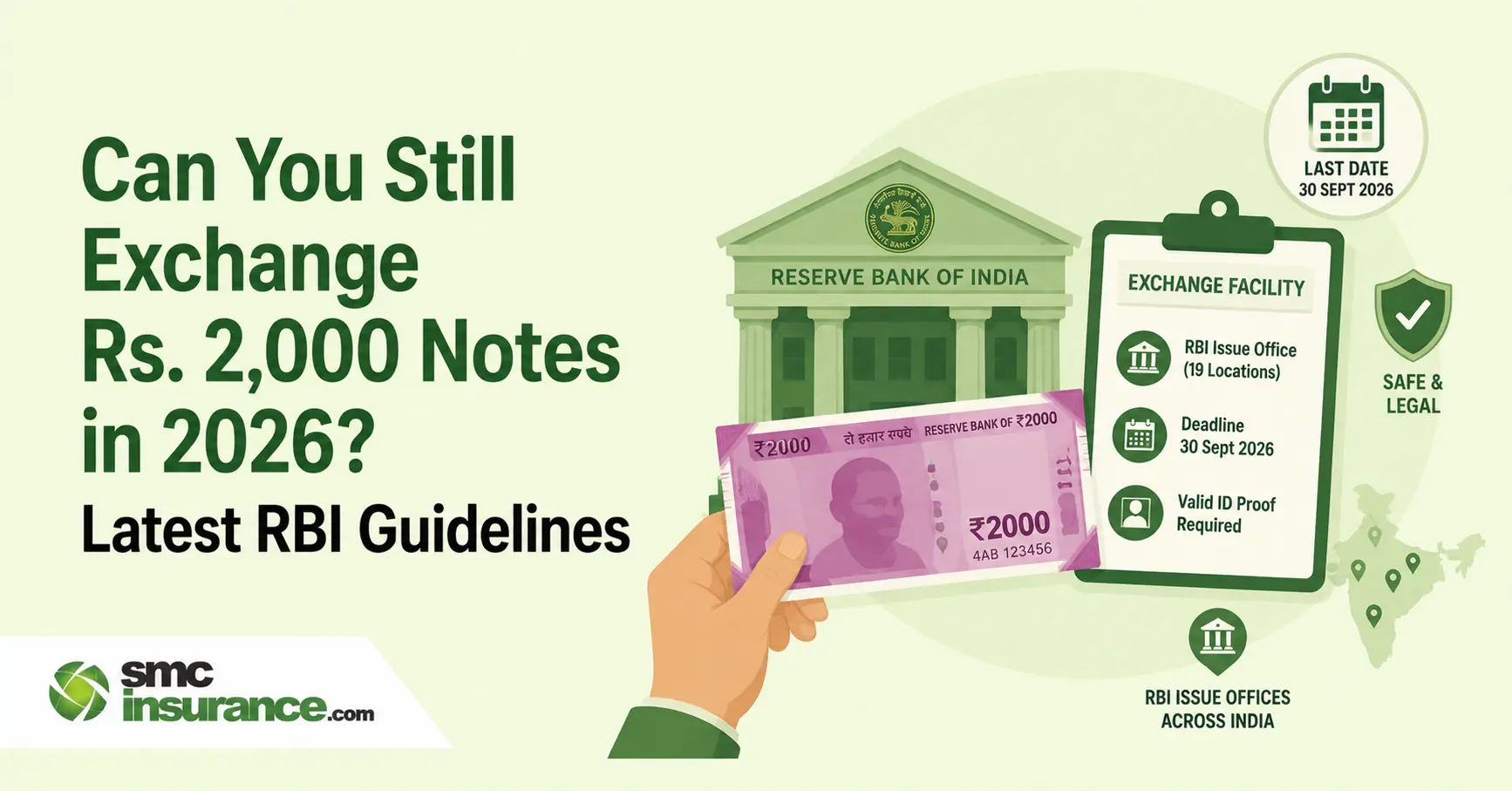
Yes, Rs. 2,000 notes continue to be legal tender in India, even though RBI withdrew them from circulation in May 2023. Individuals and entities can exchange these notes for other denominations at any of RBI's 19 Issue Offices, subject to a limit of Rs. 20,000 per transaction. Alternatively, they can tender the notes at an Issue Office for credit to an Indian bank account, without a specified amount cap. India Post also provides a route to send the notes to an RBI Issue Office for account credit. The facility remains available until further advice from RBI, while regular bank branches stopped accepting the notes after October 7, 2023.
Table of Contents
- Are Rs. 2,000 Notes Still Legal Tender in India in 2026?
- Can You Still Exchange Rs. 2,000 Notes in 2026? What RBI Allows Today
- Why Did RBI Withdraw Rs. 2,000 Notes from Circulation?
- How to Exchange or Deposit Rs. 2,000 Notes in 2026
- How Many Rs. 2,000 Notes Are Still Out There? Latest RBI Figures
- RBI Issue Offices List: Where Can You Exchange Rs. 2,000 Notes?
- Is There a Limit on Exchanging Rs. 2,000 Notes?
- Can You Still Exchange Rs. 2,000 Notes at Banks, ATMs or Online in 2026?
- What Documents Do You Need to Exchange Rs. 2,000 Notes?
- What to Do After You Exchange Rs. 2,000 Notes
- Is There a Last Date to Exchange Rs. 2,000 Notes in 2026?
A forgotten Rs. 2,000 note inside an old wedding envelope or a winter jacket can cause a small panic, because everyone you ask seems to have a different answer on whether it is still worth anything. So, can you still exchange Rs. 2,000 notes in 2026? Yes, but not at the bank branch you would normally walk into, since branches stopped accepting them on October 7, 2023. What remains are RBI’s 19 Issue Offices and India Post, with a Rs. 20,000 cap on cash exchange and a separate set of rules if you would rather have the money credited to your account. By the end of this guide you will know which route suits your amount, what to carry and which mistakes waste a trip.
Are Rs. 2,000 Notes Still Legal Tender in India in 2026?
Start here, because the answer decides whether anything else in this guide is worth your time.
RBI’s consolidated circular of June 9, 2026 states that the Rs. 2,000 note continues to be legal tender, a line the central bank has repeated in each of its status updates since announcing the withdrawal on May 19, 2023.
The confusion comes from two terms that sound alike. Withdrawing a denomination from circulation means RBI stops issuing it and draws existing notes back through the banking system, whereas demonetisation cancels legal-tender status outright, as happened to Rs. 500 and Rs. 1,000 notes in November 2016. The 2000 rupee note went through the first process and not the second.
Whether the shopkeeper at your corner will accept one is a different matter. RBI says the public can keep using these notes and receive them in payment, yet plenty of traders hesitate out of habit and a billing counter is a poor place to win that argument. Exchanging the note is usually the quicker fix.
Can You Still Exchange Rs. 2,000 Notes in 2026? What RBI Allows Today
The short version is yes, though the counter you need has changed.
Exchange is available at the 19 RBI Issue Offices, a facility that began on May 19, 2023, while the regular bank-branch window closed after October 7, 2023. Since October 9, 2023, those same offices have also accepted Rs. 2,000 notes from individuals and entities for deposit into their bank accounts and the June 9, 2026 consolidated instructions say the arrangement stays in place until further advice.
Two different things sit under that one facility. Exchange means handing over the notes and leaving with smaller denominations, which RBI caps at Rs. 20,000 at a time, while deposit or credit means the value lands in your Indian bank account with no amount cap, though identity checks and due diligence apply to both. Which is exactly where people get tripped up, turning up with Rs. 1 lakh in pink notes and expecting to walk out with cash.
Why Did RBI Withdraw Rs. 2,000 Notes from Circulation?
The history matters because it explains why RBI never cancelled the note.
RBI introduced the Rs. 2,000 note in November 2016, under Section 24(1) of the RBI Act, mainly to restore currency quickly after Rs. 500 and Rs. 1,000 notes lost their legal-tender status. Once that job was done and other denominations were available in adequate quantities, printing stopped in 2018-19.
By 2023 most of these notes had been issued before March 2017 and were nearing the end of an estimated life of four to five years and RBI also observed that the denomination was not commonly used in transactions. On May 19, 2023, under its Clean Note Policy, which exists to keep good-quality notes in public hands, it decided to withdraw them. Nothing in that decision declared the notes invalid, which is why the exchange window is still open more than three years later.
How to Exchange or Deposit Rs. 2,000 Notes in 2026
Which route fits you depends on how much you hold and how far the nearest Issue Office is.
Option 1: Exchange at an RBI Issue Office for Smaller Notes
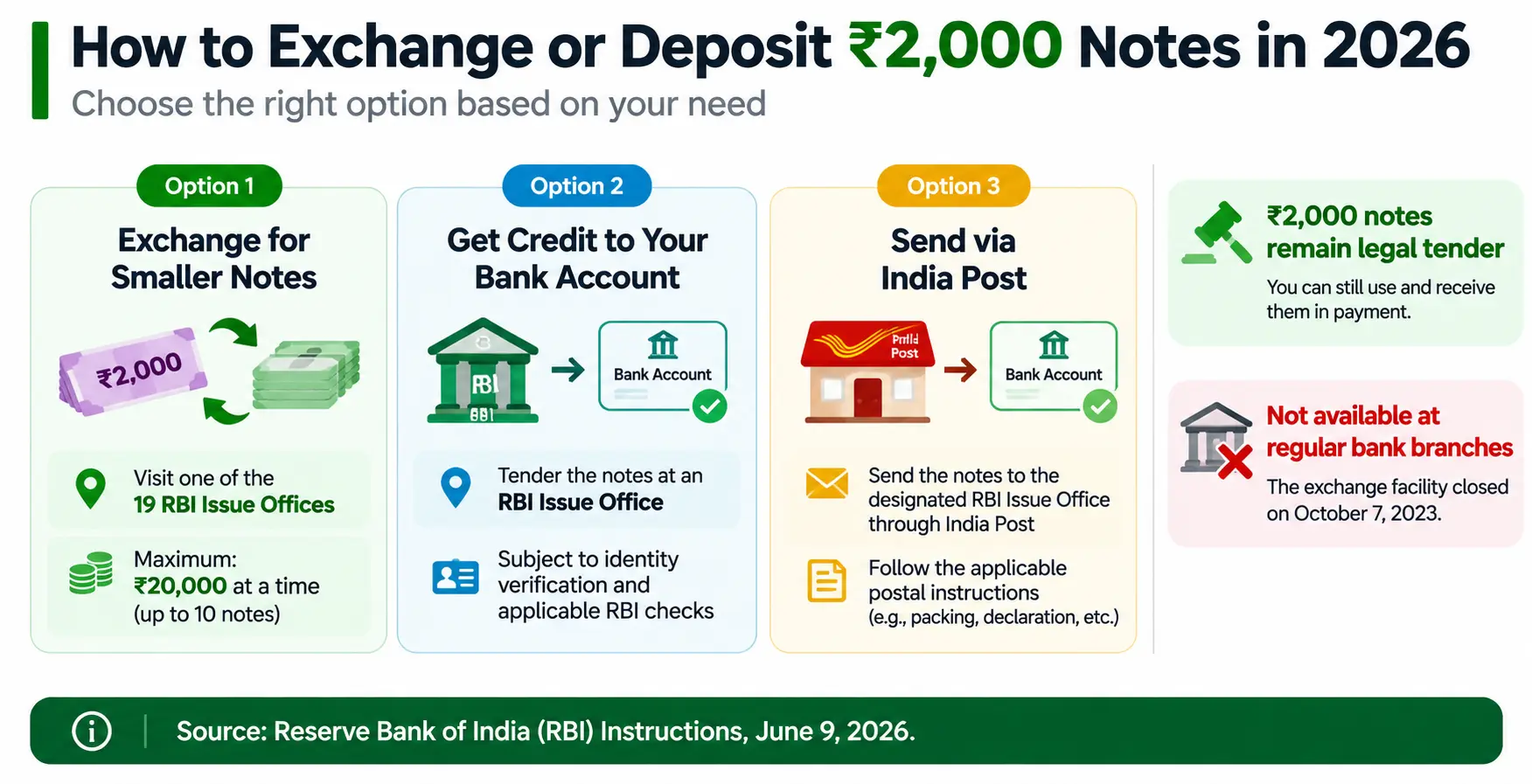
This is the only route that puts cash in your hand on the same day. Visit one of RBI's 19 Issue Offices to exchange your Rs. 2,000 notes for other denominations. The exchange facility is available up to Rs. 20,000 at a time, equivalent to ten notes. Carry valid identity documents, as RBI makes the exchange subject to applicable regulatory requirements and due diligence. Check the relevant Issue Office's location and operating arrangements before making the trip.
Option 2: Tender Notes at an Issue Office for Credit to Your Bank Account
If you hold more than ten notes, this is the sensible route. Individuals and entities can tender Rs. 2,000 notes at any of RBI's 19 Issue Offices for credit to their Indian bank accounts, without the Rs. 20,000 exchange limit applying to this facility. The process remains subject to applicable RBI and government regulations, submission of valid identity documents and due diligence. Carry your bank account details and supporting account documents to facilitate verification.
Option 3: Send Notes Through India Post
For readers far from an Issue Office, India Post is the practical answer. You can post Rs. 2,000 notes from any post office in the country to any of the 19 offices for credit to your Indian bank account, which matters in a state like Tamil Nadu, where the only office is in Chennai and someone in Madurai faces a long day out. The procedure, as laid down by the Department of Posts, runs like this:
- Get the form: Download RBI’s application for credit of Rs. 2,000 banknotes from the Forms section of the RBI website and fill in your account details.
- Attach your documents: Add a self-attested copy of an officially valid document such as Aadhaar or PAN, along with a cancelled cheque or the first page of your passbook showing your name, account number and IFSC code.
- Go to the right counter: Visit a head post office or sub-post office and ask for the Rs. 2,000 banknote booking, since the Department of Posts handles these only as insured articles.
- Respect the dispatch limit: Each posting can carry up to Rs. 20,000, meaning ten notes, so a larger stash has to go in separate postings.
- Pack in front of the postal staff: Carry the cover unsealed, pack it at the counter and complete whatever declaration the post office asks for.
- Send by insured post and keep the receipt: Use insured speed post or insured registered post, addressed to the Regional Director, Issue Department of your chosen office. For Chennai that is Reserve Bank of India, Fort Glacis, 16 Rajaji Salai, Chennai 600001, but confirm the address on RBI’s website first. Pay the postage and insurance charges and hold on to the tracking receipt until the credit appears.
In the sources we checked, RBI does not publish a turnaround time for postal credits, so keep that tracking number handy in case you need to follow up with the Issue Office.
How Many Rs. 2,000 Notes Are Still Out There? Latest RBI Figures
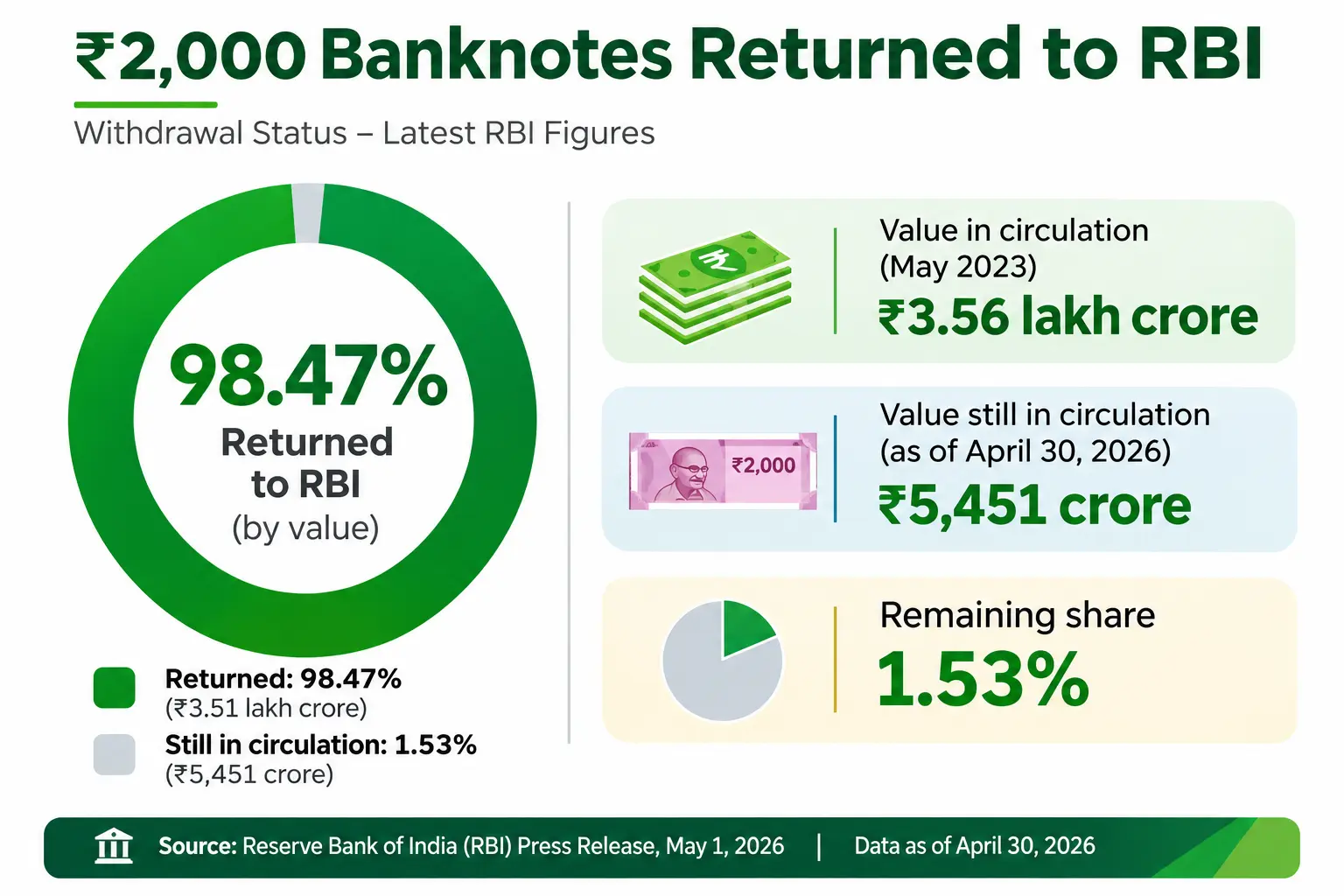
The scale of what remains puts the note in your drawer in context. When the withdrawal was announced on May 19, 2023, Rs. 2,000 notes worth Rs. 3.56 lakh crore were in circulation. RBI’s May 1, 2026 update puts that figure at Rs. 5,451 crore as of April 30, 2026, which means 98.47% has come back, roughly Rs. 3.5 lakh crore in value.
The remaining pool is still shrinking, if slowly. RBI’s earlier releases showed Rs. 5,669 crore at the end of December 2025 and Rs. 5,501 crore at the end of March 2026, so the balance has been falling by roughly Rs. 55 crore a month. These are April 2026 numbers, so check RBI’s press release page for anything newer before you quote them.
RBI Issue Offices List: Where Can You Exchange Rs. 2,000 Notes?
Here are all 19 offices, grouped by state so you can spot the nearest one quickly.
- Delhi: New Delhi
- Maharashtra: Mumbai, Belapur (Navi Mumbai) and Nagpur
- Gujarat: Ahmedabad
- Rajasthan: Jaipur
- Madhya Pradesh: Bhopal
- Uttar Pradesh: Lucknow and Kanpur
- Chandigarh: Chandigarh
- Jammu and Kashmir: Jammu
- Bihar: Patna
- Odisha: Bhubaneswar
- West Bengal: Kolkata
- Assam: Guwahati
- Telangana: Hyderabad
- Karnataka: Bengaluru (spelt Bangalore in RBI’s circular)
- Tamil Nadu: Chennai
- Kerala: Thiruvananthapuram
Before visiting, check the latest contact details and operating information for your selected RBI Issue Office through the official RBI website. Do not assume that the same operating arrangements apply to every location. Some states, Jharkhand and Chhattisgarh among them, have no Issue Office at all and for those readers the postal route is the realistic option.
Is There a Limit on Exchanging Rs. 2,000 Notes?
The cap catches people out, so here is how it applies in each situation.
Route |
What you receive |
Limit |
Exchange at RBI Issue Office | Cash in other denominations | Rs. 20,000 at a time |
Tender at RBI Issue Office | Credit to Indian bank account | No specified amount cap under the facility |
Send through India Post | Credit to Indian bank account | Follow applicable postal instructions; verify the permitted amount |
That last point is why anyone holding a large amount is better off choosing account credit than planning repeated cash trips. India Post is the one route with a running cost, since postage and mandatory insurance are payable on every posting.
Cash that sat unused for years deserves a plan once it is back in your account. If part of it should go toward a health or term cover, SMC Insurance can help you compare plans and premiums in minutes at SMC Insurance.
Can You Still Exchange Rs. 2,000 Notes at Banks, ATMs or Online in 2026?
The list of dead ends is longer than the list of options, so it helps to see both at a glance.
Channel |
Exchange or deposit of Rs. 2,000 notes in 2026 |
Regular bank branches (SBI, HDFC Bank, ICICI Bank and others) | Not available since October 7, 2023 |
ATMs and cash recyclers | Not available; banks were told to stop issuing the notes in May 2023 |
Online banking, mobile banking and UPI | Not available; physical notes cannot be exchanged digitally |
Post office counters (direct exchange) | Not available; notes can only be posted to an Issue Office for account credit |
RBI Issue Offices | Available until further advice |
India Post, sent to an RBI Issue Office | Available for account credit |
Note: Based on RBI’s circular dated June 9, 2026 and press release dated May 1, 2026. The facility continues until further advice, so recheck before acting.
Can You Exchange Rs. 2,000 Notes at Regular Bank Branches?
No. The branch facility ran only until October 7, 2023 and that covers every commercial bank, from SBI and HDFC Bank to ICICI Bank and smaller lenders. If a manager sends you away, the manager is following RBI’s instructions and arguing will not change the outcome.
Can You Exchange Rs. 2,000 Notes at ATMs?
No. Banks were told in May 2023 to stop issuing Rs. 2,000 notes and ATMs and cash recyclers were to be reconfigured accordingly. Machines are not part of the exchange facility, so the notes you hold can only be dealt with at an Issue Office or through the post.
Can You Deposit Rs. 2,000 Notes Through Online Banking or UPI?
No. Net banking, mobile apps and UPI move digital balances and have no way of taking a physical note, so RBI’s counter process remains the only path to account credit.
Can Post Offices Exchange Rs. 2,000 Notes?
Not directly. A post office will not hand you smaller notes in return and it can only book your notes as an insured article addressed to an RBI Issue Office, which then credits your account.
What Documents Do You Need to Exchange Rs. 2,000 Notes?
RBI has not published one fixed checklist for every case, so what you carry depends on the route you pick.
For exchange at an Issue Office, RBI makes the transaction subject to valid identity documents and such due diligence as RBI deems fit, so take a government photo ID such as your Aadhaar and be ready for extra questions if the amount is large. For account credit, add your bank account details and for the postal route you also need RBI’s application form, a copy of your ID and proof of the account, as described above.
One more practical point is tax. Banks report savings-account cash deposits of Rs. 10 lakh or more in a financial year to the Income Tax Department and that is a reporting threshold rather than an accusation. If you are crediting a large stash of old notes, keep a note of where the cash came from, whether household savings or a family gift, so a query later does not catch you off guard.
What to Do After You Exchange Rs. 2,000 Notes
Notes in a drawer earn nothing and once the money sits in your account it can finally do some work.
If you plan to use the exchanged money to pay health insurance premiums, consider making the payment through an accepted non-cash mode and retain the payment receipt. Under the earlier Section 80D provisions of the Income-tax Act, 1961, health insurance premiums paid in cash were not eligible for deduction, although cash payments for preventive health check-ups were permitted within the applicable limits. These provisions applied to eligible taxpayers under the old tax regime. The Income-tax Act, 2025 came into effect on April 1, 2026, so tax benefits for payments made during Tax Year 2026-27 should be checked against the corresponding provisions of the new law. Our guide to the Section 80D deduction rules explains the limits, so be sure to check it out.
Is There a Last Date to Exchange Rs. 2,000 Notes in 2026?
This is the question behind most searches and the answer comes in two parts.
October 7, 2023 was the last date for exchanging or depositing Rs. 2,000 notes through regular bank branches. However, the facility at RBI's 19 Issue Offices continues until further advice. RBI has not specified a final closure date in its June 9, 2026 consolidated instructions.
Open-ended should not be mistaken for permanent, though. “Until further advice” means RBI can close the window with a single circular and in our view that is reason enough to deal with your notes in the coming weeks rather than wait, because waiting gains you nothing and the facility is free of any deadline only for now. Check RBI’s currency notifications page for anything newer before you set out.
Whichever route you choose, stay away from agents who offer to convert your notes for a commission. The three routes above are the only authorised ones and a middleman adds cost and risk without adding any legitimacy.
Wrapping Up
Yes, Rs. 2,000 notes continue to be legal tender in India, although they have been withdrawn from circulation. Regular bank branches stopped accepting them after October 7, 2023, but RBI's 19 Issue Offices continue to provide exchange and account-credit facilities until further advice.
If you want smaller denominations, you can exchange notes worth up to Rs. 20,000 at a time. For larger holdings, you can tender the notes at an RBI Issue Office for credit to your Indian bank account. If travelling to an Issue Office is inconvenient, India Post provides another route for sending the notes for account credit, subject to the applicable postal procedure. Before taking action, check RBI's latest instructions, confirm the relevant Issue Office details and keep the necessary identification and account documents ready. Avoid unofficial agents offering to exchange the notes for a fee.
Disclaimer: The information provided on this platform is intended for general awareness and educational purposes. While every effort is made to ensure accuracy, some details may change with policy updates, regulatory revisions, or insurer-specific modifications. Readers should verify current terms and conditions directly with relevant insurers or through professional consultation before making any decision.
All views and analyses presented are based on publicly available data, internal research and other sources considered reliable at the time of writing. These do not constitute professional advice, recommendations, or guarantees of any product’s performance. Readers are encouraged to assess the information independently and seek qualified guidance suited to their individual requirements. Customers are advised to review official sales brochures, policy documents and disclosures before proceeding with any purchase or commitment.
FAQs
Yes, RBI’s 19 Issue Offices continue to exchange Rs. 2,000 notes for other denominations up to Rs. 20,000 at a time and to accept them for credit to Indian bank accounts. RBI’s June 9, 2026 instructions say the facility continues until further advice. Regular bank branches stopped accepting the notes after October 7, 2023, so a branch visit will not work.
No, the special facility at bank branches ended on October 7, 2023 and that applies to SBI, HDFC Bank, ICICI Bank and every other commercial bank. The notes can still be exchanged or deposited, but only through an RBI Issue Office or by posting them to one through India Post.
RBI allows exchange up to Rs. 20,000 at a time, which means ten notes. That cap applies to swapping notes for other denominations. If you want the value in your bank account instead, RBI allows any amount to be tendered at an Issue Office, subject to identity checks and due diligence.
Yes, RBI permits individuals and entities within India to send Rs. 2,000 banknotes through India Post to any of its 19 Issue Offices for credit to their Indian bank accounts. The process must follow the Department of Posts' applicable instructions and RBI's documentation and verification requirements. Check the current postal procedure before dispatching the notes.
There is no final date at present. The branch window closed on October 7, 2023, while the Issue Office facility continued until further advice, according to the June 9, 2026 circular. Because that wording can change with a new circular, check rbi.org.in before you go and avoid leaving it too late.
Yes, RBI has stated repeatedly that Rs. 2,000 notes continue to be legal tender, even though they were withdrawn from circulation on May 19, 2023. Withdrawal is not demonetisation. Some shopkeepers may still hesitate to accept them, so exchanging or depositing the note is the practical choice.
According to RBI's latest published status update dated May 1, 2026, Rs. 2,000 banknotes worth Rs. 5,451 crore remained in circulation as of April 30, 2026. This represents approximately 1.53% of the Rs. 3.56 lakh crore that was in circulation when RBI announced the withdrawal in May 2023. Approximately 98.47% of the original value had been returned.


