


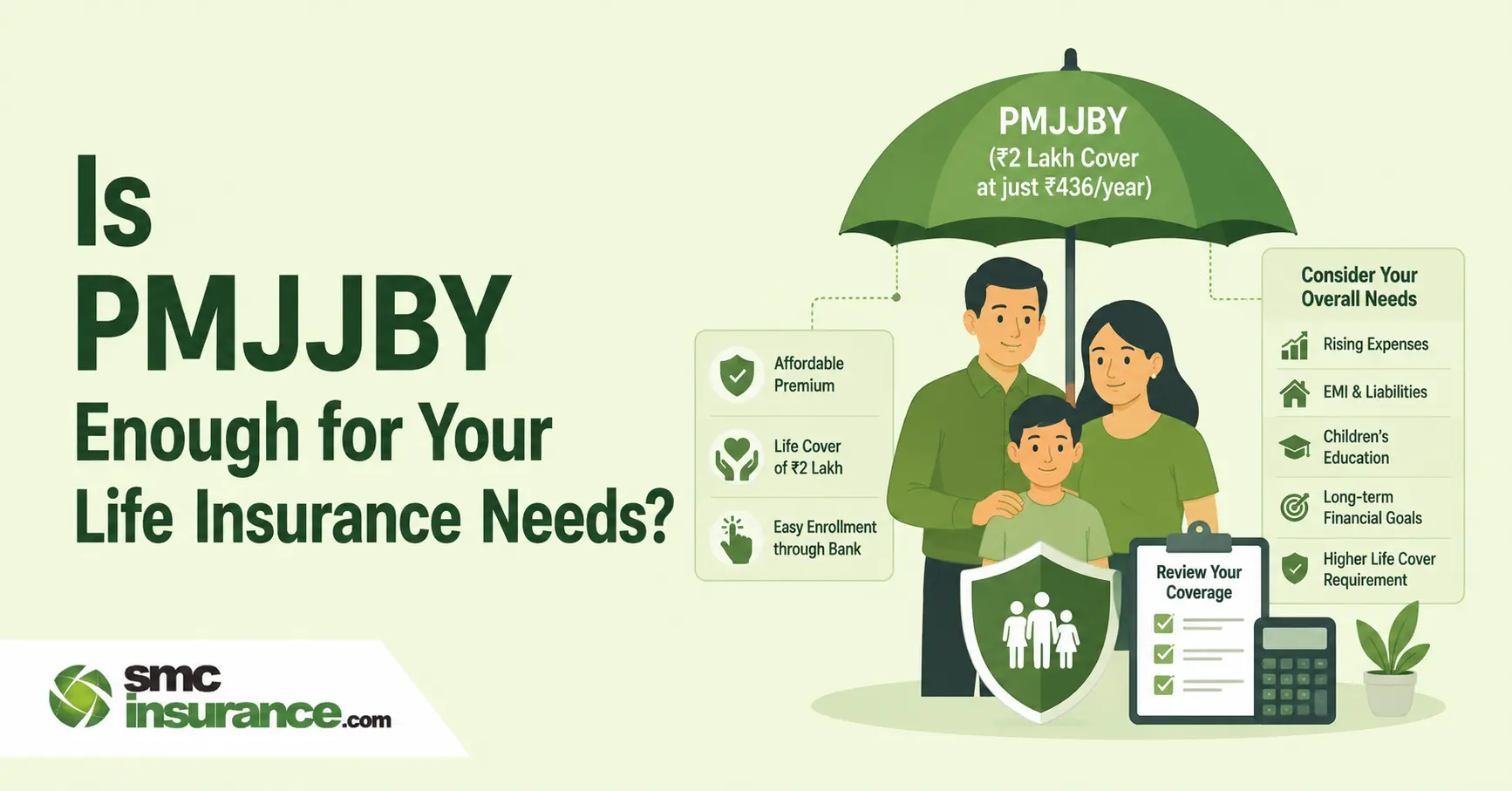

Rs 436 a year is the current annual premium for Rs 2 lakh of life cover under the Pradhan Mantri Jeevan Jyoti Bima Yojana (PMJJBY). The premium is collected through auto-debit from the subscriber's designated bank or post office account after opting into the scheme. This article breaks down exactly what PMJJBY offers, where it genuinely helps and where the gap between what you have and what your family actually needs starts to show.
Table of Contents
- What Is PMJJBY and How Does It Work?
- PMJJBY Benefits and Eligibility at a Glance
- How Much Life Cover Does an Indian Family Actually Need?
- Where PMJJBY Falls Short: Real Gaps to Know Before You Rely on It Only
- How to Enrol in or Renew Your PMJJBY Cover
- PMJJBY vs Term Insurance
- PMJJBY vs a Proper Term Insurance Plan: What Should You Actually Buy?
What Is PMJJBY and How Does It Work?
PMJJBY is a government-backed, renewable term life insurance scheme administered by the Department of Financial Services under the Ministry of Finance. It runs through banks and post offices, which act as the master policyholders, while LIC and other participating life insurers handle the actual underwriting and claims. Any account holder between 18 and 50 years can enrol and coverage continues until the subscriber turns 55, as long as the policy is renewed every year and the premium keeps getting deducted.
The mechanics are refreshingly simple and that is really the point of the scheme. You give a one-time consent for auto-debit, the bank deducts Rs 436 from your account each policy year and the cover runs from 1st June to 31st May. PMJJBY provides a Rs 2 lakh death benefit for death due to any cause. However, for first-time and rejoining subscribers, deaths other than those caused by an accident during the first 30 days from enrolment are not covered. Accidental death is covered from the date of joining. PMJJBY is designed as a simple bank- or post-office-linked insurance scheme, with enrollment based on prescribed consent and auto-debit arrangements rather than the type of individual policy application process commonly associated with retail term insurance.
PMJJBY Benefits and Eligibility at a Glance
Before deciding whether this cover fits your needs, it helps to see the full picture in one place. Here is what the scheme actually offers and who qualifies.
Feature |
Details |
Entry age | 18 to 50 years |
Cover ceases at | 55 years, subject to annual renewal |
Sum assured | Rs 2,00,000 on death due to any cause |
Annual premium | Rs 436 per subscriber |
Payment mode | Auto-debit from bank or post office account |
Policy tenure | 1 year, renewable annually (1st June to 31st May) |
Lien period | First 30 days for new enrolments, non-accidental deaths not covered |
Maturity or survival benefit | None, this is a pure risk cover |
NRI eligibility | Yes, with an Indian bank account, claims paid only in INR |
Note: One individual can enrol through only one bank account, even if they hold multiple accounts across banks. Premium amounts are subject to revision by the government from time to time.
That table looks reassuring on paper and for what it costs, it genuinely is good value. The trouble starts when you compare that Rs 2 lakh figure against what a household actually needs to stay afloat if the primary earner is gone.
How Much Life Cover Does an Indian Family Actually Need?
Most financial planners work off a simple rule of thumb here, that your life cover should be somewhere between 10 and 15 times your annual income, adjusted for outstanding loans, dependents and future goals like a child's college fees or a daughter's wedding. Someone earning Rs 8 lakh a year, going by that math, should ideally be covered for at least Rs 80 lakh to Rs 1.2 crore. PMJJBY's Rs 2 lakh does not come close to touching that number and it was never designed to.
In our experience at SMC, this gap is the single biggest misconception we run into with first-time customers. A lot of them genuinely believe they are "insured" because their salary account has PMJJBY attached to it and they stop thinking about life insurance altogether. We usually ask them one direct question during a policy review: if something happened to you tomorrow, could your family run the household on Rs 2 lakh for more than a couple of months? The honest answer is almost always no.
This is where the scheme's purpose becomes clearer. PMJJBY was designed to expand access to affordable life insurance through the banking and post-office network, particularly by making basic life cover available at a low annual premium. It was never meant to replace a proper income-replacement plan for someone with a mortgage, school fees, or dependent parents.
We at SMC believe the smarter approach is to treat your PMJJBY as a bonus that runs alongside a comprehensive term plan, not as your only policy. A term insurance plan sized correctly against your income and liabilities, paired with the near-free PMJJBY cover, gives your family a far more realistic financial cushion.
Where PMJJBY Falls Short: Real Gaps to Know Before You Rely on It Only
A few structural limitations matter here and they are worth spelling out plainly rather than glossing over.
- The sum assured never grows.
Rs 2 lakh bought in 2015 and Rs 2 lakh bought in 2026 mean very different things once you account for inflation and rising living costs. The current PMJJBY death benefit is fixed at Rs 2 lakh. The benefit does not automatically increase with income, inflation, age or financial liabilities. - Coverage stops at 55.
Most working professionals still have a decade or more of active earning years and possibly an ongoing home loan, well past that age. PMJJBY simply exits the picture right when many people still need protection. - No maturity or investment component.
This is not necessarily a downside, since a pure risk cover is exactly what keeps the premium this low, but it does mean you get nothing back if you outlive the policy and it cannot double up as a savings tool the way some other plans do. - One policy per person.
Even if you hold accounts in three different banks, you can only enrol under PMJJBY through one of them, so there is no scope to stack multiple PMJJBY covers to bump up the sum assured. - It depends entirely on your bank account staying active.
If the linked bank or post office account is closed or does not have sufficient balance to keep the insurance in force, the PMJJBY cover can terminate. Subscribers should therefore ensure that the designated account remains active and adequately funded for the applicable premium debit.
None of this makes PMJJBY a bad scheme. For the price, it delivers real value, particularly for people in the informal economy who might otherwise have zero life cover. The issue is only when it becomes someone's entire insurance plan by default, rather than by choice.
Every rupee you're not spending on real protection is a rupee your family will have to find some other way. If your only life cover right now is what your bank auto-debited without you noticing, it's worth a five-minute conversation before that becomes a problem for someone else to solve. Visit SMC Insurance to compare term plans that actually match your income and liabilities.
How to Enrol in or Renew Your PMJJBY Cover
If you are not yet enrolled, or your cover lapsed and you want to rejoin, the process is straightforward enough to do in a single bank visit or through net banking.
- Check your eligibility.
Confirm you are between 18 and 50 years old and hold an active savings account with a participating bank or post office. - Get the enrolment form.
Participating banks and post offices facilitate PMJJBY enrolment using the prescribed enrolment and consent process. Depending on the institution, customers may be able to enrol through branch or digital banking channels. - Give auto-debit consent.
You need to provide the prescribed consent/auto-debit authorisation and complete the enrolment requirements specified by the participating bank or post office. - Submit and confirm.
Once the form is processed, keep the acknowledgement receipt. Your cover typically becomes active from the date the first premium is debited, subject to the 30-day lien period for non-accidental deaths. - Renew every year.
The policy runs annually from June to May and renewal happens automatically as long as sufficient balance is available in your account on the due date. - Rejoining after a lapse.
If you exit and want to come back later, you can re-enrol by paying the fresh premium, though the 30-day lien period will apply again for non-accidental deaths.
PMJJBY vs Term Insurance
Feature |
PMJJBY |
Individual Term Insurance |
Type | Government-backed group term life scheme | Individual life insurance policy |
Cover amount | Rs 2 lakh | Selected by policyholder, subject to insurer's underwriting |
Premium | Rs 436 annually under current PMJJBY terms | Depends on age, cover, term, health and other underwriting factors |
Entry age | 18 to 50 | Depends on insurer/product |
Cover end | Age 55 under PMJJBY | Depends on policy term |
Medical underwriting | Scheme-based enrolment process | May involve medical underwriting depending on insurer/product |
Maturity benefit | None | Usually none in pure term insurance |
Customisation | Limited | Generally more scope to choose sum assured and policy term |
PMJJBY vs a Proper Term Insurance Plan: What Should You Actually Buy?
The honest answer is both and here is why that is not just a sales pitch. PMJJBY costs next to nothing and requires no medical tests, so there is no real reason to opt out of it if you are eligible. But a term insurance plan with a sum assured matched to your actual income and liabilities is what genuinely protects your family's financial future, covering things like your outstanding home loan, your children's education and your spouse's living expenses for years, not months.
Premium paid towards a standalone term plan can also bring you tax benefits under the Income Tax Act, something worth factoring into your decision if you are comparing the two on cost. Run the PMJJBY premium in the background and put your real planning effort into a term plan sized for your life, not your bank's default offering.
Summing Up
PMJJBY does exactly what it was designed to do, offering a basic financial cushion to as many bank account holders as possible at a price that is hard to say no to. For Rs 436 a year, there is genuinely no reason to skip it if you qualify. But calling it "your life insurance" stretches the truth a little too far for most working Indians, given how far Rs 2 lakh falls short of what a family needs to stay financially stable after losing its primary earner. The scheme works best as a small addition to a real plan, not as the plan itself. If your only cover today is PMJJBY, treat that as a starting point rather than a finish line and use it as the nudge to sit down and calculate what your family would actually need, then close that gap with a term plan built around your real numbers.
Disclaimer: The information provided on this platform is intended for general awareness and educational purposes. While every effort is made to ensure accuracy, some details may change with policy updates, regulatory revisions, or insurer-specific modifications. Readers should verify current terms and conditions directly with relevant insurers or through professional consultation before making any decision.
All views and analyses presented are based on publicly available data, internal research and other sources considered reliable at the time of writing. These do not constitute professional advice, recommendations, or guarantees of any product’s performance. Readers are encouraged to assess the information independently and seek qualified guidance suited to their individual requirements. Customers are advised to review official sales brochures, policy documents and disclosures before proceeding with any purchase or commitment.
FAQs
No, in most cases it is not. Rs 2 lakh is useful as a small buffer, but it will not replace years of lost income, cover a home loan, or fund a child's education. Financial planners generally recommend a cover of 10 to 15 times your annual income, which PMJJBY does not come close to matching on its own.
Yes, absolutely. There is nothing preventing you from holding a PMJJBY cover through your bank account while also owning a full-fledged term insurance plan from any insurer. In fact, this combination is what most financial advisors, including us at SMC, recommend.
No, even if you hold savings accounts across several banks, you are only permitted to enroll under PMJJBY through one account. Enrolling through more than one account inadvertently results in the excess premium being forfeited, with cover restricted to the standard Rs 2 lakh.
Yes, PMJJBY covers death due to any cause, including accidents and suicide, once the policy is active and the initial 30-day lien period has passed for non-accidental deaths. Accidental deaths are covered from day one, without any lien period restriction.
Your cover lapses immediately once the linked bank account is closed, or if the account does not have sufficient balance on the premium due date. If the linked bank or post office account is closed or does not have sufficient balance to keep the insurance in force, the PMJJBY cover can terminate. Keep the designated account active and ensure that sufficient funds are available for the applicable premium debit.
PMJJBY premiums may qualify for deduction under Section 80C, subject to the applicable conditions and the tax regime chosen. Section 80C deductions, including eligible life insurance premiums, are available under the old tax regime subject to the overall Rs 1.5 lakh limit. Taxpayers using the new tax regime generally cannot claim the Section 80C deduction. Check the latest Income Tax Department provisions for the relevant assessment year.
Coverage under PMJJBY terminates once the subscriber reaches 55 years of age, subject to annual renewal up to that point. New entrants cannot join the scheme once they cross 50 years of age.
PMJJBY is a flat, one-size-fits-all cover of Rs 2 lakh available at a fixed low premium, with no medical checks and no customisation. A regular term insurance plan, by contrast, lets you choose your sum assured, policy tenure and riders based on your actual income and life stage, though it usually involves medical underwriting and a higher premium.


