


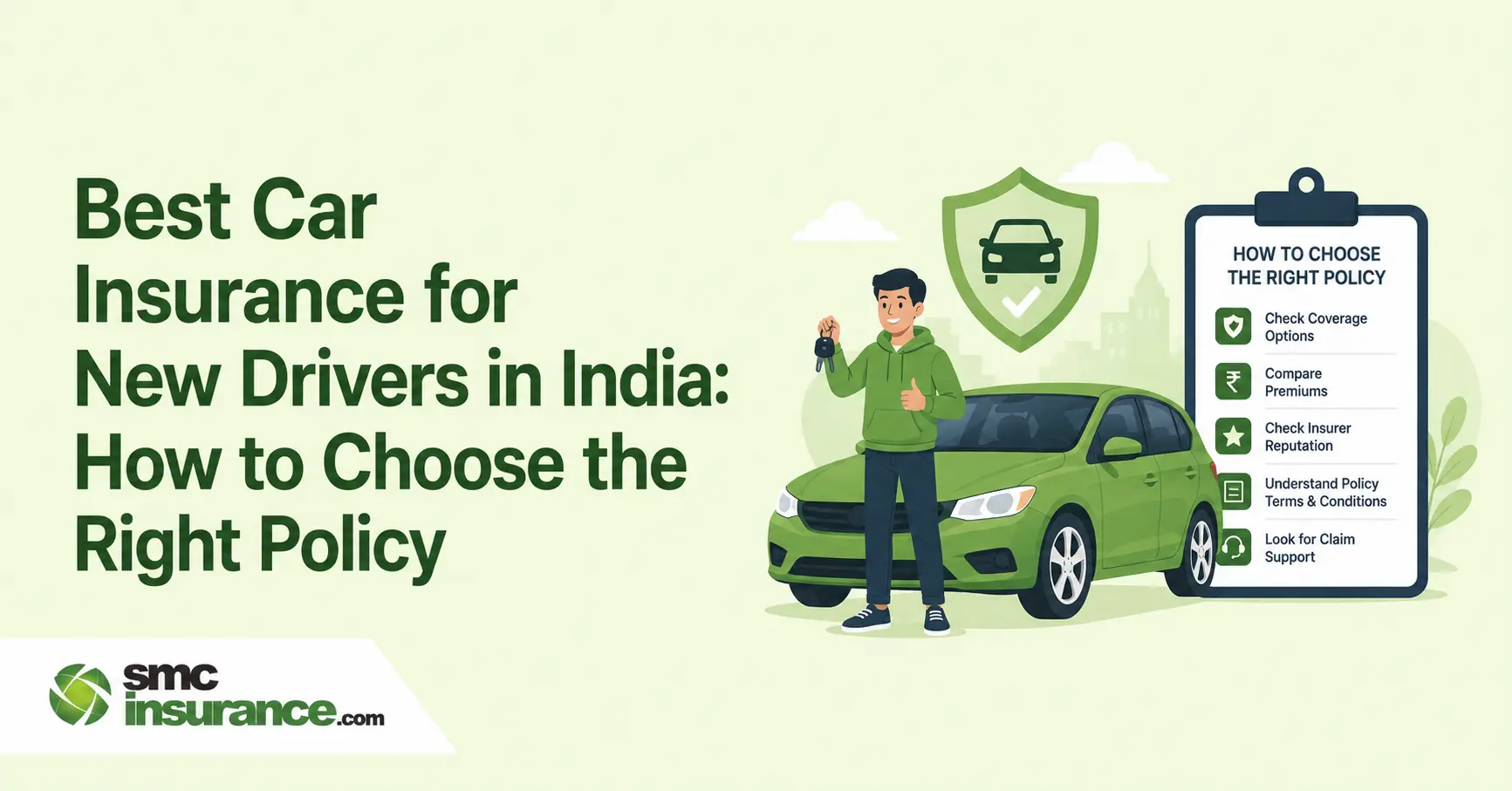
For most first-time car owners in India, comprehensive car insurance with zero depreciation cover is a practical starting point. Third-party insurance is legally mandatory, but it does not cover damage to your own vehicle. Choose an appropriate IDV, compare at least three quotations and check the insurer's nearby cashless garage network. Consider engine protection, roadside assistance or return-to-invoice cover according to your needs. In August 2026, the Supreme Court directed that mandatory third-party insurance for new cars be extended from three to four years, with IRDAI responsible for issuing the necessary implementation directions. Confirm the applicable policy duration before purchasing.
Table of Contents
- What Is the Best Car Insurancefor New Drivers in India?
- Types of Car Insurance Policies for New Drivers in India
- What's New in Motor Insurance in 2026?
- How Much Does Car Insurance Cost for a First-Time Car Owner in India?
- Best Car Insurance Companies for New Drivers in India
- Key Factors to Consider When Choosing Car Insurance for Your First Car
- Best Car Insurance Add-On Covers for New Drivers
- How to Reduce Car Insurance Premiums as a New Driver
- How to Buy the Best Car Insurance for New Drivers Online
- Common Car Insurance Mistakes New Drivers Should Avoid
The keys are in your hand and the showroom executive is already printing an insurance form whose total nobody has explained. That is when most first-time owners settle the Best Car Insurance for New Drivers question by default, because the dealer’s quote is the only one on the table. A policy picked in that hurry can cost more than it should, or leave a gap that surfaces when a bumper needs replacing and the claim cheque falls short.
This guide sets out what the law actually requires and what a comprehensive policy adds on top, then shows which add-ons earn their price in the first two years. By the end you should be able to pick, compare and buy a policy on your own in about fifteen minutes.
What Is the Best Car Insurancefor New Drivers in India?
There is no single winning policy, but there is a sensible starting point and it becomes obvious once you know what you are actually buying.
For a new car, or any car you would struggle to replace, comprehensive cover is that starting point. It combines the legally required third-party liability with protection for your own vehicle against accidents, theft, fire and natural calamities, subject to policy terms.
Where it gets personal is the fit. A financed hatchback parked on the street and driven daily through a waterlogged city needs far more protection than a paid-off second car that sleeps in a garage and goes out on weekends.
Your situation |
Sensible starting cover |
New car on a loan, parked on the street | Comprehensive with zero depreciation and return to invoice |
New car bought outright, covered parking, dry city | Comprehensive with zero depreciation |
Already hold third-party cover, want own-damage protection | Standalone own-damage policy |
Older, low-value car you could repair from savings | Third-party alone, or comprehensive without add-ons |
Note: This is a starting point, not a prescription. The right choice depends on your car’s value, how you use it and your budget and terms differ by insurer.
One disadvantage every first-time owner shares is a no claim bonus of zero, which means no renewal discount until you complete a claim-free year. Quote forms mostly ask about the car, the city of registration and the add-ons you choose, though some insurers may also weigh driving history, so declare everything honestly from the start.
Types of Car Insurance Policies for New Drivers in India
Indian motor insurance really comes in three formats and the gap between them decides what happens to your savings after an accident.
Third-Party Car Insurance Section 146 of the Motor Vehicles Act makes third-party cover compulsory for any car used in a public place. Driving without it can mean a fine of Rs. 2,000 for a first offence and Rs. 4,000 for a repeat, plus up to three months in jail. The policy pays for injury, death or property damage you cause to someone else. Compensation for death or injury is set by the Motor Accident Claims Tribunal with no upper limit, while property damage is capped at Rs. 7.5 lakh. It pays nothing for your own car, which is the gap first-time buyers tend to discover too late.
Rules for new cars have just shifted. On 4 August 2026 the Supreme Court directed that new cars carry four years of third-party cover instead of three and told IRDAI to issue the operating instructions, so ask the dealer in writing which term applies to your invoice. The same order asked for number-plate cameras to be linked with insurance and vehicle databases so that uninsured cars can be flagged and challaned automatically.
Owner-driver personal accident cover of Rs. 15 lakh is also compulsory, although you can avoid paying twice if you already hold a qualifying standalone policy, so confirm this with the insurer before buying.
Comprehensive Car Insurance A comprehensive car insurance policy bundles that same third-party liability with own-damage cover, so the insurer pays for repairs to your car after an accident, fire, theft or flood, less depreciation and deductibles. It also unlocks add-ons, which are not available on a third-party-only policy. Most of the real protection for a first car sits here.
Standalone Own-Damage Insurance Standalone own-damage insurance covers only your car and works only alongside a valid third-party policy. It became useful for new-car buyers after IRDAI required insurers to sell annual standalone cover in 2019, because you can now take the long-term third-party cover with the dealer’s insurer and shop for own-damage cover separately at renewal.
What's New in Motor Insurance in 2026?
The Supreme Court introduced important directions concerning motor insurance in August 2026, with an emphasis on clearer coverage choices and stronger protection for road users. One significant direction was the adoption of a four-layer insurance structure for private vehicles:
- Mandatory third-party insurance: Covers legally required third-party liabilities.
- Optional occupant cover: Provides additional protection for eligible passengers, subject to the selected policy.
- Personal accident protection: Addresses specified accident-related risks for eligible persons, depending on the coverage purchased and applicable requirements.
- Own-damage insurance: Protects the insured vehicle against covered damage or loss.
The Court also directed the introduction of clearer customer information and coverage-selection documents to help buyers understand what they are purchasing. For first-time car owners, the key takeaway is to examine each component of the policy instead of assuming that every person travelling in the vehicle or every type of damage is automatically covered. The operational implementation of these directions should be checked against subsequent IRDAI instructions.
How Much Does Car Insurance Cost for a First-Time Car Owner in India?
Cost has two parts, one fixed by the government and one set by the insurer and only the second part responds to the choices you make.
The third-party component of car insurance is governed by notified premium rates, while insurers determine the own-damage premium based on applicable underwriting factors. Under the Motor Vehicles (Third Party Insurance Base Premium and Liability) Rules, 2022, the annual base premiums for private cars are Rs. 2,094 for vehicles up to 1,000cc, Rs. 3,416 for vehicles above 1,000cc and up to 1,500cc, and Rs. 7,897 for vehicles exceeding 1,500cc. These are base rates, and the amount payable may vary with applicable taxes, policy duration and any subsequent regulatory revisions.
Engine capacity |
Annual third-party premium (before GST) |
Up to 1,000cc | Rs. 2,094 |
Above 1,000cc and up to 1,500cc | Rs. 3,416 |
Above 1,500cc | Rs. 7,897 |
Note: These are notified base rates before 18% GST. Electric cars have lower slabs based on motor power. Rates are revised from time to time, so confirm the current figure on your quote. The figures above represent annual third-party base premiums, not necessarily the total amount payable when insuring a newly purchased car. New vehicles are subject to multi-year third-party insurance requirements. Always check the applicable long-term premium, coverage duration and any additional own-damage premium before comparing quotes.
Insurers price the own-damage portion themselves and it moves with the car’s IDV, its age, the city of registration and the add-ons you attach. GST of 18% applies on the total and that rate has not changed for motor insurance, even though individual health and life policies became GST-free on 22 September 2025.
Your first renewal is where being new shows up. With no history you start at zero and the no claim bonus then climbs from 20% after one claim-free year to 50% after five, applied to the own-damage premium only. It follows you rather than the car, so an NCB certificate from your insurer lets you carry the discount to a replacement vehicle and a lapse beyond 90 days generally wipes it out.
Here is what a claim looks like in rupees. Consider a simplified example in which a covered plastic car part costs Rs. 15,000 to replace. Under a standard own-damage policy, a 50% depreciation deduction on that part would reduce the eligible amount to Rs. 7,500. After an assumed compulsory deductible of Rs. 1,000, the payout would be Rs. 6,500. If an applicable zero depreciation add-on removes the parts depreciation, the payout could rise to Rs. 14,000 after the same deductible. Actual claim settlements may differ depending on labour charges, additional deductibles, policy limits and exclusions. That is an illustration on parts cost alone, but it explains why the add-on matters.
Quotes that show different IDVs and add-on lists are hard to compare honestly. If you would rather have someone line them up for you, enter your car details at SMC Insurance and see like-for-like policies from our insurer partners, with claims help available after you buy.
Best Car Insurance Companies for New Drivers in India
Choosing an insurer mostly comes down to who can repair your car quickly near your home and how painless the claim feels afterwards, so the comparison below uses only what each company publishes itself. Naming one winner would mislead you. A fair shortlist is the five companies that sell car policies directly online and publish their garage numbers: ACKO, HDFC ERGO, ICICI Lombard, Bajaj General and Tata AIG.
Insurer |
Cashless garages (insurer’s own figure) |
Worth noting for a first-time owner |
Confirm before you buy |
ACKO | 4,000+ | Digital-only buying; free pick-up of damaged cars in select cities; no limit stated on the number of claims | Cashless repairs apply only to comprehensive plans |
HDFC ERGO | About 9,300 for private cars (12,277 across all vehicle types, 28 Feb 2025) | Overnight repair for minor damage in 16 listed cities; unlimited zero depreciation claims with that add-on | Overnight service depends on the damage and the garage’s capacity |
ICICI Lombard | 7,200+ (1 Sept 2026) | Doorstep cashless repair option; 30-minute roadside assistance promise; usage-based plans from 2,500 km a year | Conditions apply to the doorstep service and the promise |
Bajaj General | 7,200+ to 10,000+ | Claims can be registered from the accident spot on its app; 24x7 roadside assistance | Its pages quote different totals, so rely on the locator |
Tata AIG | 5,700+ to 6,300+ | Roadside help within 1 hour in cities and 2 hours on highways; a dedicated claim handler; no salvage deduction on partial losses | Add-on bundles and return to invoice carry car-age limits |
Note: Figures are as published by each insurer and were read in October 2026. Some include two-wheelers or use different counting dates, so treat them as pointers and check the locator with your own pincode.
Key Factors to Consider When Choosing Car Insurance for Your First Car
Five checks, done in this order, catch almost everything that goes wrong for first-time buyers.
Premium and Overall Affordability
The cheapest figure on screen is rarely the cheapest at the garage. A quote that shaves Rs. 1,500 by dropping an add-on or lowering the
IDV can cost many times that on the first claim, so compare what each premium actually buys.
Insured Declared Value (IDV) IDV is the most your insurer will pay if the car is stolen or written off and it falls as the car ages. Setting it low trims the premium but shrinks the cheque, so keep it close to the car’s current market value rather than the lowest option on the form.
Cashless Garage Network Cashless means the insurer settles with the workshop directly, so you pay only the deductible and any uncovered items. Confirm that a network garage near your home or office handles your car’s brand, because outside the network you pay first and claim reimbursement later.
Claim Settlement Process and Customer Support Find out how a claim is registered, whether a surveyor must inspect before repairs begin and how complaints escalate. Insurers expect quick intimation, often within 24 to 48 hours and repairs started before the survey can jeopardise the claim. If a claim stalls, IRDAI’s Bima Bharosa portal is the formal complaint channel, with the Insurance Ombudsman beyond that.
Policy Exclusions and Deductibles
Exclusions are where claims get rejected. Driving under the influence, driving without a valid licence, using a private car commercially and mechanical breakdown or normal wear and tear all fall outside standard cover. Beyond the compulsory deductible, a voluntary deductible lowers the premium but raises what you pay on every claim.
Best Car Insurance Add-On Covers for New Drivers
Add-ons are where a policy gets tailored and also where premiums quietly balloon, so the aim is to buy the few that match a real risk.
Zero Depreciation Cover Standard claims deduct depreciation from replaced parts and plastic, rubber, tyres and batteries lose half their value immediately. Zero depreciation cover removes that deduction so the insurer pays the full price of the new part. For a new car it is usually the first add-on worth buying, although the compulsory deductible still applies.
Roadside Assistance Cover Roadside assistance arranges towing to a garage, a flat tyre change, a battery jump-start or emergency fuel when the car stops mid-journey, depending on what the policy lists. On a highway at night, a towing number that actually works matters more than the few hundred rupees it adds.
Engine Protection Cover Standard policies generally exclude engine damage that follows water ingress, which makes a stalled car in a flooded underpass an expensive lesson. Engine protection pays for such damage, along with oil leakage and gearbox problems that do not arise from an accident, subject to policy terms. It earns its premium in cities where roads waterlog every monsoon.
Return to Invoice Cover
If the car is stolen or written off, a standard policy pays the IDV, which is lower than what you
paid at the showroom. Return to invoice tops the payout up to the original invoice value, which
matters most in the first couple of years when the gap is widest and a loan may still be running.
No Claim Bonus (NCB) Protection
NCB protection lets you make a claim without losing the discount you have built, but it typically covers one claim a
year and cannot be transferred the way the bonus itself can. For a new driver with little bonus to protect, it is a
later-year purchase rather than a day-one one.
How to Reduce Car Insurance Premiums as a New Driver
Lower premiums should come from smarter choices rather than thinner cover and three habits do most of the work.
Compare Multiple Insurance Quotes
Collect at least three quotes and force them to match on IDV, deductible and add-ons before judging the totals. A difference of a few hundred rupees often disappears once you notice that one quote carries a lower IDV.
Choose Add-Ons Carefully
Pick covers tied to a genuine risk, such as engine protection for a basement parking spot in a flood zone and skip the extras you could not explain to a friend.
Avoid Unnecessary Voluntary Deductibles
A voluntary deductible of Rs. 5,000 earns a 25% discount on the own-damage premium, capped at Rs. 1,500, so you save at most Rs. 1,500 in exchange for paying Rs. 5,000 more on any claim. That trade rarely suits someone still learning how the car behaves in tight parking. Ask whether ARAI-approved anti-theft devices earn a discount with your insurer and think twice before claiming for tiny scratches, since each claim resets your bonus.
How to Buy the Best Car Insurance for New Drivers Online
Buying online takes minutes, but the quality of the result depends on the care you put into the details and nothing obliges you to buy from the dealer.
- Keep documents ready:
You will need the vehicle invoice or registration details, your ID proof and loan details if the car is financed. - Enter details exactly:
Variant, fuel type, any CNG kit and city of registration all affect the quote and a wrong declaration can complicate a claim later. - Choose the term:
For a new car, confirm the third-party term and whether you are buying it bundled with one-year own-damage cover or separately. - Match and compare:
Keep IDV, deductible and add-ons identical across quotes, then read the policy wording on each insurer’s site before choosing. - Pay on the insurer’s verified website or app:
The policy document should reach your email within minutes. - Check the issued policy:
Verify your name, chassis and engine numbers, IDV, add-ons, personal accident cover and hypothecation details and ask for a correction at once if anything is off.
The deadline that matters is the day you first drive the car, since cover must be live before it goes on a public road. After that, diarise the renewal date, because a break beyond 90 days can wipe out your bonus. IRDAI’s motor insurance page is a good place to confirm how the rules are defined.
Common Car Insurance Mistakes New Drivers Should Avoid
Most expensive errors are made at the quote stage, long before any claim is filed.
- Choosing on price alone: The lowest premium often hides a lower IDV or a missing add-on.
- Setting an unsuitable IDV: Too low and a theft or total loss pays well under what the car is worth.
- Skipping the exclusions: A policy you have not read is a policy you cannot rely on.
- Giving inaccurate details: Hidden modifications, an undeclared CNG kit or a wrong bonus can lead to a rejected claim.
- Missing the renewal: A lapse leaves you uninsured on the road and puts your bonus at risk.
Wrapping Up,
Choosing car insurance for the first time does not have to be complicated. Start by understanding the difference between mandatory third-party protection and comprehensive coverage. Then choose a suitable IDV, examine the available add-ons and compare quotations with similar coverage conditions.
For a new car, zero depreciation can be a useful addition, while engine protection and roadside assistance may be worth considering depending on where and how you drive. Just as importantly, check the insurer's cashless garage network, claims process, deductibles and exclusions before making payment.
With the Supreme Court's August 2026 directions bringing further attention to long-term third-party insurance and clearer coverage choices, new-car buyers should also verify the latest applicable requirements. A carefully selected policy can help protect both your vehicle and your finances when an unexpected accident occurs.
Disclaimer: The information provided on this platform is intended for general awareness and educational purposes. While every effort is made to ensure accuracy, some details may change with policy updates, regulatory revisions, or insurer-specific modifications. Readers should verify current terms and conditions directly with relevant insurers or through professional consultation before making any decision.
All views and analyses presented are based on publicly available data, internal research and other sources considered reliable at the time of writing. These do not constitute professional advice, recommendations, or guarantees of any product’s performance. Readers are encouraged to assess the information independently and seek qualified guidance suited to their individual requirements. Customers are advised to review official sales brochures, policy documents and disclosures before proceeding with any purchase or commitment.
FAQs
There is no single best policy, but a comprehensive plan with zero depreciation cover suits most first-time owners because it protects your own car as well as others. Choose the insurer by garage coverage near you, claim handling and add-on terms, then compare three like-for-like quotes. Third-party alone is a legal minimum, not a protection plan for your car.
For most beginners, yes. Third-party pays for harm you cause to others and nothing for your own car and minor scrapes are common while you are still learning the car’s dimensions. Comprehensive adds own-damage cover. Third-party only makes sense for an older, low-value car whose repairs you could fund yourself.
Yes. Under Section 146 of the Motor Vehicles Act, 1988, third-party insurance is mandatory for vehicles used in public places. Driving without the required insurance can attract penalties under Section 196. In August 2026, the Supreme Court directed that new cars carry four years of third-party insurance instead of three, subject to the necessary implementation directions. Eligible owner-drivers must also comply with the applicable personal accident insurance requirements.
The third-party part is fixed at Rs. 2,094, Rs. 3,416 or Rs. 7,897 a year before GST, depending on engine size. Own-damage premiums vary with the car, its IDV, your city and the add-ons you pick, so the total differs for every buyer. Enter your registration details for an exact figure and remember 18% GST applies to the whole premium.
Not necessarily because of age. Quotes mainly depend on the car, its IDV, the city of registration and the add-ons chosen, though some insurers may consider driving history. What a new driver does lack is a no claim bonus, so you start without the 20% to 50% renewal discount that experienced owners may have built up.
Zero depreciation is usually the first, followed by engine protection if your area waterlogs, roadside assistance for highway use and return to invoice for a financed new car. NCB protection can wait until you have a bonus worth guarding. Add-ons are generally bought at purchase or renewal, since adding them mid-term is often not possible.
Yes, nothing obliges you to take the dealer’s insurance and you can buy online using your vehicle details. For a new car you can also split the policy, taking long-term third-party cover from one insurer and annual own-damage cover from another, since standalone own-damage cover has been available since 2019.


