


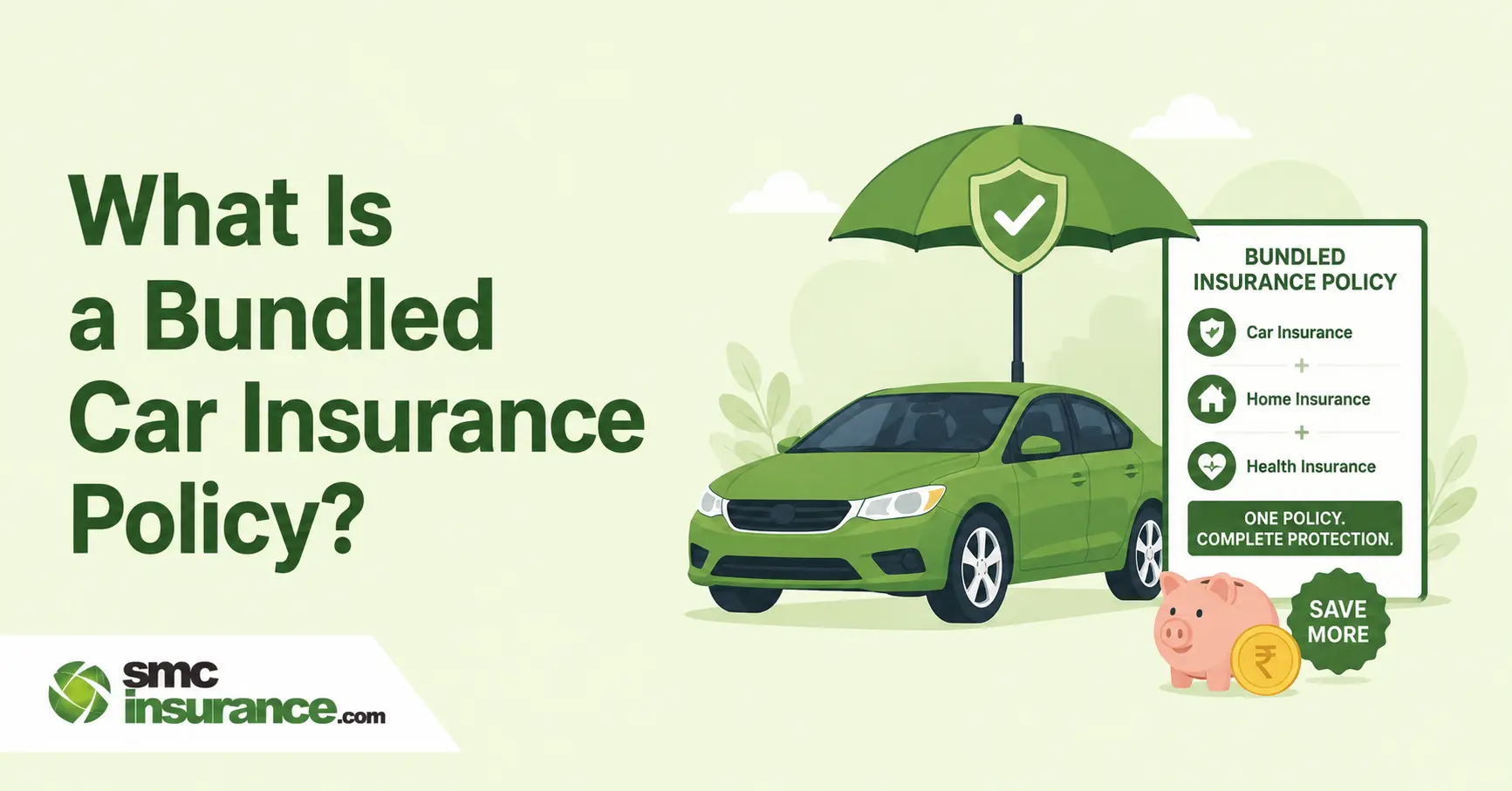
What is a bundled car insurance policy?
A bundled car insurance policy for a new private car combines three years of mandatory third-party liability insurance with one year of own-damage protection. The third-party component covers specified legal liabilities towards others, while the own-damage component protects the insured vehicle against covered risks such as accidents, theft and fire. After the first year, the own-damage policy must be renewed to maintain protection for your car. Owner-driver personal accident cover may be
included or arranged separately, depending on eligibility and the policy issued.
Table of Contents
- What Is a Bundled Car Insurance Policy and Why Do New Cars Get One?
- Bundled Car Insurance vs Standalone Own-Damage Insurance: What Is the Difference?
- Bundled Car Insurance Policy Cost: What a New Car Owner Actually Pays
- What Is Covered and Not Covered Under a Bundled Policy
- What to Do When the Own Damage Cover Ends After Year One
- Can You Buy Own-Damage Insurance From a Different Insurer?
- Buying a Bundled Insurance Policy for a New Car: Dealer Quote or Your Own Choice?
The on-road price of a new car includes an insurance line that most buyers approve without reading and the word printed beside it is usually bundled. A bundled car insurance policy has been the default for every new car sold in India since 1 September 2018. Even so, plenty of owners reach the end of year one assuming the whole thing is still running, when only half of it is. That gap shows up on the worst possible day, when a flooded basement or a scraped bumper turns into a repair estimate with no insurer behind it. Before you compare any car insurance policy options, it helps to know which part of the bundle lasts three years and which part quietly expires after one. By the end of this guide you will know what the policy contains, what the three-year component costs by engine size and what to do on the first renewal date.
What Is a Bundled Car Insurance Policy and Why Do New Cars Get One?
Start with the origin, because the structure only makes sense once you know what it replaced.
Following a Supreme Court direction in 2018, IRDAI’s circular of 28 August 2018 told insurers to offer new cars two choices. One was a long-term package covering both third-party liability and own damage for three years. The other was a bundled cover, with a three-year third-party term and a one-year own damage term. The rule applies to cars sold from 1 September 2018, which is why every dealer now quotes some version of a 3+1 plan.
The logic is simple, since a car sold with three years of liability cover cannot slip onto the road uninsured because someone forgot a renewal. On coverage, a bundled policy is a comprehensive policy. What differs is the tenure of each section, which is where most of the confusion starts.
The three covers inside the bundle
Third-party liability runs for the full three years. It pays for death or bodily injury to another person, with compensation decided by the Motor Accident Claims Tribunal and no fixed cap and for damage to someone else’s property up to Rs. 7.5 lakh.
Own damage covers your car against accident, fire, theft, flood and similar perils, but only for one year at a time. Every claim carries a compulsory deductible, which is Rs. 1,000 for cars up to 1,500cc and Rs. 2,000 above that.
Owner-driver personal accident (PA) insurance provides financial protection against specified accidental death or permanent disability. IRDAI prescribed a minimum sum insured of Rs. 15 lakh for compulsory personal accident cover, subject to the applicable policy conditions.
However, this protection should not be confused with the three-year third-party insurance term. Owner-driver PA cover may be arranged separately, and eligible vehicle owners who already hold qualifying cover may not need to purchase it again. Its duration depends on the policy issued. Before buying bundled car insurance, check whether PA protection is included, the period for which it remains valid and whether you already have an eligible policy.
Bundled Car Insurance vs Standalone Own-Damage Insurance: What Is the Difference?
Both options are legal for a new car, so the real question is how much flexibility you want in years two and three.
Feature |
Bundled policy (3-year TP + 1-year OD) |
Standalone own-damage policy |
Purpose | Provides third-party and own-damage protection together | Covers damage to the insured car when eligible third-party insurance already exists |
Third-party term | Three years | Covered under a separate existing policy |
Own-damage term | One year | Generally one year |
When purchased | Usually at new-car purchase | Can be purchased or renewed separately |
Renewal after year one | Renew the OD component | Renew the standalone OD policy |
Insurer choice | Compare available bundled policies | Can select a different insurer for OD, subject to acceptance |
Suitable for | New-car buyers seeking both covers | Owners who already have valid third-party cover |
Note: Availability and pricing of the 3-year own damage option differ by insurer. Check the policy schedule for the exact terms before you pay.
A bundled policy is a practical option for new-car buyers because it combines the mandatory long-term third-party cover with protection for their own vehicle during the first year. After that, owners can compare standalone own-damage policies, review add-ons and choose an insurer that better suits their needs. The important point is to renew own-damage protection on time, even though the original third-party policy remains active.
Bundled Car Insurance Policy Cost: What a New Car Owner Actually Pays
One cost fact explains most of the price differences between quotes: the third-party premium is set by the government, not by insurers. Two insurers quoting the same car will show an identical third-party figure, so the gap between their quotes comes entirely from the own damage section and the add-ons.
Private car category |
Annual TP premium |
3-year TP premium |
Up to 1,000cc | Rs. 2,094 | Rs. 6,521 |
1,000cc to 1,500cc | Rs. 3,416 | Rs. 10,640 |
Above 1,500cc | Rs. 7,897 | Rs. 24,596 |
Electric, up to 30 kW | Rs. 1,780 | Rs. 5,543 |
Electric, 30 kW to 65 kW | Rs. 2,904 | Rs. 9,044 |
Electric, above 65 kW | Rs. 6,712 | Rs. 20,907 |
Note: The figures shown are basic third-party insurance premiums under the Motor Vehicles (Third Party Insurance Base Premium and Liability) Rules, 2022, effective from 1 June 2022. They exclude applicable taxes and any separately charged covers. A 2024 amendment did not alter the private-car categories listed above. Buyers should check the latest applicable government notification and insurer quotation before purchasing a policy.
Under the government-notified rates shown above, the upfront three-year third-party premium for a conventional private car is approximately 4% higher than three times the corresponding annual premium. However, this is only a comparison using the same rate schedule. Actual annual premiums could change if the government revises the tariff. The three-year policy offers the benefit of uninterrupted third-party protection during its validity period without annual third-party renewals.
That small premium buys certainty, because the price is locked and a missed renewal can never leave you without liability cover. Electric cars get roughly a 15 percent discount on the third-party component.
The own damage premium moves with your Insured Declared Value, your city, the variant and the add-ons you choose. The Insured Declared Value (IDV) represents the agreed insured value of your car for total-loss and theft claims, subject to policy conditions. Under the standard depreciation schedule, a vehicle up to six months old attracts 5% depreciation for determining its IDV, while a vehicle older than six months but not exceeding one year attracts 15%.
For example, if a car's applicable listed value is Rs. 10 lakh, a 5% depreciation calculation gives an illustrative IDV of Rs. 9.5 lakh. Under standard policy wording, a vehicle may qualify as a constructive total loss when the aggregate eligible cost of retrieval and/or repairs exceeds 75% of its IDV. In this example, the threshold would be Rs. 7,12,500. Actual claim settlement depends on the policy terms, assessment and applicable deductions.
If your dealer’s quote looks heavy, you do not have to guess whether it is fair. Our team at SMC Insurance can line up bundled quotes from several insurers so you can compare the own damage portion side by side. Start at SMC Insurance.
What Is Covered and Not Covered Under a Bundled Policy
Cost is only half the picture, since the real test of a bundled plan is what it pays when you file a claim.
The own damage section responds to fire, explosion, lightning, theft, flood, storm, earthquake, riots and accidents by external means, along with damage in transit. Where it surprises people is depreciation on replaced parts. Under standard wording, rubber, plastic, tyres, batteries and airbags are depreciated at 50 percent, fibreglass at 30 percent and glass not at all. Metal parts carry no depreciation in the first six months, 5 percent up to a year, 10 percent in the second year and 15 percent in the third. This is exactly the gap that zero depreciation cover fills and it is worth pricing at purchase while the car is new.
The standard exclusions are the same across insurers:
- Normal wear and tear, mechanical or electrical breakdown and consequential loss
- Damage while driving under the influence of alcohol or drugs
- Damage while driving without a valid licence
- Losses outside the geographical area stated in the schedule
- Use of the car outside the limitations of use, such as hiring it out
Engine damage from water ingression is another common surprise and it usually needs a separate engine protection add-on.
What to Do When the Own Damage Cover Ends After Year One
This is the section most competitors skip and it is the one that protects your wallet. After twelve months your third-party cover keeps running, but the part that repairs your car stops.
- Check the own damage expiry date on the schedule:
It is not the same as the third-party expiry and the certificate shows both. - Renew before the date, not after it:
A No Claim Bonus survives only if you renew within 90 days of expiry and a lapse usually triggers a fresh inspection. - Compare before you auto-renew:
You can stay with your insurer or buy a standalone own damage car insurance policy from another one, while the three-year third-party cover stays where it is. - Revisit your IDV and add-ons:
The IDV drops with the car’s age and add-ons are generally chosen at renewal, so decide on zero depreciation and engine protection then. - Claim your discount:
Your first claim-free year earns a no claim bonus on the next own damage premium and it grows with each clean year, up to 50 percent.
A practical habit is to set a calendar reminder 30 days before the own damage date. If a lapse does happen, any damage in that window comes out of your pocket, even though the third-party cover is still valid.
Can You Buy Own-Damage Insurance From a Different Insurer?
Yes. Once the first-year own-damage cover under your bundled policy approaches expiry, you can explore standalone own-damage insurance from another insurer while retaining the existing three-year third-party policy.
This allows you to compare premiums, deductibles, add-ons, garage networks and claim services without replacing your active third-party cover. You will generally need to provide the details of your existing third-party policy when purchasing standalone own-damage insurance.
If you have earned a No Claim Bonus, you can also request its transfer to the new insurer, subject to the applicable requirements. Before switching, compare the actual coverage rather than selecting a policy solely because it has a lower premium.
Buying a Bundled Insurance Policy for a New Car: Dealer Quote or Your Own Choice?
Registration needs a valid policy, so the insurance question lands on delivery day, usually with a dealer’s form already filled out. The choice of insurer is still yours and since third-party pricing is identical everywhere, the only numbers worth comparing are the own damage premium, the add-on prices and the insurer’s garage network in your city. Sorting this out a few days before delivery, rather than at the dealership desk, gives you time to compare without pressure.
Summing Up,
A bundled car insurance policy combines two essential types of protection with different validity periods. The third-party component remains active for three years, while the own-damage component generally lasts for the first year and must be renewed separately.
Although long-term third-party insurance reduces the risk of accidentally allowing mandatory liability cover to lapse, it does not remove the need to monitor your own-damage renewal date. Before purchasing or renewing insurance, compare premiums, coverage limits, deductibles, add-ons and the insurer's service network. Also, check your owner-driver personal accident protection separately to ensure that the required cover remains valid. Understanding these differences can help you avoid unexpected gaps in insurance protection.
Disclaimer: The information provided on this platform is intended for general awareness and educational purposes. While every effort is made to ensure accuracy, some details may change with policy updates, regulatory revisions, or insurer-specific modifications. Readers should verify current terms and conditions directly with relevant insurers or through professional consultation before making any decision.
All views and analyses presented are based on publicly available data, internal research and other sources considered reliable at the time of writing. These do not constitute professional advice, recommendations, or guarantees of any product’s performance. Readers are encouraged to assess the information independently and seek qualified guidance suited to their individual requirements. Customers are advised to review official sales brochures, policy documents and disclosures before proceeding with any purchase or commitment.
FAQs
It is one policy for a new car that combines three years of third-party liability cover with one year of own damage cover. The owner-driver personal accident cover of Rs. 15 lakh is part of the package. You renew only the own damage section each year, while the third-party section carries on until its three years end.
New private cars must have three-year third-party insurance. However, own-damage insurance is not legally mandatory. A bundled policy combines the compulsory three-year third-party component with one year of own-damage protection. IRDAI withdrew the earlier long-term package structure combining three years of both covers, effective August 2020.
Your car stops being insured against accident, theft, fire and flood damage, although third-party cover continues. Any repair bill in the gap is yours to pay. Renewing within 90 days preserves your No Claim Bonus and a long gap usually means a vehicle inspection before cover restarts.
For the own damage part, generally yes. You can buy a standalone own damage policy from a different insurer at renewal and the three-year third-party cover stays with the original one. Check that the new insurer will accept your existing third-party policy details.
Yes, owner-driver personal accident protection is subject to separate regulatory requirements. The prescribed minimum cover is Rs. 15 lakh, but it may be purchased separately, and eligible owners with qualifying existing protection may not need duplicate cover. Check the policy schedule to confirm whether it is included and how long it remains valid.
Not necessarily. Under the government-notified rates effective from June 2022, the three-year third-party premium for conventional private cars was approximately 4% higher than three times the corresponding annual premium. However, annual tariffs may change, so this is not a guaranteed future cost comparison. The bundled arrangement provides continuity of third-party protection while allowing owners to compare own-damage insurance at renewal.
Yes, it is usually selected when you buy the policy and again at each own damage renewal. Insurers set their own eligibility rules based on the age of the car, so confirm the terms on your quote. Zero depreciation matters most in the first few years, when replaced parts are at their highest value.


