


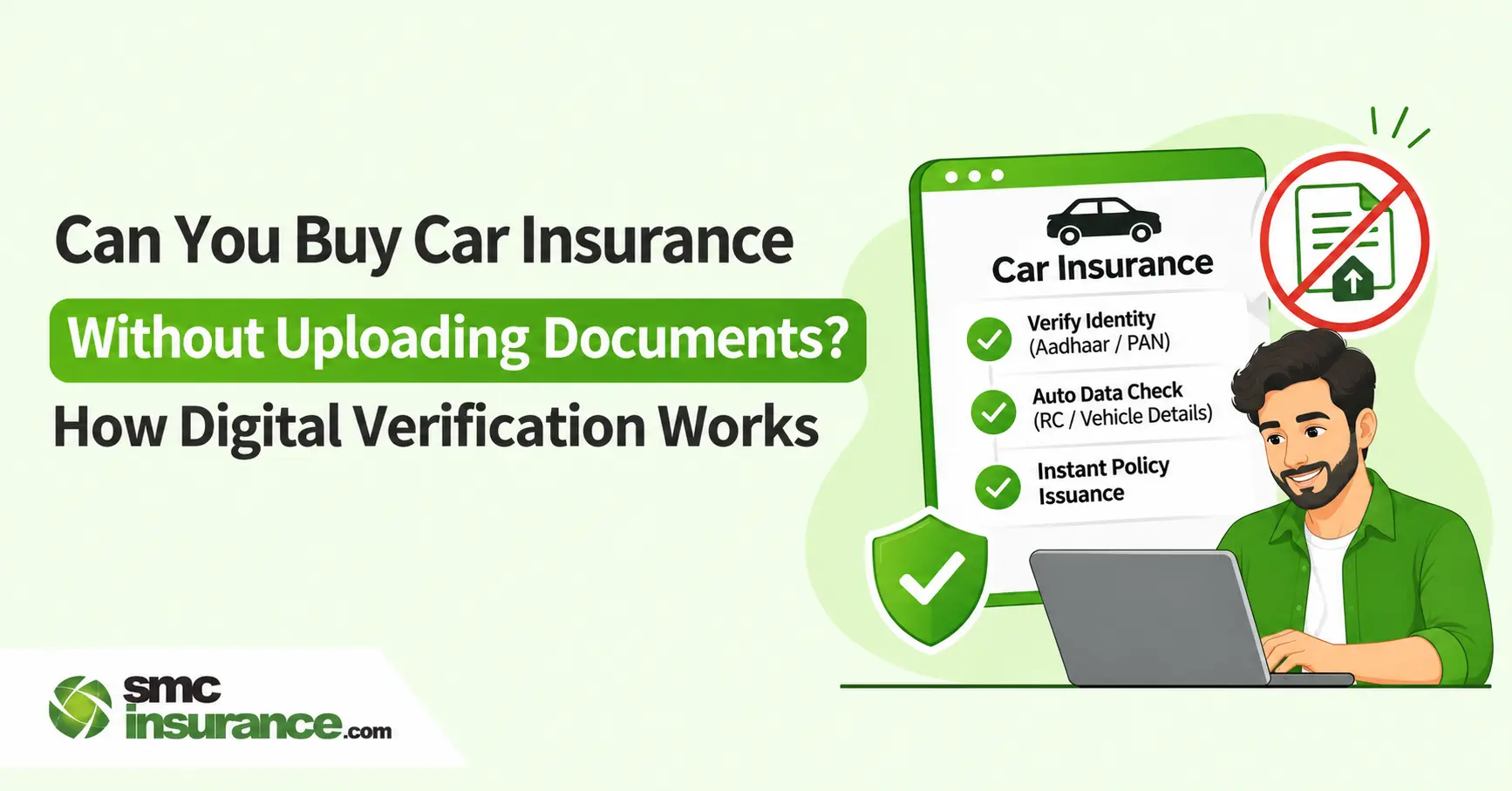
Usually yes, but identity verification is still mandatory. IRDAI permits insurers to complete KYC through approved digital methods, including Aadhaar-based verification, video identification and CKYC records. Vehicle details may also be retrieved using the registration number, reducing the need to upload an RC. However, insurers can request documents or vehicle inspection for expired policies, ownership mismatches or failed verification. Motor insurance continues to attract 18% GST.
Table of Contents
Your policy ends at midnight, it is already 10 pm and the renewal page wants a scanned RC you last saw in an email from 2022. That is when people ask whether they can buy car insurance without uploading documents, because a lapse means driving uninsured and the Motor Vehicles Act allows a fine of up to Rs. 2,000 for a first offence. The honest answer is yes and no. You can often buy car insurance online without attaching a single file, but the verification never disappears, it simply moves behind the screen. Here is what gets checked, how and when paperwork still comes up.
Buy Car Insurance Without Uploading Documents: What IRDAI Requires
Start with the rule, because it explains everything else. IRDAI’s Master Guidelines on Anti-Money Laundering/Counter Financing of Terrorism, 2022, as amended, require insurers to complete customer identification when establishing an insurance relationship. This applies to car insurance too, regardless of whether the policy runs for one year. However, verification does not always mean uploading scanned documents. Depending on the insurer and applicable requirements, customers may complete KYC through Aadhaar-based authentication or offline verification, digital KYC, video-based identification, an existing CKYC record or officially valid documents, along with PAN or Form 60 wherever applicable. In other words, uploading files is only one way to complete the process.
How Digital KYC for Car Insurance Works, Step by Step
The flow is shorter than most people expect.
- Enter your registration number:
The portal fetches the vehicle’s details from it and our quote page at SMC starts there. - Verify with Aadhaar OTP:
Where the insurer offers authorised Aadhaar-based authentication, you may be able to verify your identity using an OTP sent to your Aadhaar-linked mobile number. Other approved KYC methods remain available if this option cannot be used. - Or use your CKYC record:
If you have previously completed KYC with a participating financial institution, you may already have a CKYC identifier. The insurer can search for and retrieve an available record from the Central KYC Records Registry, reducing the need to submit the same documents again. - Fall back to video KYC:
If Aadhaar OTP verification is unavailable, some insurers may offer a video-based identification process. An authorised representative verifies your identity remotely, following the insurer's prescribed checks. Alternatively, the insurer may accept another approved KYC method. - Pay and save the policy:
DigiLocker can hold it and a 2018 transport ministry circular asks for documents shown through DigiLocker or mParivahan to be accepted.
What the insurer needs |
Digital route |
Manual upload happens when |
Identity and address | Aadhaar-based verification, video KYC, CKYC or another approved method. | Manual documents may be required when digital verification is unavailable, incomplete or unsuccessful. |
Vehicle details | Registration number lookup | RC owner name differs from the buyer |
Condition of a lapsed car | Self-inspection video | Insurer requires a surveyor |
Note: Routes differ by insurer, so check the options before paying.
When You Still Cannot Buy Car Insurance Without Uploading Documents
Paperless is the default, not a guarantee.
A lapsed policy is the big one. After expiry the insurer treats renewal as a break-in and wants proof of the car’s condition, which many now collect through a self-inspection video. ICICI Lombard’s app, for instance, asks for the engine and chassis number, front, back, sides, odometer and damage, filmed in daylight outside a closed parking area.
Switching insurers is the second trigger. Each insurer keeps its own KYC records, so a new company means a fresh check and renewing your car insurance with the same one is generally lighter. A second-hand car adds a hurdle too, since claims are processed only when the RC and policy carry the same owner name.
Does Paperless Car Insurance Cost Extra?
On money, the answer is no.
Choosing digital verification instead of document uploads does not, by itself, determine your car insurance premium. The own-damage portion depends on factors such as the insured declared value (IDV), vehicle age, location, no claim bonus and selected add-ons, while mandatory third-party premiums follow government-notified rates. Any additional platform or service fee, where applicable, should be disclosed before payment. Motor insurance continues to attract 18% GST, as the exemption introduced in September 2025 applies to specified individual life and health insurance policies, not motor insurance. Under the notified third-party premium schedule, the annual base premium for a private car with an engine capacity not exceeding 1,000cc is Rs. 2,094, or approximately Rs. 2,471 including 18% GST.
Stuck on a renewal page asking for files you cannot find? Start from your registration number at SMC Insurance and reach out to our team if a step stalls.
Wrapping Up,
The short version is simple.
Buying car insurance without uploading documents is realistic in India today, provided you read it as paperless rather than verification-free. An Aadhaar OTP, a CKYC record or a short video call now do what scanned PDFs used to. The exceptions are predictable: lapsed policies, switched insurers, mismatched names and second-hand cars. Keep your Aadhaar-linked mobile close, renew before expiry so no inspection is needed and check that the RC carries the buyer’s name.
Disclaimer: The information provided on this platform is intended for general awareness and educational purposes. While every effort is made to ensure accuracy, some details may change with policy updates, regulatory revisions, or insurer-specific modifications. Readers should verify current terms and conditions directly with relevant insurers or through professional consultation before making any decision.
All views and analyses presented are based on publicly available data, internal research and other sources considered reliable at the time of writing. These do not constitute professional advice, recommendations, or guarantees of any product’s performance. Readers are encouraged to assess the information independently and seek qualified guidance suited to their individual requirements. Customers are advised to review official sales brochures, policy documents and disclosures before proceeding with any purchase or commitment.
FAQs
In most cases, yes, if the digital check clears. Aadhaar OTP, video KYC or a CKYC record verifies identity and your registration number fetches vehicle details. Uploads return for lapsed policies, mismatched names or failed digital checks.
Generally yes. Insurers verify identity before issuing a policy and renewal can stall until that is done. Staying with the same insurer usually means the KYC on file carries you through, while a new company starts afresh.
You still have options. Video KYC lets an insurer representative verify you live and documents such as PAN, passport, voter ID or driving licence work as an offline route.
A digital copy is fine. The transport ministry’s 2018 circular asks for documents shown through DigiLocker or mParivahan to be accepted, so carrying paper is unnecessary.
Not always. Many insurers accept a self-inspection video recorded on your phone and issue the policy within hours, though availability varies.


