


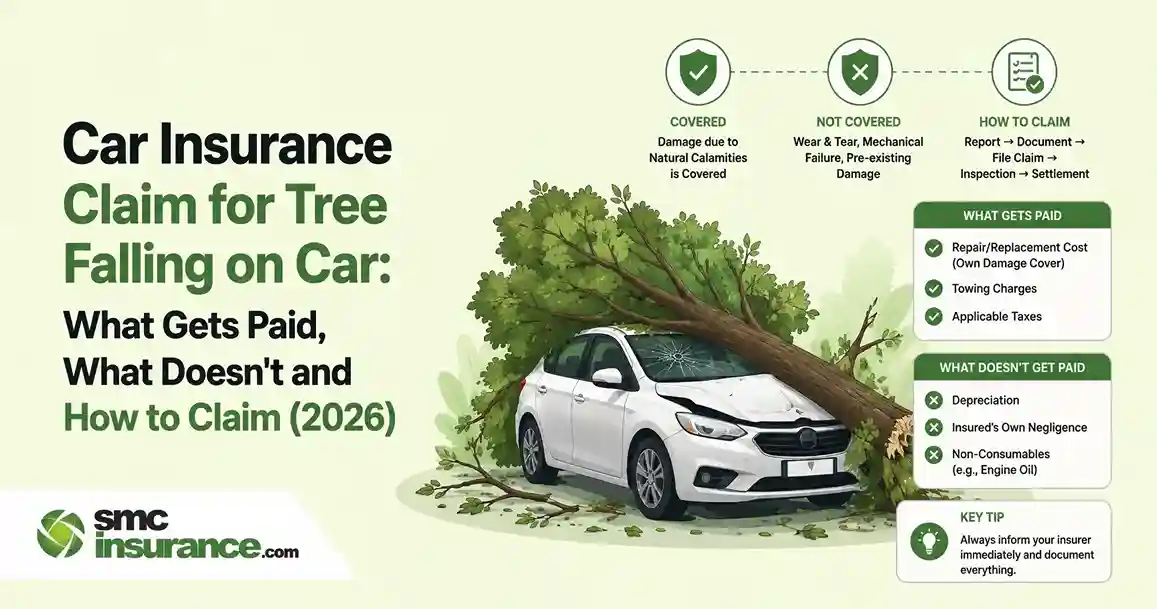

Yes, a comprehensive or standalone own damage policy covers damage from a tree or branch falling on your car, because it counts as accidental damage from an external cause. A third-party only policy pays nothing for your own car. Even on an approved claim you bear the compulsory deductible (Rs. 1,000 for cars up to 1,500cc, Rs. 2,000 above that) and depreciation on parts, unless you hold a zero depreciation add-on. Report the loss to your insurer promptly, photograph everything and leave the car unrepaired until the insurer clears it. Your no claim bonus resets at the next renewal unless you have an NCB protection add-on.
Table of Contents
- Is a Car Insurance Claim for Tree Falling on a Car Valid? Policy Types Compared
- What Tree Fall Damage Does Car Insurance Actually Pay For?
- How to File a Car Insurance Claim for Tree Falling on Car, Step by Step
- What You Still Pay Even When the Tree Fall Claim Is Approved
- Will a Tree Fall Claim Reset Your No Claim Bonus?
- Why a Tree Fall Claim Gets Rejected and How to Avoid It
- Tree Fall on Car Insurance India: Tricky Cases Worth Knowing
- How to Keep Your Car Out of a Tree Fall Claim in the First Place
A tree coming down on a parked car is usually discovered the next morning, once the rain has stopped and the damage is sitting there in daylight: a caved-in roof, a windscreen in pieces and a garage quote that runs into tens of thousands of rupees. Before you even ring the garage, the real question is whether a car insurance claim for tree falling on car will be accepted, how much of the bill the insurer will actually pay and what the claim does to your renewal premium. The answers are not the same for every policyholder, because they depend on your policy type, the add-ons you carry and how you handle the first few hours. By the end of this guide you will know whether your policy will pay and how much of the bill to expect from your own pocket.
Is a Car Insurance Claim for Tree Falling on a Car Valid? Policy Types Compared
Whether the claim is valid comes down to a single question, which is whether your policy includes own damage cover.
A standard private car package policy pays for accidental damage from external causes and for natural calamities such as storm, cyclone, flood and landslide. A falling tree qualifies either way, so it makes no difference whether the trunk gave way in a cyclone or simply toppled on a still afternoon after weeks of soaked soil. What matters is the policy you hold on the day it happens.
Policy type |
Tree fall damage to your car |
What to know |
Third-party only | Not covered | Pays for injury or property damage you cause to others, never for your own car |
Comprehensive | Covered | Subject to compulsory deductible and depreciation on parts |
Standalone own damage | Covered | Works alongside a separate third-party policy |
Comprehensive with zero depreciation | Covered, without depreciation cuts on parts | Compulsory deductible still applies |
Note: Exact inclusions and exclusions vary by insurer, so the policy schedule and wording you received are what finally govern your claim.
A lapsed policy is the other way this fails and it fails completely. If your renewal date passed last week and you assumed a grace period, there is no claim to make.
What Tree Fall Damage Does Car Insurance Actually Pay For?
Once you know the policy qualifies, the next thing to check is which parts of the damage sit inside it. Most tree fall losses involve the following:
- Roof panel, pillars, bonnet and boot lid
- Windscreen, rear glass and side windows
- Headlamps, tail lamps and outside mirrors
- Paintwork and the labour needed to refit and refinish panels
- Towing, only if you hold a roadside assistance add-on or your manufacturer warranty includes it
Structural damage is where these claims turn expensive, because bent pillars and a crushed roof can push an otherwise repairable car past the point where fixing it makes financial sense. When repair costs cross roughly 75% of the car's insured declared value, most insurers treat the loss as a total loss and settle on the IDV instead. A return to invoice add-on, if you have one, tops that up towards the original invoice price.
Engine damage needs a separate mention. A tree that lands on a waterlogged street can leave the engine exposed to water and consequential engine damage is generally paid only if you hold an engine protection add-on.
How to File a Car Insurance Claim for Tree Falling on Car, Step by Step
Knowing what is covered helps very little if the claim is fumbled in the first day, so here is the sequence that keeps it clean.
The First Hour
Stay away from the car if branches are hanging loose or a live wire is tangled in the wreckage and call the electricity board before anyone touches the vehicle. Then work through these steps:
- Photograph and film everything. Take wide shots showing the tree, the car and the registration plate together, then close-ups of each damaged panel, the break point on the trunk and the surrounding spot. A slow walk-around video with the date visible on your phone helps a great deal.
- Leave the car where it is unless staying put is dangerous. If you must move it, photograph the original position first.
- Inform your insurer through the helpline, app or email and note down the claim number. IRDAI's 2024 master circular says a claim cannot be denied over a policyholder delay that did not increase the loss, but we would never advise testing that rule.
- Hold off on repairs until the insurer confirms how the loss will be assessed.
Which is why the photos matter more than the phone call. An FIR is generally not needed when a tree falls on its own, though you should inform the police if anyone is injured or another person's vehicle or property is involved.
Documents to Keep Ready
Requirements differ slightly between insurers, but expect to be asked for these:
- Copy of your car insurance policy
- Registration certificate
- Driving licence of the person driving, or of the owner if the car was parked
- Signed claim form
- Photos and videos of the damage
- Repair estimate, plus final bills for reimbursement claims
- KYC documents and a cancelled cheque if the payout is coming to you
Survey and Settlement Timelines
Under IRDAI's 2024 rules, a surveyor should be allocated within 24 hours of the claim being reported, and a registered surveyor and loss assessor is mandatory for a motor claim of Rs. 50,000 or more. The surveyor has 15 days from allocation to submit the report. The insurer must decide the claim within seven days of receiving the survey report or within 15 days of allocating the claim to the surveyor, whichever is earlier. If the claim is not settled within the prescribed timeline, the claimant is entitled to interest at the bank rate plus 2%.
You can then repair at a network garage on a cashless basis, where the insurer pays the garage directly and you settle only the deductible and uncovered items. The alternative is a reimbursement claim, where you pay the garage first and get the approved amount back later.
What You Still Pay Even When the Tree Fall Claim Is Approved
An approved claim rarely means a zero bill and the gap between what you expect and what you pay is where most complaints begin.
Every own damage claim carries a compulsory deductible of Rs. 1,000 for private cars up to 1,500cc and Rs. 2,000 above that, plus any voluntary deductible you chose to lower your premium. On top of that, insurers apply depreciation to replaced parts: 50% on rubber, plastic, tyres, batteries and airbags, 30% on fibreglass, nothing on glass and an age-linked rate on metal parts. A tree fall tends to hit the worst combination, crushing metal panels and cracking plastic lamp housings in the same incident.
Item |
Without zero depreciation |
With zero depreciation |
Repair bill (assumed) | Rs. 60,000 | Rs. 60,000 |
Depreciation deducted (assumed) | Rs. 20,000 to Rs. 25,000 | Nil |
Compulsory deductible (up to 1,500cc) | Rs. 1,000 | Rs. 1,000 |
Insurer pays approximately | Rs. 34,000 to Rs. 39,000 | Rs. 59,000 |
You pay approximately | Rs. 21,000 to Rs. 26,000 | Rs. 1,000 |
Note: These are illustrative figures for a four-year-old car and a hypothetical bill. Actual depreciation depends on the mix of glass, plastic and metal parts replaced and consumables are usually excluded unless you have a separate add-on.
Zero depreciation is generally offered only on cars up to five years old, so if yours is close to that line, read what happens to zero depreciation cover after five years before your next renewal.
Not sure whether your current policy is comprehensive, or whether zero depreciation is on it at all? Pull out the policy schedule today rather than after the next storm. If the cover has gaps, SMC Insurance can help you compare comprehensive plans and add-ons at SMC Insurance.
Will a Tree Fall Claim Reset Your No Claim Bonus?
Yes and this surprises people because the tree fall was plainly not their fault.
The no claim bonus is a discount of up to 50% on the own damage premium and any own damage claim resets it to zero at the next renewal, whatever caused the loss. An NCB protection add-on lets you keep the discount, though it usually allows only a limited number of claims in a policy year.
For a crushed roof the question answers itself, since the repair bill will dwarf a year of premium discount. It is the small tree fall losses that need a calculator, such as a single cracked mirror where the repair cost sits close to your deductible. In those cases it can be cheaper to pay the workshop yourself and our guide on when not to claim car insurance shows how to compare the two.
Why a Tree Fall Claim Gets Rejected and How to Avoid It
Most rejections are avoidable and they cluster around a handful of mistakes:
- Wrong policy type or a lapsed policy: Third-party only or expired cover pays nothing for your own car.
- Repairs done before inspection: The surveyor cannot assess damage that has already been dismantled or fixed.
- Old damage mixed in with new: If the survey suggests some dents predate the incident, that portion, or the whole claim, can be declined.
- Wrong details at renewal: A misdeclared NCB percentage or vehicle detail can come back at claim time.
- Fraud or misrepresentation: Exaggerated losses or staged incidents void the claim entirely.
Here is a habit that costs nothing: photograph your car from all sides every few months and keep the dated images. It is the cleanest defence against an "existing damage" allegation.
Tree Fall on Car Insurance India: Tricky Cases Worth Knowing
The standard scenario is straightforward, but real incidents rarely stay that neat, so a few variations deserve a straight answer.
- Whose tree it was
Your insurer settles under own damage cover whether the tree stood on your neighbour's plot or on a roadside owned by the civic body. Chasing the tree owner is the insurer's business and a written complaint to the local body at least records the incident. Do not count on the civic body to pay, though. In June 2026 the Supreme Court held that a municipal corporation was not liable under the Motor Vehicles Act when a branch fell on a stationary autorickshaw in heavy rain, observing that constant vigil over every tree is unrealistic. That case concerned injury compensation rather than repairs, but it shows how courts view tree falls, as weather events rather than someone's negligence. - Driving into a fallen tree
Hitting a tree already lying across a highway at night is a collision, not a falling object, yet a comprehensive policy still covers it as accidental damage provided the driver held a valid licence. - Injuries
The compulsory personal accident cover, typically Rs. 15 lakh, protects only the owner-driver. Passengers need a separate cover. - Water around the car
If the tree came down on a flooded street, do not start the engine, because cranking a water-filled engine can turn a repairable loss into a write-off that the basic policy will not pay for.
How to Keep Your Car Out of a Tree Fall Claim in the First Place
Nobody can insure away the inconvenience of a wrecked week, so a little prevention is worth the effort.
- Avoid parking beneath old, hollow, leaning or visibly dead trees, especially after days of rain has loosened the soil.
- Watch for cracked branches and dead crowns on roadside trees near your home and report them to the civic body in writing.
- Move the car to covered parking when a cyclone or heavy rain alert is issued.
- Renew before the policy lapses and check that zero depreciation and NCB protection are on the schedule before the monsoon rather than after it.
Wrapping Up
A car insurance claim for tree falling on a car is one of the more straightforward own damage claims, provided you hold a comprehensive or standalone own damage policy that is active on the day of the incident. Third-party cover will not pay a rupee towards your own car, so check that first. The cost to you depends mostly on depreciation, which is why the zero depreciation add-on matters far more than most people assume until they are holding a repair estimate. Speed and evidence matter as well: report the loss promptly, photograph everything and keep the car untouched until the insurer clears repairs. Expect the no claim bonus to reset unless you have protected it and weigh that against the size of the repair before deciding to claim. Before the next storm arrives, pull out your policy schedule and confirm the cover type, the add-ons and the expiry date.
Disclaimer: The information provided on this platform is intended for general awareness and educational purposes. While every effort is made to ensure accuracy, some details may change with policy updates, regulatory revisions, or insurer-specific modifications. Readers should verify current terms and conditions directly with relevant insurers or through professional consultation before making any decision.
All views and analyses presented are based on publicly available data, internal research and other sources considered reliable at the time of writing. These do not constitute professional advice, recommendations, or guarantees of any product’s performance. Readers are encouraged to assess the information independently and seek qualified guidance suited to their individual requirements. Customers are advised to review official sales brochures, policy documents and disclosures before proceeding with any purchase or commitment.
FAQs
Yes, if you hold a comprehensive or standalone own damage policy, since a falling tree counts as accidental damage from an external cause or a natural calamity. A car insurance claim for tree falling on car is not payable under third-party only cover. You will still pay the compulsory deductible and depreciation on parts, unless you hold a zero depreciation add-on.
Usually not, because the damage comes from a natural or accidental event with no third party at fault. An FIR or police intimation is sensible if someone is injured, another vehicle or property is damaged, or the insurer specifically asks for one. Your insurer's claim form will tell you what it requires.
It is risky. The surveyor needs to see the damage to assess it and repairs done beforehand can hand the insurer grounds to dispute the claim. Inform the insurer first, wait for confirmation on how the loss will be assessed and only then go ahead with the garage.
No, third-party insurance covers injury to other people and damage to their property and it never pays for your own vehicle, whatever the cause. To be covered for a tree landing on your car you need comprehensive or standalone own damage cover.
In most cases your NCB resets to zero at the next renewal, even though the tree fall was not your fault. An NCB protection add-on can preserve it, usually for a limited number of claims per year. For small repairs close to your deductible, compare the repair cost against your NCB value before claiming.
Your insurer still settles the claim under your own damage cover, so you do not have to wait for anyone else to pay. Recovering money from the tree owner is left to the insurer. A written complaint to the local body creates a useful record, but do not expect it to reimburse you.
Under IRDAI's 2024 rules, a surveyor should be allocated within 24 hours of the claim report and the survey report is due within 15 days of allocation. The insurer must decide the claim within seven days of receiving the survey report or within 15 days of allocating the claim to the surveyor, whichever is earlier. If the claim is not settled within the prescribed timeline, the claimant is entitled to interest at the bank rate plus 2%. Actual processing may also depend on the information and documents required for the claim.


