


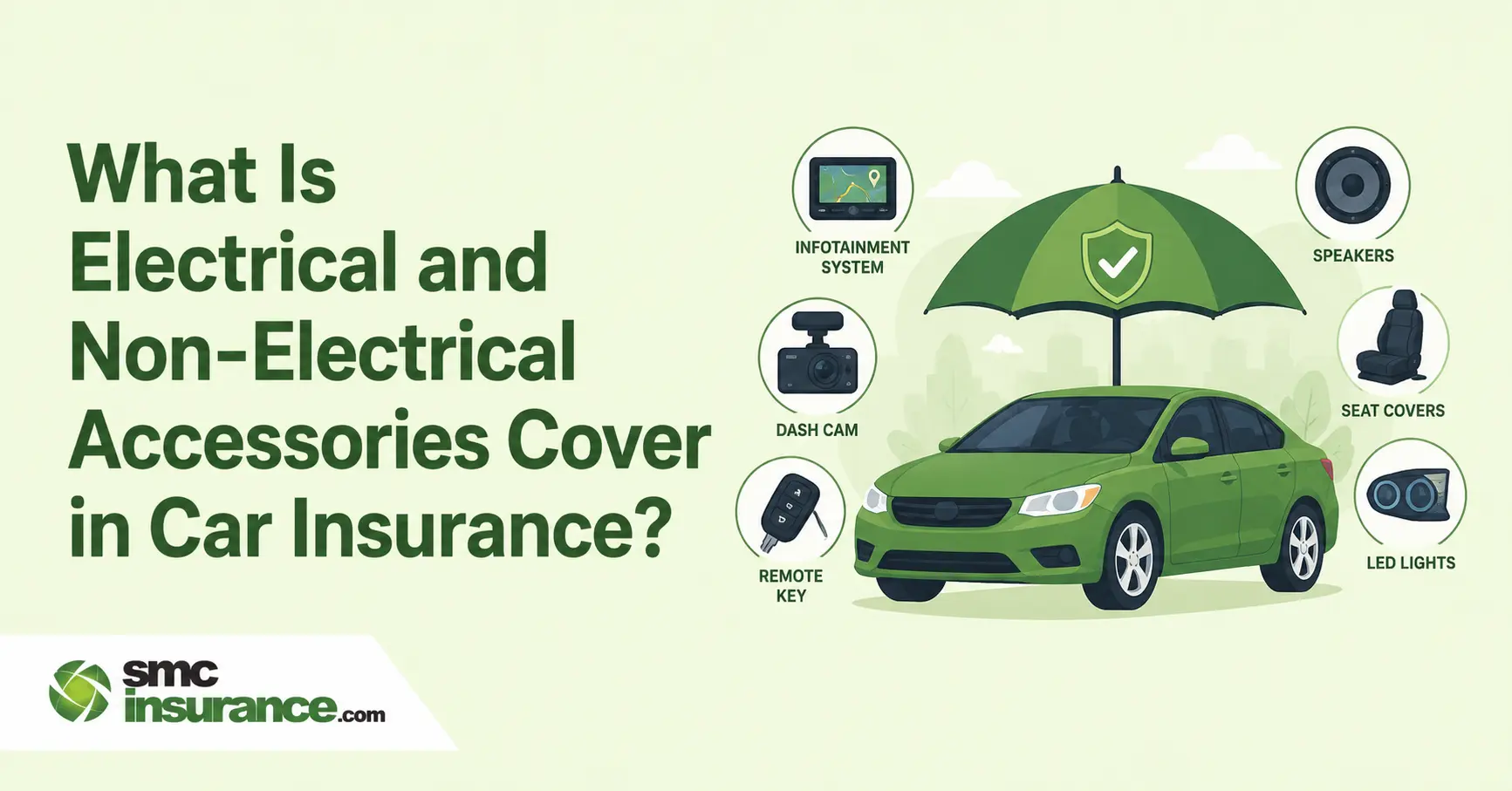
Electrical and non-electrical accessories cover is an extension on a comprehensive or standalone own-damage car policy that adds the depreciated value of aftermarket fittings to your IDV, so they are protected against fire, accident, flood and theft. Electrical items such as music systems and cameras typically cost about 4% of declared value a year plus 18% GST, while non-electrical items such as seat covers and alloy wheels are usually rated lower. Undeclared fittings are not covered, breakdown and wear are excluded and payouts are capped at the declared, depreciated value.
Table of Contents
- What Is Electrical and Non-Electrical Accessories Cover in Car Insurance?
- What Does Electrical Accessories Cover in Car Insurance Actually Pay For?
- How Much Does Accessories Cover Cost? Premium and IDV Worked Out
- How to Add Accessories Cover to Your Car Insurance Policy: Step by Step
- Is Electrical Accessories Cover in Car Insurance Worth It? Where We Would Draw the Line
If you have spent Rs. 50,000 on a new touchscreen and a set of alloy wheels, the invoice in your glovebox is not proof of cover. Your insured value is built around the manufacturer’s listed price, so anything fitted afterwards sits outside the coverage for your car until you declare it and pay for it. Owners tend to find this out at the worst moment, standing in a garage after a flood or a break-in while the surveyor asks which fittings were on the policy. Electrical accessories cover in car insurance exists to close that gap and non-electrical fittings follow similar logic with a few differences in cost and valuation. By the end of this guide you will know what to declare, what it costs and how a claim is actually paid.
What Is Electrical and Non-Electrical Accessories Cover in Car Insurance?
Start with the basic mechanism, because everything else in the policy follows from it.
Your insured declared value (IDV) is fixed from the manufacturer’s listed selling price for your model, along with any accessories that price already includes. Items outside that list, such as a third-party head unit or aftermarket wheels, have to be valued separately and added on top. One insurer’s prospectus spells this out for electrical and electronic items, saying their depreciated value can be added to the sum insured over and above the IDV. Several insurers print Electrical Accessories IDV and Non-Electrical Accessories IDV as separate lines on the policy schedule, which is the quickest way to check whether your own fittings made it in.
- Electrical accessories Anything that draws power from the car’s battery or wiring and was not in the manufacturer’s price list falls here. Think aftermarket touchscreens, amplifiers and subwoofers, reverse cameras and LED fog lamps. Insurers charge a distinct, higher rate for these, mostly because wiring brings fire and short-circuit risk.
- Non-electrical accessories Fittings that need no power sit on the other side, including leather or fabric seat covers, aftermarket alloy wheels, body kits, roof carriers and door visors. The valuation idea is the same, but the rate is generally lower and varies by insurer, so ask for the actual figure instead of assuming. CNG or LPG kits usually get their own bracket, since schedules from insurers such as Chola MS carry a separate CNG/LPG kit line beside the accessory lines.
Electrical accessories |
Non-electrical accessories |
|
Typical items | Aftermarket touchscreen, amplifier, reverse camera, LED fog lamps | Seat covers, alloy wheels, body kit, door visors |
Declared under | Electrical Accessories IDV | Non-Electrical Accessories IDV |
Premium basis | Often about 4% of declared value a year | Usually lower than electrical, set by each insurer |
Claim triggers | Fire, accident, flood, theft | Fire, accident, flood, theft |
Common trap | A unit that simply stops working is a breakdown, not a claim | Faded finish or worn upholstery is wear and tear, not a claim |
Note: Rates and valuation rules differ by insurer. Read your policy schedule and wording before relying on this table.
What Does Electrical Accessories Cover in Car Insurance Actually Pay For?
Declaring a fitting gets it onto the policy, but the policy still responds only to specific events.
Declared accessories are protected against the same insured events as the car itself: fire, explosion, accidental damage by external means, flood and storm damage and burglary, housebreaking or theft. The exclusions are just as specific. Mechanical and electrical breakdown, normal wear and ageing and consequential loss are all left out, so a speaker that blows or a head unit that freezes on its own is a repair bill you carry yourself, while the same unit destroyed in a vehicle fire is a claim.
And the payout has a ceiling. You are paid against the value you declared, after depreciation, never the bill from the accessory shop. Partial repairs also attract the standard parts deduction, which in one insurer’s published schedule is 50% on plastic, rubber and nylon parts and batteries and nil on glass. A zero depreciation cover can waive that deduction on replaced parts, though whether it reaches your declared fittings depends on the wording, so ask before you assume.
Theft needs an FIR. A claim made only for stolen accessories still counts as a claim, which can cost you your No Claim Bonus and at least one insurer’s wording notes that partial theft of accessories is not shielded even by its NCB protector add-on.
How Much Does Accessories Cover Cost? Premium and IDV Worked Out
The price is small, but the arithmetic is worth seeing once.
Electrical fittings are commonly rated at about 4% of their declared value for the year, a figure Bajaj Allianz publishes for additionally fitted electrical and electronic items. Non-electrical rates are lower and differ by insurer. GST at 18% still applies on motor premiums, because the September 2025 exemption covered only individual life and health policies. Here is a worked example for a car in its second year, assuming the insurer uses the 20% depreciation band that standard policy schedules apply to cars aged one to two years.
Electrical item |
Bill value (Rs. ) |
Value added to IDV after 20% depreciation (Rs. ) |
Touchscreen head unit | 28,000 | 22,400 |
Reverse camera | 6,000 | 4,800 |
Amplifier and subwoofer | 16,000 | 12,800 |
Total | 50,000 | 40,000 |
At 4%, the extra own-damage premium is Rs. 1,600 and with 18% GST the added cost comes to Rs. 1,888 for the year. That is a modest price for protecting Rs. 40,000 of value.
Note: This is an illustration. Actual depreciation on accessories, the premium rate and the final figure vary by insurer and policy.
Not sure how your insurer has valued the fittings already on your car? Our team at SMC Insurance can read your policy schedule with you, compare how different insurers rate accessories and get them added before a claim exposes the gap. Start at SMC Insurance.
How to Add Accessories Cover to Your Car Insurance Policy: Step by Step
The paperwork is short and renewal is the cleanest moment to do it.
- Collect the invoices:
A bill showing the item name and amount is what backs up your declared value. - List every fitting separately:
Tag each as electrical or non-electrical and note its current value. - Declare at purchase or renewal:
The cover sits with comprehensive or standalone own-damage policies and a third-party-only policy cannot carry it. - Ask about mid-term additions:
Some insurers will endorse a new fitting during the policy year, others want it at renewal, so check before you buy the next upgrade. - Read the revised schedule:
Look for the accessory lines with amounts against them. If they are blank, the fittings are not insured. - Redo it every renewal:
Depreciation changes the declared value each year.
Skipping this step has a cost. Undeclared fittings sit outside your IDV and unreported modifications can lead to a claim being cut or rejected. If a declared item is turned down, raise it with the insurer’s grievance team first and then take it to IRDAI’s Bima Bharosa portal. Our guide on how to file a car insurance claim covers the process from intimation to settlement.
Is Electrical Accessories Cover in Car Insurance Worth It? Where We Would Draw the Line
A flat yes or no would be lazy, so here is a threshold.
Our view is that if your aftermarket electrical fittings add up to more than roughly Rs. 25,000, declare them. The premium is a few thousand rupees at most and the alternative is replacing a burnt amplifier out of your own pocket. Below that, particularly on an older car where the depreciated value would be small anyway, the paperwork may not earn its keep. It matters more on a new car where the dealer billed extras separately from the vehicle, so check whether those items appear on the policy at all. Phone holders and floor mats are not worth declaring.
Keep your wider add-on covers in mind too, since accessories cover is one piece of a policy that should match how you use the car.
Wrapping Up,
Accessories are the part of a car that most often falls outside its insurance without the owner noticing. The policy values your car from the manufacturer’s price list, so anything fitted later is uninsured until you declare it, whether electrical or non-electrical. Electrical items cost more to cover, at around 4% of declared value a year plus 18% GST and non-electrical items are usually rated lower. Even declared items are paid at a depreciated value and breakdown and wear stay excluded. The practical path is short. Gather your invoices, declare the fittings at renewal, confirm they appear on the schedule and update the list each year. If the total is under Rs. 25,000, you can reasonably skip it. If it is above, a few thousand rupees is cheap protection.
Disclaimer: The information provided on this platform is intended for general awareness and educational purposes. While every effort is made to ensure accuracy, some details may change with policy updates, regulatory revisions, or insurer-specific modifications. Readers should verify current terms and conditions directly with relevant insurers or through professional consultation before making any decision.
All views and analyses presented are based on publicly available data, internal research and other sources considered reliable at the time of writing. These do not constitute professional advice, recommendations, or guarantees of any product’s performance. Readers are encouraged to assess the information independently and seek qualified guidance suited to their individual requirements. Customers are advised to review official sales brochures, policy documents and disclosures before proceeding with any purchase or commitment.
FAQs
It is an extension on a comprehensive or standalone own-damage policy that adds the depreciated value of aftermarket electrical fittings to your sum insured. Music systems, reverse cameras and added lighting are typical examples. Once declared and paid for, they are protected against insured events such as fire, accident, flood and theft. Undeclared items stay outside the policy.
Only those included in the manufacturer’s listed price are part of the IDV. Anything fitted later, including dealer extras billed separately and shop-fitted upgrades, needs to be declared with its value. Check the policy schedule for separate accessory lines to confirm what the insurer has actually recorded.
No, third-party insurance covers only your liability to others, so there is no own-damage section for accessories to sit in. The cover is available on comprehensive and standalone own-damage policies. If you hold a third-party plan and have expensive fittings, switching to a policy with own-damage cover is the route.
Electrical fittings are commonly rated at about 4% of their declared value a year and non-electrical items usually cost less, both subject to 18% GST. On Rs. 40,000 of declared value that works out to about Rs. 1,888. Rates vary by insurer, so ask for the exact figure before you buy.
They sit outside your IDV, so the insurer is unlikely to pay for them after a loss. Unreported modifications can also reduce or sink a wider claim. Declare everything of value at purchase or renewal and confirm it on the schedule.
It depends on the insurer. Some accept an endorsement once you declare the item and its value, while others prefer to add it at renewal. Ask before fitting expensive upgrades so you are not uncovered in the gap.
It can. If your policy covers the accessory theft and the insurer settles the claim under the own-damage section, your No Claim Bonus may be affected at renewal. However, some NCB-protection add-ons preserve the discount for specified eligible claims. Check whether your particular add-on covers accessory-only theft before relying on that benefit.


