


How do you restore no claim bonus in car insurance?
You cannot buy it back once an own-damage claim is paid, because the discount resets to 0% at the next renewal.
You rebuild it through five claim-free years, moving 20%, 25%, 35%, 45% and 50% on the own-damage premium, so a claim at 50% can
cost roughly Rs. 18,750 on a Rs. 15,000 premium. The only way to keep your slab after a claim is an NCB protection
add-on bought beforehand, which covers between one and three claims a year depending on the insurer. Renew
within 90 days of expiry, or the bonus is lost entirely.
Table of Contents
- Can You Restore No Claim Bonus in Car Insurance After a Claim?
- How to Rebuild Your NCB After an Accident, Slab by Slab
- NCB Protection Cover in Car Insurance: Keeping the Discount After a Claim
- Should You Claim or Pay Yourself? The NCB Break-Even Math
- Steps to Restore No Claim Bonus in Car Insurance After an Accident
- Mistakes That Reset Your NCB to Zero at Renewal
How to Restore No Claim Bonus in Car Insurance
The garage quotes Rs. 28,000 for a crushed bumper and a cracked headlamp and the insurer's cashless desk says it will pay most of it. Before you agree, know that a single own-damage claim can wipe out a No Claim Bonus that took five years to build, which on a Rs. 15,000 own-damage premium means paying Rs. 7,500 more at the very next renewal and smaller top-ups for four renewals after that. Many drivers then go looking for a way to restore no claim bonus in car insurance, only to find that the honest answer is more layered than a form or a fee. This guide sets out what can be saved, what has to be rebuilt slab by slab and how to judge whether a claim is worth filing in the first place.
Can You Restore No Claim Bonus in Car Insurance After a Claim?
Not in the way most people hope. Once an own-damage claim is paid, your discount resets to zero at the next renewal and no form or extra payment reverses that, so restoring NCB really means either preventing the loss before the claim or rebuilding it one clean year at a time.
Which events trigger the reset matters more than most policyholders realise, because a few things drivers fear do nothing to their bonus at all.
What resets your NCB and what leaves it alone?
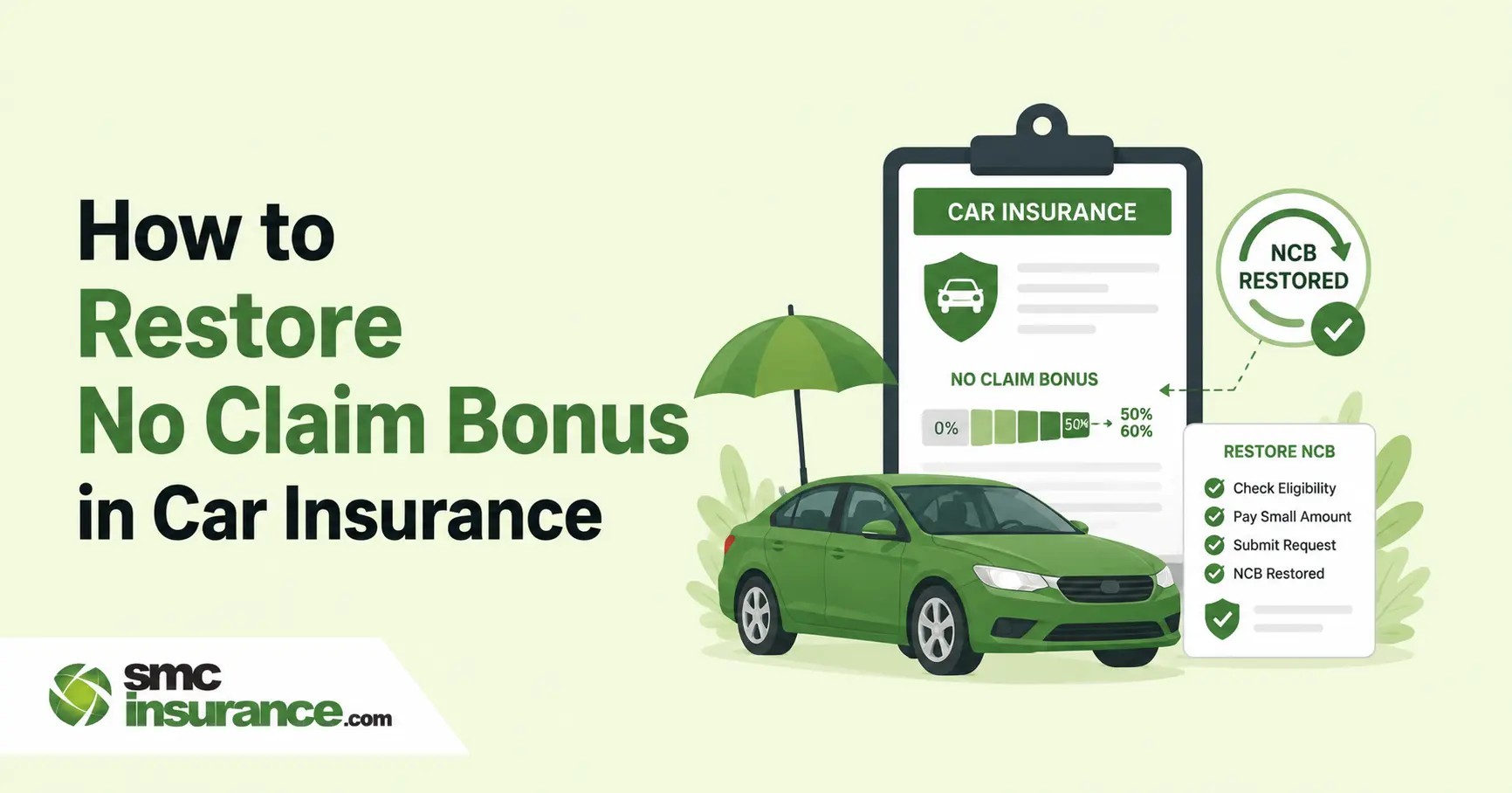
The standard slabs, drawn from the India Motor Tariff and carried into insurers' policy wordings, give 20% off the own-damage premium after one claim-free year, then 25%, 35%, 45% and finally 50% after five. The tariff speaks of claims "made or pending", so a claim you have registered but not yet settled can already count against you when renewal arrives.
Any own-damage claim, including theft and total loss, wipes the bonus unless you hold a protection add-on and so does a gap of more than 90 days between expiry and renewal. A third-party claim, on the other hand, leaves NCB untouched because the discount applies only to the own-damage part of the premium, as insurers such as HDFC ERGO state on their NCB pages.
There is one grey area. HDFC ERGO notes that the bonus may be spared after an accident when the insurer recovers most of its outlay from the driver at fault, yet that is insurer-specific, so ask in writing before you count on it.
How to Rebuild Your NCB After an Accident, Slab by Slab
Rebuilding follows the same ladder you climbed the first time, only now you can see exactly what each rung costs you.
After a claim you restart at 0%, the first clean year lifts you to 20% at the following renewal and it then takes five straight claim-free years to reach 50% again. The table assumes a Rs. 15,000 own-damage premium for someone holding 50% NCB who files one claim and compares each renewal with the one they would have had if they had not claimed.
Renewal after the claim |
Discount you get |
Discount had you not claimed |
Extra you pay (Rs. ) |
1st | 0% | 50% | 7,500 |
2nd | 20% | 50% | 4,500 |
3rd | 25% | 50% | 3,750 |
4th | 35% | 50% | 2,250 |
5th | 45% | 50% | 750 |
6th | 50% | 50% | 0 |
Total extra paid | 18,750 |
Note: Illustrative only. It holds the own-damage premium constant at Rs. 15,000, whereas the premium usually falls as the car ages and its IDV drops, so your real loss may be somewhat lower. Slabs follow the India Motor Tariff; confirm the exact rules in your own policy wording.
So the true cost of that claim is closer to Rs. 18,750 spread across five renewals than the Rs. 7,500 you notice at the first one. The climb also collapses if the policy lapses beyond 90 days, at which point you go back to the start even if you were in year three of the rebuild.
NCB Protection Cover in Car Insurance: Keeping the Discount After a Claim
The one product that actually changes the table above is the NCB protection add-on and it has to be bought before the accident, not after.
It lets you make a limited number of own-damage claims in a policy year and still carry the same slab into renewal. The limit is the insurer's to set: one IRDAI-filed standalone own-damage wording allows up to two claims a year, HDFC ERGO says up to three and other insurers protect a single claim, so read the wording rather than the brochure headline.
That same IRDAI-filed wording attaches conditions that rarely surface in a sales call. The policy must be renewed within 90 days of expiry, the car must be repaired at an authorised garage, claims settled through self-authorisation are excluded and the price depends on the car's make and current IDV.
In our view the add-on earns its cost once you reach the 35% slab, where one claim costs Rs. 9,000 in lost discount on a Rs. 15,000 own-damage premium, as the next section shows. At 20% the whole loss is about Rs. 3,000 and a premium for protection is harder to justify.
Should You Claim or Pay Yourself? The NCB Break-Even Math
Since protection must already be in place, most drivers face the harder question after the accident: is this repair large enough to justify a claim?
Compare what the insurer will actually pay, after the compulsory deductible that depends on engine capacity and any depreciation on parts, with the total discount you would lose. The table uses the same Rs. 15,000 own-damage premium and counts every renewal until you are back at your earlier slab.
NCB slab when you claim |
Renewals with a reduced discount |
Total discount lost (Rs. ) |
20% | 1 | 3,000 |
25% | 2 | 4,500 |
35% | 3 | 9,000 |
45% | 4 | 15,000 |
50% | 5 | 18,750 |
Note: If the net payout is lower than the figure in the last column, the claim costs more than it returns. Figures are illustrative and scale with your own-damage premium, so multiply the percentage loss by your actual premium.
Take a Rs. 6,000 headlamp replacement at 50% NCB. The claim would return at most Rs. 6,000 less the deductible while costing Rs. 18,750 in discount, so paying the garage directly is cheaper by a wide margin, a point we go through in more detail in our guide on when not to claim car insurance for minor damage.
Not sure what your own-damage premium or NCB slab really is, or whether your repair bill clears the break-even? Speak to an SMC Insurance advisor before you call the insurer and get the arithmetic done on your own policy at SMC Insurance.
Steps to Restore No Claim Bonus in Car Insurance After an Accident
Because the bonus cannot be bought back, these steps are about limiting the damage straight after the accident and then rebuilding without leaks.
- Get the repair estimate first and compare it with the break-even table before deciding on an own-damage claim.Take a day for this, but do not sit on a claim you have decided to make, since insurers expect prompt intimation.
- Report any injury or damage to a third party to your insurer at once.Those claims sit under the liability cover and do not reduce your NCB.
- If you hold NCB protection, check the policy for the claim limit, the authorised-garage rule and the self-authorisation exclusion before you pick a workshop.
- Renew before expiry and never later than 90 days after it and declare the NCB your previous insurer's records will show rather than the one you hope for.
- Ask for an NCB certificate before you sell the car or switch insurers, because the bonus belongs to you and not the vehicle. Insurers typically ask for the old policy copy, the RC and a photo ID and our note on how NCB transfers between insurers and vehicles covers the process.
If an insurer refuses an NCB you are entitled to, take it up with its grievance officer first and then escalate through IRDAI's Bima Bharosa portal.
Mistakes That Reset Your NCB to Zero at Renewal
Most avoidable losses happen at the renewal screen rather than on the road.
Declaring the wrong NCB is the costliest one. If a claim is still being processed when you renew and you tick "no claim" to get the higher discount, the insurer can later recover the difference or contest a future claim, which is why our piece on declaring the wrong NCB at renewal is worth reading before you fill in the form.
Selling the car without a certificate is the second. The buyer's policy starts at 0% NCB and the bonus you earned stays with you only if you can prove it when you insure the next car.
The last is assuming the bonus travels across vehicle types. NCB earned on a car policy can move to another car policy but not to a two-wheeler, so a family that swaps a car for a scooter should not expect the discount to follow.
Wrapping Up
The reality is that a paid own-damage claim sends your No Claim Bonus back to zero and nothing you buy afterwards restores it. What you control is everything around that moment, starting with the decision to claim at all.
On a Rs. 15,000 own-damage premium, a claim at 50% NCB costs about Rs. 18,750 in discount across five renewals, so small repairs are usually cheaper to pay yourself. Once you hold 35% or more, an NCB protection add-on bought before the accident is the only way to keep the slab after a claim, though its claim limit and conditions vary by insurer.
The path forward is simple enough to follow this week. Note your renewal date, get an NCB certificate on file, check whether your policy carries protection and renew inside the 90-day window without exception. If you would like a second pair of eyes on your policy, our advisors at SMC Insurance can run the numbers with you before the next renewal.
Disclaimer: The information provided on this platform is intended for general awareness and educational purposes. While every effort is made to ensure accuracy, some details may change with policy updates, regulatory revisions, or insurer-specific modifications. Readers should verify current terms and conditions directly with relevant insurers or through professional consultation before making any decision.
All views and analyses presented are based on publicly available data, internal research and other sources considered reliable at the time of writing. These do not constitute professional advice, recommendations, or guarantees of any product’s performance. Readers are encouraged to assess the information independently and seek qualified guidance suited to their individual requirements. Customers are advised to review official sales brochures, policy documents and disclosures before proceeding with any purchase or commitment.
FAQs
No, there is no route to buy or reinstate a bonus once an own-damage claim has been paid. Your discount restarts at 0% and climbs 20%, 25%, 35%, 45% and 50% with each claim-free year. Only an NCB protection add-on taken before the claim keeps your slab intact. The one grey area is an accident where the insurer recovers most of its outlay from the driver at fault, so ask yours in writing.
Yes, any own-damage claim counts, whatever its size, unless your policy carries NCB protection and the claim falls within its limit. That is why a Rs. 4,000 repair can end up costing far more once the lost discount is added. Third-party claims are the exception and do not affect the bonus.
It takes five consecutive claim-free years after the claim, which means the sixth renewal is the first at the full 50% slab. In between you receive 20%, 25%, 35% and 45% at successive renewals, assuming you renew on time and do not claim again.
No, it covers a limited number of own-damage claims per policy year and that number differs by insurer, from one claim to as many as three. Conditions such as repairs at an authorised garage and renewal within 90 days also apply. Read the add-on wording before relying on it.
The accumulated bonus is cancelled and you start again from 0% even if you had reached 50%. The tariff allows no NCB when a policy is not renewed within 90 days of expiry, so the safest habit is to renew before the policy ends.
Yes, because the bonus belongs to you and not the vehicle. Ask your current insurer for an NCB certificate and give it to the new insurer or the insurer of the new car. It moves between cars but not across vehicle types and it does not pass to the buyer of your old car.


