


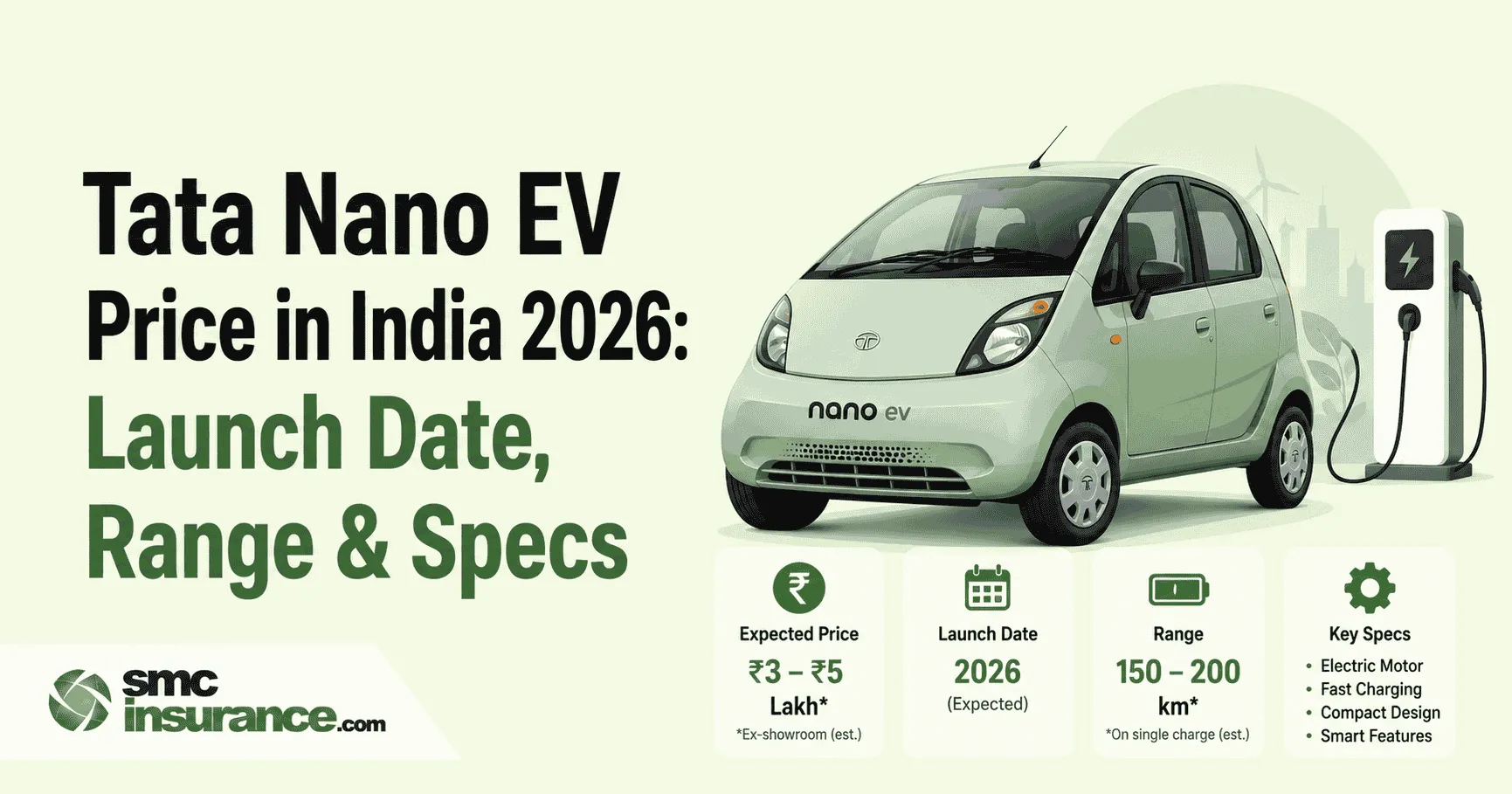

Tata Motors has not officially confirmed a Nano EV, so there is no real price, launch date or spec sheet yet. Every number online — typically ₹5 lakh to ₹9 lakh, with a range of 120–300 km — is speculation from auto portals, not a Tata Motors announcement. The closest thing to an official signal is a coy 'Try Karenge' comment from Tata's India Design Head Ajay Jain in mid-2026, hinting at a possible electric revival without confirming a product.
Table of Contents
- Is the Tata Nano EV Real? Here's the Actual Source
- A Nano EV Already Exists, Just Not From Tata Directly
- Tata Nano EV Expected Price, What Different Sources Are Saying
- Expected Features (If It Launches)
- Why the Nano's Original Failure Still Matters
- Where Does Tata's Real EV Roadmap Stand Right Now?
- Tata Nano EV vs Electric Cars Already on Sale Today
- If a Nano EV Launches, What Would the On-Road Price Look Like?
- Common Mistakes People Make Chasing This Topic
- Final Checklist, What to Track Going Forward
Search "Tata Nano EV price" and you'll get a different number on almost
every page, ₹5 lakh here, ₹9 lakh there, a 150 km range on one site and 300 km on the next. None of it is wrong exactly,
because none of it is official, it's all speculation stacked on speculation.
This guide does something most of the ranking pages don't: it separates the one real, sourced signal from Tata Motors, a designer's
comment in an interview, from the pure guesswork everyone else is repeating as fact. We'll also cover the one Nano EV that genuinely
exists today, what it would likely cost on-road if a production version does arrive, and what to buy right now if you don't want to
wait.
Last updated: August 2026. As of this writing, Tata Motors has made no product announcement, no press release, and no confirmed
timeline for a Nano EV.
Is the Tata Nano EV Real? Here's the Actual Source
In mid-2026, Tata Motors' India Design Head, Ajay Jain, was asked directly in an interview with ABP Auto Live whether the Nano could make a comeback. His reply, "Try Karenge" (we'll try), was followed by a warmer comment about wanting to put the Tata Nano on the map again, maybe in an electric avatar.
The comments carry more weight than a typical aside because of where Tata already stands: in July 2026, Tata Motors was India's electric passenger vehicle leader, retailing over 13,000 EVs and holding roughly 41% segment share, meaning any Nano EV would launch from a position of real EV manufacturing scale, not a standing start.
That's the entire official record. It's not a confirmation, a launch date, or a product roadmap, it's one executive expressing fondness for the nameplate when asked. Multiple auto publications picked up the quote and ran speculative price and spec estimates around it, and those estimates are what now dominate the search results.
Important Note
As of August 2026, Tata Motors has issued no official statement confirming a Nano EV is in development. Treat every price, range and
spec figure in this article, and every other article on this topic, as industry speculation until Tata Motors' official newsroom says
otherwise.
A Nano EV Already Exists, Just Not From Tata Directly
This is the part almost every other article on this topic buries or skips. Tata has already been part of an electric Nano, through a partnership with Jayem Automotives, which built roughly 400 units of an EV called the Jayem Neo for fleet operators.
Spec |
Jayem Neo (already built) |
Powertrain |
Rear-mounted electric motor, 48V system |
Reported battery |
Around 17 kWh |
Reported range |
Approximately 130–140 km (claimed) |
Units produced |
About 400, for fleet/commercial operators |
Availability to retail buyers |
Not sold directly to individual consumers |
The Jayem Neo proves the Nano's platform can technically be converted to an EV, it doesn't prove Tata Motors plans a retail launch. But it's the closest thing to hard evidence in this entire topic, and it's a useful reference point for range expectations.
Tata Nano EV Expected Price, What Different Sources Are Saying
Here's a transparent look at how widely the speculative price and range estimates vary depending on the source, so you can see the spread instead of anchoring on one number.
Source Type |
Estimated Price (Ex-showroom) |
Estimated Range |
Conservative auto-portal estimate |
₹5 lakh – ₹7 lakh |
120 – 150 km |
Mid-range industry speculation |
₹5.5 lakh – ₹8.5 lakh |
150 – 300 km |
Higher-end speculative estimate |
₹6 lakh – ₹9 lakh |
Over 200 km |
Reference: existing Jayem Neo (already built) |
Not sold at retail |
~130 – 140 km (claimed) |
Notice the range swings from 120 km to 300 km depending purely on which outlet you read, a 2.5x difference. That's a strong signal that these are back-of-envelope guesses, not leaked specification sheets.
Expected Features (If It Launches)
Assuming Tata does eventually bring a Nano EV to market, most industry commentary agrees it would need to look nothing like the 2008 original to meet today's safety and feature expectations.
- Touchscreen infotainment with Apple CarPlay / Android Auto
- Digital instrument cluster
- Regenerative braking
- Dual airbags and ABS as standard, given current safety norms
- Compact tall-boy hatchback design, similar footprint to the original
Why the Nano's Original Failure Still Matters
Some auto commentators are openly skeptical a Nano revival makes commercial sense at all. Battery packs are one of the most expensive components in any EV, and a genuinely sub-₹3-lakh Nano-style price point is considered unrealistic with current battery costs, which is why even speculative estimates start around ₹5 lakh, not ₹2 lakh.
The original Nano also struggled with a perception problem, it was marketed as "the cheapest car," which buyers read as "the car for people who can't afford better." Any relaunch, electric or not, would likely need a different positioning to avoid repeating that mistake.
Where Does Tata's Real EV Roadmap Stand Right Now?
While the Nano EV remains speculative, Tata's actual EV expansion is very real and already in motion. At its Investor Day on 23 June 2026, Tata Motors laid out plans to expand its passenger vehicle line-up to 25 models by FY31. The Tata Sierra EV made its confirmed debut on 30 June 2026, roughly six years after it was first showcased as a concept.
If a Nano EV does happen, it would most likely slot in as an ultra-affordable entry point beneath the existing Tiago EV and Punch EV in this broader roadmap, not as a standalone revival.
Tata Nano EV vs Electric Cars Already on Sale Today
If you need a car now and can't wait on a rumour, here's how the speculative Nano EV price band compares with what's actually available in Indian showrooms.
Model |
Status |
Starting Price (Ex-showroom) |
Tata Nano EV |
Unconfirmed / speculative |
₹5 lakh – ₹9 lakh (estimated only) |
Tata Tiago EV |
On sale |
Around ₹6.99 lakh |
MG Comet EV |
On sale |
₹7.80 lakh – ₹10.07 lakh (ex-showroom); BaaS option from ₹4.99 lakh + ₹3.2/km battery rental |
Citroen eC3X |
On sale (relaunched June 2026) |
₹11.99 lakh – ₹13.26 lakh (ex-showroom); BaaS option from ₹6.29 lakh–₹6.98 lakh + ₹2.26/km battery rental |
Note that the eC3X's ₹11.99 lakh starting price now sits well above the entire speculative Nano EV price band (₹5–9 lakh) and above the Tiago EV and Comet EV, it's no longer a true budget-segment comparison unless the BaaS cash price is used.
If a Nano EV Launches, What Would the On-Road Price Look Like?
Ex-showroom price is never what you actually pay. On-road price adds RTO registration, road tax, and car insurance — and for EVs, several states offer reduced or waived road tax, which is one genuine advantage over a petrol hatchback in the same price band.
Component |
Typical Share of On-Road Price |
Ex-showroom price |
Base cost of the vehicle |
RTO registration & road tax |
Often reduced or exempted for EVs in several states |
Comprehensive motor insurance |
Mandatory, covers own-damage plus third-party liability |
Handling & logistics charges |
Dealer-specific, usually a smaller fixed amount |
Pro Tip
Whenever you do buy a new EV, Nano or otherwise, compare comprehensive insurance quotes before you finalise the on-road price at the
dealership. Dealer-bundled insurance isn't always the cheapest option, and EV-specific covers (battery protection, for instance) vary
meaningfully between insurers.
Common Mistakes People Make Chasing This Topic
- Treating a designer's casual comment as a product confirmation It isn't one.
- Quoting a single price or range figure as fact when it's actually one outlet's guess.
- Confusing the Jayem Neo (a real, limited-production fleet EV) with an upcoming Tata Motors retail product.
- Waiting indefinitely on an unconfirmed launch instead of considering EVs already on sale today.
- Assuming EV road tax exemptions are uniform nationally They vary significantly by state.
Final Checklist, What to Track Going Forward
- Any official statement from Tata Motors' newsroom or investor communications specifically naming a Nano EV.
- Whether Ajay Jain's comments are followed up with a concept reveal at an upcoming auto expo.
- Tata's FY31 line-up roadmap for where an ultra-affordable EV might slot in below the Tiago EV.
- State-wise EV road tax and registration benefits, which affect on-road price regardless of which EV you choose.
- Real, on-sale alternatives if your timeline for buying a car can't wait on an unconfirmed launch.
The honest answer to "Tata Nano EV price" today is that there isn't one — only a designer's warm comment and a lot of confident-sounding guesses built around it. Until Tata Motors makes an official announcement, treat every number attached to this car, including the ranges in this article, as a placeholder rather than a fact.
Disclaimer: The information provided on this platform is intended for general awareness and educational purposes. While every effort is made to ensure accuracy, some details may change with policy updates, regulatory revisions, or insurer-specific modifications. Readers should verify current terms and conditions directly with relevant insurers or through professional consultation before making any decision.
All views and analyses presented are based on publicly available data, internal research, and other sources considered reliable at the time of writing. These do not constitute professional advice, recommendations, or guarantees of any product’s performance. Readers are encouraged to assess the information independently and seek qualified guidance suited to their individual requirements. Customers are advised to review official sales brochures, policy documents, and disclosures before proceeding with any purchase or commitment.
FAQs
No. As of August 2026, Tata Motors has made no official announcement, press release, or product roadmap entry confirming a Nano EV. The only public comment came from India Design Head Ajay Jain, who spoke about the idea positively without confirming a product is in development.
Estimates vary widely across auto portals, generally falling between ₹5 lakh and ₹9 lakh ex-showroom. These are speculative ranges based on segment positioning and battery cost assumptions, not a leaked or announced price from Tata Motors.
Estimates range from 120 km to over 300 km depending on the source, which shows how speculative these numbers still are. The closest real data point is the Jayem Neo, an already-built electric Nano variant with a claimed range of roughly 130–140 km.
No. The Jayem Neo is an electric conversion of the Nano platform built by Jayem Automotives in partnership with Tata, with around 400 units produced for fleet operators. It was never sold directly to retail customers and is not the same as a potential future Tata-branded Nano EV.
There is no confirmed launch date, because there is no confirmed product. Various speculative articles cite 2026, but this is an estimate, not an official timeline from Tata Motors.
Electric hatchbacks already on sale in a similar segment include the Tata Tiago EV, MG Comet EV, and Citroen eC3. These are real, purchasable options rather than a speculative future product.


