


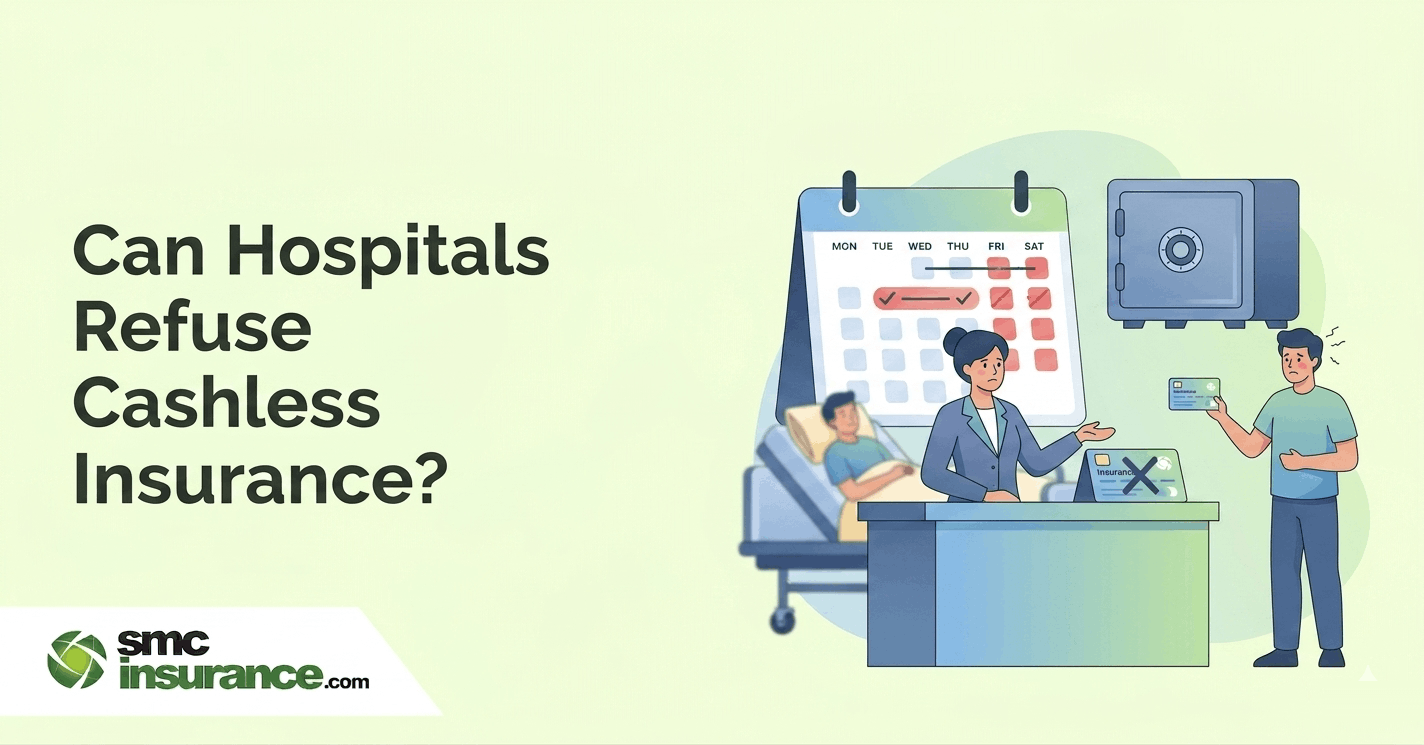

Can hospitals refuse cashless insurance in India?
Yes, but only under specific valid circumstances. A network hospital cannot refuse cashless treatment unless there is a genuine policy-based reason: your condition is under a waiting period, the treatment is excluded, or the pre-authorisation was not submitted correctly. Tariff disputes between the hospital and the insurer do not override your rights under the SLA. At a non-network hospital, cashless is generally not available unless your insurer has adopted the Cashless Everywhere initiative (General Insurance Council, January 2024). If cashless is denied unjustly, file a grievance with the insurer's GRO first. Unresolved complaints go to IRDAI's Bima Bharosa portal or the Insurance Ombudsman (up to Rs 30 lakh award, free process). Regardless of cashless outcome, you retain the right to file a reimbursement claim if the treatment is covered under your policy.
You're at the hospital billing counter, insurance card in hand. The admission staff takes one look at it and says: "Sorry, we don't accept cashless for this insurer right now." Or worse, you find out only at discharge. That moment, when a medical emergency collides with a payment dispute, is exactly the situation cashless health insurance was meant to prevent.
The hard truth is that cashless denial happens more often than most policyholders expect. About 37% of health insurance claims in India still go through reimbursement, often not by choice. Some refusals are legitimate under policy terms. Others are the result of insurer-hospital disputes that have nothing to do with you. And a few are outright wrong, fixable if you know the rules. This article breaks down when hospitals can legally refuse cashless insurance, when they cannot, what changed after IRDAI's 2024 guidelines and the "Cashless Everywhere" initiative, and exactly what to do if it happens to you.
Can a Hospital Legally Refuse Cashless Insurance? What IRDAI Says
The short answer is: it depends on whether you're at a network or non-network hospital, and whether the refusal is based on a policy clause or a tariff dispute.
Under Regulation 31(d) of the IRDAI (Health Insurance) Regulations, 2016, every general and health insurance company must maintain agreements with an adequate number of public and private hospitals across geographical areas. The list of these network hospitals must be published with the policy document. If a hospital is on that network list, IRDAI has been clear: it cannot deny you cashless treatment simply on a whim.
IRDAI has issued circulars on this more than once, specifically directing insurance companies to ensure smooth cashless treatment at all network hospitals as per the agreed Service Level Agreement (SLA). If a network hospital deviates from the SLA and refuses cashless without a valid policy reason, the insurer is expected to take action against that hospital, and you are entitled to report the incident to state authorities.
That said, there are legitimate reasons why even a network hospital or its TPA might decline a cashless request. Knowing the difference between a valid refusal and an unjust one is where most policyholders lose time, money, and patience.
Valid Reasons a Cashless Request Can Be Declined
|
Reason |
Who's Responsible |
What It Means for You |
|
Condition under waiting period (PED, specific disease) |
Insurer, as per policy terms |
Cashless denied; reimbursement also won't apply until waiting period ends |
|
Treatment is excluded from policy |
Insurer, per policy terms |
Cashless and reimbursement both denied |
|
Hospital not in insurer's network |
Network structure |
Reimbursement possible; cashless not (unless Cashless Everywhere applies) |
|
Pre-authorisation form not submitted or submitted late |
Hospital / Policyholder |
Cashless may be declined; reimbursement still an option |
|
Incomplete or unclear medical documents |
Hospital, TPA |
Cashless held pending more information |
|
Policy recently purchased; insurer investigating |
Insurer's underwriting |
Reimbursement route may be suggested |
|
Hospital blacklisted by insurer (fraud, overbilling) |
Insurer |
Cashless declined at that hospital |
|
Tariff dispute between insurer and hospital group |
Insurer + Hospital |
Cashless suspended; reimbursement route remains open |
Note: A cashless denial is not the same as a claim denial. Even when cashless is refused, a reimbursement claim can still be filed as long as the treatment is covered under your policy.
The Cashless Everywhere Initiative: A Big Promise, a Bigger Gap
In January 2024, the General Insurance Council (GIC), the industry body for non-life insurers, launched the "Cashless Everywhere" initiative. The stated goal was straightforward: allow policyholders to access cashless treatment at any hospital in India, whether or not it is on the insurer's empanelled network.
For planned procedures, the policyholder must inform the insurer at least 48 hours before admission. For emergencies, the insurer must be notified within 48 hours of hospital admission. The hospital must have a minimum of 15 beds and be registered under the Clinical Establishments Act.
On paper, this is transformational. In practice, there are two problems worth knowing.
- First, IRDAI has not issued an independent regulatory circular mandating Cashless Everywhere. The initiative is currently a General Insurance Council commitment, not a statutory IRDAI directive. Individual insurers can implement it at their own pace and with their own operational guidelines. So while most large insurers have signed on, the experience at ground level varies significantly.
- Second, the initiative does not override policy exclusions. If a condition is not covered, cashless treatment is still not available, regardless of which hospital you choose.
- Still, if your insurer participates, this significantly expands your options, especially during emergency hospitalisation far from a network hospital.
When Hospitals Withdraw Cashless: The Insurer-Hospital Tariff War
Some of the most disruptive cashless refusals in recent years have had nothing to do with your policy terms at all. They stem from contractual disputes between insurance companies and hospital groups.
In August 2025, the Association of Healthcare Providers India (AHPI), which represents over 15,000 hospitals including large chains like Max Healthcare, Medanta, and Fortis, directed its members in North India to suspend cashless services for Bajaj General Insurance policyholders from September 1, 2025. The stated reason was that reimbursement rates offered by Bajaj General had not been revised for years, even as medical inflation averaged 7–8% annually. AHPI also cited unilateral deductions and delays in claim payments.
Earlier that same year, Niva Bupa suspended its cashless arrangement with all Max Hospitals across India from August 16, 2025, asking policyholders to pay upfront and claim reimbursement instead.
The Bajaj General standoff was resolved within days. After a meeting on August 28, AHPI withdrew its advisory and cashless services were restored. But the disruption left lakhs of policyholders in limbo, many of whom had no idea the dispute was even happening.
These episodes reveal a structural tension: hospitals accuse insurers of paying outdated rates while medical costs rise. Insurers accuse hospitals of inflating bills under cashless arrangements. The policyholder is caught in the middle with no seat at the table.
The General Insurance Council, in response to the AHPI advisory, called it "arbitrary" and "disruptive to public trust." IRDAI's Vice-Chairperson has since stated that hospitals misusing cashless rules under the Insurance Act can be stripped of their network status within 15 days.
What Happens at a Non-Network Hospital?
If the hospital you visit is not on your insurer's network, cashless treatment is generally not available unless your insurer has adopted the Cashless Everywhere framework. In that case, you would need to meet the notification timeline mentioned earlier.
If cashless is not possible, the next option is a reimbursement claim. Pay the hospital bill, collect all original documents at discharge, and submit a complete claim to your insurer within the time limit specified in your policy (usually 15 to 30 days from discharge).
Under IRDAI Health Insurance Regulations (2024 Master Circular), insurers must settle a reimbursement claim within 30 days of receiving all required documents. If the insurer delays beyond this, they are liable to pay interest at 2% above the prevailing bank rate on the outstanding amount.
One important note: in emergency situations, hospitals registered under NABH and IRDAI guidelines cannot refuse treatment just because cashless is unavailable. They may ask for a deposit, but treatment must begin. Always document this in writing.
IRDAI's 2024 Guidelines: What Changed for Cashless Claims?
The IRDAI's 2024 Master Circular introduced several significant improvements to cashless claim timelines, all of which directly affect how hospitals and insurers must behave.
|
IRDAI 2024 Rule |
What It Means |
|
Cashless pre-authorisation within 1 hour |
Insurer or TPA must approve or respond within 1 hour of receiving complete documents from the hospital. |
|
Final discharge authorisation within 3 hours |
Once the hospital submits the discharge request, the insurer must provide final approval within 3 hours. |
|
No physical documents mandatory |
Insurers and TPAs must collect documents directly from hospitals; policyholders cannot be denied cashless treatment due to missing physical paperwork. |
|
No age limit for health insurance |
IRDAI removed the earlier age cap of 65 years, requiring insurers to offer policies to people of all ages. |
|
Lifetime renewal guaranteed |
Insurers cannot refuse renewal solely due to claims; denial permitted only in proven fraud cases |
|
Reimbursement settlement within 30 days |
From receipt of last required document; delay attracts 2% compound interest |
Note: These are minimum standards mandated by IRDAI. Individual insurers may offer faster timelines, but they cannot offer worse ones.
Thinking of comparing health insurance plans before your next renewal?
Picking the right insurer matters most when something goes wrong. At SMC Insurance, our advisors help you assess network hospitals in your area, check claim settlement ratios, and find a plan that actually delivers on cashless coverage when you need it most.
What to Do If a Hospital Refuses Cashless Insurance
Stay calm, act fast, and document everything. Here is the step-by-step approach.
Step 1: Get the refusal in writing
Ask the hospital billing desk to provide a written note or email stating the reason for cashless denial. This record becomes your strongest tool when filing a claim or a grievance later.
Step 2: Call your insurer's TPA helpline immediately
Your insurance card has the TPA's toll-free number. Call them, explain the situation, and ask whether a direct insurer-to-hospital arrangement can be made on the spot. Sometimes disputes are resolved at this stage.
Step 3: If cashless is denied, proceed with reimbursement
Keep every original document: admission records, prescription, test reports, bills, and the discharge summary. Retain payment receipts for every expense. Submit a complete claim within your policy's specified timeline.
Step 4: File a grievance with the insurer's GRO
Every insurer must have a Grievance Redressal Officer (GRO) whose contact details appear on your policy document and website. File a written complaint citing the unjust denial, include your documents, and note the date. Insurers are mandated to respond within 15 days.
Step 5: Escalate to IRDAI's Bima Bharosa portal If the insurer does not resolve the complaint within 15 days or the resolution is unsatisfactory, escalate through IRDAI's Integrated Grievance Management System at bimabharosa.irdai.gov.in. You will receive a token number to track progress.
Step 6: Approach the Insurance Ombudsman
If IGMS escalation does not resolve the matter, you can file a complaint with the Insurance Ombudsman at cioins.co.in within one year of the insurer's rejection. The process is free, requires no lawyer, and the Ombudsman can award up to Rs 30 lakh under the Redressal of Public Grievances Rules 2017.
Wrapping Up,
Hospitals can refuse cashless insurance. But whether a refusal is valid or unjust depends entirely on the reason behind it. A refusal because your condition is under a waiting period is a policy reality. A refusal because your insurer and hospital chain are fighting over reimbursement rates is not your fault, but it still lands on you.
IRDAI's 2024 guidelines significantly tightened timelines and added policyholders' rights that many people do not know they have. The Cashless Everywhere initiative, while not yet fully enforceable, gives you more options than before if your insurer has adopted it. And even when cashless fails, reimbursement, backed by a complete paper trail and the right escalation path, is a recoverable situation.
Understanding how cashless and reimbursement claims differ and choosing the right health insurance plan for your needs can make an enormous difference when moments like these arrive.
Disclaimer:The information provided on this platform is intended for general awareness and educational purposes. While every effort is made to ensure accuracy, some details may change with policy updates, regulatory revisions, or insurer-specific modifications. Readers should verify current terms and conditions directly with relevant insurers or through professional consultation before making any decision.
All views and analyses presented are based on publicly available data, internal research, and other sources considered reliable at the time of writing. These do not constitute professional advice, recommendations, or guarantees of any product’s performance. Readers are encouraged to assess the information independently and seek qualified guidance suited to their individual requirements. Customers are advised to review official sales brochures, policy documents, and disclosures before proceeding with any purchase or commitment.
FAQs
A network hospital is bound by a Service Level Agreement with the insurer and, under IRDAI regulations, cannot deny cashless treatment to a policyholder without a valid reason. Legitimate grounds include incomplete pre-authorisation documents, a condition under a waiting period, or treatments that are excluded under the policy. If the denial is based on a tariff dispute between the insurer and the hospital, that dispute does not legally override your entitlement to cashless care as per the SLA. You should request the refusal in writing, call your TPA immediately, and escalate through the insurer's Grievance Redressal Officer if needed.
The Cashless Everywhere initiative was launched by the General Insurance Council in January 2024. It allows policyholders to receive cashless treatment even at hospitals not on the insurer's network, provided the hospital has at least 15 beds, is registered under the Clinical Establishments Act, and you notify the insurer at least 48 hours before planned admission or within 48 hours of emergency admission. However, IRDAI has not issued a statutory circular mandating this scheme, so its availability depends on your specific insurer and policy terms. Check with your insurer before assuming it applies to your plan.
Yes, a cashless denial does not mean a claim denial. If your treatment is covered under the policy and you are admitted to a valid hospital, reimbursement remains your right. Pay the hospital bill, collect all original documents including the discharge summary, prescriptions, test reports, and bills, and submit a complete claim within the timeline stated in your policy (typically 15 to 30 days from discharge). Under IRDAI's 2024 Master Circular, the insurer must settle the reimbursement claim within 30 days of receiving all required documents. Any delay attracts 2% compound interest.
If a hospital group has suspended cashless services due to a dispute with your insurer, your practical options are: visit another network hospital where cashless is operational, use Cashless Everywhere if your insurer supports it and the hospital qualifies, or pay upfront and claim reimbursement. You can also file a complaint with your insurer's GRO, arguing that the insurer's failure to maintain an adequate hospital network has caused you financial harm. IRDAI's regulations require insurers to maintain sufficient network coverage, and regulatory pressure has previously resolved such standoffs quickly.
There is a clear three-step escalation path. First, write a formal complaint to your insurer's Grievance Redressal Officer (GRO), whose contact is on your policy document; they must respond within 15 days. If unresolved or unsatisfactory, escalate to IRDAI's Bima Bharosa portal at bimabharosa.irdai.gov.in, where you receive a complaint token and IRDAI monitors the insurer's response. If still unresolved, approach the Insurance Ombudsman at cioins.co.in within one year of the insurer's final rejection. The Ombudsman process is free, does not require a lawyer, and can award up to Rs 30 lakh.
In emergency situations, hospitals are obligated to begin treatment regardless of whether cashless is immediately confirmed. They may ask for a deposit, but treatment cannot be withheld. In non-emergency cases, if the cashless authorisation is pending, the hospital may ask for a deposit while the approval is processed. Always insist on receiving a receipt, keep all documentation, and include these amounts in your reimbursement claim later.
Under IRDAI's 2024 Master Circular, insurers and TPAs must respond to a cashless pre-authorisation request within one hour of receiving complete documents from the hospital. The final authorisation at discharge must be issued within three hours of the hospital submitting the discharge request. If the insurer misses these timelines, it is a regulatory violation. Document the timestamps and cite the breach in your grievance complaint if needed.


