



Why is the hospital asking me to pay even though I have insurance?
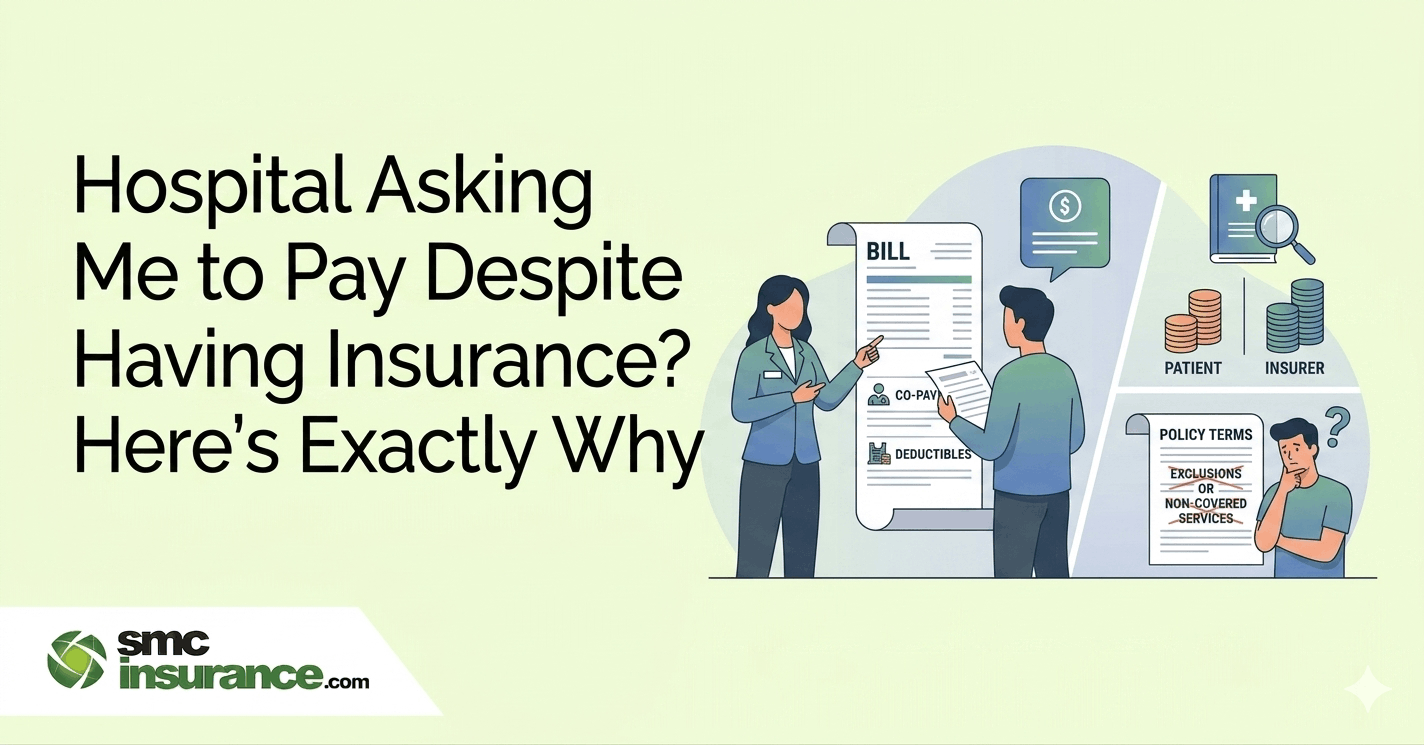
Health insurance in India does not cover 100% of every hospital bill. There are three main reasons for a balance being payable by you:
- IRDAI-defined non-payable items (consumables, comfort charges, administrative fees) that all insurers are permitted to exclude, typically Rs. 5,000–Rs. 15,000 per hospitalisation
- Policy clauses like room rent sub-limits (which trigger proportionate deductions across the entire bill), co-payment (10%–30% of every claim), deductibles, or treatment sub-limits; and
- Billing errors or insurer delays, which you can dispute. To check whether a charge is correct, ask for both an itemised bill and the insurer's settlement sheet, compare them and escalate any discrepancy to the insurer's GRO, then to IRDAI's Bima Bharosa portal (1800 4254 732) and finally to the Insurance Ombudsman at igms.irda.gov.in, all free of charge.
You checked in with a valid health insurance policy. You filled out the pre-authorisation form. The hospital confirmed it was cashless. And then, at discharge, someone slides a bill across the counter asking you to pay Rs. 40,000 out of pocket.
This happens to thousands of insured patients every month across India. The confusion is real, the frustration is justified and more often than not, the person being asked to pay has no idea what they actually owe, what the insurer has cut, or whether the hospital is even asking for the right amount. By the time you finish reading this article, you will know precisely why the hospital is asking for money, which charges are legitimate, which ones you can push back on and exactly how to do it.
Why Is the Hospital Asking You to Pay Despite Having Health Insurance?
The short answer is that no health insurance policy in India covers 100% of every rupee on every hospital bill. There are always gaps: specific items not covered under any plan, policy clauses that reduce the payout and situations where you, the policyholder, are expected to share part of the cost.
Understanding where these gaps come from is the first step to knowing which bill demands are valid and which ones are not.
IRDAI-Defined Non-Payable Items:The Charges Your Policy Will Never Cover
The Insurance Regulatory and Development Authority of India (IRDAI) has published a standard list of items that all health insurers are permitted to exclude from claim settlement. These are called non-payable items or non-medical expenses and every insurer follows this list when processing claims.
These charges appear on your hospital bill but are deducted from the insurer's payout. The balance becomes your liability.
Common non-payable items under IRDAI guidelines:
Category
Items Excluded
Room comfort items
Tissues, mineral water, laundry, telephone charges, guest services
Personal care items
Diapers, sanitary pads, beauty services, baby food
Consumable supplies
Surgical gloves, drip sets, IV cannulas, syringes, gauze
Procedural costs
Charges for items used during surgery that are not medicines (blades, sutures in some plans)
Administrative charges
Registration fees, documentation charges
|
Category |
Items Excluded |
|
Room comfort items |
Tissues, mineral water, laundry, telephone charges, guest services |
|
Personal care items |
Diapers, sanitary pads, beauty services, baby food |
|
Consumable supplies |
Surgical gloves, drip sets, IV cannulas, syringes, gauze |
|
Procedural costs |
Charges for items used during surgery that are not medicines (blades, sutures in some plans) |
|
Administrative charges |
Registration fees, documentation charges |
Note: In the 2024 revision of the IRDAI non-payable list, certain specialised post-surgical wound dressings and protective equipment used in complex procedures (such as robot-assisted surgery) were moved from the excluded list to the payable category. Check your insurer's updated list or policy wording.
For most routine hospitalisations, non-payable items typically add up to Rs. 5,000–Rs. 15,000 on the final bill. For surgeries or longer stays, this figure can go higher.
The Room Rent Trap: Why Upgrading Your Room Can Cut the Entire Claim
This is the most financially damaging clause that most policyholders never read before admission.
Most standard health insurance policies have a room rent sub-limit. This cap restricts the daily hospital room rate your insurer will pay, either as a fixed amount (say Rs. 3,000 per day) or as a percentage of the sum insured (typically 1%–2% per day). The problem is not just that the insurer won't pay for the extra room rent. The problem is something called proportionate deduction.
When you occupy a room that costs more than your policy's room rent limit, the insurer applies that ratio to virtually every other charge on the bill. Doctor fees, nursing charges, OT charges, diagnostics — all of them get cut proportionately.
A real-numbers example:
Your policy has a sum insured of Rs. 5 lakh. The room rent cap is 1% of sum insured = Rs. 5,000 per day. You were admitted to a private room costing Rs. 10,000 per day.
The admissible ratio becomes: Rs. 5,000 / Rs. 10,000 = 50%.
On a total bill of Rs. 3 lakh, the insurer pays only 50% of most line items. Your out-of-pocket cost: approximately Rs. 1.45–1.5 lakh — even though your sum insured was more than enough to cover the entire bill. Industry data shows room rent proportionate deductions affect roughly 25–30% of hospitalisation claims and are among the top three reasons for claim disputes in India.
Note: IRDAI does not fix a standard room rent cap across the industry. Insurers define their own limits. IRDAI does, however, mandate that these limits are clearly disclosed at the time of policy purchase.
Co-Payment, Deductibles and Sub-Limits: How Your Policy Shares the Cost With You
Beyond room rent, several other clauses in your policy are designed to make you bear part of the hospitalisation cost. These are not errors or wrongful deductions. They are policy features that reduce your premium in exchange for your agreement to share costs.
Co-payment (Co-pay): You agree to pay a fixed percentage of every claim. Common co-pay ratios are 10%, 20%, or 30%. Policies for senior citizens often carry mandatory co-pay clauses. On a Rs. 2 lakh bill with a 20% co-pay, you owe Rs. 40,000, regardless of your sum insured.
Deductible: A fixed amount you must pay out of pocket before the insurer steps in. Super top-up plans almost always carry a deductible (usually matching your base policy's sum insured). If your deductible is Rs. 3 lakh and your bill is Rs. 3.8 lakh, the insurer pays only Rs. 80,000.
Sub-limits on specific treatments: Many policies cap payouts for named procedures. Cataract surgery sub-limits of Rs. 30,000–Rs. 50,000 per eye are very common, even in Rs. 10 lakh policies. If the hospital charges Rs. 75,000, you pay the remaining Rs. 25,000–Rs. 45,000 yourself.
|
Clause |
How It Works |
Who It Typically Applies To |
|
Co-payment |
You pay a fixed % of every claim |
Senior citizen policies, zone-based plans, some employer policies |
|
Deductible |
You pay first; insurer pays the rest |
Super top-up plans, voluntary deductible policies |
|
Room rent sub-limit |
Insurer caps room rate, cuts entire bill proportionately |
Most standard health plans without "no room rent cap" feature |
|
Treatment sub-limit |
Insurer caps specific procedures regardless of sum insured |
Cataract, knee replacement, maternity in many mid-range plans |
Note: Read your policy's "Schedule of Benefits" page (not just the brochure) to see which of these apply to your plan.
When the Hospital Is Asking for Something It Shouldn't Be
Not every extra charge on your bill is a legitimate insurer deduction. Hospitals sometimes charge items incorrectly and there are situations where the extra demand is simply wrong.
Check for upcoding
This means billing for a more expensive procedure or consumable than what was actually used. Ask for an itemised bill and cross-check it against the treatments you actually received.Duplicate entries
Long stay bills sometimes carry the same item twice. Go line by line.Insurer delay costs
Under IRDAI's Master Circular on Health Insurance (effective July 31, 2024), your insurer must grant final cashless authorisation within three hours of the hospital's discharge request. If the insurer misses this deadline, any extra charges arising from the delay, including extra room rent for an extended stay, must be borne by the insurer's shareholder fund, not by you.Insurer processing speed (as of August 2024–May 2025)
Data presented in Parliament in December 2025 showed that a high percentage of pre-authorisation requests were processed within one hour and final discharge authorisations were granted within three hours. If your discharge got delayed and the insurer was responsible, document the timing and raise it in your claim.
What to Do When the Hospital Demands Payment You Don't Think You Owe
Before you pay anything at discharge, take these steps in order.
Step 1: Ask for an itemised bill
Never pay a consolidated amount. Request a line-by-line breakup of every charge. The hospital is required to provide this.Step 2: Ask for the Explanation of Benefits (EOB) or the insurer's settlement sheet
This document shows exactly what the insurer approved, what it deducted and why. Compare it with the hospital bill to identify which charges are a policy deduction (legitimate) and which are a hospital error or an unjustified demand.Step 3: Check which deductions were for non-payable items
Cross-reference the deducted items against the IRDAI non-payable list. If the hospital is billing you for something that goes beyond the non-payable list, question it.Step 4: Check your policy's room rent cap and whether proportionate deductions apply
If proportionate deductions have been applied, calculate the ratio yourself. If the math doesn't match what the insurer has settled, call the TPA (Third Party Administrator) helpline immediately.Step 5: If the extra demand is from the insurer's error or delay, document it
Note the time of discharge request and the time of insurer approval. If the gap is more than three hours, this becomes your basis for a formal complaint.
How to Raise a Formal Complaint If You're Being Charged Wrongly
If the hospital or insurer refuses to resolve the dispute at the time of discharge, you have a clear escalation path. All of these channels are free.
Step 1 — Insurer's Grievance Redressal Officer (GRO)
Every insurer must have a GRO whose contact details appear on your policy document. File a written complaint with supporting documents. The insurer must respond within 15 days.
Step 2 — IRDAI Bima Bharosa Portal
If the insurer does not respond satisfactorily within 15 days, escalate to IRDAI's grievance portal. You can also reach IRDAI by calling the toll-free number 1800 4254 732 or emailing complaints@irdai.gov.in.
Step 3 — Insurance Ombudsman
Once you have filed with the insurer's GRO and waited 30 days (or received an unsatisfactory resolution), you can approach the Insurance Ombudsman. There are 17 Ombudsman offices across India. You can file online at igms.irda.gov.in. The Ombudsman handles disputes up to Rs. 50 lakh, charges no fees, does not require a lawyer and typically resolves cases within three months.
According to Council for Insurance Ombudsmen data for FY 2024-25, approximately 71% of the 53,184 complaints received that year were settled in the policyholder's favour, either fully or partially. Health insurance disputes accounted for about 64% of all complaints.
Step 4 — Consumer Court
If the Ombudsman's verdict is not acceptable, you can approach the Consumer Court directly.
|
Escalation Level |
Where to Go |
Timeline |
Cost |
|
Level 1 |
Insurer's GRO (policy document) |
15 days |
Free |
|
Level 2 |
IRDAI Bima Bharosa / 1800 4254 732 |
Forwarded to insurer |
Free |
|
Level 3 |
Insurance Ombudsman (igms.irda.gov.in) |
~3 months |
Free |
|
Level 4 |
Consumer Court |
Varies |
Minimal |
Note: Before approaching the Ombudsman, you must first have filed with the insurer's GRO and either received no response in 30 days or received a resolution you disagree with. Parallel proceedings in court bar you from using the Ombudsman. Confused about whether your current plan has a room rent cap or co-pay that could shrink your next claim? The team at SMC Insurance can review your existing policy and help you understand what you'd actually owe during hospitalisation, before you need to find out at the discharge counter.
How to Avoid Getting Blindsided on the Next Hospitalisation
The best time to understand your policy's gaps is before admission, not during it.
Before any planned hospitalisation, call your insurer's TPA helpline and ask three specific questions:
- What is my room rent limit?
- Are there any sub-limits for this procedure?
- Does my policy have a co-pay clause?
Choose a room category that fits within your policy's room rent limit. This one decision alone prevents the proportionate deduction from applying and protects your entire claim.
For policies you haven't bought yet, look for plans that explicitly state "no room rent sub-limit" or "any room" category. These plans cost marginally more in premium but remove the most common source of claim disputes entirely. SMC Insurance has detailed guides on sub-limits in health insurance and on the room rent capping trap that explain exactly which plan features to check for.
If you're assessing whether your existing cover is adequate, the article on how much health insurance your family actually needs provides a useful baseline for different cities and family profiles.
Wrapping Up,
Having health insurance does not guarantee a zero-rupee hospital bill. It guarantees financial protection against major costs, but every policy has clauses that limit, share, or exclude certain charges. The practical steps are straightforward: get an itemised bill, get the insurer's settlement sheet, compare them and only pay what is genuinely your policy's share. If the numbers don't match, escalate; starting with the insurer's GRO and moving up the chain if needed.
Most importantly, the next time you buy or renew a policy, choose one that does not have a room rent cap. That single clause is responsible for more hospitalisation payment disputes in India than any other.
Disclaimer:The information provided on this platform is intended for general awareness and educational purposes. While every effort is made to ensure accuracy, some details may change with policy updates, regulatory revisions, or insurer-specific modifications. Readers should verify current terms and conditions directly with relevant insurers or through professional consultation before making any decision.
All views and analyses presented are based on publicly available data, internal research, and other sources considered reliable at the time of writing. These do not constitute professional advice, recommendations, or guarantees of any product’s performance. Readers are encouraged to assess the information independently and seek qualified guidance suited to their individual requirements. Customers are advised to review official sales brochures, policy documents, and disclosures before proceeding with any purchase or commitment.
FAQs
Cashless insurance means the insurer pays the hospital directly — but only for covered, approved amounts. The hospital collects the balance from you: non-payable items (defined by IRDAI), amounts deducted due to room rent proportionate clauses, co-pay percentages, treatment sub-limits, or any charges the insurer specifically excluded. Before paying, request both an itemised hospital bill and the insurer's settlement sheet and compare the two. Anything the hospital charges beyond the insurer's deductions and legitimate policy gaps can be disputed with the TPA or escalated to the IRDAI grievance portal.
In general, hospitals do collect the insurer-excluded portion before discharge in cashless claims. However, under IRDAI's Master Circular (effective July 2024), if the insurer fails to issue final cashless authorisation within three hours of the hospital's discharge request, any additional charges from that delay must be borne by the insurer, not you. If you believe the delay caused extra charges and the insurer is refusing to pay, document the timeline and file a formal complaint with the insurer's GRO, followed by the IRDAI Bima Bharosa portal if needed.
Non-payable items are medical and non-medical consumables and comfort charges that IRDAI has excluded from mandatory coverage under health insurance plans. The IRDAI publishes a standard list, which all insurers follow. Common examples include surgical gloves, IV drip sets, syringes, tissues, laundry charges and administrative fees. The list was last comprehensively updated in 2024, with some procedural protective items being moved to the payable category for complex surgeries. Policyholders can add a consumable rider to some plans to partially cover these costs.
Under the IRDAI Master Circular on Health Insurance Business 2024 (effective July 31, 2024), health insurers are required to issue final cashless authorisation within three hours of receiving a discharge request from the hospital. For pre-authorisation at admission, the insurer must respond within one hour. If the three-hour discharge deadline is missed, any extra charges the hospital levies because of that delay must be paid by the insurer from its shareholder fund. As of the data shared in Parliament in December 2025, 96.69% of discharge authorisations were being processed within three hours.
Start with the insurer's Grievance Redressal Officer (GRO), whose contact details are on your policy document. File a written complaint with your itemised bill, the insurer's settlement sheet and a clear statement of what you believe is wrong. The insurer must respond within 15 days. If you are not satisfied, escalate to IRDAI's Bima Bharosa portal or call 1800 4254 732. After 30 days without resolution, you can file with the Insurance Ombudsman at igms.irda.gov.in. This process is free, needs no lawyer and handles disputes up to Rs. 50 lakh. Roughly 71% of health insurance complaints filed with the Ombudsman in FY 2024-25 were resolved in the policyholder's favour.
Yes, if your policy has a room rent sub-limit. When your actual room cost exceeds your policy's daily room rent cap, the insurer applies the excess room cost ratio to doctor fees, nursing charges, diagnostics, OT charges and most other bill components. This is called proportionate deduction. A policyholder with a Rs. 5,000-per-day room rent cap who stays in a Rs. 10,000-per-day room effectively gets only 50% of most charges reimbursed, even if their sum insured is far more than the total bill. The only way to completely avoid this is to choose a room that fits within your policy's limit, or to buy a policy with no room rent sub-limit.
The Insurance Ombudsman is an independent quasi-judicial body established by the Government of India to resolve disputes between policyholders and insurers. There are 17 Ombudsman offices across India. The service is free, requires no lawyer and handles cases involving disputes up to Rs. 50 lakh. You can file online through igms.irda.gov.in or by post to the Ombudsman office in your region. The prerequisite is that you must first have filed a complaint with your insurer's GRO and either received no response within 30 days or received a resolution you find unsatisfactory. The Ombudsman typically resolves complaints within three months and its awards are binding on the insurer if the policyholder accepts them.


