


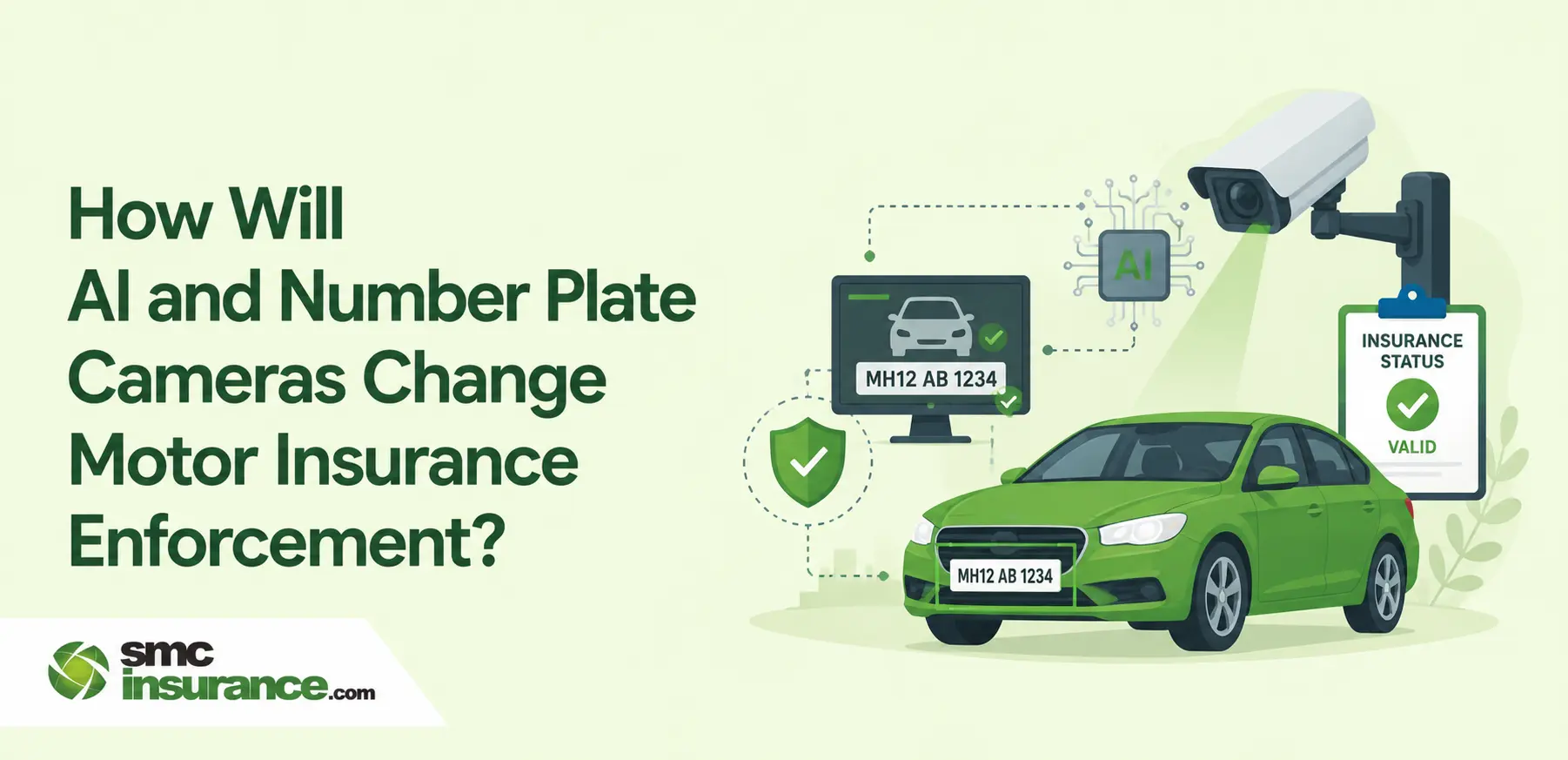
AI-enabled number plate recognition cameras can identify vehicles without valid insurance by checking registration details against VAHAN and insurance databases. The Supreme Court directed wider use of this system on 4 August 2026. Under the amended Section 196, effective 15 August 2026, the penalty starts at Rs. 5,000 for a first contravention and Rs. 10,000 for subsequent contraventions, with higher amounts possible depending on the vehicle's base premium. The Court also directed longer third-party insurance periods for new cars and two-wheelers. Vehicle owners should check their policy validity and renew before expiry.
Table of Contents
Your policy lapses by a few days, you assume nobody will notice and then a challan SMS arrives from a camera you never saw. That is where motor insurance enforcement in India is heading, with AI reading your number plate and checking it against insurance records. A lapse that once went unnoticed can now attract a penalty starting at Rs. 5,000 for a first contravention, with higher penalties possible depending on the vehicle's base premium. As automated systems make it easier to identify vehicles and verify insurance records, owners should understand the requirements for car insurance in India. Similarly, two-wheeler owners can explore two-wheeler insurance options to understand the coverage required for their vehicles. Below, we explain what the Supreme Court has ordered, what it could cost you and how to stay covered.
How AI Number Plate Recognition Checks Your Car Insurance Status
The technology is simpler than it sounds and the Supreme Court has now pointed it squarely at insurance.
An ANPR camera captures a vehicle's number plate and uses image-recognition technology to identify its registration number. This information can then be checked against insurance records to determine whether the vehicle has valid cover. On 4 August 2026, the Supreme Court directed the integration of ANPR cameras with the Insurance Information Bureau (IIB) and VAHAN databases to enable automatic e-challans for uninsured vehicles. It also directed that state police be equipped with handheld devices or mobile applications to verify insurance status during roadside checks. The extent of implementation may vary across states.
The scale explains the urgency. A Standing Committee on Finance report cited by the Court found that 16.54 crore of 30.48 crore vehicles, about 56 percent, had no valid insurance. Automated enforcement is not entirely new. In its submissions before the Supreme Court, the Ministry of Road Transport and Highways reported that electronic detection of uninsured vehicles had already begun in seven states: Odisha, West Bengal, Rajasthan, Gujarat, Himachal Pradesh, Chhattisgarh and Uttarakhand. The Court's directions aim to strengthen and expand this technology-led approach.
Uninsured Vehicle Fine and Premium Changes After the Supreme Court Order
Cameras are only half the story, because the same order changes what you must buy at the showroom.
Area |
Earlier position |
Supreme Court direction, 4 August 2026 |
Third-party cover for new private cars | 3 years | 4 years |
Third-party cover for new two-wheelers | 5 years | 6 years |
Detection of uninsured vehicles | Manual checks and electronic enforcement in selected states | Wider integration of ANPR, IIB and VAHAN for automatic e-challans |
Fuel access | No nationwide insurance-linked restriction | Development of a pilot linking fuel supply with valid insurance |
Note: IRDAI has been told to issue the necessary directions and the fuel link is a pilot proposal, so confirm timelines with your insurer.
The penalty has also changed. Following amendments to Section 196 of the Motor Vehicles Act, effective 15 August 2026, driving without valid third-party insurance attracts a penalty of three times the applicable base premium or Rs. 5,000, whichever is higher, for the first contravention. For subsequent contraventions, the penalty increases to five times the base premium or Rs. 10,000, whichever is higher. You can read more in our guide on the fine for driving without car insurance.
The Supreme Court also directed an additional year of mandatory third-party cover for new cars and two-wheelers, despite concerns raised by IRDAI and the General Insurance Council about the financial burden of longer-term policies. Buyers should verify the applicable premium and implementation requirements with their insurer. Buyers must also be offered a four-layer structure that starts with mandatory third-party insurance and adds optional occupant or pillion liability, personal accident and own damage cover.
Not sure whether your policy is still active, or what longer third-party cover will cost? Compare plans and renew in minutes at SMC Insurance before a camera finds the gap for you.
How to Check Car Insurance Status and Contest a Wrong E-Challan
Staying clear of all this takes a few habits rather than a big overhaul.
Start by checking validity through the Parivahan “Know Your Vehicle Details” option or our check car insurance status page, then store the policy on DigiLocker so it can be verified on the spot. Renew before expiry rather than after, because a lapse, even a short one, is exactly what these cameras are built to catch. If a challan arrives despite a valid policy, upload proof on the Parivahan e-challan portal to contest it. Bike owners deserve extra attention, as the General Insurance Council has noted that most uninsured vehicles are two-wheelers.
Watch Out for Fake E-Challan Messages
As traffic enforcement becomes increasingly digital, vehicle owners should also be cautious about fraudulent challan messages. Avoid opening unfamiliar payment links received through SMS or messaging apps. Instead, visit the official Parivahan e-Challan portal directly to verify whether a challan has actually been issued against your vehicle.
Wrapping Up,
Number plate cameras will not make insurance more complicated, but they will make skipping it far harder to get away with. The Supreme Court has already told the government to link cameras, VAHAN and insurance records and has lengthened mandatory third-party cover for new vehicles. Rollout will differ from state to state, yet the direction is clear.
The fine is small next to the personal liability you carry if an accident happens without cover. Check your expiry date today, renew before it lapses and keep a digital copy handy.
Disclaimer: The information provided on this platform is intended for general awareness and educational purposes. While every effort is made to ensure accuracy, some details may change with policy updates, regulatory revisions, or insurer-specific modifications. Readers should verify current terms and conditions directly with relevant insurers or through professional consultation before making any decision.
All views and analyses presented are based on publicly available data, internal research and other sources considered reliable at the time of writing. These do not constitute professional advice, recommendations, or guarantees of any product’s performance. Readers are encouraged to assess the information independently and seek qualified guidance suited to their individual requirements. Customers are advised to review official sales brochures, policy documents and disclosures before proceeding with any purchase or commitment.
FAQs
Cameras will read your plate and check it against insurance and registration databases and uninsured vehicles will receive automatic e-challans. Police will also get handheld tools for real-time checks.
The Court has directed this system, but rollout depends on states and agencies. Treat a lapse as risky already, since some cities issue camera-based challans today.
Under the amended Section 196 of the Motor Vehicles Act, effective 15 August 2026, the penalty for a first contravention is three times the applicable base premium or Rs. 5,000, whichever is higher. For subsequent contraventions, it is five times the base premium or Rs. 10,000, whichever is higher.
Not yet as a national rule. The Court asked IRDAI and the road transport ministry to design a pilot, so it remains a proposal for now.
The direction covers new vehicles, so existing policies renew as before. Confirm details with your insurer once IRDAI issues its instructions.


