


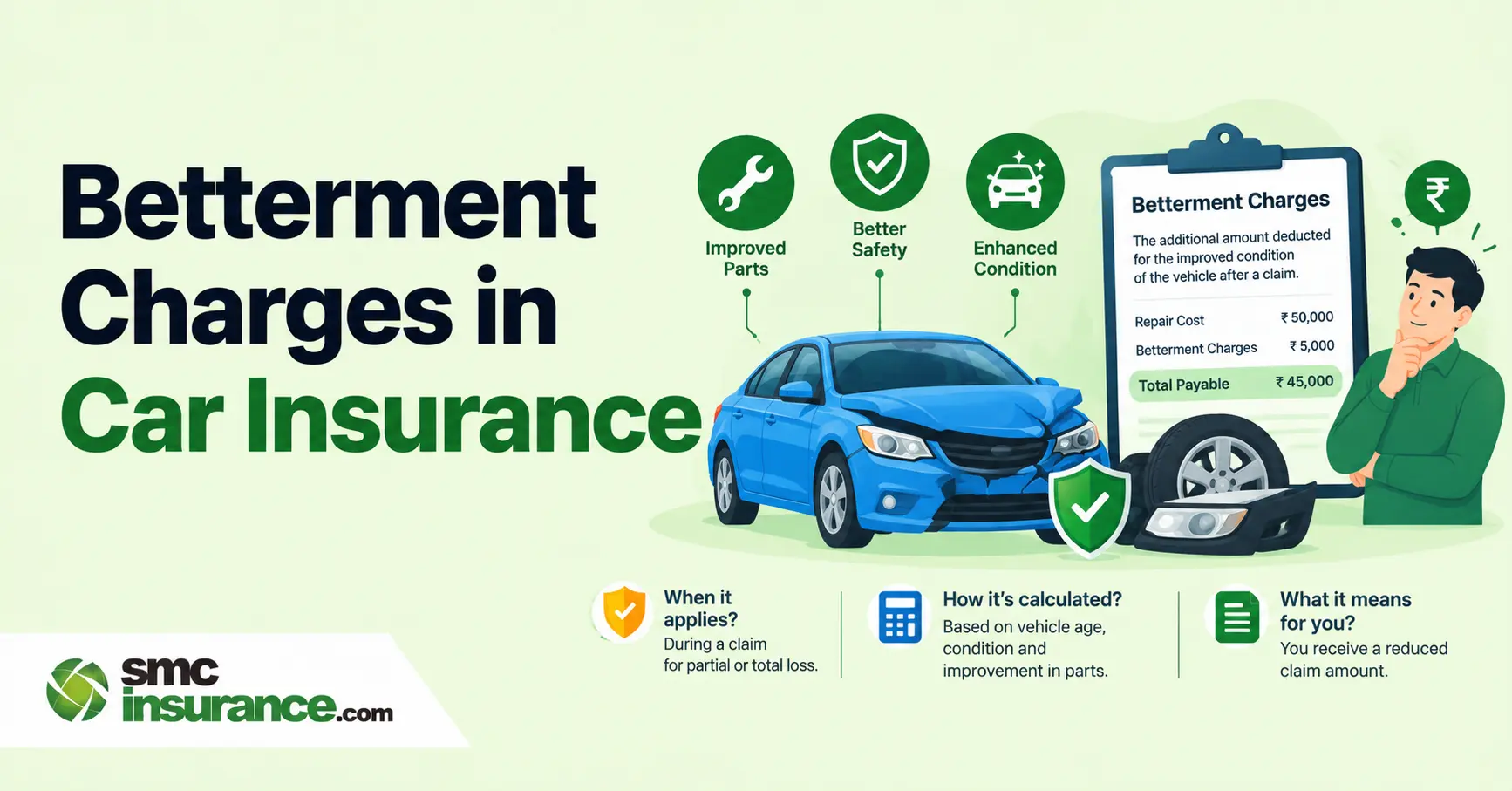

Betterment charges in car insurance refer to the amount a policyholder may have to bear when a damaged part is replaced with a superior one. They are different from standard depreciation deductions, which follow the insurer's policy terms. Common depreciation rates include 50% for plastic and rubber parts, 30% for fibreglass and no depreciation on glass. Other parts may attract age-based depreciation of up to 50%. A zero depreciation add-on can reduce deductions on eligible parts, but deductibles, excluded items and certain repair expenses may still be payable by the policyholder.
Table of Contents
- What Are Betterment Charges in Car Insurance and Why Do Insurers Apply Them?
- Betterment vs Depreciation vs Deductible
- How Insurers Calculate Depreciation on Car Parts
- Betterment Charges in Car Insurance
- Does Zero Depreciation Car Insurance Cover Betterment Charges?
- How to Reduce Betterment Charges in Car Insurance Claims
- What to Do If You Disagree With a Betterment Deduction
The garage estimate for your hatchback says Rs. 45,000, but the settlement letter from the insurer shows Rs. 31,500 and the line items in between make very little sense. Most of that gap comes from betterment charges in car insurance and the depreciation deductions that usually get lumped in with them, which is why plenty of policyholders feel short-changed even when the claim is approved without a fight. Before you blame the surveyor, it helps to know what your car insurance policy coverage actually promises on replaced parts and where that promise stops. By the end of this guide you will know what betterment means in an Indian claim, how the deduction is worked out in rupees and what you can do before and after a claim to keep more of the repair bill off your own pocket.
What Are Betterment Charges in Car Insurance and Why Do Insurers Apply Them?
Start with the logic, because once it clicks, most of the confusing lines on an assessment sheet stop looking random.
A motor policy exists to put your car back where it stood before the accident, not to leave it better off. That is the principle of indemnity. If a seven-year-old car with a faded, brittle plastic bumper gets a gleaming new one after a collision, the insurer has handed you something worth more than what you lost and betterment is the name for the slice of the bill the insurer says belongs to you for that improvement.
Here is the part most explainers skip. In the private car wordings we read for this piece, the standard claim settlement runs on a fixed depreciation schedule and the word "betterment" barely appears. Reliance General's private car package wording uses it only inside the tyre protector and rim protector add-ons, where the insurer states it will not pay betterment charges if the replacement is superior to the damaged item and no similar item is available. ICICI Lombard's own damage wording uses it only in the key protect add-on and Royal Sundaram's standalone own damage wording does not use the word at all.
So when a garage adviser says "betterment will be deducted", ask whether it means the standard depreciation deduction or an additional charge for upgrading a damaged part. These are not necessarily the same. Depreciation follows the rates mentioned in your policy, while a separate betterment charge depends on the applicable policy or add-on conditions. Understanding the difference helps you check whether the deduction is justified and whether your add-on covers it.
Betterment vs Depreciation vs Deductible
Three different deductions can sit on one settlement and they get confused because all three shrink the amount that lands in your account.
Deduction |
What it is |
Who decides it |
Example |
Depreciation | A percentage cut on the price of each replaced part, set by material or by the car's age | The policy wording, applied by the surveyor | 50% off a plastic bumper, 25% off a metal bonnet on a car between 3 and 4 years old |
Betterment | Your share when a replacement is judged better than the damaged original, usually written into specific add-on terms | The add-on wording and the assessment | A tyre protector claim where only a superior tyre is available |
Compulsory deductible | A fixed first amount you bear on every own-damage claim | The policy schedule | Commonly Rs. 1,000 for private cars up to 1500cc and Rs. 2,000 above that |
Voluntary deductible | An extra amount you choose to bear in return for a lower premium | You, at purchase | Rs. 5,000 chosen to trim the own-damage premium |
Exclusions and consumables | Costs the policy does not cover at all unless an add-on picks them up | The policy and add-ons | Engine oil, coolant and nuts and bolts without a consumables cover |
Note: Deductible amounts are set by the policy schedule and can differ by insurer and engine capacity, so always read yours. A fair assessment should not apply depreciation and betterment to the same cost of the same part, so if one bumper shows both, ask for a recalculation.
How Insurers Calculate Depreciation on Car Parts
The schedule below is what actually drives most claim deductions and it is identical in the Reliance General, Royal Sundaram and ICICI Lombard wordings we checked.
Part type |
Depreciation applied |
Rubber, nylon and plastic parts, tyres, tubes and batteries | 50% |
Fibre glass components | 30% |
Parts made of glass | Nil |
All other parts, car up to 6 months old | Nil |
Over 6 months, up to 1 year | 5% |
Over 1 year, up to 2 years | 10% |
Over 2 years, up to 3 years | 15% |
Over 3 years, up to 4 years | 25% |
Over 4 years, up to 5 years | 35% |
Over 5 years, up to 10 years | 40% |
Over 10 years | 50% |
Note: These rates apply to the relevant categories of replaced parts under the cited policy wordings. They should not be confused with the depreciation used to calculate a vehicle's Insured Declared Value (IDV). The actual claim settlement also depends on the insurer's assessment, applicable exclusions and any add-on covers purchased.
Painting charges are treated differently from replacement parts. Depreciation of 50% applies only to the cost of painting materials, not the entire painting bill. If the garage provides a combined bill without separating materials and labour, the insurer considers 25% of the painting bill as material cost and applies 50% depreciation to that amount, subject to the policy wording.
Why do plastic parts and tyres affect the most?
The schedule is flat by material, so a tyre bought three months ago takes the same 50% cut as one worn down to the grooves. Add the fact that a modern front end is mostly plastic, with the bumper, grille and lamp housings all sitting in the 50% band and a moderate front-end hit on a young car can lose more to depreciation than a heavier hit on bare metal.
Tyres carry one more catch. ICICI Lombard's wording, for instance, excludes tyre and tube damage unless the car is damaged at the same time and even then limits the insurer's liability to 50% of the replacement cost, so a puncture or a kerb cut on its own rarely turns into a claim.
Betterment Charges in Car Insurance
Numbers make this easier to see, so here is a hypothetical claim on a hatchback of 3 years and 8 months, with an engine under 1500cc and a front-end collision.
Item |
Cost (Rs. ) |
Depreciation rate |
Deducted (Rs. ) |
Front bumper (plastic) | 10,000 | 50% | 5,000 |
Bonnet (metal) | 14,000 | 25% | 3,500 |
Front tyre | 6,000 | 50% | 3,000 |
Painting (Rs. 2,000 is material, 50% of that applies) | 8,000 | 50% on material only | 1,000 |
Labour | 7,000 | Nil | 0 |
Total repair bill | 45,000 | 12,500 |
After depreciation the insurer's share is Rs. 32,500. Subtract the Rs. 1,000 compulsory deductible and the settlement comes to Rs. 31,500, which leaves you paying Rs. 13,500 out of pocket.
Now compare that with the same claim under a zero depreciation add-on.
Scenario |
Depreciation you bear (Rs. ) |
Deductible (Rs. ) |
Insurer pays (Rs. ) |
You pay (Rs. ) |
Standard own damage cover | 12,500 | 1,000 | 31,500 | 13,500 |
With zero depreciation add-on (illustrative, assuming depreciation on the bumper, bonnet and painting materials is waived, but the tyre remains excluded) | 3,000 (tyre, assumed outside the add-on) | 1,000 | 41,000 | 4,000 |
Note: All part prices are hypothetical and meant only to show the arithmetic. Whether a tyre is covered under zero depreciation differs by insurer and a separate consumables cover would handle small items like oil and coolant that sit outside this table.
The pattern is worth noticing. Of the Rs. 13,500 you absorbed in the standard case, Rs. 12,500 was depreciation and the Rs. 1,000 deductible is the one piece an add-on generally leaves untouched.
Stuck with a settlement figure that does not match your garage bill? Our team at SMC Insurance can read through your policy wording with you, point out which deductions are legitimate and tell you whether a zero depreciation add-on would have changed the number. Start at SMC Insurance.
Does Zero Depreciation Car Insurance Cover Betterment Charges?
Partly and the "partly" is where people get caught, so it pays to see exactly what the add-on does and does not do.
Zero depreciation, also sold as nil depreciation or bumper to bumper cover, waives the depreciation cut on eligible replaced parts, which is why the bumper, bonnet and paint lines in the example above stopped costing you anything. Our guide to zero depreciation car insurance goes through how it is priced and who benefits most. What it does not do is switch off every deduction on your claim and an explicit betterment exclusion in a tyre or rim protector add-on is a separate matter from the depreciation schedule.
What zero depreciation usually leaves out
Read your wording for these, because they differ from one insurer to the next.
- The compulsory deductible and any voluntary deductible you chose stay with you.
- Consumables such as engine oil, coolant and small fasteners usually need a separate consumable cover.
- Tyres, batteries and glass may be handled under their own terms or excluded from the add-on.
- Many insurers cap the number of zero depreciation claims in a policy year and some offer the cover only for cars up to a specified age.
The sensible way to judge it is to put the extra premium next to your realistic exposure. In the example above the add-on saved Rs. 9,500 on one claim, so if it costs a fraction of that, it pays for itself the first time you use it, while a lightly driven car parked in a covered basement all week may not need it as urgently.
How to Reduce Betterment Charges in Car Insurance Claims
Most of the savings are decided before the accident and the rest are decided in the first few days of the claim, so the order below matters.
- Read the add-on list at renewal, not after the crash:
Look for zero depreciation, consumables, tyre protector and rim protector and check each one for age limits and claim caps. - Know where your car sits in the schedule:
The bands step from 15% to 25% after the third year and from 25% to 35% after the fourth, which is useful when you are deciding whether an add-on is worth it this year. - Wait for the surveyor before authorising repairs:
Repairing first is a common cause of disputes and our car insurance claim guide explains the sequence in full. - Ask for an itemised estimate and the assessment sheet:
Match every part against its material, because a part in the wrong band is the easiest error to catch. - Ask for a detailed painting bill:
Request a breakdown of painting materials and labour charges. This helps you verify whether depreciation has been calculated correctly. A separate bill does not automatically reduce the deduction, as the actual material cost may be higher or lower than the standard assumed portion. - Keep photographs and invoices:
Pictures of the car before the accident and bills for recent replacements help when the surveyor questions the condition of a part.
What to Do If You Disagree With a Betterment Deduction
A deduction that follows the schedule correctly will usually stand, so the ones worth challenging are those that do not match your policy, such as the wrong age band, depreciation on a glass part, or the same cost reduced twice.
Begin by asking the insurer for a written explanation of each deduction. Compare it line by line with the schedule in your wording, then send a written request for a review with the discrepancy pointed out. If that goes nowhere, file with the insurer's grievance officer and you can also lodge the complaint through IRDAI's Bima Bharosa portal.
Begin by asking the insurer for a written explanation of each deduction. Compare it line by line with the schedule in your wording, then send a written request for a review with the discrepancy pointed out. If that goes nowhere, file with the insurer's grievance officer and you can also lodge the complaint through IRDAI's Bima Bharosa portal.
Wrapping Up,
Betterment charges in car insurance are really about one idea, that the insurer pays to restore your car and not to improve it. In Indian private car policies that idea mostly shows up as depreciation on replaced parts, with "betterment" proper turning up in specific add-on terms. Plastic parts, tyres and batteries lose half their price in a claim and metal parts lose between nil and 50% depending on the car's age. A zero depreciation add-on removes much of that, but it leaves the deductible, consumables and sometimes tyres to you. Before you buy or renew, check the add-on conditions and the age limits. When a claim happens, wait for the survey, ask for the itemised assessment and check every deduction against your own wording. Do that and the gap between the garage bill and the settlement will no longer come as a surprise.
Disclaimer: The information provided on this platform is intended for general awareness and educational purposes. While every effort is made to ensure accuracy, some details may change with policy updates, regulatory revisions, or insurer-specific modifications. Readers should verify current terms and conditions directly with relevant insurers or through professional consultation before making any decision.
All views and analyses presented are based on publicly available data, internal research and other sources considered reliable at the time of writing. These do not constitute professional advice, recommendations, or guarantees of any product’s performance. Readers are encouraged to assess the information independently and seek qualified guidance suited to their individual requirements. Customers are advised to review official sales brochures, policy documents and disclosures before proceeding with any purchase or commitment.
FAQs
Betterment charges in car insurance are the portion of a repair bill you bear when a replacement part is better than the damaged original, because insurance is meant to restore your car and not upgrade it. In Indian private car policies the same idea is usually applied through the depreciation schedule and the word itself appears mainly in add-on terms such as tyre and rim protector covers.
Not strictly, although garages often use the terms interchangeably. Depreciation is a fixed percentage cut on replaced parts, taken from the schedule in your policy and based on material or the car's age. Betterment is a contribution for an improvement and tends to be written into specific add-on terms. Your assessment sheet should show which one is being applied to each part.
It waives depreciation on eligible parts, which removes most of the deduction on a typical claim. It does not necessarily remove every deduction. Deductibles, consumables, excluded items and any betterment exclusion inside a tyre or rim protector add-on can still apply, so check the wording and any limits on claim numbers or the age of the car.
Rubber, nylon and plastic parts, tyres, tubes and batteries carry a flat 50% depreciation in the wordings we checked and fibre glass parts carry 30%. Glass is nil. Everything else, including metal panels, depends on the car's age and moves from nil up to 50% over ten years.
Yes, ask the insurer for a written explanation, compare it with your policy schedule and request a review if you spot an error such as the wrong age band. If the insurer rejects the complaint or does not reply within a month, the Insurance Ombudsman is the next step, provided you file within one year and meet the other conditions.
Choose add-ons like zero depreciation and consumables cover when you buy or renew and read their age limits and claim caps first. After an accident, wait for the surveyor, ask for an itemised estimate and assessment sheet and check each part against the depreciation schedule. A split painting bill and well-kept photographs and invoices also help your case.


