


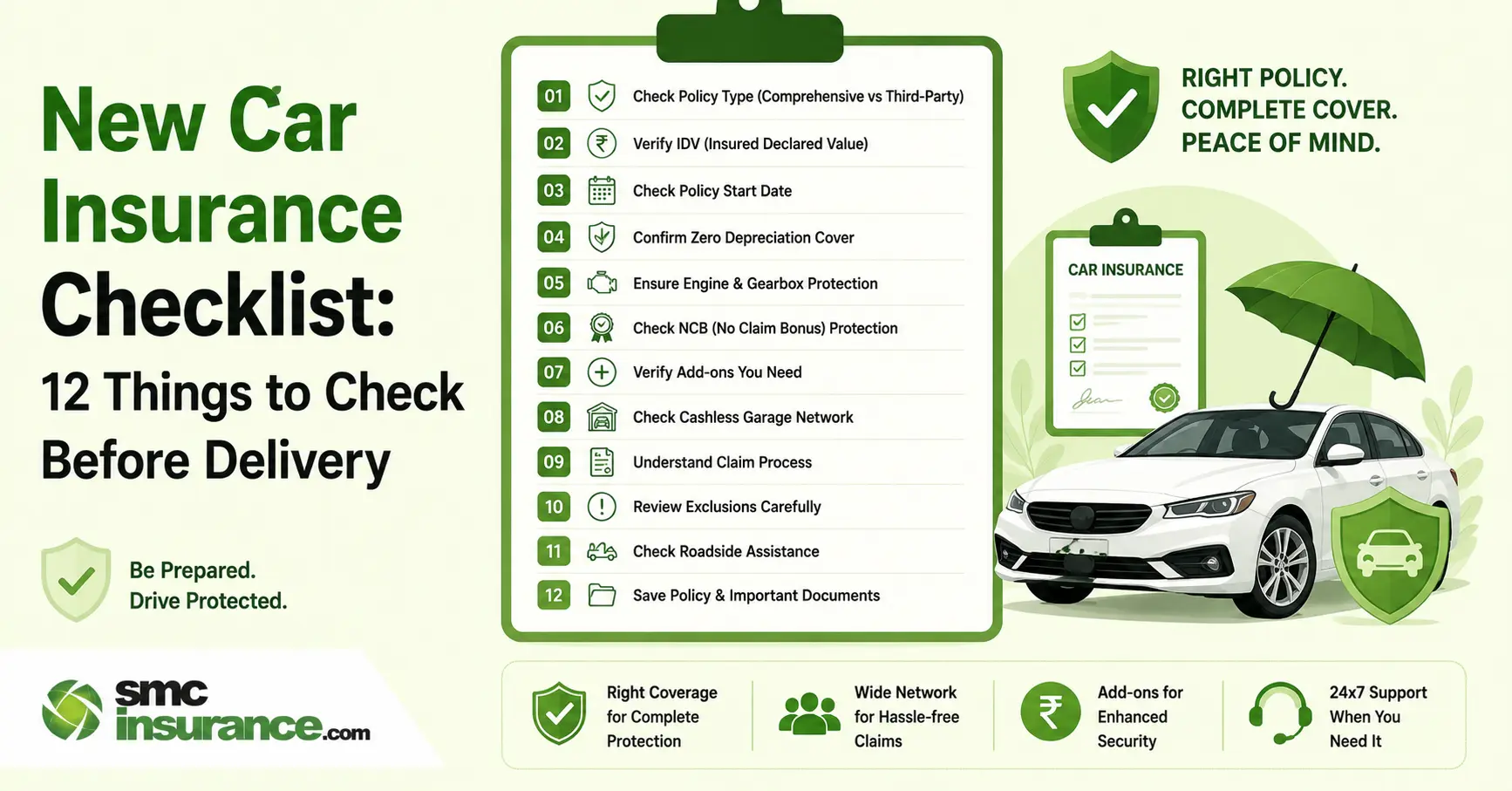
Before taking delivery, confirm four things in writing: the insurer you chose (a dealer cannot force one), the third-party tenure (three years is in force, four has been directed by the Supreme Court but awaits IRDAI’s implementation), the own-damage term (usually one year) and an IDV near 95% of the ex-showroom price. Notified three-year third-party premiums are Rs. 6,521 for cars up to 1000 cc, Rs. 10,640 for 1000 cc to 1500 cc and Rs. 24,596 above 1500 cc, before 18% GST. Check that the name, chassis number and engine number on the policy match the car, collect every document and photograph the car in daylight. From 15 December 2026, expect a four-section option form on every private car policy.
Table of Contents
The insurance line on a new car invoice usually gets about four seconds of attention, typically while the salesperson is already reaching for the keys and it regularly runs into five figures. A proper new car insurance checklist matters because that one line fixes who your insurer is and how long your third-party cover runs. A wrong chassis number or an under-declared IDV will not bother you on delivery day, only on the day you file your first claim. Rules are also shifting under buyers right now, with the Supreme Court pushing for longer third-party cover and every private car policy moving to a four-part format from 15 December 2026. By the end of this guide you will know the twelve things to verify before the car leaves the showroom and which of them the dealer is unlikely to raise.
Why Your New Car Insurance Checklist Needs an Update After IRDAI’s December 15 Rules
Two developments have changed what you should ask the dealer and both arrived within the last four months.
On 4 August 2026, the Supreme Court of India delivered its judgment in National Insurance Co. Ltd. v. Smt. Thungala Dhana Laxmi & Ors. (2026 INSC 793), directing that third-party insurance for new private cars be extended from three years to four years and for new two-wheelers from five years to six years. The Court also directed IRDAI to issue the necessary implementation directions.
A separate IRDAI circular issued on 2 November 2026 introduced the new four-section motor insurance structure but did not specify the revised third-party insurance tenure or its corresponding premium rates. Consequently, buyers should obtain written confirmation from their insurer about the applicable policy tenure and premium rather than assume that the existing three-year tariff automatically applies to a four-year policy. The full judgment is worth skimming if you want the reasoning behind it.
The same ruling ordered a four-layer policy structure and IRDAI’s circular IRDAI/CIR/MOT/10/2026 of 2 November brings it into force from 15 December 2026 for all private cars and two-wheelers, new vehicles included. Every policy will carry four sections: third-party liability, which is compulsory; legal liability towards occupants, which is optional; personal accident cover, compulsory for the owner-driver and optional for others; and own damage, which is optional. Buyers will tick their choices on an option form, the policy schedule must show the premium for each section separately and the insurer must hand over a Customer Information Sheet at the point of sale.
Which leaves one gap worth knowing about. The circular says nothing on the fourth year of third-party cover and we could not find a separate IRDAI direction implementing it as of 19 November, so the tenure on your quote is something to confirm rather than assume. Timing matters as well, because a policy issued before 15 December follows the old format while one issued from that date needs the option form.
New Car Insurance Price
Before you judge any quote, it helps to know which part of it nobody can bargain on.
The third-party portion of a new car policy is a notified tariff, set by the Ministry of Road Transport and Highways under the Motor Vehicles (Third Party Insurance Base Premium and Liability) Rules, 2022 and it depends only on engine capacity. Every insurer charges the same amount, which makes it the easiest line on the quote to audit.
Private car |
Annual third-party premium |
3-year third-party premium (new car) |
3-year premium with 18% GST |
Up to 1000 cc | Rs. 2,094 | Rs. 6,521 | Rs. 7,695 |
1000 cc to 1500 cc | Rs. 3,416 | Rs. 10,640 | Rs. 12,555 |
Above 1500 cc | Rs. 7,897 | Rs. 24,596 | Rs. 29,023 |
Electric, up to 30 kW | Rs. 1,780 | Rs. 5,543 | Rs. 6,541 |
Electric, 30 kW to 65 kW | Rs. 2,904 | Rs. 9,044 | Rs. 10,672 |
Electric, above 65 kW | Rs. 6,712 | Rs. 20,907 | Rs. 24,670 |
Note: Figures are the base third-party premiums notified in 2022, shown before GST unless the column says otherwise and the GST column is our own arithmetic at 18%. A four-year rate for new cars had not been notified in the sources we checked, so confirm the current tariff with your insurer before relying on any number here.
Use the table as a yardstick. A 1.2-litre petrol hatchback falls in the 1000 cc to 1500 cc band, so the three-year third-party line on its quote should read Rs. 10,640 before GST and anything higher needs an explanation.
Own-damage premium is where quotes diverge, because insurers price it themselves on the IDV, the variant, the city of registration and whichever add-ons are bundled in. For a car under six months old the IDV is generally set about 5% below the ex-showroom price, so a Rs. 10 lakh car carries an IDV near Rs. 9.5 lakh. Road tax, registration and the insurance premium itself sit outside that figure, which is why the gap between your on-road price and the IDV matters if the car is ever stolen or written off.
Every rupee of premium, add-ons included, carries 18% GST and the September 2025 GST overhaul left motor insurance at that rate even as it removed tax on individual life and health policies.
Holding a quote you cannot make sense of? Share it with an SMC Insurance advisor at SMC Insurance before you pay and we will point out which lines are tariff, which are optional and which look like padding.
New Car Insurance Checklist - Part One
The first check is about who gets to pick the insurer at all, so start there.
1. Confirm you chose the insurer, not the dealer
A car sale and an insurance purchase are two separate transactions and IRDAI’s rules for motor insurance service providers bar anyone from forcing a buyer towards a particular insurer. In practice a dealer cannot refuse delivery because you arrived with a valid policy from elsewhere, provided it matches the car’s details. If a salesperson says otherwise, ask for that condition in writing.
Dealer-arranged cover is not wrong, simply one quote among several, so collect at least one more before accepting the showroom’s number. The checks worth running before you buy car insurance online apply just as well to a new car. For an outside policy, ask for the VIN and engine number as soon as the dealer has them, since insurers need both to issue cover and buy the policy a few days before delivery.
2. Check the third-party tenure printed on the quote
Since 1 September 2018, following a Supreme Court order in July of that year, new cars have carried a mandatory three-year third-party policy, usually bundled with one year of own-damage cover under IRDAI’s 2018 circular. The August 2026 judgment moves that to four years, but until IRDAI’s implementing direction appears, ask the dealer in writing which tenure your policy carries and what the extra year, if any, costs. Remember, a third-party premium is a tariff rather than a negotiation, so a precise four-year figure on a quote should arrive with an explanation of where it comes from.
3. Question the own-damage term and the IDV
Own-damage cover on a new car usually runs for one year even though the third-party policy runs longer and the two do not have to come from the same insurer. IRDAI’s 2019 direction made stand-alone annual own-damage policies available for new and old cars alike, so a bundled package is a convenience rather than a rule.
Then look at the IDV. A lower figure trims the premium, yet it also caps what you receive after a theft or total loss, so an IDV well below roughly 95% of the ex-showroom price is a smaller policy rather than a saving.
4. Read the four sections and tick the option form
From 15 December the form will ask what you want beyond the two compulsory layers, which are third-party liability and the owner-driver’s personal accident cover, usually with a Rs. 15 lakh sum insured. For most families the questions that matter are whether to add legal liability towards occupants and personal accident cover for passengers or other drivers, since those protect the people actually sitting in the car.
Own damage is now an explicit choice too and a financed new car rarely makes sense without it, as many lenders insist on it anyway. We would not skip the occupant section without asking what it costs and because the schedule must show each section’s premium, that price will at least be visible.
5. Match add-ons to your actual risk
A new car does not need every add-on on the menu, only the ones that fit where it will be driven and parked. This is why you need to choose the right add-ons for your car insurance and the table below is the short version.
Add-on |
What it fixes |
Worth a hard look if |
Check in the wording |
Zero depreciation (often sold as bumper to bumper cover) | Insurer makes no depreciation deduction on replaced parts at claim time | The car is new and spends its days in city traffic | Cap on claims per year and any age limit on the car, often around five years |
Return to invoice | Pays the invoice value rather than only the IDV after a theft or write-off | You financed the car or paid a large on-road price | Whether road tax and registration charges are included |
Engine protection | Engine and gearbox damage from water ingress, hydrostatic lock or oil leakage | You drive or park in flood-prone areas, including low basements | Exclusions if the engine is restarted after water ingress |
Consumables | Oil, coolant, nuts, bolts and similar items normally excluded from claims | You are taking zero depreciation and expect to claim | Whether it is bundled with zero depreciation or sold separately |
Roadside assistance | Towing, flat tyres, battery jump-starts and fuel delivery | You do regular highway or long-distance runs | Number of calls per year and towing distance limits |
No Claim Bonus protector | Keeps your discount intact after a claim | You rely on the renewal discount | How many claims it covers in a year |
Note: Availability, caps and pricing vary by insurer and add-on wording may change under the four-section format from 15 December, so read the policy document before you pay.
A flood-prone neighbourhood changes the engine protection decision completely. A car that lives in a covered garage and mostly makes short trips can reasonably skip roadside assistance.
6. Declare every accessory the dealer fits
IDV and cover are built around the car as it leaves the factory, so a touchscreen, alloy wheels or body kit fitted at the dealership may not be covered unless it is declared and paid for on the policy. Match the accessories invoice against the schedule on the day, because a stolen sound system is a dispute you can avoid by spending five minutes on paperwork.
Part Two of the New Car Insurance Checklist
Once the quote is settled, the rest is a matter of matching paper to metal, beginning with the numbers printed on the policy.
7. Match every identifier on the policy to the car
Compare the name, address, variant and fuel type on the policy with the invoice and the chassis and engine numbers with both the dealer’s sale certificate (Form 21) and the car itself. If you took a loan, the lender should appear as the hypothecation partner. A mismatch rarely matters until a claim, at which point it can slow settlement and a wrong variant also means a wrong IDV.
8. Collect the policy documents before you leave
Walk out with the policy schedule and the certificate of insurance and from 15 December also the completed option form and Customer Information Sheet, since IRDAI requires the form to be part of the policy. Keep a PDF on your phone as well, because electronic copies of insurance certificates are generally accepted under the Central Motor Vehicles Rules. Together these are the new car insurance documents any surveyor or traffic officer will ask for first.
9. Trace the premium to the insurer
Ask for the policy number before you pay and make sure the insurance amount on the invoice matches the total on the schedule, GST included. A lump sum labelled “insurance” with no policy number behind it is the one line on an on-road price breakup worth challenging, because you cannot tell what it contains. Whoever collects the money, the receipt should come in the insurer’s name or from an authorised channel.
10. Inspect the car before the damage becomes your problem
Cover starts when the policy does, so a scratch or dent that predates it is a dispute with the dealer or manufacturer rather than an insurance claim. Treat the pre-delivery inspection as a new car delivery checklist of its own: go in daylight, check the manufacturing month on the VIN plate, record the odometer and photograph every panel with the time stamp on.
A reading of a few tens of kilometres is normal after stockyard movement and the dealer’s own inspection. A few hundred deserves a written explanation, because some new cars do get used as demo vehicles before sale.
11. Sort out the registration number and the lender’s entry
A new car typically leaves the showroom on a temporary registration, so the first policy may carry only the chassis and engine numbers. Once the registration certificate arrives, ask the insurer to update the policy with the permanent registration number through an endorsement and confirm the RC shows your lender’s hypothecation if you financed the car.
12. Put month 12 in your calendar and save the claim numbers
Third-party cover runs for years while own damage usually lasts twelve months, so your car stays legally insured after the first year even though the part that pays for repairs has quietly ended. Nothing will remind you, which is why a reminder a month before the anniversary is worth setting, followed by a fresh set of renewal quotes. A claim-free first year earns a 20% No Claim Bonus on the own-damage premium, rising to 50% after five years and our piece on how to reduce your car insurance premium shows how to protect it. If you are replacing an older car, carry that policy’s NCB certificate along, since the bonus follows the owner rather than the vehicle.
Save the insurer’s helpline, your policy number, the nearest cashless garages and the roadside assistance number in your phone before the first drive. If something in the policy turns out wrong later, ask for an endorsement and take unresolved complaints to IRDAI’s Bima Bharosa portal.
Wrapping Up,
Taking delivery of a new car feels like the finish line, yet the insurance decisions made in those last ten minutes follow you for years. Three years of third-party cover, a year of own damage and a handful of add-ons get folded into a single invoice line that few buyers read. This year that line also sits at the centre of two changes, a four-year third-party direction still waiting for implementation and a four-section policy format that begins on 15 December. The simple path forward is to ask for the quote in writing, compare it with at least one outside policy and verify tenure, IDV, add-ons and identifiers before you sign. Then inspect the car in daylight, photograph it, collect every document and set the month-12 reminder. Do that and the policy will do its job quietly in the background.
Disclaimer: The information provided on this platform is intended for general awareness and educational purposes. While every effort is made to ensure accuracy, some details may change with policy updates, regulatory revisions, or insurer-specific modifications. Readers should verify current terms and conditions directly with relevant insurers or through professional consultation before making any decision.
All views and analyses presented are based on publicly available data, internal research and other sources considered reliable at the time of writing. These do not constitute professional advice, recommendations, or guarantees of any product’s performance. Readers are encouraged to assess the information independently and seek qualified guidance suited to their individual requirements. Customers are advised to review official sales brochures, policy documents and disclosures before proceeding with any purchase or commitment.
FAQs
A new car insurance checklist should confirm which insurer you chose, the third-party tenure, the own-damage term, the IDV and the add-ons on the quote. It should also verify that the name, chassis number and engine number on the policy match your invoice and the car. Collect the policy documents and premium receipt before you drive off and do the physical inspection in daylight. Nothing about the policy should need correcting after your first claim.
No, a car sale and an insurance purchase are separate transactions and IRDAI’s rules for motor insurance service providers prohibit forcing a buyer towards a particular insurer. A valid policy from any insurer that matches the car’s details should be accepted at delivery. If a salesperson insists otherwise, ask for the condition in writing and unresolved complaints can go to the insurer’s grievance channel or IRDAI’s Bima Bharosa portal.
Three years has been the rule since September 2018. On 4 August 2026 the Supreme Court directed that it be raised to four years for new cars and asked IRDAI to issue implementing directions. IRDAI’s 2 November circular on the four-layer structure does not mention the tenure and we could not find a separate direction as of 19 November. Ask your dealer or insurer in writing which tenure your policy carries before you pay.
For most new cars in their first few years it is a sensible add-on, because without it the insurer deducts depreciation on replaced parts and you pay the difference. The cover usually limits the number of claims per year and applies only up to a certain car age, often around five years, so read the wording. Consumables are normally excluded even with zero depreciation, so check whether that is sold separately. If your driving is light and mostly on open roads, compare the extra premium with likely repair costs before deciding.
Usually after one year, even though third-party cover runs for longer. Because the car remains legally insured through the third-party policy, nothing prompts you to renew the own-damage part, so set a reminder about a month before the anniversary. Renewing within the insurer’s grace period protects your No Claim Bonus, which starts at 20% after a claim-free year and rises to 50% after five. You can renew with the same insurer or move to a different one.
No, Section 146 of the Motor Vehicles Act requires at least third-party cover before a vehicle runs on a public road and driving uninsured attracts a fine of Rs. 2,000 for a first offence and Rs. 4,000 for a repeat, with possible imprisonment of up to three months. The Supreme Court’s August 2026 order also asks for ANPR cameras to be linked with insurance databases so uninsured vehicles can be flagged automatically. The policy needs to be live before the car leaves the showroom.
Every private car policy issued from that date must follow IRDAI’s four-section structure with standard wording. You will complete an option form to choose the optional covers, the schedule will show the premium for each section and the insurer must give you a Customer Information Sheet. Third-party liability and owner-driver personal accident cover stay compulsory. Insurers remain free to price own damage themselves, so quotes will vary and comparing them matters more than before.


