


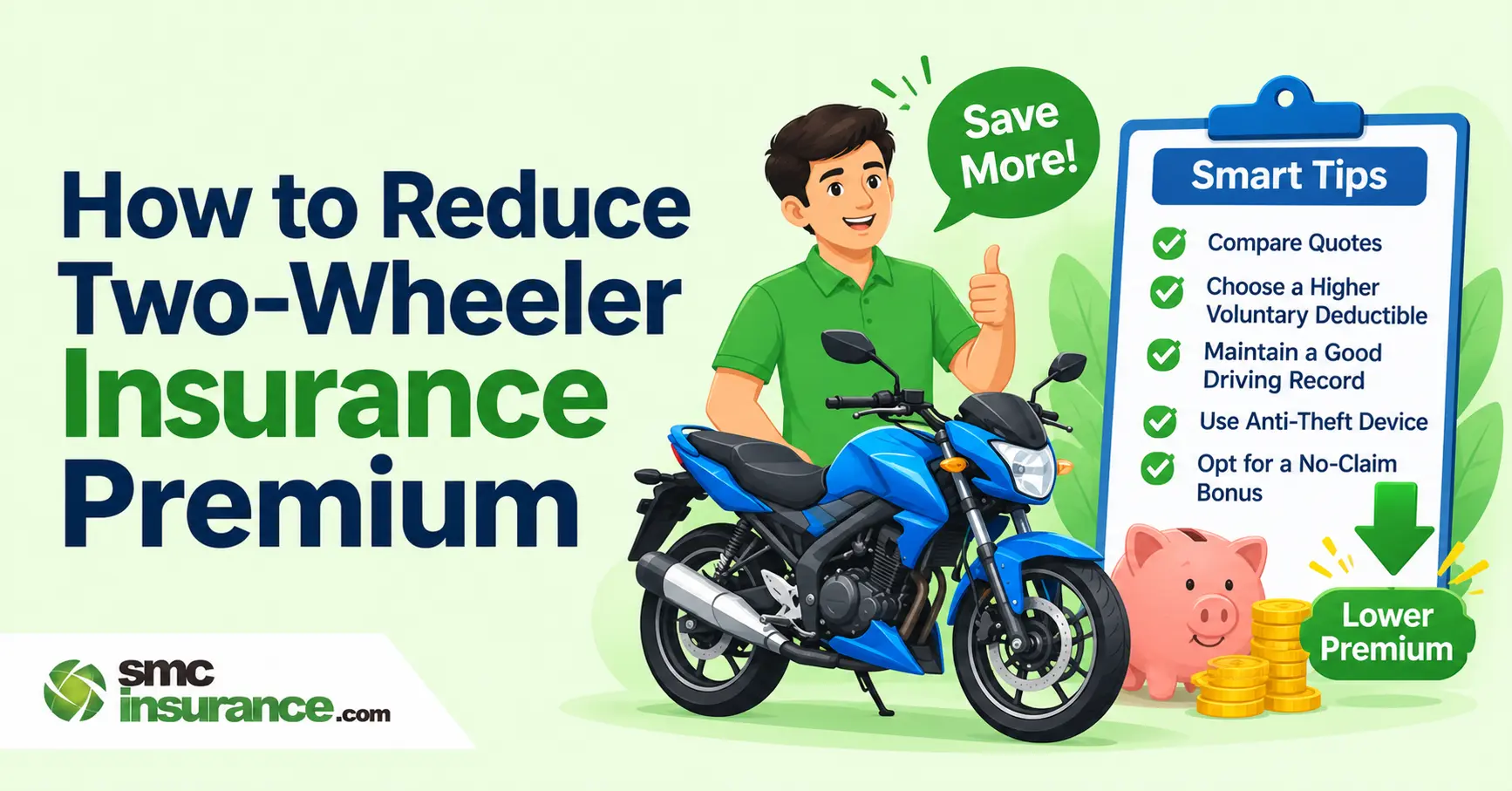
How do you reduce the two-wheeler insurance premium?
Focus on the own-damage component, since government-notified third-party premiums are fixed according to your bike's engine capacity or electric motor rating. Protect your No Claim Bonus (NCB), which can reach 50% after five consecutive claim-free years, and avoid raising small claims when paying for repairs yourself is more economical. Review unnecessary add-ons, check whether you already qualify for the Rs. 15 lakh owner-driver personal accident cover exemption, and compare quotes using the same IDV and coverage. You can also check for discounts on ARAI-approved anti-theft devices. Remember that a 90-day NCB retention period does not mean your expired insurance remains active.
Table of Contents
- What Goes Into Your Bike Insurance Premium
- No Claim Bonus in Bike Insurance
- Voluntary Deductible in Bike Insurance
- Bike Insurance Add-ons and IDV
- Rule Change From 15 December 2026: What the Four-Layer Motor Policy Means for Your Premium
- Smaller Moves That Add Up at Renewal
- A Ten-Minute Renewal Routine to Lower Your Two-Wheeler Insurance Premium
The renewal reminder says Rs. 3,400 for a scooter that has not seen a single claim and last year's cover cost noticeably less. Plenty of riders pay it without a second look, which is how a few hundred rupees, sometimes more, quietly leaves the wallet every year. The catch is that only part of a bike insurance bill can be negotiated and most tips online never say which part. If you want to reduce your two-wheeler insurance premium without ending up under-insured, a handful of levers do nearly all the work and some popular ones barely move the number. Here are the ones worth your time, the 2026 rates to measure your quote against and a rule change on 15 December 2026 that will alter how your next renewal quote looks.
What Goes Into Your Bike Insurance Premium
Before hunting for discounts, it helps to see where the money actually goes, because one slice of the bill is fixed by the government and no amount of haggling will move it.
A comprehensive two-wheeler policy is built from the third-party premium, the own-damage premium, a compulsory personal accident cover for the owner-driver and any add-ons you tick, with 18% GST added on top.
The third-party slice depends only on engine capacity and is notified by the government in consultation with IRDAI, so every insurer charges the same for the same bike. That also explains why a 160 cc bike costs almost double a 125 cc one on this line alone, Rs. 1,366 against Rs. 714, before anything else is counted.
Engine / motor capacity |
1-year TP premium |
5-year TP premium for new vehicles |
Up to 75 cc | Rs. 538 | Rs. 2,901 |
Above 75 cc to 150 cc | Rs. 714 | Rs. 3,851 |
Above 150 cc to 350 cc | Rs. 1,366 | Rs. 7,365 |
Above 350 cc | Rs. 2,804 | Rs. 15,117 |
Electric: Up to 3 kW | Rs. 457 | Rs. 2,466 |
Electric: Above 3 kW to 7 kW | Rs. 607 | Rs. 3,273 |
Electric: Above 7 kW to 16 kW | Rs. 1,161 | Rs. 6,260 |
Electric: Above 16 kW | Rs. 2,383 | Rs. 12,849 |
Note: These are the government-notified base premiums for private two-wheelers under the 2022 rules. The five-year rates apply to new two-wheelers purchasing long-term third-party cover. Applicable GST is additional. Commercial two-wheelers and vehicles used for hire or reward have separate rate classifications.
Own damage is where the room is. It depends on your bike's IDV, age, model and city, plus the discounts you qualify for and insurers price it on their own, which is why two quotes for an identical bike can sit well apart. Always check the factors that affect your bike insurance premium, so the rest of this piece sticks to what you can change.
No Claim Bonus in Bike Insurance
If one lever deserves your attention, it is this one, because it can take half off the own-damage part of your bill.
The no claim bonus is a discount on the own-damage premium for each policy year you complete without a claim. IRDAI-standardised slabs mean every insurer offers the same scale, starting at 20% after the first claim-free year and reaching 50% after five. It never touches the third-party premium and a standalone third-party policy earns none.
Claim-free years |
NCB on own-damage premium |
Saving on a Rs. 3,000 own-damage premium |
1 year | 20% | Rs. 600 |
2 years | 25% | Rs. 750 |
3 years | 35% | Rs. 1,050 |
4 years | 45% | Rs. 1,350 |
5 years or more | 50% | Rs. 1,500 |
Note: The Rs. 3,000 own-damage premium is only an illustration, so swap in your own figure. The last column is a rule of thumb, roughly two years of the discount you would give up and not an insurer formula. Theft, total loss and third-party injury claims are a different matter, so claim those without hesitation.
Before making a small own-damage claim, compare the repair expense with the NCB discount you could lose at renewal. Also consider the compulsory and voluntary deductibles and any depreciation deductions. If the repair cost is relatively small, paying for it yourself may be more economical. However, this decision should be based on your actual renewal premium and policy conditions rather than a fixed repair-cost threshold.
Then there is the arithmetic of a small dent. If the claim is admitted and paid under the own-damage section, your accumulated NCB would generally reset to zero at the next renewal unless an applicable NCB Protect cover preserves it. In this example, you would lose the opportunity to move from 45% to 50% NCB. On an illustrative own-damage premium of Rs. 3,000, that represents a Rs. 1,500 discount difference at the next renewal. The financial impact may continue over subsequent renewals until you rebuild your bonus.
The 90-Day Rule Nobody Should Test
Miss your expiry date and you still have 90 days to renew with the bonus intact. After that the accumulated discount is gone for good and insurers usually want an inspection of the bike before issuing a fresh policy, which is an avoidable hassle. Set a reminder a month before expiry and treat the 90 days as an emergency buffer, not a plan.
Selling the Bike or Switching Insurers
The bonus belongs to you as the policyholder, not to the bike. Ask the old insurer for an NCB certificate and hand it over when you insure the next vehicle or move to a new company. Validity windows for these certificates differ from insurer to insurer, so use it quickly.
Is the NCB Protect Add-on Worth Paying For?
It typically costs around 5% to 10% of the premium and often covers only a limited number of claims, commonly two. My view: buy it once you are sitting at 35% or higher, because that is when a single claim becomes expensive. Below that, skip it.
Voluntary Deductible in Bike Insurance
Every guide tells you to raise the deductible. Here is an actual table from an insurer's policy information sheet and it is less exciting than the advice suggests.
Voluntary deductible |
Discount on own-damage premium |
Maximum discount |
Rs. 500 | 5% | Rs. 50 |
Rs. 750 | 10% | Rs. 75 |
Rs. 1,000 | 15% | Rs. 125 |
Rs. 1,500 | 20% | Rs. 200 |
Rs. 3,000 | 25% | Rs. 250 |
Note: Figures are from a leading private insurer's two-wheeler policy document and other insurers may differ slightly. A separate compulsory deductible of Rs. 100 applies on every claim and earns no discount.
Read the last row again. Agreeing to bear Rs. 3,000 of every claim buys a discount that tops out at Rs. 250, so on a Rs. 3,000 own-damage premium the 25% headline shrinks to about 8%. For most riders that is a poor trade. The exception is an older bike you ride carefully and would happily repair out of pocket, where the Rs. 500 or Rs. 750 tier costs you very little.
Bike Insurance Add-ons and IDV
This is where renewals quietly get padded, since add-ons are pre-ticked on some quote pages and a habit from last year can survive for years.
IDV, the insured declared value, is the most an insurer pays on theft or total loss and a lower figure does lower the premium. It also lowers the cheque you receive if the bike disappears and a leading insurer's wording treats a bike as a constructive total loss once repairs cross 75% of IDV. Shaving IDV to save a few hundred rupees is the one economy that backfires.
Add-ons deserve the same scrutiny. Our breakdown of bike insurance add-ons lists what each cover does and the table below shows when each one earns its price.
Add-on |
Worth it if |
Skip it if |
Zero depreciation | The bike is fairly new and sees city traffic where scrapes are routine | The bike is old, since many insurers restrict this cover on older vehicles anyway |
NCB protect | Your bonus is 35% or higher | You are still at 20% or 25% |
Engine protect | You ride through waterlogged streets in the monsoon | You ride and park in dry areas |
Roadside assistance | You make long highway runs or own a breakdown-prone bike | Your commute is short and a service centre is close |
Key and tyre covers | The bike has an expensive key system or alloy wheels | It is a standard commuter |
Pillion rider cover | You regularly carry a passenger | You always ride alone |
Note: Add-on names and terms vary by insurer and every box you tick raises the premium, so read the policy wording before confirming.
Rule Change From 15 December 2026: What the Four-Layer Motor Policy Means for Your Premium
This one is new and it works in your favour if you read your renewal quote line by line.
Under an IRDAI circular dated 2 November 2026 (IRDAI/CIR/MOT/10/2026), general insurers must issue private car and two-wheeler policies in four separate sections from 15 December 2026, using standard policy wording, a customer option form and a customer information sheet.
Section |
What it covers |
Status |
I. Third-party liability | Injury, death or property damage to others | Mandatory |
II. Legal liability to pillion riders and occupants | Your legal liability towards the person riding behind you, plus employees | Optional, extra premium |
III. Personal accident | The owner-insured, plus pillion riders and other occupants | Owner-insured cover mandatory, subject to exemptions; the rest optional |
IV. Own damage | Loss of or damage to your bike | Optional, priced by the insurer |
Note: The premium must be shown against each section. Existing third-party policyholders can add Section II during the policy period, from the same insurer, without cancelling the current policy. The new structure is intended to make the different components of motor insurance easier to understand before purchase. Insurers must provide a customer option form and a Customer Information Sheet, explaining the available covers and the choices made by the policyholder. The policy schedule must also clearly display the coverage selected and the premium charged for each section. This allows buyers to understand exactly what they are paying for instead of viewing the policy as one combined premium.
What changes in practice is visibility. Each cover carries its own price, so trimming is easier and so are mistakes. IRDAI has framed the change as clarity and choice, not as a price cut, so do not expect your quote to shrink by itself. Insurers also keep their freedom to price own damage.
My advice is to use the new option form deliberately. Do not drop Section II if a pillion rider sits behind you even occasionally, because that is the cover that deals with your legal liability towards them. And think twice before skipping own damage on any bike you could not afford to repair or replace.
Smaller Moves That Add Up at Renewal
None of these will make headlines, but together they take a visible bite out of the bill.
Skip the Duplicate Personal Accident Cover
Every two-wheeler policy carries a compulsory Rs. 15 lakh personal accident cover for the owner-driver, which costs a few hundred rupees a year, about Rs. 330 before GST on several insurers' disclosures. If you already hold a personal accident policy of at least Rs. 15 lakh covering death and permanent disability, total and partial, IRDAI lets you opt out of buying it again and a cover bundled with your car policy can do the job. That makes it easy to pay twice without noticing.
Compare Like for Like
Own-damage pricing is the competitive part, so quotes for the same bike do differ. Match IDV and add-ons first, then compare price and check the cashless garage list near where you live, since a cheap quote is no bargain if repairs drag. The third-party bike insurance portion is identical everywhere, so leave it out when you compare.
Buying a New Bike? Know the 5+1 Structure
Every new two-wheeler sold since September 2018 comes with five years of third-party cover, usually bundled with one year of own damage. From the second year you renew only the own-damage part, which happens to be exactly the part you can shop around for. A multi-year own-damage plan may carry a modest concession and spares you annual renewals, but it ties you to one insurer, so weigh that against the freedom to compare every year.
A Ten-Minute Renewal Routine to Lower Your Two-Wheeler Insurance Premium
Here is the sequence worth following, in the order that saves the most money.
- Check your expiry date and current NCB on the policy schedule and set a reminder 30 days before expiry.
- Get two or three quotes with identical IDV and add-ons, from insurer websites or the SMC calculator.
- Strike off every add-on you ticked out of habit, using the table above as your filter.
- Check whether you already hold a personal accident policy of Rs. 15 lakh or more.
- Compare cashless garages near your home or workplace before choosing the cheapest quote.
- Pay before expiry. If life gets in the way, renew within 90 days, after which the NCB lapses and an inspection usually follows.
If a renewal goes wrong, escalate through the insurer's grievance process first, then the Insurance Ombudsman or the IRDAI Bima Bharosa portal.
Summing Up,
There is no trick that halves a bike insurance bill overnight and anyone promising one is selling something. The third-party premium is fixed by the government, so your real savings sit in the own-damage part, where the no claim bonus is the heavyweight. Protect it by renewing within 90 days and by paying for small repairs yourself. Trim add-ons to what your riding needs, keep IDV honest and skip the personal accident cover if you already hold Rs. 15 lakh elsewhere. Treat the voluntary deductible as a footnote, since the capped discounts rarely justify the risk. With the four-layer structure arriving on 15 December 2026, your next quote should show each cover and its price, which makes a line-by-line review easier than ever. Start by noting your expiry date and current NCB, then compare same-IDV quotes through the
bike insurance calculator before you pay anything.
Disclaimer: The information provided on this platform is intended for general awareness and educational purposes. While every effort is made to ensure accuracy, some details may change with policy updates, regulatory revisions, or insurer-specific modifications. Readers should verify current terms and conditions directly with relevant insurers or through professional consultation before making any decision.
All views and analyses presented are based on publicly available data, internal research and other sources considered reliable at the time of writing. These do not constitute professional advice, recommendations, or guarantees of any product’s performance. Readers are encouraged to assess the information independently and seek qualified guidance suited to their individual requirements. Customers are advised to review official sales brochures, policy documents and disclosures before proceeding with any purchase or commitment.
FAQs
Start with the own-damage side, since third-party stays fixed by engine capacity. Make sure IDV reflects the bike's actual age without pushing it far below market value, drop add-ons such as zero depreciation that older bikes gain little from and protect whatever NCB you have built. If the bike is worth very little and you would repair it yourself, third-party only cover is legal, but you then carry the full risk of theft or damage.
It reduces it, but not by much. One insurer's published table gives 5% (maximum Rs. 50) at Rs. 500 and 25% (maximum Rs. 250) at Rs. 3,000 on the own-damage premium. A separate compulsory deductible of Rs. 100 applies on every claim and earns nothing. Unless your bike is old and you ride very cautiously, the small saving rarely justifies paying thousands out of pocket at claim time.
Often yes, because own-damage pricing differs by insurer and your NCB travels with you. Ask your current insurer for an NCB certificate, then take the new policy before 90 days have passed since expiry. Compare quotes at the same IDV and with the same add-ons, otherwise the cheapest number may simply be the thinnest cover.
It is the cheapest legal option, from Rs. 538 to Rs. 2,804 a year before GST depending on engine capacity, plus the compulsory personal accident cover. But it pays nothing for damage to your own bike or for theft and it earns no NCB, so the bonus you have built can be forfeited. For a reasonably new bike the saving is usually not worth the exposure.
IRDAI has presented the change as a transparency and choice measure, not a price cut. Policies issued from 15 December 2026 must show third-party liability, legal liability towards pillion riders, personal accident and own damage as separate sections with separate premiums. Insurers still price own damage themselves. You may save by declining optional sections you do not need, but think carefully before dropping pillion cover if you carry passengers.
A single claim in a policy year generally resets the NCB to zero at the next renewal, however large your accumulated discount was. The slab then restarts at 20% after the next claim-free year. An NCB protect add-on, typically priced at 5% to 10% of the premium, can preserve the discount, though most plans limit how many claims it covers.


