


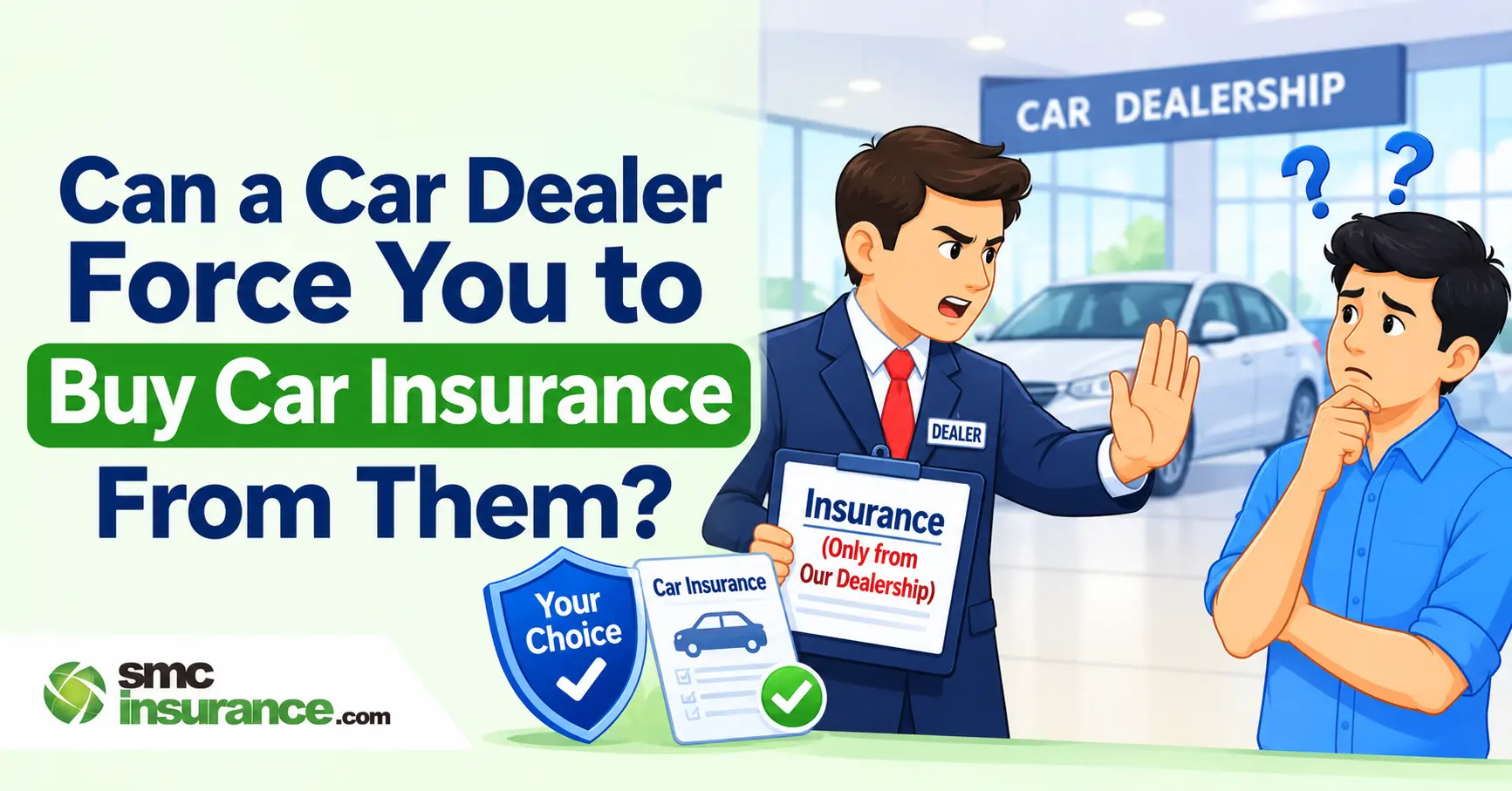
No, a car dealer cannot make purchasing its own insurance policy a compulsory condition for buying a car. You can choose an insurer of your choice, provided the vehicle has the legally required third-party cover before it is used on a public road. For a new private car, this means a three-year third-party policy. Under the 2022 government notification, the base three-year premium is Rs. 6,521 for cars up to 1,000 cc, Rs. 10,640 for cars above 1,000 cc and up to 1,500 cc, and Rs. 24,596 for cars above 1,500 cc, before applicable GST.
If a dealer pressures you to purchase its insurance package or withholds delivery despite receiving valid insurance documents, retain written evidence and consider approaching the manufacturer and the appropriate consumer grievance authority. For a dealership-related consumer grievance, you can approach the National Consumer Helpline (NCH) by calling 1915 or 1800-11-4000. You can also register a complaint through its official website. The NCH provides a pre-litigation grievance redressal channel and forwards complaints to the concerned organisation for a response.
Table of Contents
- Can a Car Dealer Force You to Buy Car Insurance?
- Why Showroom Car Insurance Gets Pushed So Hard?
- How to Compare Car Insurance Quotes Before Buying
- Buying Car Insurance From Outside the Dealer
- What to Do When a Car Dealer Forces You to Buy Insurance Before Delivery?
- When the Dealer’s Car Insurance Is Worth a Second Look
- New Car Insurance Rules in 2026 and What IRDAI Wants to Change
The balance amount is paid, the car is washed and waiting under the showroom lights and then the executive slides an insurance form across the desk and says delivery happens only after you sign it. If you have already lined up a cheaper policy online, that moment feels like a trap, because nobody wants to risk the delivery date over a few thousand rupees. So, can a car dealer force you to buy car insurance from them? No, they cannot and the price gap between a showroom policy and one you choose yourself can be real money.
Below you will find what a dealer can genuinely demand on delivery day and the exact steps to follow if the showroom refuses to budge.
Can a Car Dealer Force You to Buy Car Insurance?
The short version is no, but the longer version has a few conditions that dealers quietly lean on.
Section 146 of the Motor Vehicles Act, 1988 requires every vehicle on a public road to carry at least a third-party policy and driving without one can attract a fine of Rs. 2,000, rising to Rs. 4,000 for a repeat offence, along with possible imprisonment of up to three months. Nothing in that section, or in IRDAI’s framework for motor insurance, says the policy has to come from the dealership. So the real question is never whether you need cover on delivery day, since you do, but who gets to pick the insurer and that choice belongs to you.
What a dealer can legitimately ask for:
A dealer is within its rights to insist that the car leaves the showroom insured. Every new private car sold since September 2018 must carry a three-year third-party policy, a rule that followed a Supreme Court direction and an IRDAI circular, so whatever policy you bring should show that term. The owner’s name and the chassis and engine numbers must also match the invoice, because a mismatch is the one fair reason for a dealer to reject outside paperwork. Anything beyond that, such as demanding one particular insurer, is where the pressure begins.
Why forcing the sale is a restrictive trade practice:
The Consumer Protection Act, 2019 treats it as a restrictive trade practice, under Section 2(41), when a seller makes you buy one product as a condition for getting another. Legal commentators apply that directly to dealers who hold back a car until you sign for their insurance and a consumer commission is where such a complaint finally gets decided. This is general information and not legal advice, since the outcome depends on what the dealer actually said and wrote.
One genuine exception to watch for is the free insurance scheme. If the offer says the cover is free only through a tie-up insurer, you can still decline it and buy elsewhere, but the discount may disappear, so read the offer letter before you decide.
Why Showroom Car Insurance Gets Pushed So Hard?
Money explains most of the pressure and the numbers are now in the public domain.
In a consultation paper released on 23 September 2026, titled Recalibrating Economics of Insurance Distribution, IRDAI reported that dealers and OEM-linked brokers earn between 27% and 38% of the premium on new-vehicle own-damage cover. Across FY25, these channels brought in roughly Rs. 29,000 crore of motor premium and took home nearly Rs. 7,050 crore as commission and between FY23 and FY25 motor premium grew about 34% while commission grew about 259%. The paper also observed that a dealer’s main business is selling cars and that the choice of policy is mostly steered by the dealer rather than made by the buyer.
That commission sits inside the own-damage premium you pay, which is why a customer walking in with an outside policy is an inconvenience to the showroom. It also explains the lines buyers keep reporting, such as cashless works only with our insurer, or outside policies will slow down registration.
How to Compare Car Insurance Quotes Before Buying
Comparing two car insurance quotes requires more than looking at the final premium. A showroom package may include additional covers that are absent from an online quote, while a cheaper policy may offer a different IDV or higher deductibles. Before making a decision, check the following:
- Insured Declared Value: Compare the IDV offered by both insurers.
- Own-damage coverage: Check the insured risks and exclusions.
- Add-ons: Compare zero depreciation, engine protection, roadside assistance and return-to-invoice cover, where available.
- Deductibles: Check the compulsory and voluntary deductible amounts.
- Garage network: Verify whether your preferred workshop is included in the insurer's network.
- Claim conditions: Read the policy wording and understand the claim settlement requirements.
Once these details match, compare the final premium, including applicable taxes. This will help you identify whether the showroom policy actually offers better value or simply includes additional covers you may not need.
Buying Car Insurance From Outside the Dealer
Before you compare a single quote, it helps to know which part of the premium can move and which part cannot.
Third-party rates are notified by the government for each engine size, so every insurer and every dealer charges the same base amount. A buyer of a 1,197 cc hatchback, for example, pays Rs. 10,640 plus 18% GST, roughly Rs. 12,555, for the three-year third-party cover, whether the policy comes from the showroom or from an app on your phone.
Private car engine capacity |
Annual TP base premium |
Three-year TP base premium for a new car |
Three-year premium including 18% GST |
Up to 1,000 cc | Rs. 2,094 | Rs. 6,521 | Rs. 7,695 |
Above 1,000 cc up to 1,500 cc | Rs. 3,416 | Rs. 10,640 | Rs. 12,555 |
Above 1,500 cc | Rs. 7,897 | Rs. 24,596 | Rs. 29,023 |
Note: These are the notified base rates for private cars under the Motor Vehicles (Third Party Insurance Base Premium and Liability) Rules, 2022. GST-inclusive amounts are rounded to the nearest rupee. The three-year figures apply to new private cars. Electric vehicles have separate rate categories based on motor power.
The part where prices differ: own damage and add-ons
Own-damage premium is priced by each insurer on its own model and it moves with the car, the city and the insured declared value, or IDV. That is where a dealer’s commission lives and it is also where a bundled package can quietly add add-ons you never asked for. A cheaper quote with a lower IDV looks attractive but pays out less if the car is stolen or written off, so always compare quotes at the same IDV and with the same add-ons. Choosing between comprehensive and third-party insurance depends on the level of protection you need, while a zero depreciation add-on can help new-car owners reduce out-of-pocket expenses on eligible claims.
What you compare |
Dealer’s policy |
Policy from outside |
Third-party premium | Fixed rate, same for everyone | Same fixed rate |
Own-damage premium | Set by the insurer, with dealer commission built in (27% to 38% on new vehicles, per IRDAI’s paper) | Set by the insurer and quotes differ by channel, so compare at least two |
Choice of insurer | Usually the few insurers tied to the showroom | Any IRDAI-registered insurer |
Add-ons | Often sold as a ready-made package | You pick each add-on on its merit |
Effect on delivery | Cannot be made a condition of delivery | Must be valid and match the car’s details |
Cashless repairs | Depends on the insurer’s garage network | Depends on the insurer’s garage network, with reimbursement as the fallback |
Note: This table is a comparison framework and not a price list. Actual premiums depend on the insurer, car model, city, IDV and add-ons chosen.
Holding a dealer quote and not sure which lines are padding? Share it with an SMC Insurance advisor at SMC Insurance and get an outside quote at the same IDV before delivery day, so the car leaves with the cover you actually chose. Our guide on how to lower your car insurance premium is a good companion read while you compare.
What to Do When a Car Dealer Forces You to Buy Insurance Before Delivery?
If the dealer is already digging in, a calm paper trail will do more for you than an argument at the showroom desk.
- Buy the outside policy before delivery day: Most insurers can issue a new-car policy against the dealer’s invoice using the chassis and engine numbers, since the registration number does not exist yet.
- Match the details: The owner’s name, chassis number and engine number should read exactly as on the invoice and the third-party term should show three years. This is the only ground on which a dealer can fairly reject your paperwork.
- Email the policy to the dealer: Keep the wording plain, along the lines of: I have a valid policy for this car, the copy is attached, please confirm delivery on the agreed date.
- Ask for any refusal in writing: Save every WhatsApp message, call log and email, because that evidence is what carries the complaint later.
- Escalate to the manufacturer: Write to the carmaker’s customer care and mark the dealership’s general manager, since a complaint on record matters more to the brand than to a single showroom.
- Call the helplines: If your grievance concerns the insurer's conduct, policy issuance or insurance-related service, you can first approach the insurer's grievance redressal officer. If the matter remains unresolved, you can escalate it through IRDAI's Bima Bharosa portal or contact its grievance helpline on 155255 or 1800 4254 732. For a dispute specifically involving a car dealership's refusal to accept an outside policy, the consumer grievance route may be more appropriate.
- File with the consumer commission if delivery is still withheld: Complaints go online through the e-Jagriti portal and must be filed within two years of the cause of action. Attach the booking receipt, invoice, payment proofs, your policy and the written exchanges and note that the commission can order relief such as delivery or a refund along with compensation, depending on your facts.
When the Dealer’s Car Insurance Is Worth a Second Look
None of this means the showroom option is always a bad deal and an honest comparison sometimes comes out in its favour.
A dealer may attach a free accessory kit or an extended warranty to a policy from a tie-up insurer and if that freebie is worth more than the premium gap, taking it is a sensible call. The cleaner test is to ask the dealer to match your outside quote line by line, with the same IDV and the same add-ons. If they do, you save yourself the chase for documents and nobody has been forced into anything.
Cashless repairs are the other worry and here the dealer’s claim is weaker than it sounds. Cashless is simply a tie-up between an insurer and a workshop, so if your insurer is not on that workshop’s network you can still get reimbursement after the repair. Buyers who are financing the car should also check with the lender, since lenders typically ask for a comprehensive policy with their name noted as financier, but the choice of insurer generally stays with you.
New Car Insurance Rules in 2026 and What IRDAI Wants to Change
The rules above are what protects you today and a set of proposals now on the table could tighten them further. The three-year third-party requirement for new cars continues to apply and it covers only the liability part, so a long-term comprehensive policy remains your choice. IRDAI also allows own-damage and third-party cover to be bought as separate policies, which means the two need not come bundled from one seller.
The September 2026 consultation paper goes further. It proposes nil commission on new-vehicle third-party cover, a 5% ceiling on own-damage commission for dealers registered as distribution entities, a duty on dealers to tell new-vehicle buyers they can buy elsewhere, a digital purchase route through platforms such as Bima Sugam and a bar on refusing cashless repairs just because the policy came from another channel. These are proposals and not final rules. Comments closed in late October and IRDAI’s chairman has said draft regulations will follow with another round of consultation.
Wrapping Up,
A car dealer cannot force you to buy car insurance from the showroom and delivery cannot lawfully be held back just because your policy came from somewhere else. What the dealer can insist on is a valid policy that matches the car, with the three-year third-party cover a new private car must carry. Since the third-party premium is the same everywhere, the only real money in play sits in the own-damage premium and add-ons, which is exactly where the dealer’s commission lives. So collect at least one outside quote at the same IDV before delivery day and ask the dealer to match it if they want your business. If they refuse, keep everything in writing, escalate to the manufacturer and use 1915, 155255 and e-Jagriti in that order. Knowing this before you reach the showroom desk usually changes the whole conversation.
Disclaimer: The information provided on this platform is intended for general awareness and educational purposes. While every effort is made to ensure accuracy, some details may change with policy updates, regulatory revisions, or insurer-specific modifications. Readers should verify current terms and conditions directly with relevant insurers or through professional consultation before making any decision.
All views and analyses presented are based on publicly available data, internal research and other sources considered reliable at the time of writing. These do not constitute professional advice, recommendations, or guarantees of any product’s performance. Readers are encouraged to assess the information independently and seek qualified guidance suited to their individual requirements. Customers are advised to review official sales brochures, policy documents and disclosures before proceeding with any purchase or commitment.
FAQs
No, you are free to buy a new-car policy from any insurer and a dealer cannot make its own policy a condition for delivery. What the dealer can ask for is a valid policy that matches the car’s details, including the three-year third-party cover. If a dealer insists otherwise, ask for it in writing and escalate to the manufacturer.
Not if your policy is valid and matches the car. A refusal on any other ground can be treated as a restrictive trade practice under the Consumer Protection Act, 2019. Email the policy, ask for a confirmed delivery date and keep every reply. If delivery stays blocked, you can approach the consumer commission through e-Jagriti.
Often the own-damage part costs more, because IRDAI’s paper puts dealer commission on new vehicles at 27% to 38%. It is not guaranteed in every case, though, so compare two outside quotes at the same IDV and with the same add-ons. The third-party portion is identical everywhere, so only the rest is worth negotiating.
Yes, for new private cars it has applied since September 2018 and is bought at the time of purchase. It covers only your liability to others, so own-damage cover is a separate choice. For a car up to 1,000 cc the base three-year premium is Rs. 6,521, plus 18% GST.
It depends on whether your insurer has a tie-up with that workshop, not on who sold you the policy. If it does not, you can pay and claim reimbursement, or use any garage on your insurer’s cashless list. Check the garage list before you buy, since it matters more than the sales pitch.
Start with the manufacturer’s customer care and the dealership’s general manager, in writing. You can then call the National Consumer Helpline on 1915 and raise an insurance grievance with IRDAI on 155255 or through Bima Bharosa. The final route is a consumer commission complaint on e-Jagriti, filed within two years.
Possibly. If the free insurance offer is tied to a specific insurer in the scheme’s terms, buying elsewhere may mean giving up that benefit. Read the offer letter, work out what the benefit is worth and compare it with the outside premium before you decide.


