


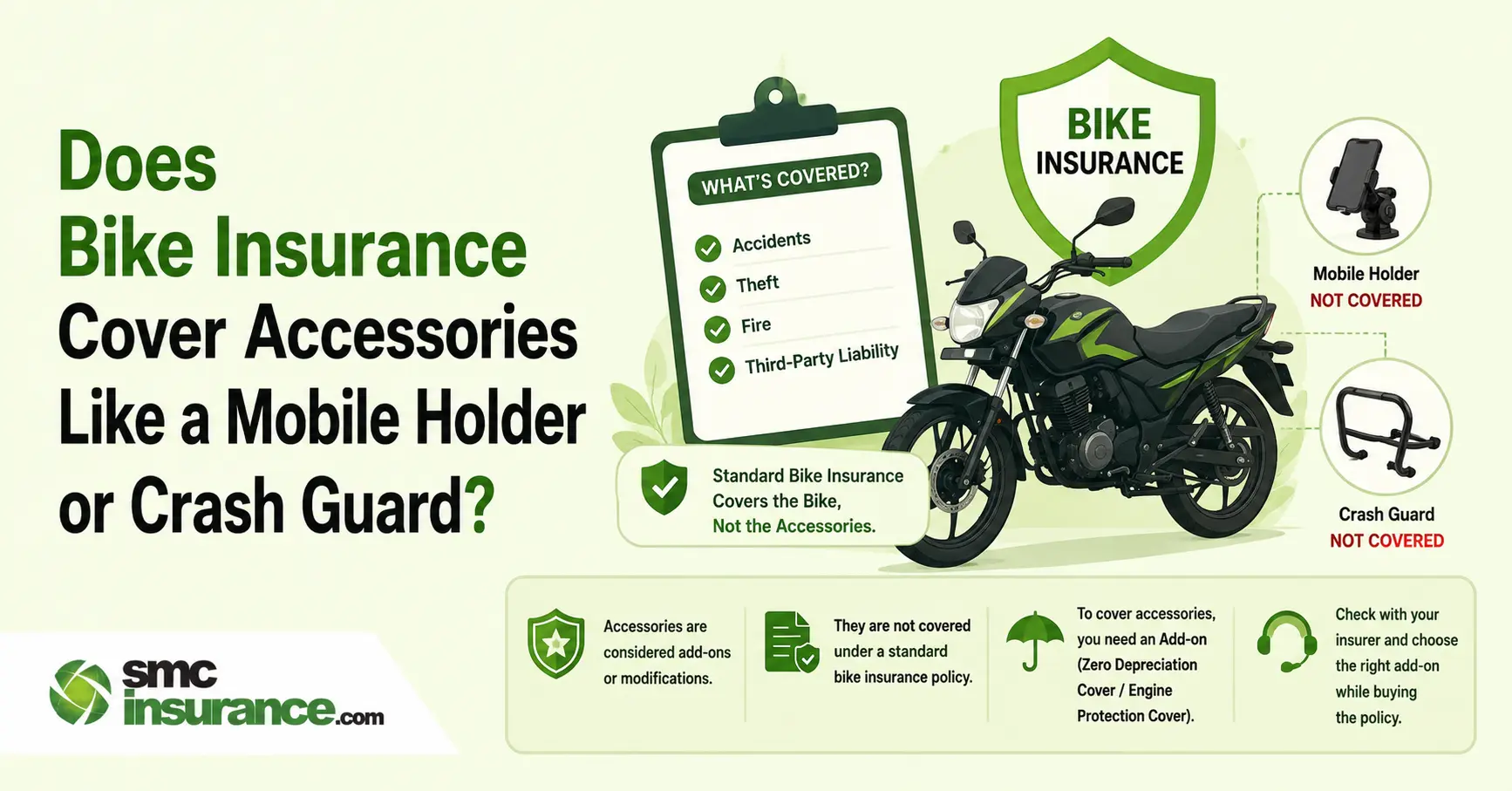
No, not automatically. A standard comprehensive or standalone own-damage bike insurance policy does not necessarily cover every aftermarket accessory fitted to your motorcycle. Items such as mobile holders, crash guards, auxiliary lights and charging units may need to be declared and insured separately through the relevant accessory cover. Insurers generally distinguish between electrical/electronic and non-electrical accessories, and the applicable premium and insured value depend on the insurer's policy terms. Third-party-only insurance does not cover damage to your own bike or its accessories. Also, check whether your policy includes a separate loss-of-accessories extension if you want protection against theft of accessories independently of the motorcycle.
Table of Contents
- Does Bike Insurance Cover Accessories?
- Is a Mobile Holder Covered Under Bike Insurance?
- Are Crash Guards Covered in Bike Insurance?
- Bike Accessories Insurance Cover
- How Bike Insurance Accessories Cover Is Priced?
- Accessory or Modification? Why the Label Matters at Claim Time
- How to Make Your Bike Insurance Cover Accessories: Step by Step
The fall itself is rarely the expensive part. You skid on a wet patch near a signal, the crash guard takes the hit exactly as it was designed to and the bike escapes with a scratched tank. Then the workshop estimate arrives and the bent guard and the cracked phone mount sit on a separate line that your insurer may not pay for at all.
So does bike insurance cover accessories like a mobile holder or crash guard? Not by default and that one word decides whether you get a settlement or a polite refusal. A standard policy protects what the factory fitted, while anything bolted on afterwards has to be declared and insured separately.
Below, we sort out what insurers count as an accessory, where the holder and the guard actually land, what declaring them does to your IDV and premium and what to fix before your next renewal. By the end you will know which of your fittings are protected and how to close the gap on the rest.
Does Bike Insurance Cover Accessories?
Everything else here is measured against the base policy, so it helps to be precise about what that policy actually insures.
A standard comprehensive or standalone own-damage bike insurance policy primarily covers the insured motorcycle against specified own-damage risks. However, aftermarket accessories are not automatically included in the insured value simply because they are fitted to the bike. If you want these items insured, you must inform the insurer and opt for the applicable accessories cover, wherever offered. The insurer may assess the declared value of the accessories separately and include it in the policy documentation. Remember that IDV is primarily relevant to total loss and constructive total loss settlements; it is not the payout limit applicable to every partial-damage claim.
When you declare aftermarket accessories, the insurer assesses their value separately according to its underwriting and valuation rules. The insured value of the accessories may be added to the vehicle's overall IDV for applicable total loss or constructive total loss calculations, after considering the relevant depreciation. The declared accessories and their insured values should also be reflected in the policy schedule or relevant endorsement. Always check the issued documents rather than assuming that simply informing the insurer has secured coverage.
Electrical and non-electrical accessories in bike insurance
Insurers commonly distinguish between electrical/electronic accessories and non-electrical accessories when offering additional own-damage protection. Electrical or electronic fittings generally include aftermarket equipment that requires an electrical connection or electronic power to operate, such as auxiliary lights, GPS devices, electronic communication systems and USB charging units. Non-electrical accessories generally include physical fittings such as crash guards, seat covers, luggage carriers and certain alloy wheels. However, the final classification of an accessory can vary by insurer. If an item combines mechanical and electronic components, confirm its classification before purchasing the cover.
The split carries weight in the documents themselves. Liberty General Insurance's two-wheeler prospectus states that loss or damage to electrical and electronic accessories can be taken on payment of an additional premium, so those items are priced as their own line. Non-electrical fittings run through each insurer's accessories add-on, which is why the route differs from company to company.
Why a third-party policy cannot help
A third-party policy pays for injury or damage you cause to others, never for your own bike, so there is nothing for an accessories cover to attach to. You need a comprehensive policy, or a standalone own damage bike cover running next to a third-party one.
Is a Mobile Holder Covered Under Bike Insurance?
Not on its own. Whether it counts as electrical or non-electrical depends on what it does and insurers are not consistent about it. A plain spring clamp has no circuit, so it generally lands with the non-electrical items, while a mount with a USB port or wireless charging pad is treated as electrical.
And that is before theft enters the picture, which is where the fine print bites. Theft protection is another condition worth checking before you purchase accessories cover. A standard two-wheeler policy may exclude loss of accessories due to burglary, housebreaking or theft when the motorcycle itself has not been stolen. However, some insurers offer a separate loss-of-accessories extension that can cover specifically declared accessories against these events for an additional premium.
For example, Universal Sompo's standard two-wheeler policy wording contains an exclusion for accessory theft unless the insured motorcycle is stolen at the same time. Its policy documentation also provides a separate Loss of Accessories endorsement for declared accessories against burglary, housebreaking or theft, subject to the applicable conditions.
Therefore, do not assume that accidental-damage protection for accessories automatically includes standalone theft protection. Check whether the specific theft extension is available, whether it has been opted for and whether the accessory is listed in the policy documents.
Our view is simple. A basic clamp that costs less than a tank of petrol is not worth its own line on the policy, but a holder with a charging module, declared along with the bike's other electrical fittings, usually is. Unclip it and take it with you and you have solved the theft problem for free.
Are Crash Guards Covered in Bike Insurance?
This is the item that gets argued about most at the workshop counter.
Crash guards, also sold as leg guards, are metal bars bolted near the engine to take the first knock in a fall. Because they look like safety equipment, riders assume the policy treats them like part of the frame. It does not, since they are added after purchase and sit outside the factory specification.
ICICI Lombard lays out the logic. No two guards are alike in size, build or price, so the insurer has no fair standard value to work from. Proving that a particular bend happened in this fall rather than an earlier scrape is another headache. And a guard that shines in a minor tip-over offers little in a serious crash, which makes it a weak candidate for default cover. Zurich Kotak makes the same point from the claims side, noting that leaving guards out heads off disputes over the amount payable.
What changes the outcome is declaration. List the guard under non-electrical accessories with its invoice value at purchase or renewal and damage from a covered accident becomes claimable under the accessories cover, subject to the depreciation applied to that declared value. Leave it off and the workshop repairs the bike while you pay for the guard yourself.
Zero depreciation will not rescue an undeclared guard. Royal Sundaram's add-on wording lists damage to uninsured items, electrical and non-electrical accessories included, among its exclusions, so a cover built to trim deductions on plastic body parts does nothing for a fitting the policy never knew about. Our explainer on the zero depreciation add-on shows what it does cover.
Bike Accessories Insurance Cover
Here is how the usual fittings sort out, so you can check your own bike against the list.
Accessory |
Likely classification |
Automatically covered? |
Recommendation |
Basic mobile holder | Usually non-electrical | Not necessarily | Confirm with insurer |
Mobile holder with USB charging | Usually electrical/electronic | Not necessarily | Declare if eligible |
Wireless charging mount | Usually electrical/electronic | Not necessarily | Confirm classification |
Aftermarket crash guard | Usually non-electrical | Not necessarily | Declare separately |
Auxiliary LED lights/fog lamps | Electrical/electronic | Not necessarily | Declare separately |
GPS device | Electrical/electronic | Not necessarily | Declare separately |
Bluetooth communicator | Electrical/electronic | Not necessarily | Confirm if vehicle-mounted |
Seat cover | Non-electrical | Not necessarily | Check accessories cover |
Saddlebags/luggage carrier | Non-electrical | Not necessarily | Check whether covered |
Aftermarket alloy wheels | Non-electrical | Not necessarily | Declare separately |
Custom exhaust/engine modifications | Modification | Not necessarily | Obtain insurer's written confirmation |
Helmet, riding jacket and knee guards | Personal riding equipment | Not automatically covered by vehicle accessories cover | Check separate personal-equipment benefits |
Note: The classifications above are indicative and may differ between insurers and insurance products. Some items may be treated as vehicle accessories, while others may fall under modifications or separate personal-equipment benefits. Coverage is available only when permitted by the insurer and recorded in the applicable policy schedule or endorsement. Always confirm the classification and coverage conditions before purchasing.
How Bike Insurance Accessories Cover Is Priced?
Money is where most riders stop reading, so here is the mechanism without the jargon.
The additional premium for insuring aftermarket accessories depends on the type of accessory, its declared value and the insurer's applicable pricing structure. Electrical/electronic and non-electrical accessories may be assessed separately, with the insurer determining the additional premium based on the applicable own-damage rates and policy conditions. Some insurers may also prescribe limits or specific valuation requirements for individual accessories.
To understand the actual cost, request quotations for the same motorcycle with and without the declared accessories. Compare the additional premium, insured value, applicable deductibles and coverage exclusions before making a decision.
Should you declare your accessories?
Your situation |
Recommendation |
Reason |
Basic mobile clamp and inexpensive seat cover | Evaluate the additional premium | Compare the replacement cost with the insurance cost |
Crash guard and saddlebags on a touring bike | Consider declaring | These fittings can involve significant replacement expenses |
Aftermarket LED lights, GPS or charging equipment | Consider declaring as electrical/electronic accessories | Electronic fittings can be expensive to replace |
Heavily modified motorcycle | Obtain written confirmation from the insurer | Some modifications may affect eligibility and coverage |
Third-party-only policy | Upgrade to suitable own-damage cover | Third-party insurance does not protect your own motorcycle |
Note: Optional and Declare are our editorial calls, not insurer rules. The real test is simple: if replacing the lot would hurt your wallet, declare it.
Not sure which of your fittings an insurer will actually count? Compare quotes at SMC Insurance with your accessories declared and without and you will see the exact extra cost before you commit. Far better to find the gap now than at the workshop counter.
Accessory or Modification? Why the Label Matters at Claim Time
There is a line between a bolt-on and a change to the bike itself and insurers watch it closely. ICICI Lombard separates bike modifications into cosmetic ones and performance-enhancing ones. A phone holder or a seat cover is a bolt-on that does not change how the bike rides. A new exhaust, different handlebars or engine tuning changes the machine and those changes are where trouble starts.
Industry guidance on claim rejections keeps returning to the same two points. Undisclosed modifications give the insurer grounds to refuse a claim and a change that contributed to the accident can sink it outright. Changes that alter the bike's registered specifications also need RTO approval, so a modification that is neither approved nor declared is hard to defend when the surveyor arrives.
For accessories the practical rule is plain. Declare what you bolted on and talk to your insurer before you change anything that touches performance or the RC. Our overview of add-ons in bike insurance shows what else can be attached when you renew.
How to Make Your Bike Insurance Cover Accessories: Step by Step
The process is short, but each step protects the one after it.
- List every fitting with its invoice value: Keep the bills and photograph each item fitted on the bike. Insurers may ask for proof of value and photos settle arguments about what was on the bike before an accident.
- Sort them into electrical and non-electrical: A charging phone mount, LED lights and a GPS unit go in the first group, while guards, seat covers and bags go in the second.
- Declare at purchase, at renewal or when you upgrade: The accessories cover attaches to a comprehensive or standalone own-damage policy, so a switch from third-party to comprehensive is also a valid moment to add it.
- Check the policy schedule, not just the payment page: It should show an accessories IDV and separate premium lines for electrical and non-electrical items. A line showing zero means that category is not insured.
- Ask about mid-term additions: Whether you can add a new fitting between renewals depends on the insurer, so get the answer in writing before you rely on it.
- Claim promptly and keep the paperwork ready: Inform the insurer soon after the incident and share invoices for every declared fitting. If a claim is wrongly refused, escalate through the insurer's grievance channel, then to the IRDAI Bima Bharosa portal and finally to the Insurance Ombudsman.
The cost of skipping the first step is concrete. ICICI Lombard notes that undeclared accessories may have depreciation applied or be excluded from the claim altogether.
Summing Up,
A standard bike insurance policy protects the bike the factory built and nothing more. The mobile holder, the crash guard and every other fitting you added afterwards stays unprotected until you declare it, value it and pay for it and that only works on a comprehensive or own-damage policy. Theft deserves a second look, because some wordings exclude accessory theft unless the whole bike goes and zero depreciation will not paper over a fitting you never declared.
The fix is cheap compared with the loss. Gather your invoices, sort the fittings into electrical and non-electrical and ask for quotes with and without them before renewal. Read the policy schedule once it lands, confirm the accessory lines carry a value and keep the bills in the same folder. If your bike has performance changes, settle those with your insurer first. Do this once a year and the next workshop estimate will hold far fewer surprises.
Disclaimer: The information provided on this platform is intended for general awareness and educational purposes. While every effort is made to ensure accuracy, some details may change with policy updates, regulatory revisions, or insurer-specific modifications. Readers should verify current terms and conditions directly with relevant insurers or through professional consultation before making any decision.
All views and analyses presented are based on publicly available data, internal research and other sources considered reliable at the time of writing. These do not constitute professional advice, recommendations, or guarantees of any product’s performance. Readers are encouraged to assess the information independently and seek qualified guidance suited to their individual requirements. Customers are advised to review official sales brochures, policy documents and disclosures before proceeding with any purchase or commitment.
FAQs
Not automatically. Aftermarket accessories such as mobile holders, crash guards and auxiliary lights may require separate declaration and an additional accessories cover under a comprehensive or standalone own-damage bike insurance policy. The insurer will determine the applicable classification, insured value and premium. Check your policy schedule to confirm that the accessories have been accepted for coverage.
No, a third-party-only bike insurance policy covers your legal liability towards third parties but does not cover damage to your own motorcycle or its accessories. To insure aftermarket accessories, you need a comprehensive/package policy or a standalone own-damage policy alongside valid third-party insurance, with the applicable accessories cover specifically opted for.
It depends on the mobile holder's design and the insurer's classification. A basic mechanical clamp without electrical components may be treated as a non-electrical accessory. A holder with USB charging, wireless charging or integrated electronic components may be classified as an electrical/electronic accessory. Confirm the category with your insurer before declaring its value.
Not automatically. A zero-depreciation add-on does not extend coverage to accessories that have not been insured separately. For example, Royal Sundaram's two-wheeler Depreciation Waiver Clause excludes damage to uninsured electrical and non-electrical accessories. Declare eligible aftermarket accessories separately and check whether the zero-depreciation benefit applies to them under your policy.
If you do not declare an aftermarket accessory, the insurer may not include its repair or replacement cost in an admissible claim. The actual treatment depends on the policy wording and the circumstances of the loss. Undisclosed modifications may also create complications if they affect the vehicle's specifications or the terms of insurance. Always inform your insurer about additional fittings and obtain confirmation that they are covered.
It depends on your policy and the additional covers you have purchased. A standard two-wheeler policy may exclude accessory theft when the motorcycle itself has not been stolen. However, some insurers offer a separate Loss of Accessories extension for specifically declared fittings against burglary, housebreaking or theft. Check whether this extension is available and included in your policy.
Yes, the insured value of accessories may reduce over time due to depreciation. However, the applicable depreciation may differ from that of the motorcycle and can depend on the type and condition of the accessory. Check the revised insured value of your declared fittings when renewing your bike insurance policy.


