


How to buy car insurance instantly in India?
Visit the official website of an IRDAI-approved insurer or licensed broker. Enter your vehicle registration number, select your coverage (third-party, own-damage, or comprehensive), apply your NCB discount, choose relevant add-ons and pay online via UPI, net banking, or card. Your e-policy is issued to your registered email within 5 to 10 minutes of payment. Third-party premiums start at Rs. 2,094 per year (plus 18% GST) for cars up to 1,000 cc, as fixed by IRDAI. The e-policy is legally valid at checkpoints and for claims. Keep your RC, PUC, driving licence and previous policy details ready before you start.
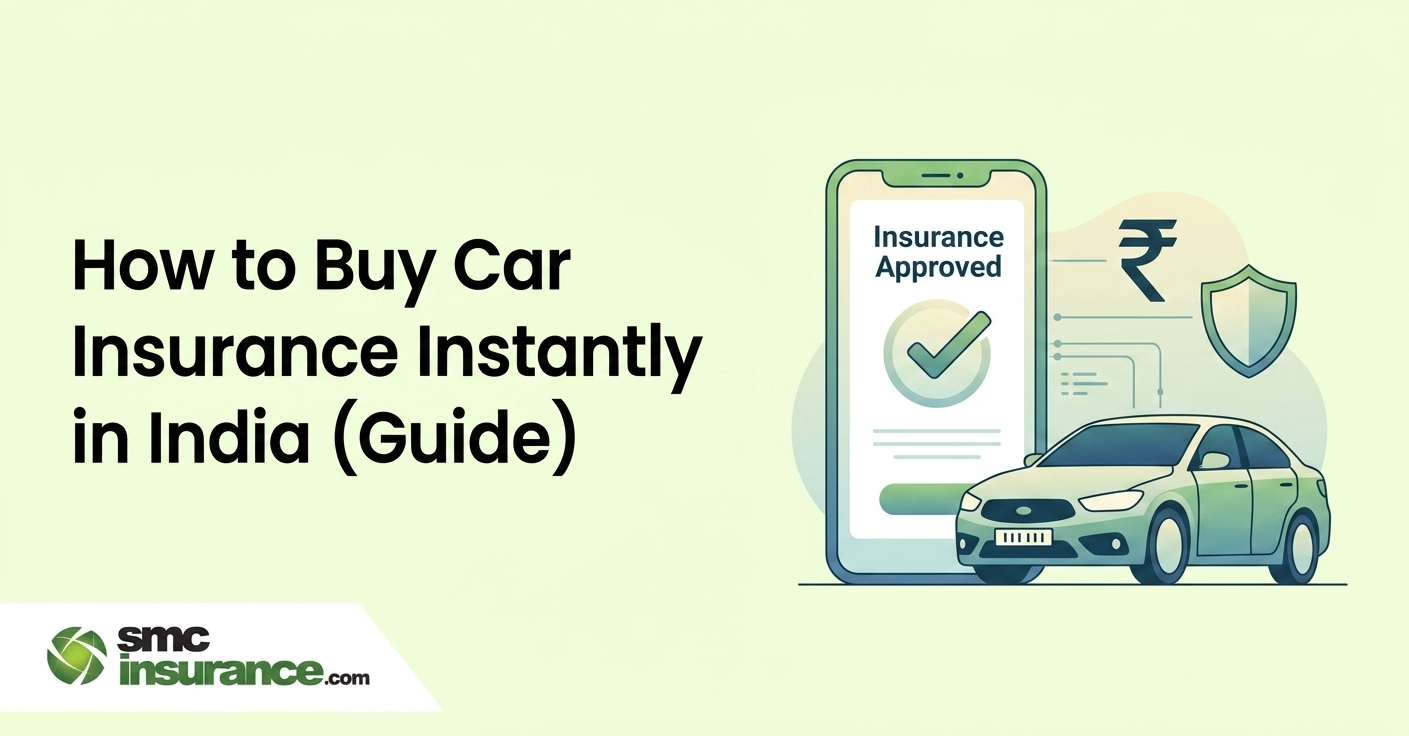
You just bought a car. Or your policy expired three days ago and you only realised it this morning. Either way, you need car insurance now, not after a week of paperwork and back-and-forth calls. The good news? Buying car insurance instantly is genuinely possible in India today. Most IRDAI-approved insurers issue a digital policy within 10 minutes of payment. No agent visit. No physical documents. No waiting.
What trips people up is not the process itself but not knowing what to check before clicking "Pay." A rushed buy can mean wrong coverage, no add-ons when you need them, or an insurer whose cashless garage is nowhere near your home. This guide walks you through exactly how to buy car insurance instantly online in India, what documents you need, what to double-check and what the numbers actually look like.
Table of Contents
- What Does "Instant Car Insurance" Actually Mean?
- Digital Policy Storage and Bima Sugam
- Types of Car Insurance You Can Buy Online Instantly
- What Documents Do You Need to Buy Car Insurance Online?
- How to Buy Car Insurance Instantly: Step-by-Step
- How to Buy Car Insurance from SMC Insurance
- How Much Does Instant Car Insurance Cost?
- Add-Ons Worth Adding at the Time of Purchase
- What to Check Before You Hit Pay?
- What Happens After You Buy? A Quick Claim Primer
What Does "Instant Car Insurance" Actually Mean?
The word "instant" gets used loosely by insurers. Here's what it really means in practice.
A car insurance policy qualifies as instant when you receive your e-policy document on your email or mobile within minutes of completing payment online. No physical inspection. No courier. No manual underwriting delay. The policy is digitally issued and is legally valid from the moment of issuance.
Since April 2024, IRDAI has further accelerated digitisation through its electronic insurance initiatives, making digital policy issuance the standard mode for new policies across the industry. You can show it on your phone at a police checkpoint. You can use it to raise a claim. It is not a provisional or temporary certificate.
Some policies show as "active" immediately but full own-damage coverage may take 24 to 48 hours to kick in if the vehicle is flagged for inspection. This typically happens with lapsed policies or older vehicles. For new cars and active renewals, coverage usually starts the same day.
Digital Policy Storage and Bima Sugam
After purchasing your policy, save the e-policy in your email, DigiLocker account, or any insurer-supported digital repository. Digital storage makes it easier to access policy details during claims, vehicle inspections, or traffic checks.
The insurance industry is also moving towards a unified digital ecosystem through initiatives such as Bima Sugam, which aims to simplify policy purchase, servicing, and claims through a common digital platform.
Types of Car Insurance You Can Buy Online Instantly
Understanding which policy you're buying changes everything about what gets covered.
|
Policy Type |
What It Covers |
Best For |
Instant Issuance |
|
Third-Party (TP) Only |
Damage/injury to another person or property |
Older cars, budget buyers |
Yes |
|
Standalone Own Damage (OD) |
Damage to your own car only |
Those who already have TP cover |
Yes |
|
Comprehensive |
TP + Own Damage combined |
New and mid-age cars |
Yes |
Note: Third-party insurance is mandatory under the Motor Vehicles Act, 1988. Driving without it can attract a fine of up to
Rs. 2,000 for a first offence and up to Rs. 4,000 for a repeat offence under the Motor Vehicles (Amendment) Act, 2019. A
comprehensive policy gives you the fullest protection but at a higher premium.
For new private cars purchased from
September 2018 onwards, IRDAI mandates a 3-year third-party cover bundled at the time of purchase, with the option to add annual own-damage cover separately.
What Documents Do You Need to Buy Car Insurance Online?
One reason online insurance is genuinely fast is that the document requirement is minimal. Keep these ready before you start.
|
Document |
Purpose |
Format Accepted |
|
Vehicle Registration Certificate (RC) |
Vehicle identity and ownership proof |
Soft copy or details to type in |
|
Previous Insurance Policy |
NCB carry-forward; renewal reference |
Soft copy |
|
Driving Licence |
Eligibility for personal accident cover |
Soft copy |
|
PUC Certificate |
Claim validity; emission compliance |
Soft copy |
|
Aadhaar / PAN |
KYC and eKYC verification |
Soft copy |
Note: For brand-new cars purchased directly from a dealership, you may not yet have your RC. In that case, the temporary registration number and
the dealer invoice are accepted by most insurers for issuing an initial policy.
You do not need to physically submit any of these. Most insurers accept self-declaration with digital verification at the time of claim. Ensure that your driving licence and PUC certificate are valid and up to date.
How to Buy Car Insurance Instantly: Step-by-Step
The process takes 5 to 10 minutes from start to finish for a renewal or new purchase. Here's how it works across most IRDAI-approved insurers or licensed brokers.
Step 1: Visit the Insurer's or Broker's Official Website
Go directly to the official website of an IRDAI-licensed insurer or a IRDAI-registered insurance broker. Look for the "Car Insurance" section. Do not rely on random third-party apps that are not IRDAI-registered.
Step 2: Enter Your Vehicle Registration Number
Most platforms auto-fetch your car's make, model, variant and fuel type from the registration number. If buying a new car, select "Brand New Car" and fill in the details manually.
Step 3: Select Coverage Type and IDV
Choose between third-party, standalone OD, or comprehensive. For comprehensive cover, you'll be asked to set your IDV (Insured Declared Value). IDV is essentially the current market value of your car after depreciation. Setting it too low saves on premium but reduces your claim payout significantly. Set it as close to the actual market value as possible.
Step 4: Add Your No Claim Bonus (NCB)
If you haven't raised any claims in the previous policy year, your NCB discount carries forward. NCB starts at 20% after one claim-free year and can go up to 50% over five years. This is one of the most valuable discounts in car insurance. Do not skip this step.
Step 5: Choose Add-Ons
This is where most people rush and regret later. More on this below.
Step 6: Pay Online
UPI, net banking, debit and credit cards are all accepted. Payment confirmation triggers policy issuance.
Step 7: Download Your E-Policy
You will receive a soft copy on your registered email within minutes. Save it on your phone immediately.
How to Buy Car Insurance from SMC Insurance (Step-by-Step)
Go to the SMC Insurance website.
On the homepage, click the "Car Insurance" insurance category.
You can then enter your registered vehicle number and click on "View Quotes". You also have the option to check quotes by giving the bike number.
In case of vehicle insurance, the upcoming prompts will ask you for your vehicle details like brand, model, fuel type, variant and respective RTO.
Once given, you can check the policy start and end date, confirm NCB details and view quotes from various insurers.
On submission, SMC will display a list of available plans or quotes from partner insurers. You can view plan details like coverage, benefits, inclusions/exclusions, add-ons (if available), insured declared value (for vehicles), etc.
Compare the available options and consider things like third-party vs comprehensive, add-ons (e.g. zero-depreciation, roadside assistance) as per your needs.
Once you select the plan you want, click the button labeled "Buy Now".
Fill out your personal details as required (owner name, address, contact, driving licence/RTO info or health info depending on policy). Ensure all details are accurate.
Make the payment via the online gateway supported by the website. After payment confirmation you will receive your policy document or certificate electronically (through email or website account).
Once everything is processed, your insurance policy becomes active. Keep a digital or printed copy of your policy/certificate for future reference.
Throughout the buying process, you have the option to contact the SMC Team for any ki
nd of support you need.
How Much Does Instant Car Insurance Cost?
Premiums vary by policy type, car engine size and insurer for own-damage cover. Third-party premiums, however, are fixed by IRDAI and remain the same across all insurers.
Third-Party Premium Rates (IRDAI-Fixed, Private Cars)
|
Engine Capacity |
Annual TP Premium (Base) |
|
Up to 1,000 cc |
Rs. 2,094 |
|
1,001 cc to 1,500 cc |
Rs. 3,416 |
|
Above 1,500 cc |
Rs. 7,897 |
|
Electric (up to 30 kW) |
Rs. 1,780 |
|
Electric (30 kW to 65 kW) |
Rs. 2,904 |
|
Electric (above 65 kW) |
Rs. 6,712 |
Note: These are base rates as notified by MoRTH in consultation with IRDAI. An 18% GST is applicable on top
of the base premium. EV owners get a 15% discount on TP premiums to encourage green vehicle adoption. Rates are subject to
revision by IRDAI periodically.
Own-damage premiums vary by insurer and are calculated based on your car's IDV, age, location,
fuel type and NCB status. Standard deductibles are fixed at Rs. 1,000 for cars up to 1,500 cc and Rs. 2,000 for cars above 1,500 cc.
Comparing plans takes 10 minutes. Choosing the wrong one can cost you lakhs at claim time. Visit
SMC Insurance
to compare IRDAI-approved car insurance plans instantly and get the right coverage from the first try.
Add-Ons Worth Adding at the Time of Purchase
Add-ons are optional covers you attach to a comprehensive policy. They raise your premium modestly but can prevent massive out-of-pocket expenses when you actually need to claim. The time to add them is at purchase, not after an accident.
|
Add-On |
What It Covers |
Who Needs It |
|
Zero Depreciation |
Full cost of replaced parts, no depreciation deduction |
Cars under 5 years old |
|
Return to Invoice |
Original on-road price if car is stolen or total loss |
New cars, high-value cars |
|
Engine Protection |
Damage from water ingress or oil leakage |
Cars in flood-prone cities or areas |
|
Roadside Assistance |
Towing, fuel, tyre change, battery jump-start |
Daily commuters, long-distance drivers |
|
NCB Protector |
Protects your NCB even after a claim |
Drivers with 3+ years of NCB |
|
Consumables Cover |
Cost of nuts, bolts, oil, coolant during repairs |
Mid-to-high segment car owners |
Note: Add-ons like Zero Depreciation and Engine Protection are only available with comprehensive policies. Third-party-only policies do not support these covers. For motor insurance add-ons in detail, check the SMC Insurance guide.
What to Check Before You Hit Pay?
Speed is good. Carelessness is expensive. Before completing your purchase, run through this quick checklist.
Claim Settlement Ratio (CSR)
This is the percentage of claims an insurer settles against those received in a year. Review the insurer's claim settlement performance, claim servicing record, grievance statistics, and cashless garage network. These factors together provide a better picture of the claims experience than any single metric.Cashless Garage Network
Check whether the insurer has authorised cashless garages near your home, workplace and frequently driven routes. A plan that forces you to pay first and claim reimbursement later creates unnecessary stress.Policy Start Date
Confirm your policy starts today, not after verification. Some platforms show your payment as successful but delay the policy activation by 24 hours if a background check is triggered.NCB Carry-Forward
If you're renewing and have accumulated NCB, make sure the new policy reflects the correct NCB percentage. Missing this is money left on the table.Read the Exclusions
Flooding due to negligence (like driving through a waterlogged road after a warning), driving under influence and unlicensed driving are common exclusions across all comprehensive policies.
What Happens After You Buy: A Quick Claim Primer
Buying instantly is only half the story. The other half is knowing what to do when you actually need to use your policy.
For own-damage claims under a comprehensive policy, the process is fairly quick. Inform your insurer within 24 to 48 hours of the incident, take your car to a cashless network garage and let them coordinate directly with the insurer. You pay only the deductible and non-covered costs.
Third-party claims work differently. They involve the Motor Accident Claims Tribunal (MACT) and compensation decisions can take months or even years. The maximum property damage compensation under third-party cover is capped at Rs. 7.5 lakh. There is no upper cap for bodily injury or death claims, which are decided by the tribunal.
Knowing this distinction matters when you decide between third-party only and comprehensive. For a detailed breakdown of third-party versus comprehensive car insurance , the SMC Insurance comparison covers both policies clearly.
Summing Up,
Buying car insurance instantly in India is no longer a complicated process. The technology is there, the regulation is solid and most IRDAI-approved insurers now issue e-policies in under 10 minutes. What matters is buying smart, not just fast.
Choose the right coverage type for your car's age and your driving habits. Set an honest IDV. Carry your NCB forward. Pick add-ons that match your actual risk, not just the cheapest plan on the screen. Check the insurer's claim settlement ratio and their cashless garage footprint in your city before paying.
Disclaimer: The information provided on this platform is intended for general awareness and educational purposes. While every effort is made to ensure accuracy, some details may change with policy updates, regulatory revisions, or insurer-specific modifications. Readers should verify current terms and conditions directly with relevant insurers or through professional consultation before making any decision.
All views and analyses presented are based on publicly available data, internal research, and other sources considered reliable at the time of writing. These do not constitute professional advice, recommendations, or guarantees of any product's performance. Readers are encouraged to assess the information independently and seek qualified guidance suited to their individual requirements. Customers are advised to review official sales brochures, policy documents, and disclosures before proceeding with any purchase or commitment.
FAQs
Visit the official website of any IRDAI-approved insurer or licensed broker. Enter your vehicle registration number, select your coverage type (third-party, own-damage, or comprehensive), add any required add-ons, enter your NCB and complete payment online. Your e-policy will be sent to your registered email within minutes of successful payment. The entire process typically takes 5 to 10 minutes. Keep your RC, PUC certificate, previous policy copy and driving licence details ready before you start.
Yes, in most cases. If the policy has lapsed recently (within a few weeks), many insurers will issue the policy online after self-declaration. If the policy has been expired for an extended period, the insurer may require vehicle inspection or additional verification before granting own-damage coverage. In that case, there will be a delay. Renewing before the policy expiry date helps ensure uninterrupted coverage and preserves benefits such as accumulated No Claim Bonus, subject to insurer rules.
Yes, as per IRDAI regulations, an e-policy issued by an IRDAI-registered insurer holds full legal validity. You can produce it on your mobile phone at police checkpoints, RTO inspections and while raising insurance claims. There is no requirement to have a physical copy.
The minimum premium for a third-party-only car insurance policy starts at Rs. 2,094 per year (before 18% GST) for private cars with engines up to 1,000 cc. This rate is fixed by IRDAI and is identical across all insurers. For a comprehensive policy, the premium is higher and depends on your car's IDV, age, location, NCB and chosen add-ons.
Yes, most comprehensive car insurance policies allow you to add Zero Depreciation cover at the time of purchase itself. This add-on is available only with comprehensive policies and is most beneficial for cars up to five years old. Adding it at purchase is always cheaper than trying to add it mid-term and many insurers do not allow mid-term add-on inclusions at all.
For most straightforward purchases and renewals, coverage begins from the policy start date which is the date of purchase. However, if the vehicle requires inspection (usually for lapsed policies or vehicles above a certain age), full own-damage coverage may be delayed until inspection is cleared. Always confirm the exact policy start date and coverage activation time before completing payment.


