


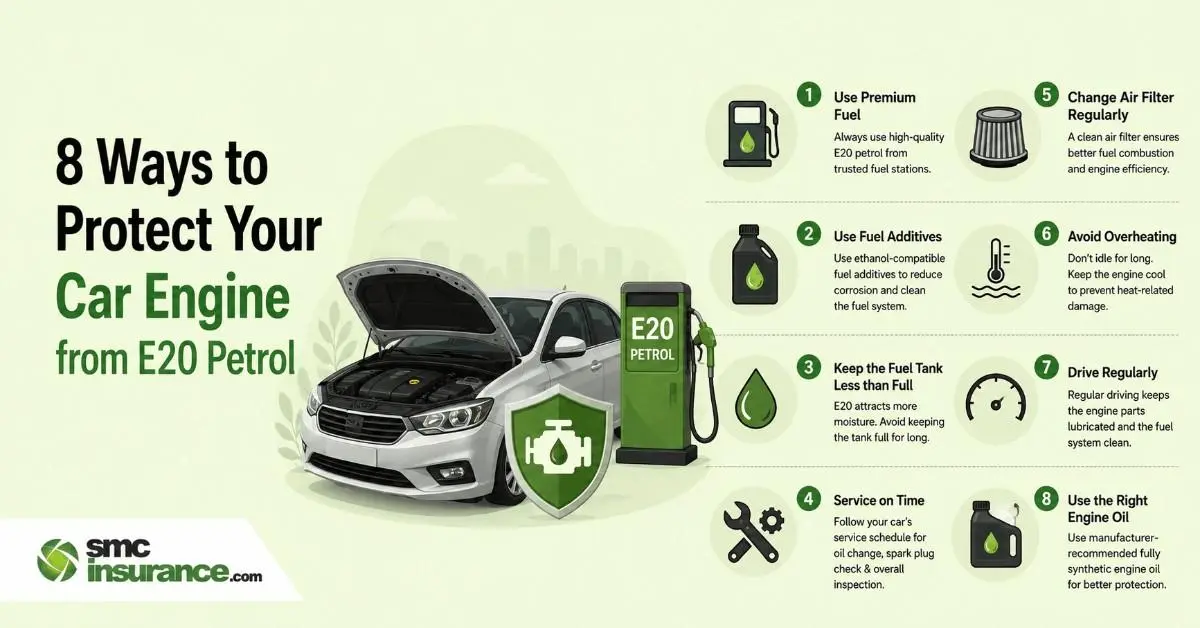
E20 petrol, a blend containing 20% ethanol and 80% petrol, is now the nationwide base petrol standard in India. Vehicle compatibility depends on the manufacturer's specification, with E20 material-compatible vehicles introduced from April 2023 and E20-optimised vehicles following from 2025. Government and industry testing has not found widespread engine damage in older vehicles, although some older vehicles may require earlier replacement of certain rubber components or gaskets. Check your owner's manual and the vehicle manufacturer's compatibility guidance before changing your maintenance schedule.
Follow the maintenance schedule specified by your vehicle manufacturer. If your manufacturer recommends additional inspection or earlier replacement of fuel-system components for E20 use, follow that guidance. Comprehensive car insurance won't cover this gradual wear, so consider an engine protection add-on for genuine peace of mind.
Your mechanic just handed you a bill for a clogged fuel filter and a fuel pump that gave up eight months early and the only thing you changed recently was the petrol pump you fill up at. E20 has now become India's nationwide base petrol standard. For cars built before the E20 transition, compatibility depends on the vehicle manufacturer's specifications and the fuel-system components used in that model. Government and industry testing has found no widespread pattern of engine failure or abnormal wear attributable to E20, including among older vehicles. However, some older vehicles may require earlier replacement of certain rubber components or gaskets. Here are eight practical, mechanic-approved ways to protect your car engine from E20 petrol, whether you're driving a five-year-old hatchback or a car that predates the whole ethanol rollout.
Table of Contents
What E20 Petrol Actually Does to Your Engine
Before you can protect anything, it helps to know what you're protecting it from. E20 petrol is a blend of 80% regular petrol and 20% ethanol and ethanol behaves nothing like the fuel your engine was originally tuned around. E20 can reduce fuel economy because ethanol has a lower energy content than petrol. Current government and ARAI material indicates that some vehicles may experience a roughly 3% to 5% reduction in fuel economy, although real-world mileage also depends heavily on driving conditions, tyre pressure, servicing and air-conditioner use. The government's own clarification puts that drop at roughly 1 to 2% for E10-era cars that were later calibrated for E20 and 3 to 6% for older, uncalibrated models.
The bigger issue for your engine isn't the mileage, though. It's chemistry. Ethanol has an affinity for water, so water contamination remains an important fuel-storage concern. However, current government guidance does not support treating water accumulation or phase separation as an inevitable consequence of using E20. Modern vehicle fuel systems include safeguards against water entry, and E20 fuel is required to meet prescribed quality standards. E20 compatibility depends on the materials used in the vehicle's fuel system. Vehicle manufacturers have therefore had to validate fuel-system components, including seals and other materials, for higher ethanol blends. Some older vehicles may require earlier replacement of certain rubber components or gaskets, but current government and industry evidence does not show widespread abnormal wear from E20 use.
Ethanol compatibility is particularly relevant to fuel-system materials such as seals, O-rings, hoses and other components. The extent of any impact depends on the vehicle's design and the materials used. Some older vehicles may require earlier replacement of certain rubber components or gaskets, while current field data do not show widespread abnormal wear from E20 use.
What Does the Latest 2026 Evidence Say About E20?
India's E20 transition is now supported by several years of testing and real-world vehicle data. In July 2026, the government reported that more than 20 crore two-wheelers and more than 3 crore petrol cars had been operating on E15+ and E20 blends without verified evidence of widespread engine failure or vehicle breakdown attributable to ethanol blending.
The government also reported that one of India's largest passenger vehicle manufacturers serviced 2.84 crore vehicles during FY 2025-26, including around 1.5 crore older vehicles that were not originally E20-certified, without reporting E20-related engine damage or abnormal component wear.
ARAI has separately reported that E20-compatible vehicles undergo structured validation and cited testing over 40,000 to 60,000 km. It also said the fuel-efficiency impact observed in laboratory testing remained within approximately 2% to 6%.
For owners, the practical takeaway is to follow the manufacturer's fuel and maintenance recommendations rather than assume that vehicle age alone makes E20 unsafe.
Is Your Car Actually at Risk from E20 Petrol?
Not every car needs to worry equally and lumping a 2024 Nexon in with a 2011 Swift does nobody any favors. Risk comes down almost entirely to when your car was built and what its fuel system was designed to handle.
|
Vehicle Information |
What the Owner Should Do |
|
E20-compatible / E20-optimised vehicle |
Follow the manufacturer's recommended maintenance schedule |
|
Older vehicle specified for E10 |
Check the owner's manual and manufacturer's E20 guidance before making maintenance changes |
|
Vehicle with no clear ethanol compatibility information |
Confirm with an authorised service centre or manufacturer |
|
Older vehicle showing fuel-system symptoms |
Have the fuel system inspected rather than assuming E20 is the cause |
This is a general risk guide based on India's E20 rollout timeline. Always check your owner's manual or ask an authorised service centre to confirm your exact vehicle's ethanol compatibility, since some manufacturers upgraded specific models earlier than the industry average. Vehicle age alone does not determine E20 compatibility. Check the manufacturer's fuel specification, owner's manual and any E20 compatibility marking on the vehicle.
If you fall in the moderate or high-risk band, the eight steps below are worth building into your regular car maintenance routine, not just something you do once and forget.
8 Ways to Protect Your Car Engine from E20 Petrol
None of these require an engine overhaul or a new car. They're small, deliberate habits that keep the ethanol-related wear from compounding into something expensive.
1. Get Your Fuel Lines, Hoses and Seals Inspected
Ask your mechanic specifically to check the rubber fuel lines, the O-rings around the fuel pump assembly and the tank gasket at your next service. Older rubber compounds can swell, harden or crack when they're constantly exposed to ethanol and a hairline crack in a fuel line is a fire risk, not just a performance issue. Ask your authorised service centre to inspect fuel-system components such as hoses, seals, O-rings and gaskets if your vehicle manufacturer recommends it or if you notice fuel leakage, starting problems or other symptoms. The government has noted that some older vehicles may require earlier replacement of certain rubber parts and gaskets when using higher ethanol blends.
2. Shorten Your Fuel Filter Replacement Interval
Follow the fuel-filter replacement interval specified by your vehicle manufacturer. Do not shorten the interval solely because the car uses E20 unless the manufacturer or authorised service centre recommends doing so. If you notice reduced performance, difficulty starting or other fuel-system symptoms, have the filter and fuel system inspected. Ethanol's solvent action loosens years of accumulated deposits from your tank walls and all of that debris has to pass through the filter before it reaches your injectors. A filter is a cheap part. A set of damaged injectors is not.
3. Don't Let the Tank Run Low or Sit for Weeks
An empty or half-empty tank has more air space and more air space means more surface area for moisture to condense on. If you're someone who drives short distances and lets the tank hover near empty for days, you're giving ethanol more opportunity to pull water out of the air and settle it inside your tank. Avoid storing your vehicle for long periods without following the storage recommendations in the owner's manual. If the car will remain unused for an extended period, follow the manufacturer's guidance for fuel storage and periodic operation rather than relying on a generic tank-filling rule.
4. Add an Ethanol-Safe Fuel Stabiliser Before Long Parking Spells
If your vehicle will remain unused for an extended period, follow the storage instructions provided by the vehicle manufacturer. Avoid adding aftermarket fuel additives unless they are approved or recommended for your vehicle. Run the engine for a few minutes after adding it so the stabiliser actually circulates through the system.
5. Move Up Your Engine Oil Change Schedule
Continue to follow the engine-oil replacement interval specified by the vehicle manufacturer. If your car develops a fuel-system or engine-running problem, have it diagnosed rather than automatically shortening the oil-change interval because of E20. Fresh oil also does a better job protecting your engine from the extra moisture ethanol introduces into the system.
6. Watch for Early Warning Signs from the Fuel Pump and Injectors
Hard starting, hesitation during acceleration, rough idling or unusual fuel-pump noise can indicate a fuel-system or engine problem. These symptoms do not by themselves prove that E20 is the cause, so have the vehicle inspected by an authorised service centre before replacing components. Older electric fuel pumps in particular weren't built with ethanol-rated internals and they tend to show stress before anything catastrophic happens. Catching these symptoms early usually means a part replacement. Ignoring them usually means a tow truck.
7. Stick to Reputed Fuel Stations
Use reputable fuel stations and avoid purchasing fuel from outlets where you have concerns about fuel quality. E20 and ethanol used in the blending programme are subject to prescribed quality standards and checks across the supply chain. Fill up at branded pumps you trust and if you're driving an older or high-performance car that isn't E20-rated, some owners opt for premium, lower-ethanol options like XP100 where available, though these cost noticeably more per litre.
8. Get an Annual Fuel-System Check, Even Without Symptoms
Don't wait for a warning light or a rough idle to have your fuel system looked at. Have your vehicle serviced according to the manufacturer's recommended schedule. If you own an older vehicle or notice fuel-system symptoms, ask the authorised service centre to inspect relevant fuel-system components and confirm whether any additional checks are recommended for E20 use. A mechanic who knows what ethanol-related wear looks like can spot early corrosion or a swelling hose before it becomes a breakdown on the highway.
What Does E20-Related Maintenance Cost?
There is no fixed cost for maintaining a car that runs on E20 petrol. The amount you pay depends on the vehicle's make and model, engine, variant, the component involved, parts prices, labour charges and the location of the workshop. Official manufacturer service calculators reflect these differences rather than publishing a single E20-specific maintenance cost for all cars. Hyundai's service calculator, for example, provides separate estimates for periodic maintenance and repair or replacement and states that the estimates can vary by city. Kia's official calculator similarly factors in the vehicle model, engine, transmission, variant, location and service interval when calculating indicative service costs.
|
Maintenance or Repair |
What Determines the Cost |
What You Should Do |
|
Fuel filter replacement |
Vehicle model, filter design, part price and labour |
Follow the replacement interval specified by the manufacturer rather than adopting a blanket E20-specific interval |
|
Fuel hose, seal or gasket replacement |
Vehicle design, component required, part price and labour |
Replace components when inspection or the manufacturer's service recommendation indicates that replacement is necessary |
|
Fuel-system inspection |
Workshop labour rates and the extent of inspection |
Ask an authorised service centre for a model-specific estimate |
|
Engine oil and oil-filter service |
Oil specification, quantity, filter and labour |
Follow the manufacturer's prescribed oil specification and service interval |
|
Fuel pump or injector repair |
Vehicle model, affected component, parts and labour |
Have the actual fault diagnosed before approving replacement |
|
Major engine repair |
Cause and extent of damage, parts required and labour |
Obtain a written diagnosis and repair estimate before authorising major work |
E20 does not automatically mean that your car will incur additional repair costs. Follow the manufacturer's maintenance schedule and have any unusual fuel-system or engine symptoms diagnosed before assuming that E20 is responsible.
This is exactly the gap that catches most owners off guard, the assumption that a comprehensive car insurance policy will step in if the engine fails. It usually won't, unless you've planned for it. If you're weighing whether your current policy actually covers this kind of mechanical wear, SMC Insurance's advisors can walk you through the right add-on before your next renewal at SMC Insurance.
Does Car Insurance Cover E20-Related Engine Damage?
Here's where a lot of car owners get an unpleasant surprise. A standard comprehensive car insurance policy generally does not cover normal wear and tear or mechanical breakdown. Whether an E20-related loss is covered depends on the cause of the damage and the specific terms and exclusions of the policy. If a component fails because of gradual deterioration, it may fall outside the policy's coverage. Insurers treat corrosion, seal degradation and slow performance decline as wear and tear, not as an insurable event, regardless of what caused it.
What can help is an engine protection cover add-on, which specifically covers repair or replacement costs for internal engine components damaged by issues like oil leakage or sudden mechanical failure. It's worth being precise about what this does and doesn't do. In our experience advising customers on this, an engine protection add-on can extend cover for specified engine and gearbox damage that is excluded from the base policy. The exact protection varies by insurer. For example, insurer policies may cover consequential damage arising from water ingress or lubricating-oil leakage, subject to the policy terms and exclusions. Normal wear and tear is generally excluded. That distinction matters more with E20 in the picture, because so much of the ethanol-related wear is gradual by nature.
If you're deciding on add-ons at your next renewal, it's worth
reading through the full range of motor insurance add-on covers available, since a consumables cover alongside engine protection often makes more practical sense for older, E20-exposed vehicles than either one on its own. Our general advice to customers with a pre-2023 car is to treat the add-on as a safety net for the unexpected, while the
eight habits above do the actual work of preventing damage in the first place.
Useful Guide: Does Car Insurance Cover Engine Damage Caused by E20 Petrol?
Wrapping Up
E20 is now firmly established as India's nationwide base petrol standard. For most vehicle owners, the practical response is to follow the manufacturer's maintenance schedule and confirm the vehicle's declared ethanol compatibility rather than assume that E20 will damage the engine. Current government and industry evidence has not found widespread engine failure, abnormal corrosion or reduced vehicle life attributable to E20, including in a large population of older vehicles. Some older vehicles may nevertheless require earlier replacement of certain rubber components or gaskets.
The fuel itself isn't the villain some social media posts make it out to be. In July 2026, the government reported that more than 20 crore two-wheelers and more than 3 crore petrol cars had been operating on E15+ and E20 blends without verified evidence of widespread engine failure or vehicle breakdown attributable to ethanol blending. ARAI has also reported E20 validation involving 40,000 to 60,000 km testing. What it has found and what mechanics across the country will confirm, is that rubber, plastic and metal parts not designed for higher ethanol content wear out faster than they used to. That's a maintenance problem, not a reason to panic or sell your car. Shorten your service intervals where it matters, keep an eye on the early warning signs and don't assume your insurance will quietly absorb the cost of neglect. A little discipline now, spread across eight simple habits, is far cheaper than a fuel pump replacement six months from now.
Also Read:
Disclaimer:The information provided on this platform is intended for general awareness and educational purposes. While every effort is made to ensure accuracy, some details may change with policy updates, regulatory revisions, or insurer-specific modifications. Readers should verify current terms and conditions directly with relevant insurers or through professional consultation before making any decision.
All views and analyses presented are based on publicly available data, internal research, and other sources considered reliable at the time of writing. These do not constitute professional advice, recommendations, or guarantees of any product’s performance. Readers are encouraged to assess the information independently and seek qualified guidance suited to their individual requirements. Customers are advised to review official sales brochures, policy documents, and disclosures before proceeding with any purchase or commitment.
FAQs
Current government and industry evidence does not show widespread engine failure or abnormal wear in older vehicles using E20. However, vehicle compatibility depends on the manufacturer's specifications, and some older vehicles may require earlier replacement of certain rubber components or gaskets. Check the owner's manual and manufacturer guidance for your specific model. With the maintenance steps above, most of these cars run fine on E20 for years without major issues.
Check the fuel specification in your owner's manual and look for the ethanol-compatibility marking provided by the manufacturer. You can also confirm compatibility with the manufacturer's authorised service centre. Vehicle age alone should not be used to determine E20 compatibility.
No, using E20 petrol does not by itself invalidate your vehicle warranty. The government has stated that automobile manufacturers continue to honour warranty obligations for vehicles using E20. However, warranty claims remain subject to the individual manufacturer's warranty terms and conditions.
Some vehicles may experience a reduction in fuel economy of around 3% to 5%, according to current government material. ARAI has reported an E20 fuel-efficiency impact in the range of approximately 2% to 6% in laboratory testing. Actual mileage varies with driving conditions, tyre pressure, servicing, air-conditioner use and driving habits.
E20 is now the nationwide base petrol standard. The government has mandated 20% ethanol blending in petrol across India. Separately, E85 has been introduced for flex-fuel vehicles specifically designed and certified to use it. Premium petrol products may also be available at selected outlets, but they should not be treated as a nationwide E10 alternative.
A standard comprehensive policy will not, since gradual wear and corrosion are treated as excluded wear and tear. An engine protection add-on cover can help with sudden mechanical failures, but it's not designed to cover damage that builds up slowly over time.


