


E20 petrol, containing up to 20% ethanol, is now the standard petrol blend mandated for sale across India, with a minimum Research Octane Number of 95. ARAI testing reported a 2-6% reduction in fuel efficiency compared with E10, although the actual impact varies by vehicle and operating conditions. E20-compatible vehicles have undergone extensive testing, while owners of older bikes should check their owner's manual or consult an authorised service centre for fuel compatibility and maintenance advice. These habits matter most for carburetted and older motorcycles.
Your bike started rough this morning. Again. You have checked the spark plug twice this month, the mileage has dropped without any change in your riding style and the mechanic keeps mentioning something about "ethanol fuel" without really explaining what that means for your engine. If this sounds familiar, you are not imagining things. Petrol sold across India is now subject to the country's E20 mandate and the higher ethanol blend can affect fuel efficiency depending on the vehicle and its calibration. While E20-compatible vehicles have undergone extensive validation, owners of older motorcycles should check their manufacturer's fuel recommendations and keep up with routine servicing. This guide walks you through what E20 petrol actually does inside your fuel system and the eight practical steps that keep your bike engine running the way it should.
Table of Contents
What Is E20 Petrol and Why Is It in Every Bike's Tank Now
E20 refers to petrol containing up to 20% ethanol. From April 1, 2026, the Centre directed oil companies to sell ethanol-blended petrol with up to 20% ethanol, conforming to BIS specifications and having a minimum Research Octane Number (RON) of 95, across India's states and Union Territories, subject to limited exemptions. The Ministry of Petroleum and Natural Gas has directed oil companies to sell this blend, meeting a minimum Research Octane Number of 95, across every state and union territory from April 1, 2026, with only limited regional exemptions permitted. India has mandated the sale of 20% ethanol-blended petrol from April 1, 2026, marking a major step in the country's clean-fuel and energy-security push. India originally targeted 20% ethanol blending in petrol by 2030 under the National Policy on Biofuels, 2018. The target was later advanced to Ethanol Supply Year (ESY) 2025-26. India achieved the 20% blending target in 2025-26, five years ahead of the original 2030 target.
The automotive industry began introducing E20 material-compatible vehicles from April 2023, followed by vehicles with E20-tuned engines from April 2025. However, compatibility should still be checked against the specific motorcycle's owner's manual or manufacturer guidance rather than determined solely by its registration year. Older motorcycles that were designed and certified for lower ethanol blends may have different material and fuel-system specifications. However, compatibility varies by model and manufacturer, so the motorcycle's owner's manual or manufacturer guidance should be treated as the primary reference.
How Ethanol Actually Affects Your Bike's Engine and Fuel System
Ethanol is not petrol behaving slightly differently. It is chemically a different fuel with different properties and those differences matter once it starts circulating through metal, rubber and plastic components that were never built for it.
Recent ARAI and government updates provide a broader picture. E20-compatible vehicles undergo durability, performance and reliability testing covering the engine, fuel lines and other components. July 2026 ARAI testing reported a 2-6% reduction in fuel efficiency compared with E10, while the government said extensive validation has not shown widespread engine failures attributable to E20. An unpublished ARAI report cited by Times of India says E20 fuel deteriorates rubber parts in E10-compliant vehicles, while raising fuel use by 2-6%. A separate, earlier ARAI laboratory study reached a similar conclusion after testing eight metals, six rubber compounds and four plastics against both E10 and E20 fuel. While it found no significant impact on metal components, certain rubber and plastic materials showed greater deterioration when compared with E10 fuel under laboratory conditions.
There is a second issue that has nothing to do with the engine's internals and everything to do with chemistry. Ethanol can absorb water and excessive water contamination can eventually cause phase separation in ethanol-blended petrol. However, phase separation is not an inevitable result of normal humidity. Water entering the fuel system through contamination, poor storage or other sources is a more relevant concern. If significant water contamination occurs, the resulting ethanol-water phase can affect engine operation. If that layer gets drawn into the carburettor or injector, expect rough idling, misfires, or the bike simply refusing to start.
On the mileage front, the government has been fairly direct about the trade-off. For vehicles designed for E10 and calibrated for E20, mileage may drop by just 1-2 per cent, while in other vehicles, it could be around 3-6 per cent. Independent automotive engineers speaking to PTI placed the figure in a similar range for older, non-compliant vehicles. There can be a drop in mileage ranging from 2-5 per cent, depending on the type of vehicle, purely because of the lower calorific value of ethanol compared to petrol.
None of this means your bike is at risk of sudden failure. It means routine care now matters more than it used to, particularly if your bike predates the E20-compliant generation.
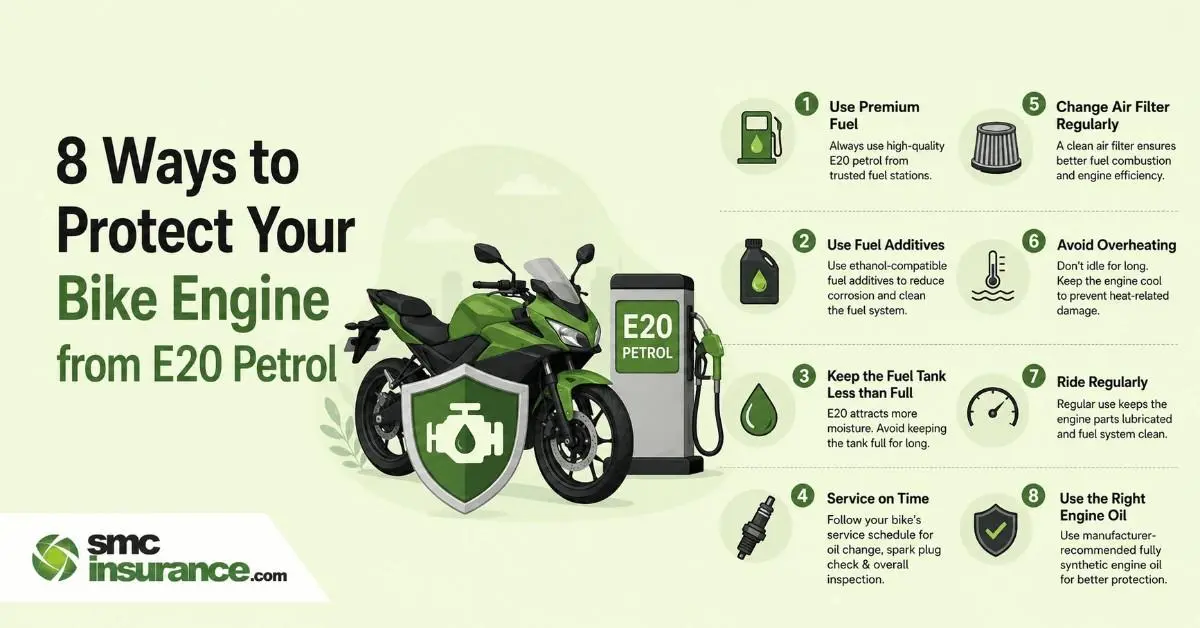
8 Ways to Protect Your Bike Engine from E20 Petrol
1. Get Fuel-System Rubber Parts Checked Before They Fail
Fuel hoses, the carburettor float bowl gasket and O-rings are the parts most exposed to ethanol's slow degrading effect. Ask your mechanic to inspect these during your next service instead of waiting for a fuel leak or a stalling engine to force the issue. Bikes registered before April 2023 should get this check done every six months rather than once a year.
2. Seal the Fuel Cap Properly, Every Single Time
Keep the fuel cap properly closed and its seal in good condition. This helps prevent water or contaminants from entering the fuel system and is especially sensible when the motorcycle is stored for extended periods. Check the rubber seal on the cap lid for cracks, make sure it clicks shut fully and skip the cheap aftermarket plastic covers that create small gaps around the lid instead of sealing it.
3. Do Not Let the Tank Run Low, Especially Before the Bike Sits Idle
An emptier tank has more air space and more air space means more room for moisture to condense inside. If you know the bike will be parked for a few days, top it up rather than letting it run down. For extended storage, follow the motorcycle manufacturer's storage procedure. Depending on the model, this may include specific instructions for fuel, battery care and other components.
4. Ride Regularly to Keep Fuel Moving
A tank that sits untouched for weeks gives ethanol more time to absorb moisture and separate from the petrol. Bikes that are used often, even for short rides, keep fuel circulating and reduce the odds of this happening. If the motorcycle will remain unused for an extended period, follow the storage instructions in the owner's manual rather than routinely starting the engine for a few minutes.
5. Fill Up Only at Fuel Stations You Trust
Adulterated or poorly stored fuel compounds every problem ethanol already creates. Stick to reputable, high-footfall pumps, particularly when travelling through unfamiliar towns. Use authorised fuel stations and avoid purchasing fuel from unverified sources. If you suspect contaminated fuel, have the motorcycle inspected rather than continuing to ride it.
6. Watch for Early Warning Signs Instead of Riding Through Them
Hard starting, rough idling, jerky acceleration or sudden stalling can have several causes, including fuel contamination, ignition issues, fuel-system problems or other mechanical faults. If these symptoms appear after refuelling or persist despite routine maintenance, have the motorcycle inspected by an authorised service centre. Getting the bike to a service centre at the first sign saves you from a bigger repair bill later.
7. Schedule a Pre-Season Service, Not Just an Annual One
If your motorcycle is used in areas with heavy monsoon conditions, a pre-monsoon inspection can be a useful addition to its normal service schedule. Ask the service centre to check the fuel system, spark plug, air filter, tyres, brakes and other components recommended for inspection by the manufacturer. Use this service to get the spark plug, air filter and fuel lines checked, on top of the usual oil change.
8. Consider an Ethanol-Safe Fuel Additive for Older Bikes
For an older motorcycle, check the owner's manual or consult an authorised service centre before using any fuel additive or treatment. Do not assume that an ethanol-treatment product is necessary simply because the motorcycle is older. If the manufacturer recommends a particular additive, fuel treatment or storage procedure, follow that guidance and use only a compatible product. Check with your bike's manufacturer or an authorised service centre before picking a product, since compatibility can vary by engine type.
Also Read:
E20 Petrol: Effects and Fixes at a Glance
|
Issue Caused by E20 Petrol |
Why It Happens |
What Helps |
|
Rubber hose, gasket and seal wear |
Ethanol degrades rubber compounds not designed for E20 |
Inspect according to the manufacturer's service schedule and whenever symptoms of deterioration appear |
|
Water in the fuel tank (phase separation) |
Ethanol is hygroscopic and absorbs moisture from humid air |
Follow the manufacturer's storage guidance, keep the fuel system properly sealed and avoid unnecessary long-term storage of fuel |
|
Mileage drop of roughly 2-6% |
Ethanol has a lower calorific value than pure petrol |
Maintain the motorcycle according to the manufacturer's schedule and keep tyres correctly inflated. Actual fuel economy also depends on riding style, traffic, road conditions and vehicle condition |
|
Hard starting or rough idling |
Moisture-contaminated fuel reaching the carburettor or injector |
Get the bike checked at the first sign rather than continuing to ride it |
|
Injector or carburettor deposits |
Ethanol can leave residue during storage or infrequent use |
Periodic injector cleaning and ethanol-safe fuel additives for older bikes |
The 2-6% fuel-efficiency range reflects ARAI's July 2026 reporting on controlled testing of vehicles using E20 compared with E10. Actual fuel economy varies by vehicle, calibration, riding conditions, road conditions and vehicle condition.
Beyond the maintenance side, it helps to remember that engine wear from fuel-related issues and engine damage from an accident or a flooded road are treated very differently by your insurer. Routine ethanol-related wear typically falls outside standard own damage bike insurance, since that cover is built around accidental damage, theft and natural calamities rather than gradual mechanical degradation. Riders who want a financial cushion against sudden mechanical or electrical breakdown often look at add-on covers offered alongside standard two-wheeler insurance policies, so it is worth asking your insurer what is and is not included before you assume you are covered.
Worried about what your current policy actually protects against once E20 wear enters the picture? SMC Insurance's advisors can walk you through add-on options that fit how you actually ride, so you are not left guessing when something does go wrong. Check your two-wheeler insurance options with SMC Insurance and get clarity on what is covered.
Which Two-Wheelers Should Pay Closer Attention to E20 Compatibility?
The effect of E20 depends on the motorcycle's design, fuel-system materials, engine calibration, age and maintenance history. Owners of older motorcycles should check the owner's manual or contact the manufacturer to confirm the recommended fuel blend. Motorcycles that are certified for E20 can be used according to the manufacturer's recommendations, while owners of older models should follow the applicable maintenance and inspection guidance rather than relying on the vehicle's age alone.
Summing Up
E20 petrol is now the standard fuel across India and it is not going away. The government's own data shows the mileage drop is modest for most riders and manufacturers have already built newer bikes to handle the higher ethanol content without issue. The main practical consideration for owners of older motorcycles is fuel compatibility and maintenance. E20 has been extensively tested and current government and ARAI assessments do not indicate widespread engine failures attributable to the fuel. Older motorcycle owners should therefore check manufacturer guidance, follow the recommended service schedule and investigate persistent fuel-system or performance symptoms promptly.
A cracked fuel cap seal, a tank left half-empty for weeks, or a rubber hose overdue for inspection are small things individually, but they compound quickly once ethanol is in the mix. Stay ahead of it with regular checks, sensible fuel habits and a service schedule that accounts for your bike's age and E20 becomes a manageable part of ownership rather than a recurring repair bill.
Disclaimer:The information provided on this platform is intended for general awareness and educational purposes. While every effort is made to ensure accuracy, some details may change with policy updates, regulatory revisions, or insurer-specific modifications. Readers should verify current terms and conditions directly with relevant insurers or through professional consultation before making any decision.
All views and analyses presented are based on publicly available data, internal research, and other sources considered reliable at the time of writing. These do not constitute professional advice, recommendations, or guarantees of any product’s performance. Readers are encouraged to assess the information independently and seek qualified guidance suited to their individual requirements. Customers are advised to review official sales brochures, policy documents, and disclosures before proceeding with any purchase or commitment.
FAQs
E20 petrol is safe for bikes manufactured from April 2023 onward, since these are built to be E20-compliant. Older bikes with E10-era rubber components can experience gradual wear in hoses, seals and gaskets, so they need closer monitoring rather than being unsafe outright.
How much E20 affects mileage varies by vehicle and test conditions. ARAI reported in July 2026 that controlled testing found a 2-6% reduction in fuel efficiency compared with E10. Real-world fuel consumption can vary depending on the motorcycle, riding style, road conditions and maintenance.
Direct engine damage from E20 alone is uncommon. The more realistic risk is wear to rubber fuel-system components over time, or fuel contamination from moisture buildup if the tank and fuel cap are not maintained properly.
Check your bike's manual or ask your dealership. As a general rule, two-wheelers manufactured from April 2023 onward are built to run on E20 fuel without needing modified parts.
Hard starting, rough idling, jerky acceleration, or sudden stalling, particularly after refueling or during humid weather, are the usual warning signs. Get the fuel system checked as soon as these appear.
It is not mandatory for E20-compliant bikes but can be useful for older, infrequently ridden motorcycles as an extra layer of protection against moisture and injector deposits. Check compatibility with your service centre before using one.
Using E20 petrol does not by itself invalidate a motor insurance policy. However, standard two-wheeler policies generally exclude normal wear and tear and mechanical or electrical breakdown. Whether E20-related damage is covered therefore depends on the specific policy wording, the cause of damage and the insured event. In June 2026, the government clarified that E20 use alone cannot be treated as a reason to invalidate motor insurance or reject a claim.
Beyond your bike's usual service schedule, it is worth adding a dedicated fuel-system check every six months for pre-2023 bikes, along with a pre-monsoon inspection of the spark plug, air filter and fuel lines.


