


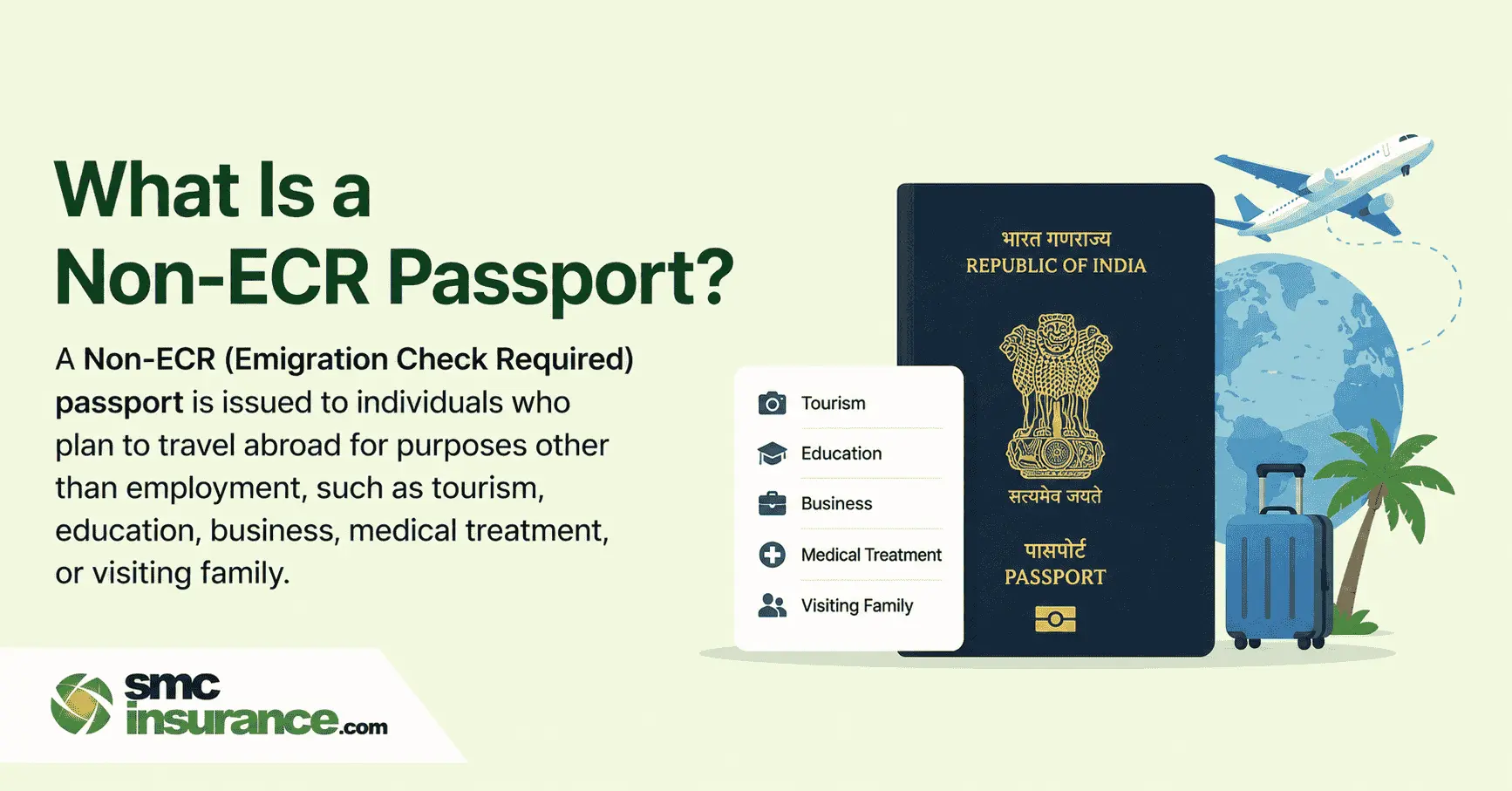

A Non-ECR passport is an Indian passport for which no emigration clearance is required before travelling abroad for employment. Eligibility comes from passing Class 10 or above, being over 50, government service, paying income tax, holding a recognised professional or diploma qualification, or a few other listed categories. It does not replace a visa or work permit and it applies specifically to 18 notified countries. For an adult 36-page passport with 10-year validity, the current application fee is Rs. 2,500. Deletion of ECR through passport reissue also costs Rs. 2,500 for a 36-page booklet. A 60-page booklet costs Rs. 3,500. Tatkaal attracts an additional Rs. 2,500 fee.
You are filling out your passport application and you hit that one question: "Are you eligible for the Non-ECR category?" Suddenly you are not sure whether to tap Yes or No and a wrong answer here can mean extra paperwork later, or worse, getting stopped at the airport when you least expect it. So what is a Non-ECR passport and does it actually apply to you? In simple terms, a Non-ECR passport means you do not need emigration clearance from the Protector of Emigrants when travelling abroad for employment in the notified ECR countries. It does not remove visa, work-permit or immigration requirements imposed by the destination country. By the end of this guide, you will know exactly who qualifies, what documents to keep ready, how to check your own status and what it costs to fix it if your passport currently shows ECR.
Table of Contents
- What Does Non-ECR Mean in a Passport?
- Why Does the Non-ECR Category Exist?
- Who Is Eligible for a Non-ECR Passport?
- Is 10th Pass Required for a Non-ECR Passport?
- Non-ECR Passport Eligibility by Category
- Documents Required for a Non-ECR Passport
- How to Apply for a Non-ECR Passport in India
- How to Check Whether Your Passport Is ECR or Non-ECR
- ECR vs Non-ECR Passport: What Is the Difference?
- Which Countries Require Emigration Clearance for ECR Passport Holders?
- Benefits of a Non-ECR Passport
- Can an ECR Passport Be Changed to Non-ECR?
- Non-ECR Passport Fees
- Common Mistakes When Applying for Non-ECR
- Key Takeaways
What Does Non-ECR Mean in a Passport?
ECR stands for Emigration Check Required. Non-ECR is the opposite, it means Emigration Check Not Required. You will also come across the older term ECNR, which refers to the same thing. Passport Seva does not usually print Non-ECR as a separate stamp. Instead, the passport carries the text "EMIGRATION CHECK REQUIRED" only when the ECR category applies. If that line is missing from your passport, you are treated as Non-ECR by default.
This status matters mainly for one situation, going abroad for employment. It does not mean you can enter any country freely or skip a visa. A Non-ECR passport is not a substitute for a work permit, a visa, or any other requirement your destination country asks for. It only removes one specific step, the emigration clearance from the Protector of Emigrants and only for a defined list of countries.
Why Does the Non-ECR Category Exist?
The ECR framework is intended to protect vulnerable sections of Indian citizens seeking overseas employment. Passport Seva explains that the system was introduced to protect groups such as children and less-educated workers from exploitation while working abroad. The Emigration Act of 1983 gives the Protector of Emigrants (PoE) the authority to verify that a worker's overseas job offer is genuine before that worker leaves the country.
Education, age, income and profession all factor into who needs this extra check and who does not. A person with a Class 10 certificate, a government job, or a recognised professional qualification is assumed to have enough awareness and documentation to protect themselves, so the check is waived. It has nothing to do with restricting general travel and everything to do with regulating overseas employment specifically.
Who Is Eligible for a Non-ECR Passport?
This is the part most readers actually search for, so let's get specific. You generally qualify for Non-ECR if you fall into any one of these categories. You only need to meet one, not all of them.
- Passed Class 10 (matriculation) or hold any higher educational qualification
- Above 50 years of age, regardless of education
- Children up to 18 years of age can qualify under the minor category, subject to the passport validity and application conditions. At reissue after turning 18, proof of another Non-ECR category must be submitted, or ECR stamping may apply. Applicants aged 15 to 18 seeking a full-validity 10-year passport must also provide proof of Non-ECR eligibility.
- Diplomatic or official passport holders, along with spouse and dependent children
- Gazetted government servants, along with spouse and dependent children
- Income-tax payers in their individual capacity, along with eligible spouses and dependent children, subject to the prescribed proof of income-tax assessment and payment
- Recognised professionals such as doctors, engineers, chartered accountants, cost accountants, advocates, teachers, scientists and accredited journalists
- Holders of a two-year diploma from an NCVT or SCVT recognised institute, or a three-year diploma from a government-recognised polytechnic
- Registered nurses qualified under the Indian Nursing Council Act, 1947, though nurses are separately listed as a POE-notified profession and may still require clearance for specific job categories despite their qualification
- Seamen holding a valid Continuous Discharge Certificate (CDC), as well as eligible Sea Cadets and Deck Cadets meeting the prescribed qualification and training requirements
- Persons holding permanent immigration visas or PR status for countries such as the USA, UK or Australia
- Persons who have stayed abroad for more than three years, whether continuously or in separate periods, and their eligible spouses
The Passport Seva document checklist lists Class 10, Class 12 and degree certificates as accepted proof for the education-based category, so that page is worth a quick look before you finalise which document you are submitting.
Is 10th Pass Required for a Non-ECR Passport?
Not strictly, but it is the most common route. Passing Class 10 is one of the biggest eligibility categories and it is the one most first-time applicants rely on because a marksheet is easy to produce. That said, plenty of people qualify without it. Someone who has never appeared for board exams but is above 50, or qualifies under the income-tax payer category by providing the prescribed proof of income-tax assessment and payment. So, if you did not clear 10th grade, check the other categories before assuming you are stuck with ECR.
Non-ECR Passport Eligibility by Category
Eligibility Category |
Typical Supporting Proof |
Class 10 or higher education | Educational certificate |
Above 50 years | Birth certificate or school leaving certificate |
Government employee (gazetted) | Service certificate from the department |
Income tax payer | PAN and latest ITR |
Recognised professional | Degree or professional registration |
Diploma holder | NCVT/SCVT or polytechnic diploma certificate |
Registered nurse | Nursing Council registration |
Seafarer | Valid CDC |
Permanent immigration status | PR card or immigration visa copy |
Minor (up to 18 years) | Birth certificate |
Note: Exact document requirements can vary by case and the Passport Seva portal has the final word, so always cross-check before your appointment.
Documents Required for a Non-ECR Passport
Whichever category applies to you, carry both the originals and photocopies to your Passport Seva appointment. The originals get checked and handed back, the copies get retained. Depending on your route, you may need:
- Class 10, Class 12 or degree certificate for the education route
- Proof of date of birth, useful for the age-based and minor categories
- PAN card and last year's ITR for the income tax route
- Government service certificate for gazetted employees
- Professional degree or council registration certificate
- Diploma certificate from a recognised NCVT, SCVT or polytechnic institute
- Nursing registration certificate under the Indian Nursing Council Act
- CDC for seafarers
- Copy of PR card or permanent immigration visa where applicable
- Proof of address
The Passport Seva document checklist lists Class 10, Class 12 and degree certificates as accepted proof for the education-based category, so that page is worth a quick look before you finalise which document you are submitting.
How to Apply for a Non-ECR Passport in India
Applying for Non-ECR is not a separate application, it is a section within your regular passport application. Here's the sequence.
- Register on the Passport Seva portal.
Create your account if you do not already have one. - Choose a fresh passport or reissue.
Pick whichever applies to your situation. - Fill in personal, address, family, education and employment details.
Be accurate here, mismatches cause delays. - Answer the Non-ECR eligibility question.
Select the category that applies and be ready to back it up. - Pay the applicable fee.
This depends on booklet size, age group and whether you choose Tatkaal. - Book your appointment
At the nearest Passport Seva Kendra or Regional Passport Office. - Visit the centre
With originals and copies of every supporting document. - Complete verification
Including biometrics and police verification where required.
Once approved, the reissued passport carries no ECR endorsement and you are treated as Non-ECR going forward.
How to Check Whether Your Passport Is ECR or Non-ECR
This one is easy once you know where to look. Open your passport to the last page, the one just above your father's name. If it says "EMIGRATION CHECK REQUIRED" in print, you are in the ECR category. If that line is absent, your passport is Non-ECR, even though the word "Non-ECR" itself is not printed anywhere. Older passports issued before January 2007 used a physical stamp instead of printed text, but the logic is the same, presence of the ECR mention means ECR, absence means Non-ECR.
If you are still unsure, do not rely on guesswork or a random blog. Log into the Passport Seva portal and check your application category, or visit your nearest Passport Seva Kendra and ask a staff member to confirm it directly.
ECR vs Non-ECR Passport: What Is the Difference?
Feature |
ECR Passport |
Non-ECR Passport |
Full form | Emigration Check Required | Emigration Check Not Required |
Printed on passport? | Yes, explicitly stated | Generally not separately printed |
Overseas employment | Needs PoE clearance for 18 specified countries | No clearance needed for those countries |
Who typically falls here | Those without qualifying education or category proof | Class 10+ pass, government staff, professionals and other listed categories |
Visa requirement | Still applies based on destination | Still applies based on destination |
Tourism and family visits | Not restricted | Not restricted |
Note: ECR status does not stop anyone from tourism, business visits or family travel. The clearance requirement applies specifically to employment travel to the 18 notified countries.
Which Countries Require Emigration Clearance for ECR Passport Holders?
As per the current Ministry of External Affairs information, emigration clearance applies to ECR passport holders travelling for employment to the following notified countries: Afghanistan, Bahrain, Iraq, Indonesia, Kingdom of Saudi Arabia, Kuwait, Jordan, Libya, Lebanon, Malaysia, Oman, Qatar, Sudan, Syria, Thailand, United Arab Emirates and Yemen.
The list and applicable emigration rules can change, so applicants should verify the current position with the Ministry of External Affairs or Passport Seva before travelling.
Benefits of a Non-ECR Passport
- No PoE clearance needed for employment travel to the 18 listed countries
- Fewer forms and less paperwork before departure for overseas jobs
- Smoother process for professionals, graduates and frequent business travellers
- One less step to worry about if you regularly travel abroad for work
None of this means visa-free travel. You still have to meet whatever entry, work permit or visa conditions your destination country sets, Non-ECR only removes the Indian government's emigration check for employment purposes.
Planning that overseas move can feel like a lot to manage at once, between the passport, the visa and the actual job offer. That is exactly where a good travel insurance plan earns its place, covering you for medical emergencies, lost documents and trip disruptions while you sort the rest out. Explore your options at SMC Insurance.
Can an ECR Passport Be Changed to Non-ECR?
Yes. If you now qualify for Non-ECR status, you can apply for passport reissue for deletion of the ECR endorsement.
- Confirm the Non-ECR category you qualify under.
- Apply online for passport reissue through Passport Seva.
- Provide the required documentary proof of your Non-ECR eligibility.
- Pay the applicable reissue fee and schedule an appointment.
- Visit the Passport Seva Kendra with the original documents and self-attested copies.
- If approved, the reissued passport will no longer carry the ECR endorsement.
Non-ECR Passport Fees
Passport fees were revised across the board from 1 July 2026 under the Passports (Amendment) Rules, 2026, the first change in over a decade. There is no separate charge specifically for Non-ECR status, deletion of ECR falls under the standard reissue fee for change in personal particulars.
- 36-page passport, fresh or reissue (adult): Rs. 2,500
- 60-page passport, fresh or reissue (adult): Rs. 3,500
- Deletion of ECR or change in personal particulars follows the same reissue fee slab as above
- Tatkaal processing adds a separate premium on top of the normal fee
These figures reflect the post-July 2026 revision. Fees are subject to periodic change, so always confirm the exact amount on the official Passport Seva fee calculator before you pay.
Common Mistakes When Applying for Non-ECR
- Assuming every passport is automatically Non-ECR without checking
- Selecting "Yes" for Non-ECR eligibility without matching documentary proof
- Carrying only photocopies and forgetting the originals for verification
- Working off an outdated fee figure from an old article
- Mixing up Non-ECR status with visa-free entry
- Believing ECR blocks tourism or family visits, it does not
- Trusting unofficial websites over the Passport Seva portal for current rules
- Not checking whether the specific destination country is even on the 18-country list before worrying about clearance
Key Takeaways
- Non-ECR means Emigration Check Not Required and it mainly affects overseas employment travel.
- Class 10 pass is one major route to eligibility, but age, income tax status, government service and professional qualifications are equally valid.
- ECR status is printed on the passport, Non-ECR is generally not separately printed, its absence is the confirmation.
- Non-ECR is not the same as visa-free travel, destination country rules still apply.
- Passport fees were revised from 1 July 2026, always confirm the current figure on Passport Seva before paying.
- When in doubt about your status or eligibility, check the official Passport Seva portal rather than a third-party site.
Summing Up
A Non-ECR passport is not a special document, it is simply the default status your passport carries once you clear one of several eligibility checks tied to education, age, income or profession. Most Indians who have studied past Class 10 or hold a steady income already qualify without realising it. The confusion usually comes in at the point of application, when people either assume eligibility without proof or discount themselves without checking every category. If your current passport shows the ECR endorsement and you now qualify, applying for deletion through a straightforward reissue is entirely possible and does not cost extra beyond the standard reissue fee. Check your passport, match yourself against the eligibility list above, keep your documents ready and use the Passport Seva portal for anything that needs a final confirmation. For a related read on document checklists, see our guide on applying for a passport in India and for a closer side-by-side comparison, our piece on ECR vs Non-ECR in Indian Passport breaks it down further.
Disclaimer: The information provided on this platform is intended for general awareness and educational purposes. While every effort is made to ensure accuracy, some details may change with policy updates, regulatory revisions, or insurer-specific modifications. Readers should verify current terms and conditions directly with relevant insurers or through professional consultation before making any decision.
All views and analyses presented are based on publicly available data, internal research, and other sources considered reliable at the time of writing. These do not constitute professional advice, recommendations, or guarantees of any product’s performance. Readers are encouraged to assess the information independently and seek qualified guidance suited to their individual requirements. Customers are advised to review official sales brochures, policy documents, and disclosures before proceeding with any purchase or commitment.
FAQs
A Non-ECR passport is an Indian passport where the holder does not need emigration clearance from the Protector of Emigrants before travelling abroad for employment to certain notified countries. Eligibility depends on education, age, profession, government service or income tax status.
Non-ECR stands for Emigration Check Not Required. The passport does not carry the "EMIGRATION CHECK REQUIRED" endorsement that ECR passports show.
Yes, ECNR was the older, more commonly used term for the same status. Non-ECR is the current terminology used by Passport Seva.
A person may qualify for Non-ECR status if they fall into any of the specified categories, including those who have passed matriculation or above, are above 50 years of age, are eligible government servants or their qualifying family members, qualify as income-tax payers under the prescribed conditions, hold qualifying professional degrees or diplomas, or meet other specified categories.
It is the most common route but not the only one. Age, qualifying government service, qualifying income-tax payment, professional qualifications and other specified categories are independent routes.
Check the ECR/Non-ECR page of your passport. If the "EMIGRATION CHECK REQUIRED" endorsement is present, it is an ECR passport. If the endorsement is absent, the passport is treated as Non-ECR.
Yes. ECR only affects employment travel to 18 specified countries. Tourism, business visits and family travel are not restricted.
Yes, without any additional emigration clearance. The clearance requirement applies strictly to employment purposes in the notified countries.
Yes. You can apply for passport reissue, select the applicable change in personal particulars and submit proof of your new Non-ECR eligibility category.
No. Non-ECR only removes the Indian emigration clearance step. Visa, work permit and immigration requirements set by the destination country still apply in full.


