


To apply for an Indian passport, register on the Passport Seva portal, fill the online form, upload your documents, pay the fee and book a Passport Seva Kendra (PSK) appointment. A normal 36-page adult passport now costs Rs. 2,500 (Rs. 5,000 under Tatkaal) after the fee revision that took effect on 1 July 2026. Normal passport applications may take up to 30 working days, excluding the police verification period. Tatkaal passports are generally issued within the prescribed Tatkaal timeline, subject to eligibility, document verification and the applicable police verification process. You'll generally need proof of identity, present address and date of birth. Aadhaar can be used as proof of photo identity and address, subject to validation. Date-of-birth requirements depend on your date of birth and the documents prescribed by Passport Seva.
A passport application in India isn't complicated, but it punishes small mistakes. A name spelled one way on your Aadhaar and another way on your bank passbook can bounce your application back weeks after you submitted it. This guide walks you through registering on Passport Seva, filling the form correctly, gathering the right documents, paying the current fee and getting through your Passport Seva Kendra appointment without a second trip. Whether you're applying for the first time, renewing an expired booklet, or adding your child, you'll find the exact sequence below, along with the fee revision that came into effect this July.
Table of Contents
- The Process at a Glance
- Who Needs to Apply and Which Type of Application Fits You
- Step-by-Step Passport Application Process
- Documents Required for a Passport Application
- Passport Fees in 2026
- Tatkaal vs Normal: Which Should You Choose
- Why Your Passport Matters Beyond Travel
- Common Mistakes That Delay Applications
- What Happens After You Apply: Tracking and Police Verification
- 2026 Rule Updates At a Glance
The Process at a Glance
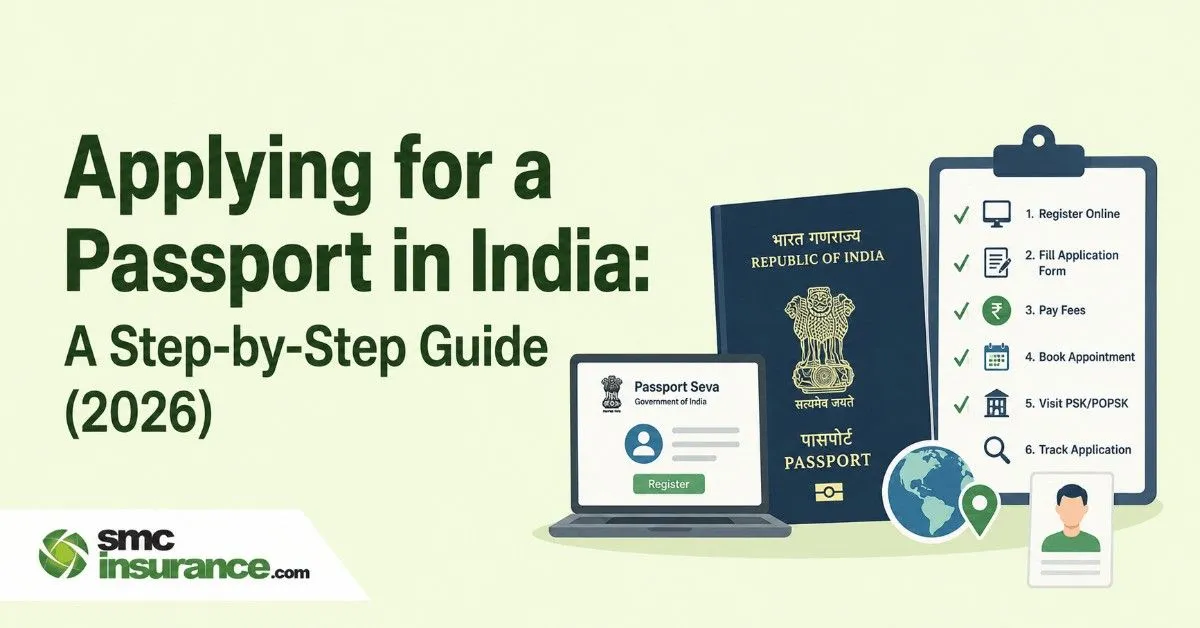
Nearly every applicant follows the same six steps, whether it's a fresh passport or a renewal:
- Register on the Passport Seva portal with your name, email and a password.
- Log in and fill the online application form, choosing a fresh application or reissue.
- Submit the online application, pay the applicable fee and schedule your appointment.
- Carry the required original documents and self-attested photocopies to your PSK/POPSK appointment.
- Book your PSK or POPSK appointment at a centre near you.
- Visit the PSK for document verification, biometrics and officer approval.
- Wait for police verification and dispatch of your passport.
Here's what that looks like in numbers right now.
What you're checking |
Normal (36-page) |
Tatkaal (36-page) |
Fresh adult passport (18+) |
Rs. 2,500 |
Rs. 5,000 |
Typical timeline |
Up to 30 working days for an ordinary fresh passport, excluding the police verification period |
Generally within the prescribed Tatkaal timeline, subject to eligibility, document verification and applicable police verification |
What's new in 2026 |
Fee revised 1 July 2026 (up from Rs. 1,500) |
e-Passport rollout is being implemented in phases. Applicants at Passport Offices technically enabled for e-Passport issuance will receive an e-Passport. Existing valid passports remain valid until expiry and don't need replacement solely because of the rollout. |
These are the government-notified fees for a standard 36-page adult passport effective 1 July 2026. Always confirm the live figure on the official Passport Seva portal before paying, since fees for 60-page booklets, minors and replacements differ and are covered in detail further below.
Who Needs to Apply and Which Type of Application Fits You
Before you touch the online form, figure out which category you actually fall into. Passport Seva treats fresh applications, reissues, minors and lost or damaged passports as different flows and picking the wrong one wastes an appointment slot.
-
Fresh Passport
This is for anyone who has never held an Indian passport before. You'll go through full document verification and, in most cases, post-issue police verification. -
Reissue or Renewal
If your passport is expiring, has expired, or you need to update details like your address or name, you apply for reissue rather than a fresh passport. For ordinary fresh and reissue applications, the applicable passport fee is generally the same for the corresponding booklet category. Certain replacement and special-service categories have separate fees. -
Minor's Passport
Children under 18 get a passport that's valid until they turn 18 or for five years, whichever comes first. Minor passport applications have additional requirements. Children below four years must carry a recent passport-size photograph measuring 4.5 cm × 3.5 cm with a white background. The exact documents and police-verification requirements depend on the child's age and circumstances. -
Lost or Damaged Passport
This follows a separate replacement process with its own, higher fee structure, since the government treats it differently from a routine renewal.
Once you know your category, the actual process is nearly identical across all four. Here's how it plays out end to end below.
Step-by-Step Passport Application Process
This is the part most guides rush through and it's exactly where applications go wrong. Take it one step at a time.
Step 1: Register on the Passport Seva Portal
Head to the official Passport Seva Online Portal and create an account with your name, a working email address and a password. You can also use the mPassport Seva app if you'd rather do this on your phone. Once registered, log in with your User ID, password and the captcha, then select "Apply for Fresh Passport/Reissue of Passport."
Step 2: Fill the Online Application Form
This is where accuracy matters more than speed. Every field, your name, date of birth, address, parents' names, needs to match your supporting documents exactly. A mismatched middle initial or an address that doesn't match your proof of residence is one of the most common reasons applications get delayed at the PSK counter. Use the "Save My Details" option as you go, so a dropped connection doesn't cost you the whole form.
Step 3: Upload Documents and Pay the Fee
Once your application is submitted, go to "View Saved/Submitted Applications," select it and click "Pay and Schedule Appointment." Choose your preferred PSK or POPSK, then pay online through UPI, a debit or credit card, or net banking. Even where supporting information or documents are submitted digitally, applicants should carry the required original documents and self-attested photocopies to the PSK/POPSK appointment. Your appointment gets confirmed the moment payment goes through and you should download the appointment receipt immediately since you'll need the Application Reference Number (ARN) it contains.
Step 4: Book Your PSK or POPSK Appointment
Slots at busy centres fill up fast, so it helps to have your travel dates in mind and book as early as your document readiness allows. POPSKs (Post Office Passport Seva Kendras) are often less crowded than the main PSKs in metro cities and they're worth checking if your city has one.
Step 5: Visit the PSK for Verification
Arrive at your allotted time with your originals, even if you've already submitted digital copies through DigiLocker. You'll move through three counters: document verification, biometrics (fingerprints and photograph) and a final review by the granting officer. Keep your Acknowledgement Receipt safe once you're done, since you'll need it if you want to track your application later.
Step 6: Police Verification and Dispatch
For most fresh applications, police verification happens after your PSK visit and before the passport is printed. For Tatkaal and Aadhaar-linked cases, it's typically done after the passport is already issued, which is exactly why Tatkaal is fast on paper but not always fast in practice. A police officer will visit your registered address to confirm your details and updates now come through the mPassport Police App, which has sped up how quickly reports get filed compared to the old paper process.
Documents Required for a Passport Application
Getting your documents right the first time saves you a second trip to the PSK. Here's what you need, organised by category.
Category |
Examples of Accepted Documents |
Proof of Identity |
Aadhaar and other prescribed photo-identity documents, subject to Passport Seva requirements |
Proof of Address |
Aadhaar, electricity/water/telephone bills, rent agreement, eligible photo bank passbook and other prescribed documents |
Proof of Date of Birth |
Birth certificate and other documents permitted under the applicable DOB rules |
Minors |
Documents vary according to the minor's age and circumstances, including parental consent documents where applicable |
Tatkaal |
Additional documents as specified in the current Tatkaal document list |
Aadhaar can be used as proof of photo identity and present address,
subject to successful validation. It should not be treated as a universal proof of date of birth; Passport Seva
has separate requirements for establishing DOB based on the applicant's date of birth.
For children born on or after 1 October 2023, a birth certificate is compulsory as proof of
date of birth — ensure the birth is registered and the certificate is available before
applying. Tatkaal applicants aged 18 or above generally need to submit three specified documents
from the Passport Seva list, along with the documents normally required for the application.
The current Passport Manual also provides for a Verification Certificate in the prescribed format in
applicable cases. Check the current Tatkaal document list and the Document Advisor before your appointment,
since requirements can vary by application category.
Passport Fees in 2026
This is the section that's changed the most this year, so treat any fee number you see elsewhere with caution if it isn't dated after 1 July 2026. The Ministry of External Affairs revised the Passports Rules through the Passports (Amendment) Rules, 2026 and the new schedule came into force on 1 July. It's the first fee change since 2012, so the jump feels sharp if you're used to the old numbers.
Category |
Booklet |
Normal Fee |
Tatkaal Fee (total) |
Adult (18+), fresh or reissue |
36 pages |
Rs. 2,500 |
Rs. 5,000 |
Adult (18+), fresh or reissue |
60 pages |
Rs. 3,500 |
Rs. 6,000 |
Minor (under 18), fresh |
36 pages |
Rs. 1,750 |
Rs. 4,250 |
Lost or damaged (adult) |
36 pages |
Rs. 5,000 |
Rs. 7,500 |
Lost or damaged (adult) |
60 pages |
Rs. 6,000 |
Rs. 8,500 |
Lost or damaged (minor) |
36 pages |
Rs. 4,250 |
Rs. 6,750 |
These are the government-notified rates effective 1 July 2026. Reissue costs the same as a fresh application in every category — there's no separate discounted renewal fee. Always cross-check the live fee on the official Passport Seva portal before paying, since sub-categories and miscellaneous certificate charges aren't all listed here. A standard fresh or reissued 36-page adult passport went from Rs. 1,500 to Rs. 2,500, a jump of roughly 67%. The 60-page version rose from Rs. 2,000 to Rs. 3,500. Minors and lost-or-damaged categories were hiked too and none of them were spared. One thing that didn't change: a 10% rebate on the basic passport fee is available for fresh passport applications by minors aged 8 years or below and senior citizens above 60 years. The rebate does not apply to reissue applications. If you applied and paid before 1 July 2026, you were charged under the old fee schedule regardless of when your appointment falls. If you're applying now, budget for the new numbers.
What Changed on 1 July 2026?
A standard fresh or reissued 36-page adult passport went from Rs. 1,500 to Rs. 2,500, a jump of roughly 67%. The 60-page version rose from Rs. 2,000 to Rs. 3,500. Minors and lost-or-damaged categories were hiked too and none of them were spared. One thing that didn't change is the 10% rebate on the basic passport fee is available for fresh passport applications by minors aged 8 years or below and senior citizens above 60 years. The rebate does not apply to reissue applications. That discount applies only to fresh applications, not to
reissues, so don't expect it if you're renewing.
If you applied and paid before 1 July 2026, you were charged under the old fee schedule regardless of when your
appointment falls. If you're applying now, budget for the new numbers.
Between the fee hike and the paperwork, getting your passport application right the first time saves both money and time. If you're already at the stage of applying, it's also worth thinking about what comes right after, because a passport alone doesn't protect you once you're actually abroad. That's where we usually see the gap. At SMC Insurance, we've had travellers come to us the week before departure realising their passport was sorted but their trip wasn't insured against a cancelled flight, a lost bag, or a medical emergency overseas.
It takes minutes to compare plans once your travel dates are fixed.
Tatkaal vs Normal: Which Should You Choose
Tatkaal has a reputation for being the fast lane and it usually is, but it doesn't guarantee what most people assume it does.
- When Tatkaal Actually Helps
Tatkaal genuinely speeds up two things: how quickly you can get an appointment slot and how fast your passport gets printed and dispatched once your PSK visit is done. If you need a booklet in a week for an emergency trip, Tatkaal is the only realistic option. - What Tatkaal Doesn't Guarantee
Here's the part that trips people up. Police verification for Tatkaal cases usually happens after the passport is already issued, not before. That means you get your passport fast, but if anything unusual turns up during the post-issue verification, it can still create complications later. Tatkaal speeds up the paperwork and the printing, not necessarily the background check. - The Cost-Speed Tradeoff
Tatkaal adds Rs. 2,500 to the applicable normal passport fee under the 2026 fee schedule. For most people planning a trip more than a month out, normal processing at 15 to 30 days is cheaper and just as reliable. Tatkaal earns its cost when your travel dates genuinely can't wait.
Why Your Passport Matters Beyond Travel
A passport gets you past immigration, but it isn't the only document that protects your trip once you're on the other side of it. Most countries won't ask to see proof of travel insurance at the border, but a growing number do, particularly across the Schengen area and a handful of destinations that have made it a visa condition. It's worth checking which countries currently require travel insurance before you assume it's optional for yours.
Even where it isn't mandatory, a passport only proves who you are, not that you can afford a hospital bill in a country where a single night's admission can run into lakhs. Do not assume that an Indian domestic health policy will cover medical expenses overseas. Whether overseas treatment is covered depends on the terms and geographical scope of the particular policy, so check your policy wording before travelling. If you're applying for a visa alongside your passport, it's also worth understanding your ECR and Non-ECR passport status, since it affects emigration clearance for certain
countries and is a separate check from the passport application itself.
Common Mistakes That Delay Applications
A handful of avoidable errors account for most of the delays we hear about.
- Mismatched Name Spelling
If your Aadhaar says "Mohammed" and your bank passbook says "Mohd," that inconsistency can hold up verification. Pick one spelling and get your documents aligned before you apply. - Address Proof That Doesn't Match Your Current Residence
If you've moved recently, you can provide acceptable proof of your present address. Passport Seva requires proof of the current address rather than proof for every previous address, but you must disclose all places where you lived during the previous year in the application. - Photo Specification Errors
For applications submitted at a PSK or POPSK, applicants generally do not need to carry a separate photograph because the photograph is captured during the appointment. However, minor applicants below four years of age must carry a recent 4.5 cm x 3.5 cm passport-size photograph with a white background.
Catching these before your PSK appointment, not during it, is the difference between a fifteen-minute visit and a rescheduled one.
What Happens After You Apply: Tracking and Police Verification
Once you've been through the PSK, your Application Reference Number becomes your main tool for tracking. You can check your status anytime on the Passport Seva portal using your ARN and you'll also get SMS updates as your file moves through each stage.
Police verification is the stage most people worry about, mainly because they don't know what to expect. An officer visits your registered address, usually within a few weeks of your PSK appointment for normal applications, to confirm you live where you say you do. Keep a copy of your acknowledgement receipt and any supporting documents handy in case they're asked for. The mPassport Police App has made this considerably faster than it used to be, since officers can file their reports digitally instead of routing paperwork through multiple desks.
2026 Rule Updates at a Glance
- Fee revision: Effective 1 July 2026, the first change in fourteen years. A 36-page adult passport now costs Rs. 2,500 normal, Rs. 5,000 Tatkaal.
- e-Passport rollout: e-Passport rollout is being implemented in phases. Applicants at Passport Offices that are technically enabled for e-Passport issuance will receive an e-Passport. Existing valid passports remain valid until their expiry and do not need to be replaced solely because of the e-Passport rollout.
- Aadhaar-linked fast-track: Aadhaar remains the fastest route through identity, address and date-of-birth verification in one document.
- Birth certificate mandate: Compulsory as date-of-birth proof for children born on or after 1 October 2023.
Wrapping Up
Applying for an Indian passport in 2026 comes down to the same six steps it always has: register, fill the form accurately, upload your documents, pay the current fee, get through your PSK appointment and wait for police verification. What's changed is the cost, up sharply since 1 July and the fact that every new passport now comes with an embedded chip whether you ask for it or not. The applicants who get through this fastest are the ones who match their documents to each other before they show up, not the ones who pay extra for Tatkaal and hope for the best. Once your passport is in hand, don't treat the trip planning as done. A passport gets you through immigration, but it won't cover a cancelled flight or a hospital bill overseas, so it's worth lining up your travel insurance around the same time you book your tickets.
Also Read:
Disclaimer:The information provided on this platform is intended for general awareness and educational purposes. While every effort is made to ensure accuracy, some details may change with policy updates, regulatory revisions, or insurer-specific modifications. Readers should verify current terms and conditions directly with relevant insurers or through professional consultation before making any decision.
All views and analyses presented are based on publicly available data, internal research, and other sources considered reliable at the time of writing. These do not constitute professional advice, recommendations, or guarantees of any product’s performance. Readers are encouraged to assess the information independently and seek qualified guidance suited to their individual requirements. Customers are advised to review official sales brochures, policy documents, and disclosures before proceeding with any purchase or commitment.
FAQs
Register on the Passport Seva portal, fill the application form with accurate personal details, upload your supporting documents, pay the fee online and book your PSK appointment. Visit the PSK for biometrics and document verification, then wait for police verification before your passport is dispatched.
You'll need proof of identity, proof of address and proof of date of birth. Aadhaar is accepted across all three categories, which makes it the simplest single document to submit, alongside PAN, voter ID, or a birth certificate depending on what you're proving.
A fresh or reissued 36-page adult passport costs Rs. 2,500 under normal processing and Rs. 5,000 under Tatkaal, effective from the fee revision on 1 July 2026. The 60-page version costs Rs. 3,500 normal and Rs. 6,000 Tatkaal.
Tatkaal costs roughly double and speeds up your appointment slot and dispatch, typically 1 to 3 days after your PSK visit. Normal processing takes 15 to 30 days. Police verification timelines can still vary under either category, since Tatkaal verification often happens after the passport is issued rather than before.
Normal applications typically take 15 to 30 days from submission to dispatch. Tatkaal applications are usually issued within 1 to 3 days of your PSK appointment, though this depends on your verification category and how quickly police clearance comes through.
If you were born on or after 1 October 2023, a birth certificate is mandatory as proof of date of birth. If you were born before that date, you can use alternatives like Aadhaar, PAN, or a 10th standard marksheet instead.
An e-Passport has an embedded RFID chip that stores your biometric data securely. e-Passports are being rolled out in phases across Passport Offices. If your Passport Office is enabled for e-Passport issuance, your passport will be issued in the e-Passport format. Existing valid passports remain valid until their expiry.
Aadhaar isn't strictly mandatory, but it's strongly recommended since it's accepted as proof of identity, address and date of birth in a single document, which speeds up both your online application and your Aadhaar-linked fast-track verification.
The process mirrors the adult application, but you'll need the child's birth certificate, Annexure D as parental consent and self-attested copies of both parents' passports. A newborn can apply as soon as the birth certificate is issued, using a thumb impression instead of a signature.
A passport alone doesn't cover medical emergencies, cancelled flights, or lost baggage overseas. Several countries, particularly across the Schengen region, require proof of travel insurance as a visa condition and it's worth arranging cover around the same time you finalise your passport and travel dates.


