


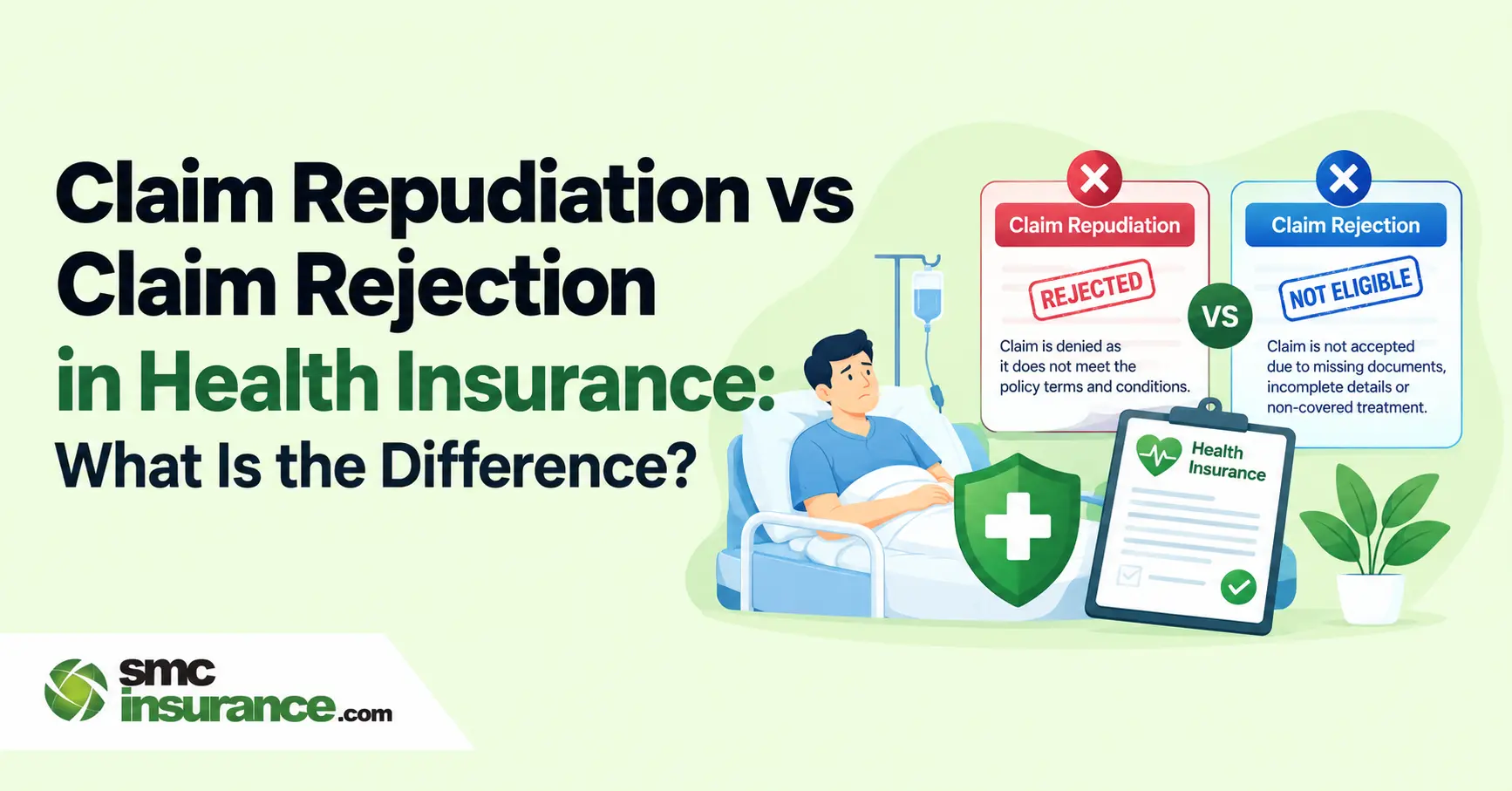

Claim rejection usually means the insurer stopped at a procedural or eligibility gap, such as missing documents or a wrong policy number and many of these can be corrected and resubmitted. Claim repudiation is a formal denial under the policy terms after the insurer has examined the claim, typically for non-disclosure or a treatment the policy excludes. The two labels are industry habit rather than separate legal procedures, so go by the reason and the policy clause quoted in your letter. If you disagree with the insurer's decision, first raise a written complaint with its grievance redressal officer. If the response is unsatisfactory or you receive no reply within 30 days, you may approach the Insurance Ombudsman. This free grievance mechanism handles eligible insurance disputes involving compensation of up to Rs. 50 lakh, including applicable expenses. Complaints must generally be filed within one year of the relevant insurer's decision or the expiry of the response period.
Table of Contents
- Claim Repudiation vs Claim Rejection in Health Insurance
- Claim Rejected vs Repudiated: How to Read the Reason on Your Letter
- Health Insurance Claim Rejection Rate in India
- What Do the Latest Government Figures Reveal About Health Insurance Claims?
- Can You Challenge a Partially Settled Health Insurance Claim?
- Can an Insurer Repudiate Your Claim After Five Years? The Moratorium Period in Health Insurance Explained
- How to Avoid Claim Repudiation and Claim Rejection in Health Insurance
- Claim Repudiation vs Claim Rejection in Health Insurance: What to Do Next, Step by Step
The insurer’s email arrives after you have already dealt with the hospital, and one word in it matters more than the rest: rejected, or sometimes repudiated. Most people treat the two as the same, and for your wallet they are, since neither pays a rupee. What changes is your next move. Knowing the difference between claim repudiation vs claim rejection in health insurance tells you whether you are fixing a missing discharge summary this week or preparing a formal dispute and the stakes are real. Because insurers repudiated about 36.4 lakh of the 325.72 lakh health claims they received in FY2023-24. If you are still comparing health insurance coverage options, the answers below also show which policy terms decide whether a claim gets paid. By the end you will know how to read the letter in your hands, and which step to take on day one.
Claim Repudiation vs Claim Rejection in Health Insurance
Insurers and most explainers draw the line in roughly the same place, so it helps to start with the working definitions before looking at where they blur.
- What claim rejection usually means A health insurance claim may be described as rejected when the insurer declines to process or approve it. This could happen because of incomplete documentation, incorrect claim details or concerns about eligibility under the policy. Some issues can be resolved by submitting additional information, while others may require a formal challenge. Since insurers do not always use rejection and repudiation in exactly the same way, policyholders should examine the stated reason rather than relying only on the terminology. Typical triggers are a missing discharge summary or a hospitalisation reported after the deadline in your policy wording. The claim itself may be perfectly valid, which is why a rejection can often be reversed by correcting the file.
- What claim repudiation usually means Repudiation is the formal no. The insurer has examined the claim against the policy contract and concluded that it is not payable, so the objection sits in the contract and not in the paperwork. Common grounds include a condition you did not disclose when buying the policy, treatment inside a waiting period, a procedure on the exclusion list, an exhausted sum insured and documents the insurer believes were fabricated. Sending the same claim again with a tidier file achieves nothing here; you need new evidence or a better reading of the wording. And here is the bit most explainers skip. These labels are industry habits and not two separate legal procedures. IRDAI's published data counts denied claims as repudiated and tracks part-payments separately as disallowed, so there is no separate line for rejections at all. Even published explainers disagree on where some reasons belong, with a lapsed policy filed under rejection in one and under repudiation in another. The word at the top of your letter therefore tells you less than the reason written beneath it.
And here is the bit most explainers skip. These labels are industry habits and not two separate legal procedures. IRDAI's published data counts denied claims as repudiated and tracks part-payments separately as disallowed, so there is no separate line for rejections at all. Even published explainers disagree on where some reasons belong, with a lapsed policy filed under rejection in one and under repudiation in another. The word at the top of your letter therefore tells you less than the reason written beneath it.
Claim Rejected vs Repudiated: How to Read the Reason on Your Letter
Because the label can mislead, the table below sorts the reasons insurers most often give by what they mean for you in practice.
Reason on the letter |
Label you will usually see |
Can it be fixed? |
Your first move |
Missing bills or discharge summary, or a wrong policy number or name | Rejection | Yes | Send the corrected set in one email and get an acknowledgement |
Hospitalisation reported or claim filed after the deadline | Rejection | Sometimes | Explain the delay in writing, with hospital records as proof |
Policy lapsed on the admission date | Rejection or repudiation, depending on the insurer | Rarely | Check the grace period in your policy and your premium payment date |
Treatment inside a waiting period | Repudiation | Rarely | Verify the waiting period dates on your policy schedule |
Treatment on the exclusion list | Repudiation | Rarely | Ask for the clause and test it against the actual diagnosis |
Pre-existing condition not disclosed | Repudiation | Depends | Gather past records and count how many months of continuous cover you have |
Sum insured exhausted | Non-payment or partial payment | Usually no, unless additional cover is available | Check whether your policy has a restoration benefit or any other available coverage |
Claim amount falls within the deductible | Non-payment under the deductible provision | Usually no, unless the deductible was applied incorrectly | Verify the deductible amount and check whether another policy can cover the expense |
Documents suspected to be fabricated | Repudiation | Rarely | Take legal advice before you reply |
Cashless request declined at the hospital | Neither, strictly | Yes | Pay the bill and file a reimbursement claim |
Note: Labels differ across insurers and the 'can it be fixed' column is a rule of thumb and not a promise. Your policy wording and the insurer's letter decide each case.
The last row deserves a second look. A hospital's cashless request being declined is not a decision on your claim, because the insurer has only refused to pay the hospital directly at that moment. You can usually settle the bill yourself and file for reimbursement afterwards. IRDAI's 2024 master circular expects insurers to decide a cashless request within one hour and give final authorisation within three hours of the hospital's discharge request, so a vague or delayed refusal is worth questioning. Our guide to cashless health insurance explains how pre-authorisation works.
Health Insurance Claim Rejection Rate in India
The scale of the problem is easier to judge once you see the official figures.
Official figures indicate an improvement in the proportion of health insurance claims paid in recent years. According to information released by the Ministry of Finance, the claims-paid ratio by number increased from 82.46% in FY2023–24 to 87.50% in FY2024–25. However, a higher industry-wide settlement ratio does not guarantee approval of every claim, as individual outcomes continue to depend on coverage conditions, exclusions and the evidence submitted.
The following year looked better on paper. According to IRDAI's Annual Report 2024–25, general and health insurers settled approximately 3.26 crore health insurance claims, paying a combined Rs. 94,248 crore. The average amount paid per settled claim was Rs. 28,910. Of the total claims registered in insurers' records, approximately 87% were settled, 8% were repudiated and 5% remained pending as of 31 March 2025. These figures provide a useful picture of industry-wide claim outcomes, although an individual policyholder's experience will depend on the insurer, policy terms and circumstances of the claim.
Part-payment is the denial nobody calls a denial
Some of the most common disappointments never show up as a rejection or a repudiation at all. IRDAI tracks partial deductions separately as disallowance and the Ministry's reply links it to items such as non-medical expenses. Room rent caps and sub-limits can also trim a bill, depending on your plan. If a settlement arrives short, ask for the itemised deductions with the policy clause against each one, because every line is either backed by the wording or it is not.
What Do the Latest Government Figures Reveal About Health Insurance Claims?
The latest official figures show that health insurance claim settlement has improved, although deductions and denials remain important concerns for policyholders. According to information released by the Ministry of Finance, the claims-paid ratio by number increased from 82.46% in FY2023–24 to 87.50% in FY2024–25.
The Ministry also reported that 1,37,361 grievances relating to general and health insurance were registered on IRDAI's Bima Bharosa portal during FY2024–25. Of these, 1,27,755 complaints, representing approximately 93%, were disposed of during the same financial year.
These figures highlight why policyholders should understand the difference between a claim being fully settled, partially paid or denied. Even when a claim is approved, deductions arising from co-payments, deductibles, room rent restrictions and other policy conditions can affect the final payout.
Can You Challenge a Partially Settled Health Insurance Claim?
Yes, a health insurance claim does not need to be completely rejected before you can question the insurer's decision. For instance, an insurer may approve hospitalisation expenses but deduct certain amounts because of room rent restrictions, co-payments, deductibles or other policy conditions. If you disagree with these deductions, request an itemised settlement statement and identify the policy provision supporting each reduction.
Where the deductions appear inconsistent with your coverage, you can submit a written grievance to the insurer. If the issue remains unresolved, eligible disputes involving partial repudiation can also be taken to the Insurance Ombudsman. The important distinction is that a partial payment does not necessarily mean the insurer's calculation is correct or beyond challenge.
Can an Insurer Repudiate Your Claim After Five Years? The Moratorium Period in Health Insurance Explained
One rule protects long-standing policyholders more than any other and many buyers still do not know it exists.
IRDAI's Master Circular on health insurance business, dated 29 May 2024, cut the moratorium period from eight years to five. IRDAI reduced the health insurance moratorium period to 60 continuous months under its 2024 framework. Once the applicable period has been completed, insurers generally cannot contest a policy or claim on grounds of earlier non-disclosure or misrepresentation, except in cases involving established fraud. Continuous coverage, including eligible portability and migration periods, is relevant when calculating the moratorium. However, the protection does not eliminate contractual exclusions, deductibles, co-payments or other applicable coverage restrictions.
Two limits matter. The moratorium does not switch off exclusions or waiting periods, so a treatment the policy never covered stays uncovered in year six. It also depends on continuous cover, so a gap at renewal can break the chain and if you are moving insurers you should port without a break, as our guide to health insurance portability explains.
The other date to know is the waiting period for pre-existing diseases. Since April 2024 the cap is three years, down from four and a pre-existing condition is generally one diagnosed or treated in the 36 months before you bought the policy. Your exact dates sit on the policy schedule and our explainer on waiting periods in health insurance shows how they interact with a claim.
How to Avoid Claim Repudiation and Claim Rejection in Health Insurance
Most denials are decided months before the hospital visit, at the proposal form and in how the policy is used, so that is where the effort pays off.
Disclose everything on the proposal form, including the small things. A blood pressure tablet taken for five years feels too minor to mention, yet it is exactly the kind of detail a claims reviewer can find in hospital records. A disclosed condition might bring a waiting period or a higher premium, whereas an undisclosed one can cost you the whole claim later.
Treat the policy schedule as a calendar. Note the date each waiting period ends along with the renewal date and put premium payment on auto-renewal so a lapse never hands the insurer a clean reason to refuse. When a hospitalisation is planned, ask for pre-authorisation before admission and for an emergency inform the insurer or its TPA within the window your wording allows.
Keep a claim file from the first day, with every bill, prescription, investigation report and the discharge summary, plus copies. Then check your sum insured against current hospital costs in your city, because a policy that runs out mid-treatment produces a repudiation that no paperwork can fix.
Reading a policy for the first time after a claim is denied is the expensive way to learn what it says. Our advisors at SMC Insurance can walk you through the waiting periods and exclusions in your current plan, or compare it with alternatives, at SMC Insurance.
Claim Repudiation vs Claim Rejection in Health Insurance: What to Do Next, Step by Step
Here is the order of play, which matters because the early steps are cheap and the late ones are slow.
- Get the reason in writing, with the clause
A denial letter should spell out why, with reference to the policy terms and a vague 'not payable' is reason enough to write back and ask for the clause. Under IRDAI's 2024 health master circular a claim cannot be turned down without approval from the insurer's three-member Claims Review Committee, so the decision is not one executive's call. - Check it against your policy schedule and wording
Compare the dates, the waiting period and the exclusion cited with what your own documents say. A wrong date, or a clause that does not match your treatment, is the strongest ground you can have. - If it is a rejection, fix it and resubmit quickly
Send the missing or corrected documents in a single email, ask for an acknowledgement and keep copies. Reimbursement claims are meant to be settled within 15 days of submission under the September 2024 master circular and a delay attracts interest at 2 per cent above the bank rate. Since the clock runs from your last necessary document, a complete resubmission is what starts it. - If it is a repudiation, escalate with evidence
Write to the insurer's grievance redressal officer, attaching earlier medical records, the policy schedule and your reading of the clause. The 2024 master circular expects insurers to resolve complaints within 14 days, with reasons tied to the policy terms. - Go outside the insurer if you must
When the reply is unsatisfactory or does not come, lodge the complaint on IRDAI's Bima Bharosa portal or approach the Insurance Ombudsman, which is usually the quickest route for an individual policyholder.
Step |
Where |
When you can use it |
Key limit or timeline |
Insurer's claims team | Written reply with documents | Straight after a rejection | Reimbursement to be settled within 15 days of submission |
Grievance Redressal Officer | Insurer's grievance email or portal | After the decision, in writing | Insurer should resolve within 14 days |
Bima Bharosa | IRDAI's complaint portal | If the insurer's reply does not resolve it | Regulator-run portal for escalating an unresolved complaint |
Insurance Ombudsman | Council for Insurance Ombudsmen offices | Insurer rejects the complaint, you are not satisfied, or 30 days pass with no reply | Individual policies, claim value up to Rs. 30 lakh, file within one year, free to approach |
Consumer commission or court | Through a lawyer | Claims above the Ombudsman limit, or if you prefer a formal route | Fees and timelines depend on the forum |
Note: Limits and timelines are as published on IRDAI's policyholder portal and in the 2024 master circulars. The Ombudsman's award binds the insurer, which has 30 days to comply, though insurers can appeal within that window. Confirm the current limit with the Council for Insurance Ombudsmen before filing.
The route is well used. According to the Council for Insurance Ombudsmen's annual report for FY2024-25, its 17 offices received 53,184 complaints, around 64 per cent of them on health insurance and roughly 71 per cent were resolved in the policyholder's favour. A repudiated claim can also be reopened, but through a representation with new evidence or a reasoned challenge, since an unchanged resubmission is likely to meet the same answer.
Summing Up,
A rejection and a repudiation both leave the bill with you, yet they point in different directions. Rejection is usually about the file and a corrected resubmission often settles it. Repudiation is about the contract and it calls for evidence, a clause-by-clause reading and, if needed, a formal complaint. Because insurers and even published explainers use the two words loosely, the reason in the letter is what you should act on. The 60-month moratorium and the three-year cap on pre-existing disease waiting periods give long-standing policyholders real protection, but only when the proposal was honest and the cover never lapsed. So disclose fully, diarise your waiting periods and keep the claim file ready before you ever need it. The next time that email arrives, read the reason before you read the label and escalate in the order set out above. If you are unsure whether your current plan would hold up, our advisors at SMC Insurance are happy to review it with you.
Disclaimer: The information provided on this platform is intended for general awareness and educational purposes. While every effort is made to ensure accuracy, some details may change with policy updates, regulatory revisions, or insurer-specific modifications. Readers should verify current terms and conditions directly with relevant insurers or through professional consultation before making any decision.
All views and analyses presented are based on publicly available data, internal research and other sources considered reliable at the time of writing. These do not constitute professional advice, recommendations, or guarantees of any product’s performance. Readers are encouraged to assess the information independently and seek qualified guidance suited to their individual requirements. Customers are advised to review official sales brochures, policy documents and disclosures before proceeding with any purchase or commitment.
FAQs
Rejection normally means the insurer declined to process the claim because of a procedural or eligibility gap, such as missing documents or a wrong policy number and it can often be corrected. Repudiation is a formal denial under the policy terms after the claim has been examined, for example for non-disclosure or an excluded treatment. Insurers use the words loosely, though, so rely on the reason and clause in your letter rather than the label.
Usually yes, if the reason is something you can correct, such as a missing document or a mismatched detail. Reply within the deadline in your policy wording, send everything in one go and ask for a written acknowledgement. If the reason is a waiting period or an exclusion, a resubmission will not change the outcome and you should challenge the decision through the grievance route instead.
Ask for the reason with the policy clause, then write to the insurer's grievance redressal officer with your evidence. If the reply is unsatisfactory or does not arrive within 30 days, you can approach the Insurance Ombudsman for individual policies where the claim value is up to Rs. 30 lakh, within one year. There is no charge, the award binds the insurer and it has 30 days to comply. Larger claims go to the consumer commission or the courts.
Not for non-disclosure or misrepresentation once you complete 60 continuous months of coverage, unless the insurer establishes fraud. That is the moratorium rule in IRDAI's 2024 master circular. It does not override exclusions or waiting periods written into your policy, so a treatment the plan never covered stays uncovered. Continuity matters too, because the 60 months count continuous cover, including time under a ported policy.
No, a refused cashless request means the insurer will not pay the hospital directly at that moment, sometimes because it wants more information and your claim has not been finally decided. You can generally pay the bill and file for reimbursement with the same documents. IRDAI expects a cashless decision within one hour and final discharge authorisation within three hours, so ask the hospital desk for the reason in writing.
Under IRDAI's September 2024 master circular, reimbursement claims should be settled within 15 days of submission, while a cashless request should be decided within one hour with final authorisation within three hours of the discharge request. Claims that need an investigation can take longer. If the insurer misses its deadline it owes interest at 2 per cent above the bank rate, so keep your submission date and acknowledgement as proof of any delay.
IRDAI's master circular says a health policy is renewable and cannot be refused merely because you made a claim in earlier years. The exceptions are established fraud, non-disclosure and misrepresentation. A repudiation for non-disclosure is therefore the one that can put your renewal in question, so deal with it promptly and keep your answers consistent across the proposal, the claim and any grievance.


