


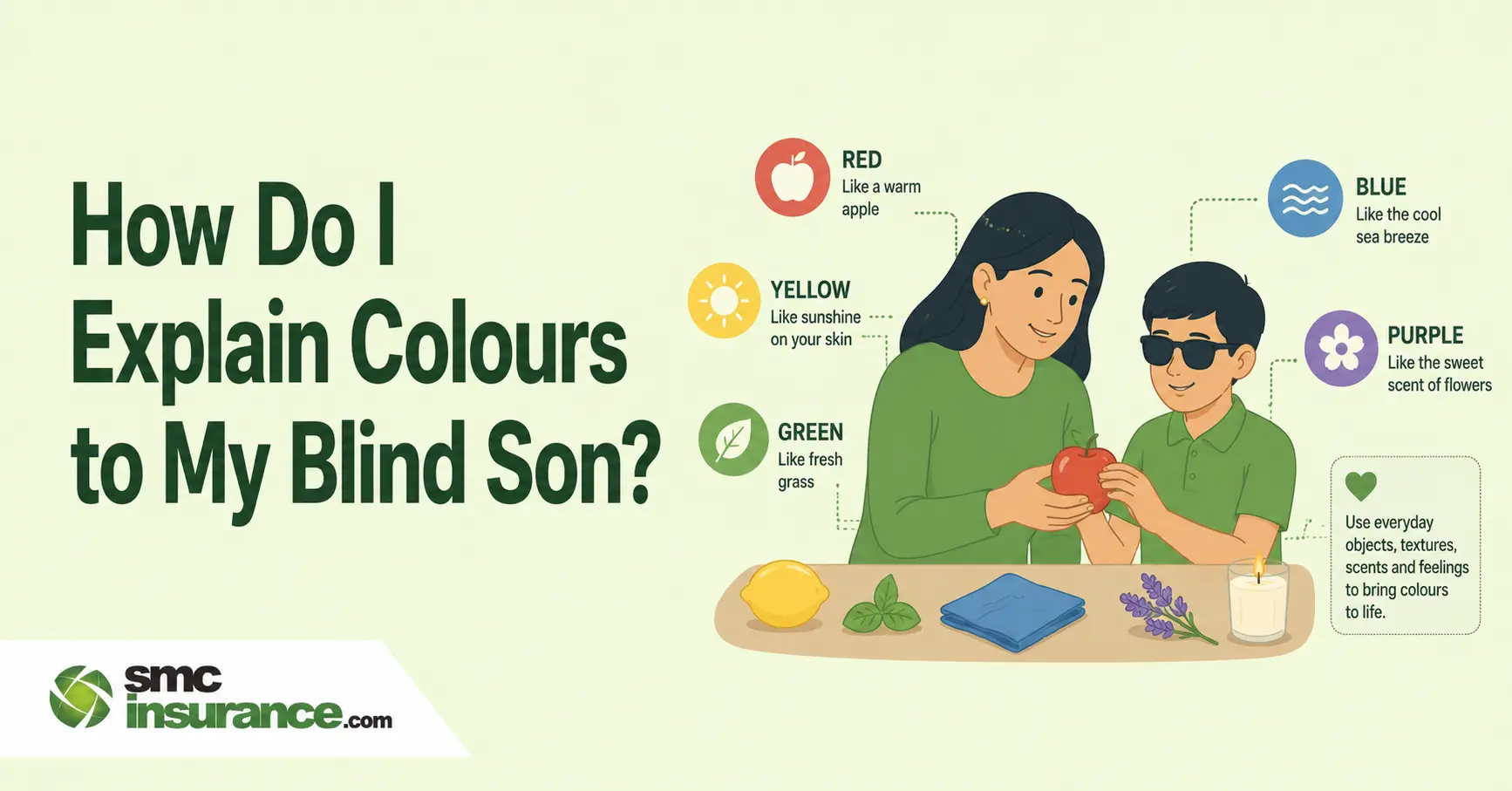

A blind child can understand colour, just not through sight. Explain colours to a blind child by linking each one to something he already experiences: temperature, texture, sound, smell and emotion. Say "red feels hot, like standing near a fire" rather than "red looks like an apple." Keep using colour words in everyday conversation instead of avoiding them and let his questions decide how much detail you give. There is no single correct explanation, only the one that makes sense to your son.
Your son points toward the sky during a car ride and asks what blue actually feels like, or why everyone gasps at a rainbow he will never see. You go quiet for a second, hunting for words that will not turn into a science lecture on wavelengths. Most parents raising a blind child hit this exact moment sooner or later, usually without warning, often somewhere as ordinary as breakfast or the walk to school.
The good news is that learning how to explain colours to a blind child is far simpler than it feels in that first flustered pause. Colour becomes real for him the same way almost everything else does, through touch, sound, smell, temperature and the daily habit of hearing you describe the world out loud, one object at a time. By the end of this guide, you will have a clear, age-appropriate way to talk about colour with your son that never leaves him standing outside the conversation.
Table of Contents
- Can a Blind Child Understand Colours?
- The Best Way to Explain Colours to a Blind Child
- 7 Simple Ways to Teach Colours
- How to Explain Individual Colours to a Blind Child
- What If My Son Asks, "What Does Blue Look Like?"
- Should You Avoid Talking About Colours With a Blind Child?
- How to Teach Colours at Different Ages
- Common Mistakes Parents Should Avoid
- When Should Parents Talk to a Doctor or Eye Specialist?
- How Health Insurance Can Support Children's Eye Care
Can a Blind Child Understand Colours?
Yes, in the sense that actually matters to him. A sighted person understands colour as light hitting the retina, but a child who is blind, especially one blind from birth, can still build a working, useful idea of colour as information. He learns that fire trucks are red because red signals urgency, that leaves are green because green means something is growing and that traffic lights use colour to tell drivers what to do next. None of that requires ever having seen a colour. It only requires hearing the word attached to the object, again and again, inside ordinary conversation.
Once you accept that colour understanding does not depend on eyesight, the rest of this guide becomes a lot less intimidating.
The Best Way to Explain Colours to a Blind Child
The single most useful shift you can make is to stop reaching for visual comparisons. Telling a child who has never seen anything that "blue is like the sky" explains nothing, because the sky itself is an abstract idea to him. What works instead is anchoring each colour to a sense he already relies on every day: how something feels against his skin, what it sounds like, whether it smells sweet or sharp and how it makes him feel.
Think of colour, for your son, less like a picture and more like a small bundle of associations. Red is not a shade, it is warmth, urgency and the smell of strawberries. Blue is not a wavelength, it is coolness, calm and the sound of water. Build these bundles patiently and colour stops being a mystery he is locked out of.
7 Simple Ways to Teach Colours
None of these methods needs special equipment or training. Most use things you already have at home and you can mix and match depending on what catches your son's interest that day.
- Connect Colours With Familiar Objects.
Start with objects your son already knows well through touch or taste. Apples are red, bananas are yellow, spinach is green. This will not mean much on its own, but it gives him a mental filing system to attach richer sensory detail to later. - Use Touch and Texture.
Texture is one of the strongest teaching tools you have. Rough tree bark can stand in for brown, smooth glass for blue, soft cotton for white. Keep a small basket of textured objects at home and revisit it often so the associations stick. - Use Temperature.
Temperature works because your son feels it constantly, unlike colour, which he cannot. Red and orange can sit at the warm end of the scale, blue and white at the cool end and green somewhere fresh and in between. Over time he will start predicting temperature associations on his own, which is a good sign the concept has landed. - Use Sounds and Music.
Sound gives colour a personality. A loud trumpet blast can represent red, gentle wind chimes can represent green and the low rumble of a drum can stand in for black. You do not need to be musical yourself. Everyday household sounds work just as well as instruments. - Use Smell and Taste.
Smell and taste create some of the most lasting memories of all, which makes them ideal for teaching. Strawberries and cherries for red, lemons and bananas for yellow, mint and fresh grass for green. Cooking together is a natural opportunity to fold this in without it feeling like a lesson. - Explain Colour Through Emotions and Culture.
Colours carry emotional and cultural weight that goes well beyond how they look. In India, red often marks weddings and celebrations, saffron carries religious and national significance and white can signal mourning in some communities and simplicity in others. Sharing these associations helps your son follow conversations at festivals, in school and among relatives, even without seeing a single colour himself. - Use Colour Naturally in Everyday Conversation.
This is the habit that ties every other method together. Mention colour the way you would with any sighted child: "here is your blue water bottle," or "your uniform has a green stripe on it." Repetition inside normal conversation does more for long-term understanding than any single structured lesson ever will.
Here is a quick reference you can adapt using objects your son already knows well.
Colour |
Texture |
Temperature |
Sound |
Red | Rough brick or bark | Hot, like a fire | Loud, like a trumpet |
Orange | Ridged orange peel | Warm, afternoon sun | Bright, like a bell |
Yellow | Warm, dry sand | Warm, like sunlight | Cheerful, birdsong |
Green | Soft leaves or grass | Fresh, after rain | Gentle, rustling wind |
Blue | Smooth glass or water | Cool, like a stream | Soft, ocean waves |
Brown | Tree bark, soil | Warm, earthy | Low, a deep drum |
Black | Smooth stone | Warm after sun, cool in shade | Deep, a low drum |
White | Cotton, fresh snow | Cold | Quiet, hushed |
Note: These pairings are starting points, not rules. Swap in whatever textures, sounds and objects are already part of your son's daily life.
How to Explain Individual Colours to a Blind Child
A few worked examples make this easier to apply straightaway:
- For red, you might say it feels hot like standing near a stove, tastes like a ripe strawberry and shows up on fire engines and stop signs because it grabs attention fast.
- For blue, describe it as cool like water from a tap, calm like the sound of waves and common on school uniforms and the sky people talk about overhead.
- Yellow can be warm sunlight on skin, the taste of a banana and the colour of happiness in most conversations your son will overhear.
- Green works well as fresh grass underfoot, the smell of mint and a word people use for anything growing, from trees to vegetables.
- Black and white are often easiest explained as opposites: black as a warm, smooth stone or a deep drumbeat, white as fresh, cold cotton or a hushed, quiet sound.

What If My Son Asks, "What Does Blue Look Like?"
Answer honestly rather than dodging the question. You can say that blue is something sighted people experience through their eyes and that you cannot fully describe it any more than you could describe a smell using only sounds. What you can do is share what blue represents to most people: calm, coolness, the ocean, a clear sky on a good day.
It helps to know that even sighted adults often fumble badly when asked to describe colour in plain words, stumbling over comparisons that do not quite land. Sharing that struggle honestly with your son shows him he is not missing some simple, obvious answer that everyone else has and he does not. He is missing an experience tied to eyes, not a piece of information he is entitled to but has been denied.
Should You Avoid Talking About Colours With a Blind Child?
No and avoiding the topic usually does more harm than good. A child who has never had sight does not grieve the absence of colour the way a newly sighted-then-blind adult might, but he is almost always curious about it, because everyone around him keeps mentioning it. Shutting the conversation down, even gently, teaches him that colour is a subject to feel awkward about rather than one more thing he can learn like any other.
Keep the tone light and matter-of-fact. Answer what you can, admit what you cannot fully explain and let his curiosity set the pace.
How to Teach Colours at Different Ages
What makes sense for a toddler will feel babyish to a ten-year-old, so it helps to adjust your approach as your son grows.
Age Group |
What to Focus On |
Example Activity |
0 to 2 years | Simple sensory exposure, no formal teaching needed | Narrate colours casually while dressing, feeding or bathing him |
3 to 5 years | Primary colours through touch, smell and taste | Build a colour box: red with cotton dipped in strawberry scent, warm cloth and a rough brick chip |
6 to 9 years | Practical, safety-related uses of colour | Explain traffic lights, matching school uniforms and labelling his own clothes and stationery |
10 years and up | Nuance, culture and social use of colour | Discuss festival colours, fashion pairing and colour-identifying apps or assistive tools |
Note: Treat these age bands as mere guidance. Move at whatever pace suits your son's own curiosity and comfort.
Common Mistakes Parents Should Avoid
A few habits tend to slow down learning more than parents realise, so it helps to watch out for them.
- Leaning only on visual comparisons, such as "blue is like the sky," which means little to a child who has never seen the sky.
- Trying to teach every colour and every shade at once instead of building understanding gradually.
- Ignoring regional or cultural colour meanings that your son will encounter at school, festivals and family events.
- Assuming there is one perfect explanation for each colour, when different senses and comparisons work for different children.
- Avoiding the topic altogether out of a fear of upsetting him, which usually causes more discomfort than the questions themselves.
Watch for these patterns and adjust as you go. There is no need to get every conversation right; consistency matters far more than perfection.
When Should Parents Talk to a Doctor or Eye Specialist?
Most parents already know their child is blind by the time colour conversations come up, but it is worth staying alert to signs that need a specialist's attention regardless. These include a white or grey reflection in the pupil in photographs, no response to bright light, unusual eye movements, or a lack of eye contact well past the age when it is typically expected.
Babies born premature or with low birth weight need a separate layer of caution. Retinopathy of prematurity, a condition affecting the blood vessels in the retina, is becoming one of India's leading causes of preventable childhood blindness as more premature infants survive thanks to better neonatal care. Regular screening in the weeks after birth and quick action if a doctor flags a concern, makes a real difference to outcomes.
For congenital cataract, timing matters enormously. Doctors generally recommend surgery within the first four months of life for the best chance at useful vision, since delays tend to worsen the long-term outcome. If your child has already been diagnosed with a condition like this, or if anything about their eyes worries you, a paediatric ophthalmologist should be your first call, not a search engine.
How Health Insurance Can Support Children's Eye Care
Eye conditions in children are rarely a one-time expense. Diagnosis, surgery, follow-up visits and sometimes years of monitoring add up quickly, which is where a well-chosen health insurance plan makes a real difference to a family's finances.
Under IRDAI norms, standard health insurance plans in India are required to cover internal congenital diseases, including conditions like congenital cataract and congenital glaucoma, once the applicable waiting period is over. This waiting period usually runs about two years if the condition is diagnosed after you buy the policy and can stretch to four policy renewals if it was diagnosed before the policy started. External congenital conditions are typically treated differently and often sit outside standard cover, so it is worth reading the policy wording carefully or asking an advisor before you buy, particularly when you are comparing a children's health insurance plan.
Cataract surgery itself is usually classified as a day care procedure and does not require an overnight hospital stay, with costs generally ranging from about ₹15,000 to ₹40,000 per eye depending on the hospital and technique used. Once the waiting period has passed, this is typically covered up to your sum insured under most standard policies. If you want a closer look at how this works in practice, our article on whether cataract surgery is covered by health insurance breaks down the waiting periods and sub-limits insurers commonly apply.
What often catches parents off guard is what standard policies tend to leave out. Routine eye check-ups, spectacles, contact lenses and correction for refractive errors are commonly excluded from base health plans in India. In our experience advising families at SMC, this is one of the most frequent surprises parents run into mid-claim, so we usually suggest asking specifically about an OPD add-on or rider while comparing plans, since this can cover consultations and diagnostic tests that the base policy will not touch.
Before you buy or renew a family or child health plan,
it helps to know exactly what you are signing up for. Our
guide on what to check before buying health insurance walks through the questions worth
asking an insurer before you commit.
Not sure what your current policy actually covers for your child's eye care? Do not wait for a claim to find out the hard way. Compare child health insurance plans and OPD riders and get a clear answer before you need one, at SMC Insurance.
Wrapping Up
Explaining colour to a blind son is less about finding one perfect sentence and more about building a habit. Keep colour words in your everyday conversation, lean on touch, temperature, sound, smell and emotion instead of visual comparisons and let his questions guide how deep you go.
There will be moments, like when he asks what blue actually looks like, where the honest answer is that you cannot fully translate a sighted experience into words. That is fine. What he needs from you is not a perfect definition, but consistency, patience and the sense that colour is just one more part of the world you are both figuring out together, not a locked door he is standing outside of.
Disclaimer: The information provided on this platform is intended for general awareness and educational purposes. While every effort is made to ensure accuracy, some details may change with policy updates, regulatory revisions, or insurer-specific modifications. Readers should verify current terms and conditions directly with relevant insurers or through professional consultation before making any decision.
All views and analyses presented are based on publicly available data, internal research, and other sources considered reliable at the time of writing. These do not constitute professional advice, recommendations, or guarantees of any product’s performance. Readers are encouraged to assess the information independently and seek qualified guidance suited to their individual requirements. Customers are advised to review official sales brochures, policy documents, and disclosures before proceeding with any purchase or commitment.
FAQs
Yes, while a blind child cannot see colour, he can understand it as a concept tied to texture, temperature, sound, smell and emotion. Parents who explain colours to a blind child consistently, using senses he already relies on, usually find he builds a genuinely useful understanding of colour over time.
Describe red through what it feels, sounds and tastes like: hot like standing near a fire, loud like a trumpet and sweet like a ripe strawberry. Point out where red shows up in daily life, such as stop signs and fire engines, so the word carries real meaning beyond the sensory comparison.
Lean on coolness and calm. Blue can feel cool like water from a tap, sound gentle like ocean waves and represent a relaxed, peaceful mood. Be honest that you cannot fully describe the visual experience itself and focus instead on what blue represents to the people around him.
Keep it simple and sensory. Narrate colours casually during everyday routines like dressing or feeding and use a small basket of textured, scented objects tied to specific colours. Formal lessons are not necessary at this age; repetition inside normal conversation works best.
Yes, always. Avoiding the topic tends to make a child feel more excluded, not less. Most blind children are simply curious about colour because everyone around them keeps mentioning it and answering openly helps them feel part of the conversation.
Yes, blind people, including those blind from birth, can understand colour as a concept even without ever seeing it. They build this understanding through language, sensory associations and cultural context, much like they understand many other ideas they cannot directly perceive.
Someone born blind typically understands colour through repeated exposure to the word in context, paired with sensory associations like texture, temperature, sound and smell, along with the emotional and cultural meanings colour carries in daily life and conversation.
Be honest that colour is a visual experience you cannot fully translate into words, then pivot to what that colour represents: a feeling, a temperature, a sound, or where it commonly shows up. Children generally respond better to an honest "I cannot fully describe it, but here is what it means" than to a vague dodge.
Use the senses your child already relies on: touch and texture, temperature, sound, smell and taste and emotional or cultural associations. Combine two or three of these for each colour and mention colour naturally in everyday conversation rather than treating it as a separate lesson.
Yes, particularly if this is a new development rather than a lifelong condition, or if you notice other signs like unusual eye movements, no response to light, or a white or grey reflection in the pupil. A paediatric ophthalmologist can identify the underlying cause and advise on treatment where one exists.
It depends on the condition and the policy. Internal congenital eye conditions like congenital cataract are generally covered under standard health plans once the waiting period is over and cataract surgery is usually covered as a day care procedure. Routine eye exams, spectacles and refractive error correction are commonly excluded unless you add an OPD rider, so it is worth checking your policy wording or speaking to an advisor before you need to claim.


