


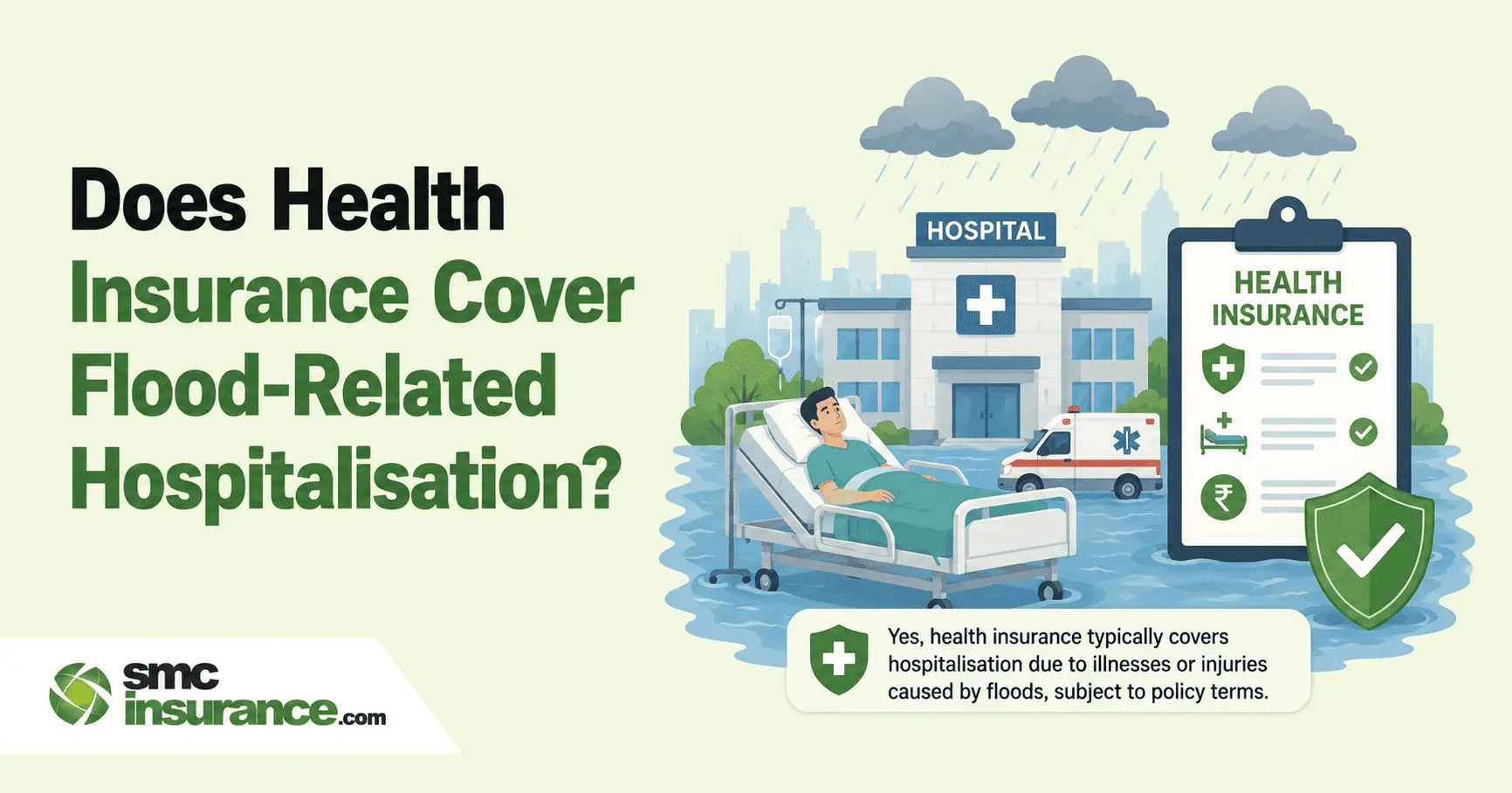

Most comprehensive health insurance policies can cover medically necessary hospitalisation for illnesses or injuries that occur after a flood, subject to the policy's coverage, waiting periods, exclusions, sub-limits and other terms. Flooding itself is not a separate health insurance benefit. Conditions such as leptospirosis, dengue or other infections, as well as accidental injuries, may be covered when the treatment qualifies under the policy. Damage to your home, vehicle or belongings is outside the scope of health insurance and falls under property or motor insurance.
The rain hasn't even let up and your street already looks like a canal. Somewhere in that brown water is a mosquito breeding ground, a manhole with no cover and a neighbour's dog that just won't stop barking at nothing. A few days later, someone in the house is running a fever that won't break, or worse, is being wheeled into a hospital with suspected leptospirosis after wading through knee-deep water to get to work. The medical bill lands before the fever does. That is when most people first ask whether their health insurance actually pays for flood-related hospitalisation, or whether the policy quietly excludes the one season it is needed most. This article walks through what gets covered, what doesn't and exactly how to file a claim when the water finally recedes.
Table of Contents
- What Counts as Flood-Related Hospitalisation Under a Health Policy
- The Illnesses and Injuries That Actually Send People to Hospital
- Where Health Insurance Draws the Line
- The IRDAI Rules That Actually Work in Your Favour
- What Flood Hospitalisation Actually Costs
- How to File a Flood Hospitalisation Claim
What Counts as Flood-Related Hospitalisation Under a Health Policy
Insurers don't use the phrase "flood-related hospitalisation" anywhere in a policy wording, and there's no separate flood clause sitting inside your health insurance document waiting to be triggered. What actually happens is simpler, and in a way, more useful — once you're hospitalised for a medical condition, however it was caused, the insurer looks at whether that condition and the treatment fall within the policy's regular inpatient benefit. A flood is just the backstory.
So if you're admitted for leptospirosis after walking through contaminated floodwater, your insurer processes it exactly like it would process a claim for pneumonia or appendicitis. The same applies to a fracture from slipping on a flooded staircase, or electrocution from a live wire that fell during a storm. Most indemnity health policies require inpatient hospitalisation, generally for at least 24 hours, unless the treatment qualifies as a covered day-care procedure or the policy provides another applicable benefit. Check the definition of hospitalisation and day-care treatment in your policy document.
This is also where day-care procedures and domiciliary hospitalisation clauses matter more than people expect during monsoon. If hospitals are running over capacity and a doctor prescribes treatment at home instead — because you can't get a bed or can't safely travel through flooded roads — a domiciliary hospitalisation benefit can still let you claim, provided your policy includes that feature and the condition would ordinarily have required hospital admission.
The Illnesses and Injuries That Actually Send People to Hospital
Ask any doctor in a flood-hit city what walks through the door in the days after heavy rain, and you'll get roughly the same list every time.
Leptospirosis tops that list in India, spreading through contact with floodwater contaminated by animal urine, and it can escalate quickly if untreated. Dengue and chikungunya surge because stagnant water left behind by floods becomes a mosquito nursery within days. Typhoid, cholera and acute gastroenteritis follow contaminated drinking water supplies, common once sewage lines and freshwater pipes get compromised during flooding. Respiratory infections climb too, driven by prolonged dampness and overcrowded shelters in badly hit areas.
From an insurance perspective, the important point is not whether a disease is labelled "flood-related." The claim is assessed based on the illness or injury, medical necessity, hospitalisation requirements and the policy's coverage, exclusions and waiting periods. Then there's the physical side of flooding people forget until it happens to them — slips on wet or submerged roads, road accidents caused by poor visibility and waterlogging, and electrocution from downed power lines all lead to hospitalisation that's covered the same way as any accidental injury claim.
What's Covered vs What Needs an Add-On
Situation |
Covered Under Base Health Policy? |
Notes |
Hospitalisation for leptospirosis, dengue, typhoid or other infectious diseases |
May be covered |
Depends on the policy's inpatient coverage, waiting periods, exclusions, sub-limits and medical admissibility |
Injury from a fall, road accident, or electrocution during a flood |
May be covered |
Falls under the policy's hospitalisation benefit, subject to exclusions and admissibility conditions. A separate accident rider isn't necessarily required. |
OPD consultation and diagnostics without admission |
Only if OPD cover is included |
Base policies often exclude outpatient costs |
Home healthcare or nursing when hospitals are full |
Only with domiciliary hospitalisation benefit |
Must meet the condition's usual admission criteria |
Ambulance charges during evacuation |
May be covered |
Subject to policy terms and the ambulance sub-limit |
Damage to your home, furniture, or vehicle from floodwater |
No |
Needs home insurance with an STFI add-on or motor cover |
Pre-existing conditions worsened by flood exposure |
Subject to the PED waiting period |
Under the current IRDAI framework, the maximum waiting period for health insurance is 36 months; the exact period depends on the policy |
Note: Coverage terms vary by insurer and plan. Always confirm sub-limits and add-on availability in your specific policy document before relying on any figure in this guide.
Where Health Insurance Draws the Line
This is the part people get wrong most often, and it costs them at the worst possible time. Health insurance pays for what happens to your body. It does not pay for what happens to your house, your car, or your belongings, even when a flood causes both on the same day.
If your ground-floor flat takes on three feet of water and ruins your furniture, that's a property insurance claim and it only pays out if your home policy carries an STFI, Storm Tempest Flood and Inundation, add-on. Health insurance does not cover physical damage to your home, furniture or vehicle. Such losses fall under property or motor insurance, where coverage depends on the applicable policy and its flood, storm, tempest and inundation provisions or relevant motor add-ons. Your bike stalling in a waterlogged street and its engine seizing up is a motor insurance matter, not a health claim and standard comprehensive bike insurance won't touch it without a hydrostatic lock or engine protection add-on. If you're curious how that specific gap plays out, we've broken it down separately in our piece on whether bike insurance covers engine damage from water.
Health insurance also won't pay for hospitalisation under 24 hours unless it falls under a listed day-care procedure, won't cover OPD-only visits unless you've specifically bought that rider, and won't cover a pre-existing condition that flares up during a flood if you're still inside the policy's waiting period. None of this is unique to flood claims — it's just that flood season is when people run into these boundaries for the first time, usually while standing at a hospital counter.
The IRDAI Rules That Actually Work in Your Favour
A few regulatory changes over the past two years have quietly made flood-season hospitalisation easier to manage financially and most policyholders have no idea these exist.
The IRDAI's Master Circular on Health Insurance Products, which supersedes 55 previous circulars, mandates that health insurers finalise cashless claims within three hours of receiving a discharge request from a hospital, with cashless authorisation for emergencies decided within one hour. That matters enormously during a flood, when you may be admitted to whichever hospital is reachable rather than the one on your insurer's preferred list.
The Cashless Everywhere initiative has expanded access to cashless treatment at eligible non-network hospitals, subject to the insurer's process, hospital requirements and policy terms. It is therefore useful during an emergency when a nearby network hospital is unavailable, but policyholders should not assume that every non-network hospital will automatically process a cashless admission. In practice this means a leptospirosis admission at a non-network hospital during a citywide flood doesn't automatically force you into a reimbursement claim and a long wait for your money back, provided you notify the insurer within the required window, typically 48 hours for emergency admissions.
IRDAI has also shown it will step in directly during a disaster. Flood-related insurance claims can also trigger special facilitation measures during major disasters. In Assam's 2026 floods, the state government said it had asked insurers to ensure quick and hassle-free settlement for affected people in Sivasagar, Charaideo, Jorhat and Golaghat, with insurers agreeing to simplify claim forms and reduce documentation requirements. Such measures are event- and region-specific, so policyholders should check their insurer's latest claims instructions during a major disaster. It's worth checking IRDAI's website or your insurer's app during any major flood event, since similar fast-track directives tend to follow whenever a region is officially declared disaster-affected.
What Flood Hospitalisation Actually Costs
This is where the coverage question stops being theoretical. The cost of treating a flood-associated illness can vary widely depending on the disease, severity, hospital, duration of admission, room category, investigations, medicines and whether ICU care is required. Severe leptospirosis can involve complications such as kidney or liver failure and may require intensive medical care, which can significantly increase treatment costs — and none of this includes the days of lost income while you or a family member recovers.
Without a health policy that actually responds to these claims, that entire cost sits with the household, right when floodwater has probably already damaged something else at home.
Pro Tip
This is exactly the gap a comprehensive health policy is meant to close, and it's worth checking today whether
yours actually does. At SMC Insurance, we help you compare health insurance plans that cover monsoon-linked hospitalisation properly, including OPD and domiciliary add-ons that base policies skip. Reach out through SMC Insurance and we'll walk you through what your current
policy actually covers before the next flood tests it.
How to File a Flood Hospitalisation Claim
Filing during a flood is not fundamentally different from filing any other health claim, but a few extra steps save you time when phone lines are down and roads are blocked.
- Notify your insurer as early as possible
For planned admissions, insurers generally want 48 hours' notice; for emergencies, notify within 48 hours of admission itself. Use the insurer's app or WhatsApp helpline if phone lines are congested, since most insurers now accept digital notification. - Choose any hospital if your network hospital is unreachable
Under the Cashless Everywhere rules, you're not restricted to network hospitals during a genuine emergency. Ask the hospital's insurance desk to confirm they can process a cashless request even without a prior tie-up. - Keep every document from day one
Save admission papers, discharge summary, itemised hospital bills, diagnostic reports and prescriptions. For leptospirosis and vector-borne disease claims, insurers often ask for the specific lab test confirming diagnosis, so don't let that report go missing. - Track the cashless timeline
Your insurer must decide on a cashless request within one hour for emergencies and clear final discharge within three hours once your hospital submits the final bill. If the issue is not resolved, use the insurer's internal grievance mechanism first. If the grievance remains unresolved, policyholders can approach IRDAI's grievance redressal mechanism and, where eligible, the Insurance Ombudsman. - If cashless isn't possible, switch to reimbursement without delay
Pay the bill, collect every original document at discharge and submit your reimbursement claim within your policy's specified window, usually 15 to 30 days from discharge. - Escalate through the Insurance Ombudsman if a genuine claim is rejected
The process is free and disputes over flood-related and monsoon illness claims are rarely about eligibility, more often about documentation gaps that can be corrected on appeal.
If you want the fuller version of this process, including how room rent limits and network status affect your payout, our detailed guide on the health insurance claim process in India covers both cashless and reimbursement routes step by step. And if a cashless request does get turned down at the hospital counter, we've written a separate playbook on what to do when a cashless claim is rejected that's worth bookmarking before monsoon, not during it.
Summing Up
Health insurance does cover flood-related hospitalisation — for the diseases and injuries that follow flooding, not the flood itself. Leptospirosis, dengue, typhoid, gastroenteritis and accident-related injuries from slips, falls, or electrocution during a flood are all standard inpatient claims once you clear the usual hospitalisation criteria. What your policy won't touch is property damage, vehicle damage, or OPD visits without a specific rider, and pre-existing conditions still sit behind their waiting period regardless of the season.
The regulatory environment has genuinely improved things too, with faster cashless timelines and the ability to use non-network hospitals during emergencies. The real risk isn't that your policy excludes flood illness — it's discovering, mid-admission, that you never checked whether it includes OPD cover, domiciliary hospitalisation, or a high enough sum insured to absorb a serious dengue or leptospirosis bill. Reviewing that now, before the next heavy monsoon week, costs nothing and saves you the argument at the billing counter later.
Disclaimer: The information provided on this platform is intended for general awareness and educational purposes. While every effort is made to ensure accuracy, some details may change with policy updates, regulatory revisions, or insurer-specific modifications. Readers should verify current terms and conditions directly with relevant insurers or through professional consultation before making any decision.
All views and analyses presented are based on publicly available data, internal research, and other sources considered reliable at the time of writing. These do not constitute professional advice, recommendations, or guarantees of any product’s performance. Readers are encouraged to assess the information independently and seek qualified guidance suited to their individual requirements. Customers are advised to review official sales brochures, policy documents, and disclosures before proceeding with any purchase or commitment.
FAQs
Yes, once you're hospitalized for a diagnosed condition like dengue or leptospirosis, it's processed as a standard inpatient claim, subject to your policy's usual terms around admission duration, sub-limits and network status. The flood context doesn't change how the claim is assessed.
Yes, accidental injuries sustained during a flood, including falls on wet or waterlogged surfaces, road accidents and electrocution, are covered under the accidental hospitalisation benefit most comprehensive health policies already include.
In most cases, yes. Under IRDAI's Cashless Everywhere framework, insurers must process cashless claims at any hospital, not only their network facilities, as long as you notify them within the required timeline for emergency admissions.
No, health insurance only covers medical treatment. Damage to your home, its contents, or your vehicle from floodwater needs a separate home insurance policy with an STFI add-on, or a motor policy with the relevant water-damage cover.
Not typically, since illnesses like dengue, leptospirosis and typhoid are treated as new, unrelated medical events rather than pre-existing conditions. The standard waiting period applies only if the hospitalisation is linked to a condition you already had before buying the policy.
You'll need admission and discharge summaries, itemised hospital bills, diagnostic and lab reports confirming the condition and prescriptions. For vector-borne diseases specifically, insurers usually ask for the lab test that confirms diagnosis, so keep that report safe.
Under IRDAI's Master Circular, insurers must decide on emergency cashless requests within one hour and clear final discharge within three hours of receiving the complete bill from the hospital.
Only if your policy includes an OPD benefit or rider. Standard base health insurance plans typically cover inpatient hospitalisation only, so outpatient consultations and medicines during monsoon usually come out of pocket unless you've added that cover.


