


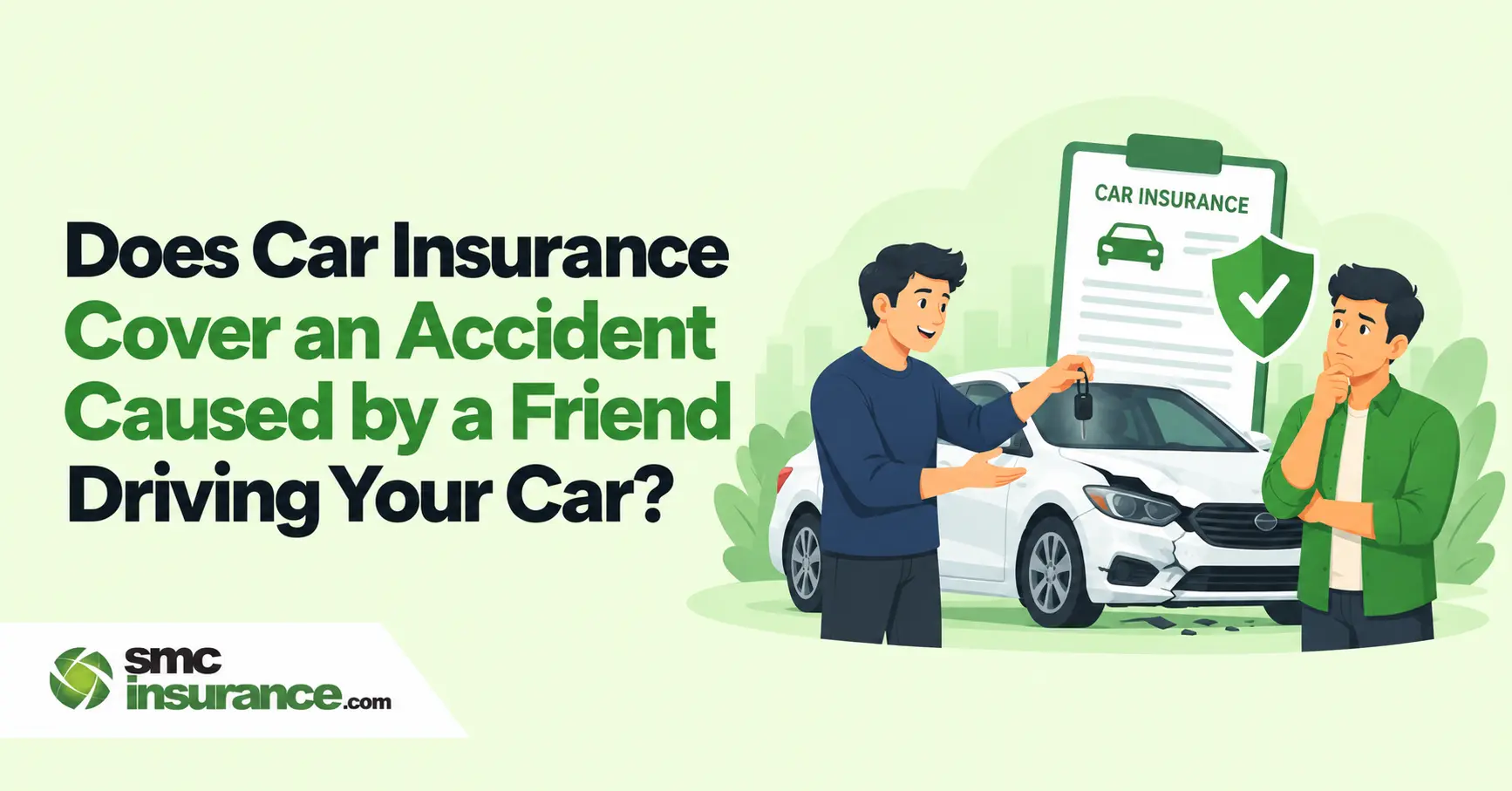
Yes, your car insurance can generally cover an accident caused by a friend who was driving your car with your permission, subject to the terms and conditions of your policy. The policy covers the insured vehicle and may extend liability protection to a permitted driver. The driver must meet applicable legal and policy requirements, including holding a valid licence and following the policy's permitted-use conditions. This is called permissive use. Coverage can still be denied if the driver lacked a valid licence, was drunk, took the car without consent, or was using it commercially. Even on an approved claim, you'll lose your No Claim Bonus, pay the compulsory deductible (Rs. 1,000 to Rs. 2,000 depending on engine size) and may see a higher renewal premium, all against your name as the registered owner.
Table of Contents
- Who Actually Gets Covered When Someone Else Drives Your Car
- When Your Insurer Can Actually Reject the Claim
- What a Friend's Accident Actually Costs You
- Own Damage vs Third-Party: How the Claim Actually Splits
- What To Do If Your Friend Crashes Your Car
- Should You Just Avoid Lending Your Car Altogether?
You hand your friend the keys for a quick supermarket run, or maybe a longer trip because you're the one who's tired after a night shift. Ten minutes later, your phone rings and it's not good news. A scraped bumper, a dented door, maybe worse. Your first thought after checking if everyone's okay is usually this: whose insurance pays for this mess? Yours, since it's your car? Or does the fact that you weren't behind the wheel change everything?
Here's the short version: your car insurance is written against the vehicle, not the person driving it, so in most cases your policy will still respond. But most cases is doing a lot of work in that sentence and the difference between a smooth claim and a rejected one usually comes down to details people never bother reading until the day they need them. By the end of this, you'll know exactly what gets covered, what doesn't and what it costs you even when the claim goes through.
Who Actually Gets Covered When Someone Else Drives Your Car
Most people assume car insurance is tied to the driver, the way a driving licence is. It isn't. A private car policy in India is a contract that covers the vehicle described in it, along with anyone who drives that vehicle with the owner's permission. Insurers call this permissive use and it's the reason your policy doesn't suddenly stop working the moment someone other than you takes the wheel.
So if your friend, your cousin, or your neighbour borrows your car with your knowledge and gets into an accident, your comprehensive policy will generally cover the repair to your own car and your third-party cover will handle any liability toward the other vehicle, person, or property involved. For an own-damage claim, the key question is generally whether the damage resulted from an insured event and whether the policy conditions were met. For third-party claims, questions of legal liability and compensation are handled separately under the motor insurance and motor accident claims framework.
There's one exception insurers do spell out clearly: excluded drivers. If your policy document specifically names someone as excluded, usually because of a poor claims history or some other underwriting reason, that person driving your car voids coverage for that trip. A friend or family member can generally drive the insured car with the owner's permission, but the claim remains subject to the policy's driver clause, permitted use, licence requirements and other applicable terms. Before lending the car, it is worth checking the policy schedule and wording if there is any uncertainty about who can drive the vehicle.
When Your Insurer Can Actually Reject the Claim
This is where a lot of confusion sets in, because people conflate "covered" with "covered no matter what." A friend driving your car with permission satisfies the first condition. It doesn't automatically satisfy every other clause in your policy. Insurers can and do reject or restrict claims in a handful of specific situations and it's worth knowing all of them before you ever hand over your keys.
- No valid driving licence
If the friend did not hold a valid licence for the vehicle at the time of the accident, the insurer may deny an own-damage claim or apply the policy's applicable exclusions. Third-party liability is governed separately under the Motor Vehicles Act, and an insurer's obligations toward third parties can differ from its liability under the own-damage section. This is the single biggest reason friend-driven claims fall through and it's entirely avoidable with a two-second check before you hand over the keys. - Driving under the influence
If the driver was under the influence of alcohol or drugs when the accident occurred, the own-damage claim may be excluded under the policy. Third-party liability is governed separately by the applicable policy terms and the Motor Vehicles Act. - Unauthorised use
If someone takes and drives the car without the owner's permission, the situation is different from a friend driving with consent. The insurer will assess the claim under the applicable policy terms and the circumstances of the incident. - Commercial use of a private car
If a private car is being used for a purpose outside the policy's permitted use, such as carrying passengers for hire or reward or making commercial deliveries where such use is not covered, the insurer may apply the relevant policy exclusion.
Our advisors at SMC see this play out more often with the licence condition than anything else. Someone lends their car to a friend visiting from another city, not realising the friend's licence lapsed six months ago and finds out only when the claim gets flagged during verification. A quick look at the licence validity before handing over the keys would have avoided the entire headache.
What a Friend's Accident Actually Costs You
Even when the claim sails through without a hitch, "covered" doesn't mean "free." As the registered owner, several financial consequences land on you, not your friend, because the policy and the claim history sit against your name and your vehicle.
What Happens |
How It Affects You |
No Claim Bonus (NCB) | Resets to zero on renewal if you make an own-damage claim, even though you weren't driving. An NCB Protect add-on, where you have one, can shield this. |
Compulsory deductible | You pay this out of pocket on every own-damage claim: Rs. 1,000 for cars up to 1500cc, Rs. 2,000 above that, as fixed under the India Motor Tariff regulations. |
Voluntary deductible | If you'd opted for one to lower your premium, that amount also comes out of your pocket first, on top of the compulsory deductible. |
Renewal premium | Insurers price renewals partly on claim history against the vehicle, so a claim this year can nudge next year's premium up regardless of who was driving. |
Legal notices | For third-party injury or death, FIRs and Motor Accidents Claims Tribunal (MACT) notices go to you first, as the registered owner, even if your friend was driving. |
Note: NCB slabs and deductible amounts follow IRDAI's standardised structure and apply uniformly across insurers; actual premium impact varies by insurer and vehicle.
Worth flagging separately: your No Claim Bonus climbs from 20% after one claim-free year to a ceiling of 50% after five and it's calculated only on the own-damage portion of your premium. Losing it because your friend clipped a gate pillar can mean paying several thousand rupees more at renewal, which is exactly why some owners quietly choose to absorb minor repair costs themselves rather than claim.
Thinking about how to keep your No Claim Bonus and premiums in check even after a mishap? Talk to an SMC advisor about the right add-ons for your policy at SMC Insurance.
Own Damage vs Third-Party: How the Claim Actually Splits
Not every accident is the same and the coverage that kicks in depends heavily on what got damaged and how badly. Here's how the split typically works.
Type of Damage |
What Covers It |
Damage to your own car | Your comprehensive/own-damage cover, subject to deductibles and policy terms |
Damage to another person's vehicle or property | Third-party liability cover, capped at Rs. 7.5 lakh for property damage under current regulations |
Injury or death to a third party | Third-party liability cover, with compensation decided by the Motor Accidents Claims Tribunal based on the victim's age, income and severity of injury, with no upper statutory limit |
For minor fender-benders, this rarely gets complicated. It's the accidents involving serious injury or a written-off third-party vehicle where the Rs. 7.5 lakh property cap and the tribunal process actually start to matter and where you'd be glad you were carrying a comprehensive policy rather than the bare legal minimum.
What To Do If Your Friend Crashes Your Car
If this has already happened, or you want to be ready in case it does, here's the sequence that actually protects your claim.
- Check for injuries first
Nothing about insurance matters until everyone involved has been looked at. Call for medical help immediately if anyone is hurt. - Document everything at the scene
Photos of both vehicles from multiple angles, the road position, any visible skid marks and a clear photo of your friend's driving licence. Insurers lean heavily on this evidence during verification. - File a police FIR where required
This is generally necessary for any third-party injury, death, or significant property damage and some insurers ask for it even in serious own-damage cases. - Inform your insurer within 24 to 48 hours
Delayed intimation is one of the more common and entirely avoidable, reasons claims get delayed or questioned. Be upfront that your friend was driving with your permission and had a valid licence at the time. - Choose cashless or reimbursement and wait for the surveyor
Don't start repairs before the insurer's surveyor has inspected the vehicle, or you risk complications in claim settlement.
Should You Just Avoid Lending Your Car Altogether?
Not necessarily, but a little groundwork goes a long way. Before you hand over your keys for anything beyond a five-minute errand, it's worth confirming your friend's licence is current and mentally noting that any claim will sit against your NCB and your renewal premium, not theirs. If you regularly lend your car to the same person, say a flatmate or a family member who doesn't live with you, it's worth asking your insurer directly whether that person needs to be named on the policy or whether standard permissive use already has you covered. Policy wording does vary slightly between insurers on this point, so a quick call beats an assumption.
Summing Up,
A friend crashing your car isn't the insurance nightmare it feels like in the moment, provided a few basic conditions are met. Your comprehensive policy covers damage to your own car, your third-party cover handles the other side and permissive use means the driver doesn't need to be you for any of that to apply. What it won't shield you from is the licence check, the sobriety of the driver and whether the car was being used the way your policy expects it to be used. And even a clean, approved claim still costs you something: your NCB resets, your deductible comes out of your pocket and your renewal premium can tick upward. The smartest move isn't refusing to ever lend your car. It's knowing exactly what you're agreeing to before you hand over the keys and reading your policy's exclusions once, properly, before you need to.
Disclaimer: The information provided on this platform is intended for general awareness and educational purposes. While every effort is made to ensure accuracy, some details may change with policy updates, regulatory revisions, or insurer-specific modifications. Readers should verify current terms and conditions directly with relevant insurers or through professional consultation before making any decision.
All views and analyses presented are based on publicly available data, internal research and other sources considered reliable at the time of writing. These do not constitute professional advice, recommendations, or guarantees of any product’s performance. Readers are encouraged to assess the information independently and seek qualified guidance suited to their individual requirements. Customers are advised to review official sales brochures, policy documents and disclosures before proceeding with any purchase or commitment.
FAQs
Yes, under the concept of permissive use, your car insurance policy generally covers accidents caused by anyone driving with your consent, as long as they hold a valid driving licence and weren't under the influence at the time. The claim is filed against your policy, not your friend's.
Yes, any own-damage claim resets your NCB to zero at renewal, regardless of who was driving, unless you have an NCB Protect add-on that specifically shields a limited number of claims per year.
No, ownership isn't the deciding factor for a permissive-use claim. The insurer looks at whether the driver had your consent, a valid licence and wasn't driving under the influence, not whether their name appears on the RC.
The insurer can legally reject the claim in this situation. An invalid, expired, or wrong-category licence is one of the most common reasons friend-driven car insurance claims get denied, so checking licence validity before lending your car matters more than most people realise.
No, third-party insurance only covers your legal liability toward another person's vehicle, property, or injuries. Damage to your own car needs a comprehensive or standalone own-damage policy alongside it.
No, since the claim is filed against your policy and your vehicle, it shows up in your claim history and affects your NCB and renewal premium, not your friend's insurance record.
Yes, current regulations cap third-party property damage compensation at Rs. 7.5 lakh per accident. If the actual damage costs more, you as the vehicle owner become liable for the difference. There's no such cap for third-party injury or death, where compensation is decided by the Motor Accidents Claims Tribunal.


