


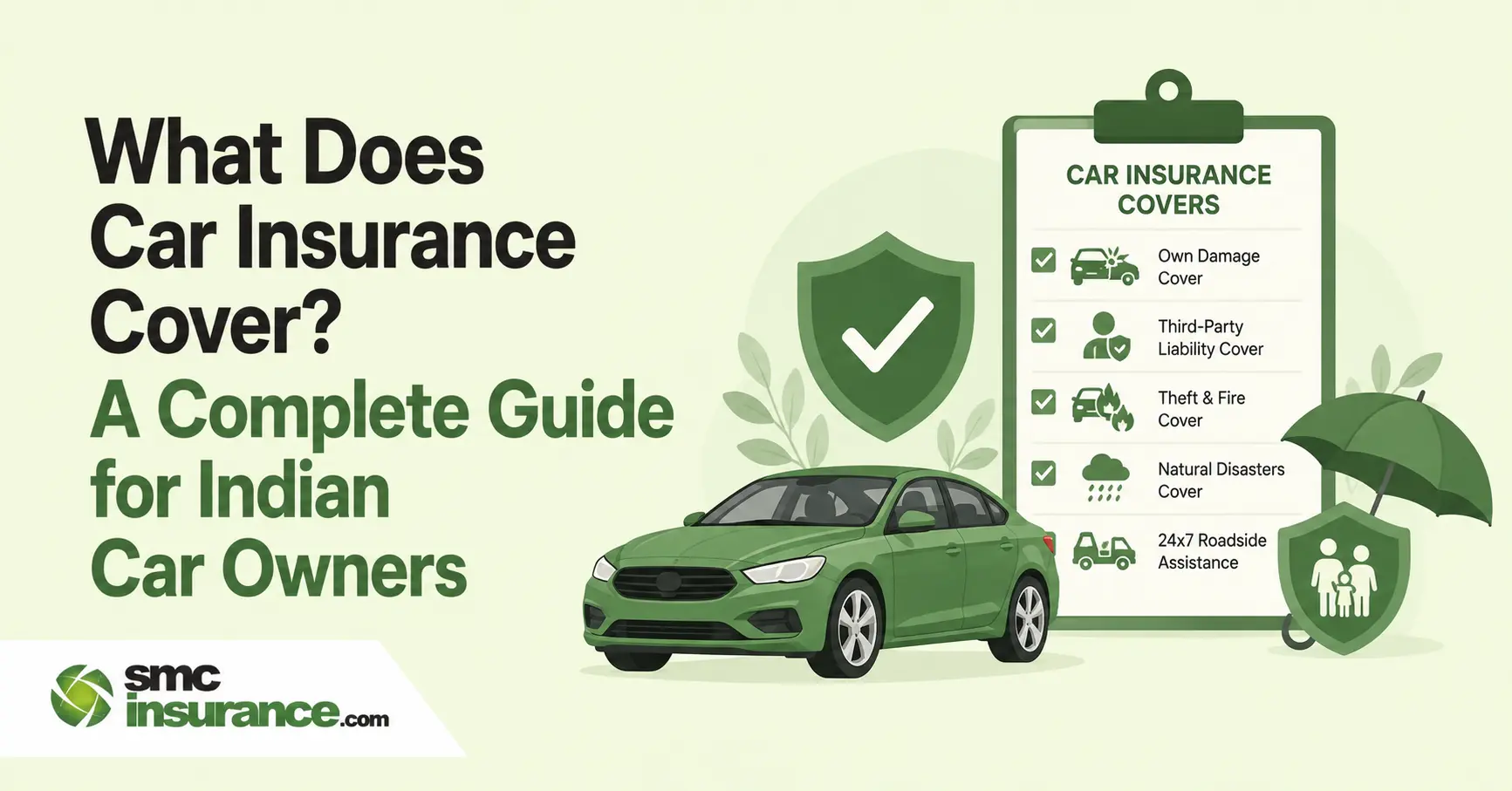
Car insurance in India can cover third-party liabilities and damage to your own vehicle, depending on the policy you choose. Third-party insurance is mandatory and covers your legal liability for injury, death or property damage caused to a third party. Comprehensive and standalone own-damage policies can also cover specified damage to your car, such as accidents, fire, theft and natural calamities. A compulsory personal accident cover for the owner-driver has a minimum sum insured of Rs. 15 lakh, subject to the applicable policy and PA cover requirements. It excludes wear and tear, unlicensed or drunk driving and mechanical breakdown. Add-ons like zero depreciation and engine protection extend coverage further for an additional premium.
Table of Contents
Your car insurance policy is probably sitting in a folder somewhere and you have likely never read it end to end. Most people don't, until the day they need to file a claim and discover that the scratch on their bumper, the flooded engine, or the mechanic's bill for a burnt-out AC compressor falls into a grey zone their policy never really explained. That gap between what you assumed was covered and what your insurer actually pays out is where most disputes begin. By the end of this guide, you will know exactly what your car insurance covers, what it leaves out and which add-ons close the gaps that matter most for your car.
The Three Types of Car Insurance and What Each One Actually Covers
There isn't just one kind of car insurance in India and knowing the difference is the first step toward understanding what your own policy protects. The Motor Vehicles Act, 1988 mandates one type of cover and insurers offer two more that build on top of it. Here's how the three differ.
- Third-Party Car Insurance
Third-party insurance is the only cover every car owner in India must buy before driving on public roads. It pays for injury, death, or property damage you cause to someone else, their vehicle, or their property. It does not pay a single rupee toward repairing your own car.
Compensation for death or permanent disability of a third party is unlimited under the law and is decided case by case by the Motor Accident Claims Tribunal. Property damage liability, however, is capped, currently at Rs. 7.5 lakh per claim. So if you clip a parked car outside a mall, this is the cover that pays for the other person's dent, not yours. - Comprehensive Car Insurance
Comprehensive car insurance combines third-party liability cover with own-damage protection for the insured vehicle. Depending on the policy wording, own-damage cover can respond to risks such as accidents, fire, theft and specified natural or man-made events.
It pays for damage from accidents, fire and explosions, along with natural events like floods, storms and earthquakes. The owner-driver is also subject to compulsory personal accident cover requirements. The minimum capital sum insured specified by IRDAI is Rs. 15 lakh. For an annual CPA cover, the IRDAI circular specifies a premium of Rs. 750, valid until further notice. However, an owner-driver who already has an eligible standalone personal accident cover meeting the applicable requirement may not need duplicate CPA cover under the motor policy. - Standalone Own Damage (OD) Cover
If your car already has third-party insurance, you can purchase a standalone own-damage policy to insure the vehicle against covered losses such as accidents, theft, fire and other specified perils. This lets you choose the insurer and own-damage cover separately from your third-party policy. This works well when you're switching insurers mid-term or want to price the OD and TP portions independently. In our experience, this route helps drivers with a clean claim history the most, since they can carry a fat No Claim Bonus on the OD side without disturbing their existing third-party policy.
Coverage |
Third-Party Only |
Standalone Own Damage |
Comprehensive |
Third-party injury or death liability | Yes | No | Yes |
Third-party property damage (up to Rs. 7.5 lakh) | Yes | No | Yes |
Own car accident damage | No | Yes | Yes |
Theft of the vehicle | No | Yes | Yes |
Fire and natural disasters | No | Yes | Yes |
Personal accident cover for owner-driver | Subject to applicable CPA requirement | Not part of OD itself | Subject to applicable CPA requirement |
Legally sufficient on its own | Yes | No | Yes |
Note: A standalone own damage policy only works alongside an existing, valid third-party policy. It cannot be bought as your sole cover and lapses if your third-party policy lapses.
What Comprehensive Car Insurance Covers in Detail
Once you've settled on comprehensive cover, here's what actually falls under it:
- Accidental damage to your car from a collision, whether or not another vehicle is involved
- Fire and explosion damage, including an electrical short circuit under the bonnet
- Natural calamities such as flood, cyclone, hailstorm, landslide and earthquake
- Theft of the vehicle or its insured accessories
- Malicious damage, riots and strikes
- Damage sustained while the car is in transit by road, rail, or inland waterway
- Personal accident cover for the owner-driver
- Optional cover for passengers, if added on
A comprehensive policy also indirectly covers your legal liability while someone else is driving your car with your permission, as long as that person holds a valid licence. Own-damage cover generally applies to the insured vehicle when it is used in accordance with the policy terms. The person driving the vehicle must also meet the applicable licence and policy conditions for a claim to be admissible.
Add-On Covers That Close the Gaps Standard Policies Leave Open
A standard comprehensive policy is a solid foundation, but it still has holes that most owners only discover during a claim. Add-ons plug those holes for a modest extra premium.
- Zero depreciation cover is the one we recommend most often at the time of purchase, especially for cars less than five years old, since it pays the full repair cost without deducting depreciation on plastic, fibre and rubber parts.
- Return to Invoice cover can bridge the difference between the vehicle's Insured Declared Value and its eligible invoice value when the car is stolen or suffers a qualifying total or constructive total loss, subject to the add-on's terms and eligibility conditions.
- Roadside assistance, consumables cover, engine protection and NCB protection round out the usual list and each one earns its premium differently depending on how you actually use the car.
Cars that spend a lot of time in flood-prone cities benefit most from engine protection cover. Cars that sit in a covered basement all week and rarely see rain barely need it at all.
What Car Insurance Does Not Cover
Knowing the exclusions matters just as much as knowing the inclusions, because this is where claims get rejected. A standard car insurance policy will not pay for:
- Regular wear and tear, or gradual mechanical and electrical breakdown
- Damage caused while driving without a valid licence
- Damage caused while driving under the influence of alcohol or drugs
- Consequential damage, such as an engine seizing because you kept driving through a flooded road
- Depreciation on tyres, tubes and batteries, which is handled separately even under a zero dep add-on
- Use of a private car for commercial purposes without informing the insurer
- Losses that occur outside the geographical area specified in the policy
Third-Party Premium Rates
Third-party premiums aren't set by insurers competing with one another. The IRDAI fixes them centrally, so the rate stays the same no matter which company you buy from.
Engine Capacity |
Annual Third-Party Premium |
Up to 1000cc | Rs. 2,094 |
1000cc to 1500cc | Rs. 3,416 |
Above 1500cc | Rs. 7,897 |
Note: These are the regulated base rates for private cars under a single-year third-party policy. Comprehensive premiums run higher because they add an own-damage component, which insurers price individually based on your car's IDV, age, registered city and claim history. You can always verify the current regulated rates directly on the IRDAI website.
Electric cars follow separate third-party premium slabs. The applicable rate is based on the vehicle's electric motor capacity rather than the engine-capacity slabs used for conventional private cars. For the currently published annual rates, cars up to 30 kW fall in the Rs. 1,780 slab, those above 30 kW and up to 65 kW fall in the Rs. 2,904 slab, and those above 65 kW fall in the Rs. 6,712 slab. Applicable taxes are charged separately.
Note: Premium rates can change if the government notifies revised rates, so verify the applicable rate at renewal.
Driving without a valid policy isn't just a coverage gap, it's a punishable offence under Section 196 of the Motor Vehicles Act, attracting a fine of Rs. 2,000 for a first offence and Rs. 4,000 for a repeat one, along with possible imprisonment of up to three months.
Getting the coverage question right before you buy saves you a far more stressful conversation at claim time. If you're comparing quotes and unsure which add-ons are worth the extra premium for your specific car and city, SMC's advisors can walk you through the numbers before you commit. Reach out at SMC Insurance and we'll match the cover to how you actually drive, not to a generic template.
How to Decide How Much Coverage You Actually Need
Coverage decisions usually come down to three questions: how old is the car, how often is it driven in flood-prone or high-theft areas and how much can you comfortably pay out of pocket if something goes wrong. A car under three years old with an active loan almost always justifies zero depreciation and engine protection. A car past its seventh or eighth year, where the IDV has dropped significantly, often makes more financial sense on a standalone OD policy with fewer add-ons, since the payout ceiling is lower anyway.
If you renew every year without reviewing these choices, you're either overpaying for cover you don't need or underinsured for a risk you actually face. Either way, it's worth five minutes at renewal time to check.
Summing Up,
Car insurance in India isn't one product, it's three: third-party, comprehensive and standalone own damage, each covering a different slice of risk. Third-party is the mandatory floor, protecting the other side of any accident you cause. Comprehensive
brings your own car into that equation too, covering accidents, theft, fire and natural disasters, along with a personal accident cover
for the owner-driver. Add-ons like zero depreciation and engine protection close the specific gaps a standard policy leaves behind
and they're worth pricing out individually rather than skipping by default. The exclusions matter just as much, because
unlicensed driving, drunk driving and plain wear and tear will get any claim rejected regardless of how comprehensive
your policy looks on paper. Before your next renewal, read your policy schedule once, properly and match what's
listed against how you actually use the car day to day.
Disclaimer: The information provided on this platform is intended for general awareness and educational purposes. While every effort is made to ensure accuracy, some details may change with policy updates, regulatory revisions, or insurer-specific modifications. Readers should verify current terms and conditions directly with relevant insurers or through professional consultation before making any decision.
All views and analyses presented are based on publicly available data, internal research and other sources considered reliable at the time of writing. These do not constitute professional advice, recommendations, or guarantees of any product’s performance. Readers are encouraged to assess the information independently and seek qualified guidance suited to their individual requirements. Customers are advised to review official sales brochures, policy documents and disclosures before proceeding with any purchase or commitment.
FAQs
Depending on the policy type, car insurance covers third-party liability for injury, death, or property damage, plus own damage from accidents, fire, theft and natural disasters under comprehensive plans. Most comprehensive policies also include a personal accident cover for the owner-driver worth Rs. 15 lakh. Add-ons extend this further based on what you choose to include.
Standard comprehensive policies don't cover mechanical or electrical breakdown of the engine, including damage from normal wear. If the engine is damaged by an insured event such as flooding or an accident and you've added an engine protection cover, the repair or replacement cost is covered separately from the standard policy.
Yes, theft of the entire vehicle or its insured accessories is covered under comprehensive and standalone own damage policies, but not under third-party-only policies. You'll usually need to file a police FIR before the insurer processes a theft claim.
Yes, if you're at fault in an accident, your own damage cover under a comprehensive policy pays for repairs to your car, while your third-party cover pays for the other person's losses. A third-party-only policy will not pay for your own car's damage even if you caused the accident.
Wear and tear, mechanical or electrical breakdown, damage while driving without a valid licence or under the influence of alcohol or drugs and consequential damage from ignoring an obvious hazard like a flooded road are all excluded from standard car insurance policies.
Yes, a personal accident cover of Rs. 15 lakh for the owner-driver is mandatory and is usually bundled into both third-party and comprehensive policies for a flat premium of Rs. 750 a year, unless you already hold a separate personal accident policy of an equal or higher sum insured.
Comprehensive car insurance covers flood, cyclone, storm and earthquake damage as standard. Engine damage caused by attempting to drive through floodwater, commonly called hydrostatic lock, is only covered if you've added an engine protection add-on.
Yes and it's the only legal minimum required under the Motor Vehicles Act, 1988. It's usually the cheaper option upfront, but it leaves your own car completely uninsured against accidents, theft and natural disasters.


