


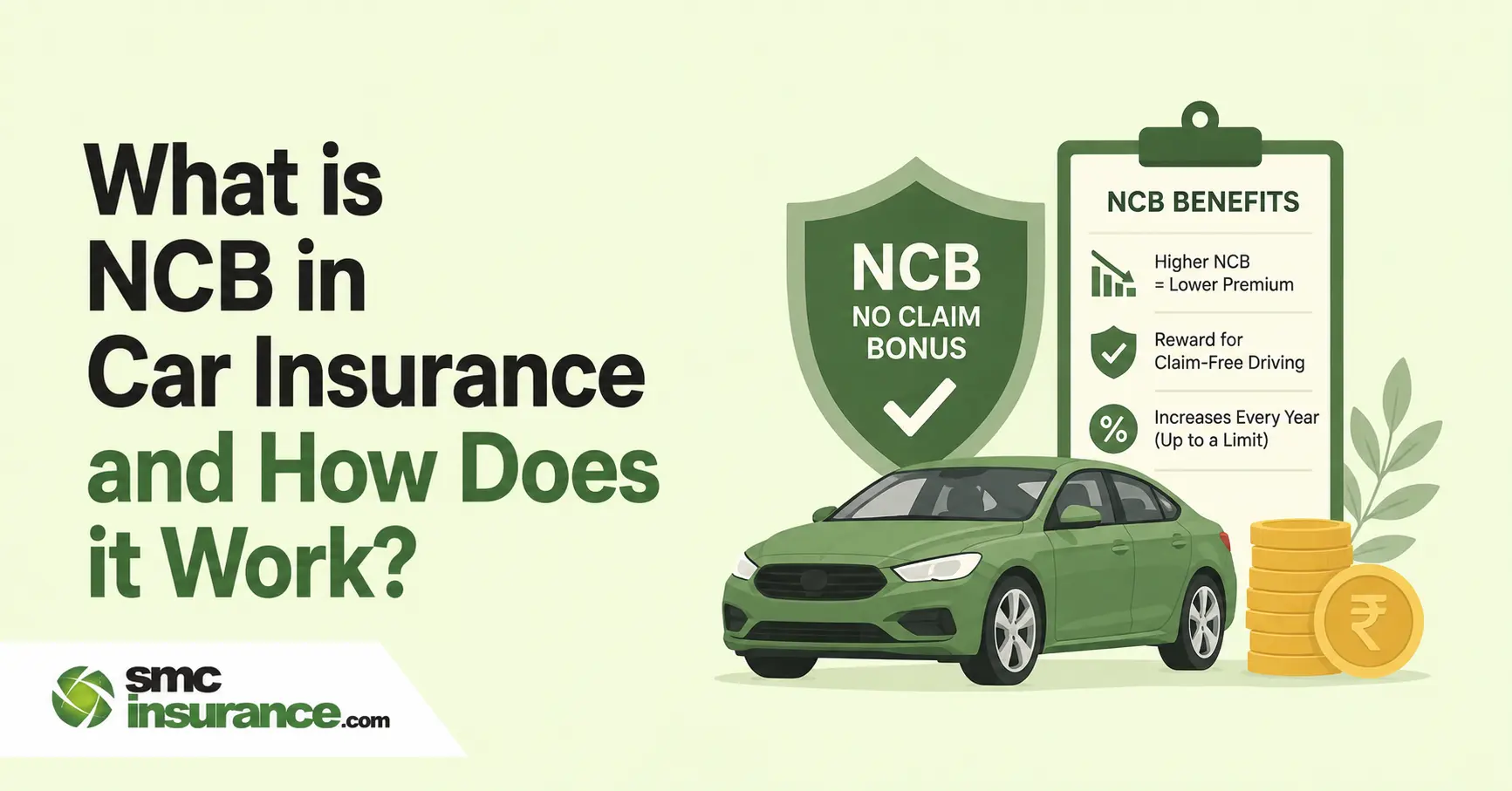
No Claim Bonus (NCB) is a premium discount offered on the Own Damage component of a car insurance policy when you do not file a claim during the policy period. The discount increases with every consecutive claim-free year, starting at 20% after the first year and going up to 50% after five claim-free years. NCB belongs to the insured rather than the vehicle, so it can generally be carried to another car or insurer subject to applicable conditions and proof of entitlement. A claim can affect or remove the NCB at the next renewal, unless an NCB protection add-on applies under its specific terms.
Table of Contents
- What is No Claim Bonus (NCB) in Car Insurance?
- How Does NCB Work in Car Insurance?
- NCB Percentage Chart: Year-Wise Slab
- Small Claim or Save Your NCB? Run the Numbers First
- How to Transfer NCB to a New Car or a New Insurer
- What Happens to NCB After an Accident or Theft?
- Can You Protect Your NCB? The NCB Protector Add-On
- Terms and Conditions Worth Knowing
You dent your bumper backing out of a parking spot, nothing dramatic, maybe Rs. 8,000 worth of paint and plastic. When your car suffers damage, filing an insurance claim may seem like the obvious next step. However, making a claim can affect your No Claim Bonus (NCB). That decision could cost you more than the repair bill over the next few years because a claim can affect the NCB you have accumulated. Under standard terms, a claim can result in the NCB being lost at the next renewal, while an NCB protection add-on may preserve it for eligible claims. That discount has a name, No Claim Bonus, and most car owners in India only learn how it works after they've already lost it. By the end of this article, you'll know exactly how NCB builds up, when it's worth protecting, and when filing a claim actually makes financial sense.
What is No Claim Bonus (NCB) in Car Insurance?
NCB is a premium discount that you can accumulate for each consecutive policy year in which you do not make an Own Damage claim. It has nothing to do with third-party claims against you or with how many years you've simply owned a car. It rewards one thing only, a claim-free policy period. Under the standard motor insurance NCB structure, the benefit begins at 20% after one claim-free year and increases progressively, reaching a maximum of 50% after five consecutive claim-free years.
Here's the part most people miss. NCB applies only to the own-damage (OD) portion of your premium, not to the third-party liability portion, which IRDAI fixes separately and doesn't discount for claim-free driving. So a comprehensive policy with a high OD component benefits far more from NCB than a bare third-party plan, where there's nothing to apply the discount to in the first place.
How Does NCB Work in Car Insurance?
The mechanics are simpler than most explanations make them sound.
You start every new comprehensive policy at 0% NCB. Complete one policy year without an own-damage claim, and your renewal premium reflects a 20% cut on the OD component. Stay claim-free for a second year, and it rises to 25%, then 35%, 45%, and finally 50% by year five. If you make a claim during the policy period, the NCB you have built up may be reset at the time of renewal under standard NCB rules. However, an NCB Protection add-on can help you retain the accumulated discount for eligible claims, subject to the policy terms.
The NCB is linked to you as the policyholder rather than the insured vehicle. As a result, the accumulated benefit can generally be transferred when you replace your existing car with a new one or move your policy to a different insurer, subject to applicable documentation and insurer rules. What you can't do is transfer it to a different person, even a spouse or a child, because it's tied to your individual claims record.
Our advisors at SMC often see customers assume NCB is automatically applied at renewal. It isn't automatic if you're switching insurers. When switching insurers, declare your previous NCB and provide proof of entitlement. Depending on the insurer, this may include a renewal notice, an NCB certificate or a letter confirming your NCB entitlement.
NCB Percentage Chart: Year-Wise Slab
This is the exact structure IRDAI prescribes, and every insurer operating in India follows it without variation.
Claim-Free Policy Years |
NCB Discount on OD Premium |
After 1st year | 20% |
After 2nd consecutive year | 25% |
After 3rd consecutive year | 35% |
After 4th consecutive year | 45% |
After 5th consecutive year | 50% |
Note: This discount applies strictly to the own-damage premium component. It has no effect on the third-party liability premium, which IRDAI revises and fixes independently each year.
To see what this actually means in rupees, take a car with an annual own-damage premium of Rs. 18,000. A driver with 25% NCB pays Rs. 13,500 on that component alone, a saving of Rs. 4,500 before you even factor in the third-party premium and taxes. Push that same driver to 50% NCB after five claim-free years, and the OD premium drops to Rs. 9,000, half of what it started at.
Small Claim or Save Your NCB? Run the Numbers First
This is the decision that trips up most policyholders, and it deserves more thought than a reflexive call to the insurer.
Say you're sitting on 35% NCB and a minor collision leaves you with a Rs. 15,000 repair bill. Filing the claim gets that repaired at no direct cost beyond your deductible. But at your next renewal, your NCB resets to 0%, and depending on your OD premium, that could mean paying several thousand rupees more every year for the next three to five years while you rebuild the discount. Add those years up, and the "free" repair often costs more than paying out of pocket ever would have.
Estimated Repair Cost |
What Usually Makes Sense |
Under Rs. 10,000 | Pay from pocket, protect your NCB |
Rs. 10,000 to Rs. 30,000 | Compare your NCB loss against the repair cost before deciding |
Above Rs. 30,000 | Filing a claim is usually worth it |
Note: These are general guidelines, not fixed rules. Your actual break-even point depends on your current OD premium, your existing NCB slab, and how many years remain before you hit the 50% ceiling.
Thinking this through before every minor scratch becomes second nature once you've done it a couple of times. If the maths feels like too much to work through on your own at renewal time, that's exactly the kind of call our team at SMC fields regularly, and it takes a few minutes to sort out.
How to Transfer NCB to a New Car or a New Insurer
Whether you've sold your old car or you're simply unhappy with your current insurer, the process to carry your NCB forward follows the same basic steps.
- Request an NCB certificate from your existing insurer. This document states your accumulated NCB percentage and the date it was earned.
- Share this certificate with your new insurer or the dealer handling your new policy, along with your previous policy number.
- The new insurer verifies your claims history, often cross-checking against the Insurance Information Bureau's shared database, before applying your carried-forward NCB to the new policy's OD premium.
- Complete the transfer within 90 days of your old policy's expiry. This window matters more than most people realise, because it's the single biggest reason policyholders lose NCB they've genuinely earned.
If you're transferring NCB after selling your car and buying a new one, keep your sale documents (Form 29 and 30), the delivery note or booking receipt for the new vehicle, and your old registration transfer copy ready. Insurers ask for these to confirm the ownership chain hasn't broken along with the NCB claim.
What Happens to NCB After an Accident or Theft?
The outcome here depends heavily on who was at fault and how the claim gets settled.
If you're at fault, or the cause is unclear, and you file a claim to repair your own car, your NCB drops to zero immediately, regardless of how minor the damage was. If a third party caused the accident and your insurer recovers the full repair cost from their insurer, your NCB stays intact, because technically you haven't made a claim against your own policy.
Total loss situations work differently again. If your car is stolen or damaged beyond economical repair, and your insurer settles the claim based on the car’s Insured Declared Value, you lose all accumulated NCB. There's no third party to recover costs from in most theft cases, so the bonus simply can't be preserved unless you'd taken an NCB protector add-on beforehand.
Can You Protect Your NCB? The NCB Protector Add-On
Yes, and for drivers who've built up several years of NCB, it's worth genuine consideration. The NCB protector add-on lets you keep your accumulated discount intact even after filing a limited number of own-damage claims in a policy year, typically one or two, depending on the insurer's specific terms.
It costs a modest additional premium, and the exact number of protected claims varies by insurer, so it's worth reading the policy wording rather than assuming every provider offers identical protection. For a driver at 50% NCB, the math usually favours the add-on, since losing that discount and rebuilding it from scratch over five years costs far more than the protector's annual premium.
Terms and Conditions Worth Knowing
A few rules apply across every insurer, and they're easy to overlook until they cost you money. NCB applies only to comprehensive or standalone own-damage policies, never to third-party-only cover. It cannot be split between two vehicles if you own more than one car, since each vehicle earns and carries its own separate NCB. And if your policy lapses for more than 90 days past its expiry date, the accumulated bonus is forfeited entirely, with no grace period offered by any insurer under current IRDAI norms.
Wrapping Up,
NCB rewards exactly one behaviour, staying claim-free, and the reward compounds meaningfully over five years, from a 20% discount to a full 50% off your own-damage premium. The mistake most car owners make isn't misunderstanding the slab structure. It's treating every minor scratch as claim-worthy without weighing what that claim actually costs across the following renewal cycles. Before you file for anything under roughly Rs. 15,000 to 20,000, do the comparison first. Keep your NCB certificate handy whenever you switch cars or insurers, stay inside that 90-day renewal window without fail, and consider an NCB protector once you've built up a discount worth defending. Handled this way, NCB stops being fine print and starts functioning as one of the more reliable ways to lower your
car insurance cost year after year.
Disclaimer: The information provided on this platform is intended for general awareness and educational purposes. While every effort is made to ensure accuracy, some details may change with policy updates, regulatory revisions, or insurer-specific modifications. Readers should verify current terms and conditions directly with relevant insurers or through professional consultation before making any decision.
All views and analyses presented are based on publicly available data, internal research and other sources considered reliable at the time of writing. These do not constitute professional advice, recommendations, or guarantees of any product’s performance. Readers are encouraged to assess the information independently and seek qualified guidance suited to their individual requirements. Customers are advised to review official sales brochures, policy documents and disclosures before proceeding with any purchase or commitment.
FAQs
NCB stands for No Claim Bonus, a discount insurers apply to your own-damage premium for every consecutive year you don't file a claim. It's not a cashback or a refund, it simply lowers what you pay at renewal.
NCB starts at 20% after your first claim-free year and rises in fixed IRDAI-mandated steps to a maximum of 50% after five consecutive claim-free years. The discount applies only to the own-damage portion of your premium.
No, NCB is available only on comprehensive policies or standalone own-damage covers. Third-party premiums are fixed by IRDAI and don't change based on your claims record.
Yes, provided you request an NCB certificate from your current insurer and complete the switch within 90 days of your old policy's expiry. Beyond that window, the accumulated bonus is lost.
Yes, a single own-damage claim resets your NCB to 0%, regardless of how many consecutive claim-free years you'd built up before it, unless you hold an NCB protector add-on.
You lose your accumulated NCB in both cases, since the insurer settles based on the car's Insured Declared Value and there's typically no third party to recover costs from.
No, NCB is linked to the policyholder as an individual, not to the vehicle or the household, so it cannot be transferred to a spouse, child, or any other person.
Yes, through an NCB protector add-on, which lets you file a limited number of own-damage claims in a policy year without losing your accumulated discount. Terms on how many claims are covered vary by insurer.


