


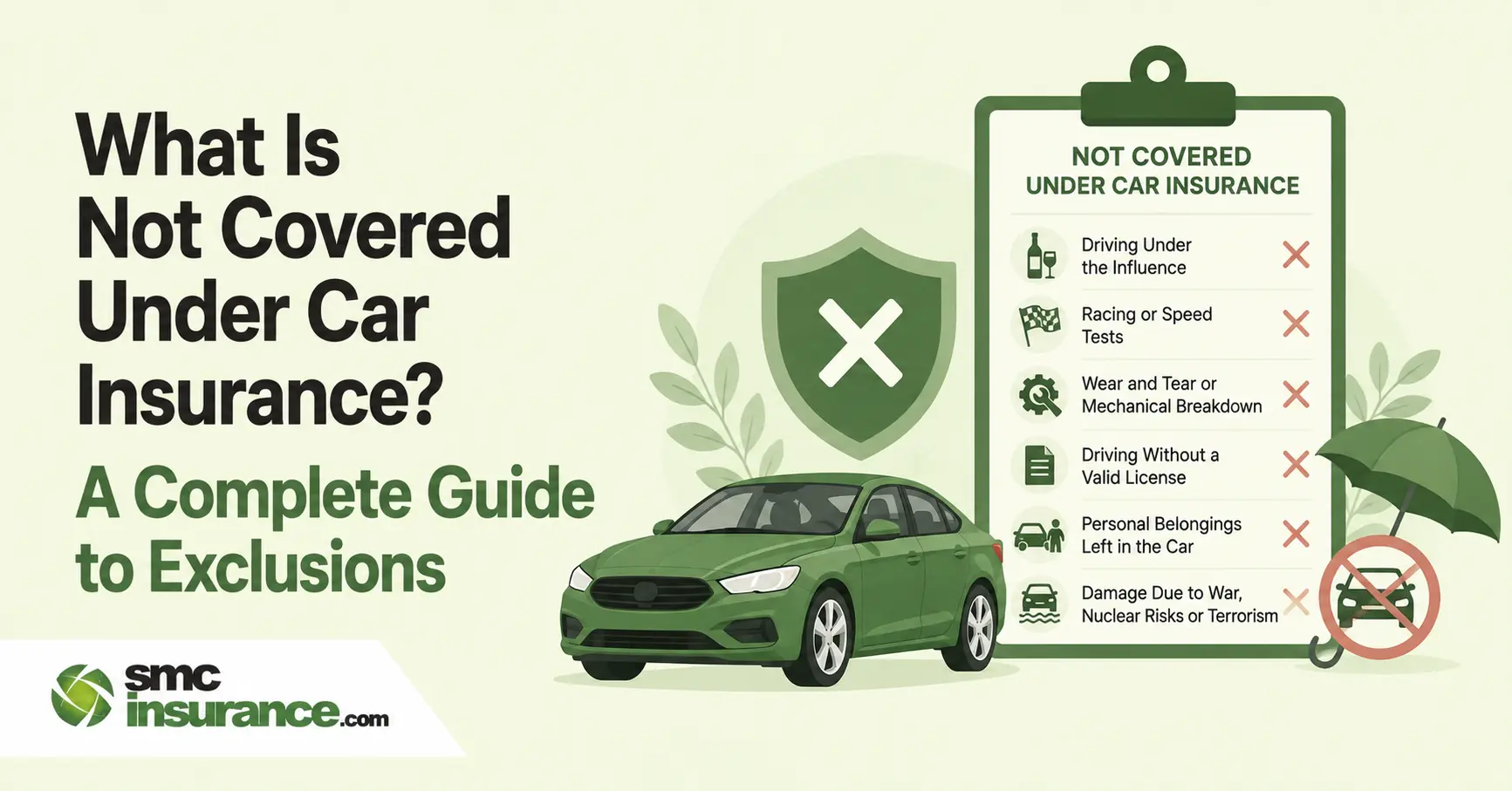
Car insurance generally does not cover normal wear and tear, standalone mechanical or electrical breakdowns, losses arising when the vehicle is used in breach of policy conditions, or damage caused while driving without an effective licence or under the influence of alcohol or drugs. Consequential engine damage caused by water ingress is generally excluded from the base Own Damage cover, although an Engine Protect add-on may cover specified water-ingress or oil-leakage-related damage. Package/comprehensive and standalone Own Damage policies generally cover insured perils such as flood, inundation, earthquake and theft, subject to the policy wording. In a total-loss or theft claim, the standard Own Damage settlement is generally linked to the vehicle's IDV, while add-ons such as Return to Invoice may provide additional protection subject to their terms.
Table of Contents
You've just paid your car insurance premium, feeling reasonably protected. Then your engine seizes after you drove through ankle-deep water on a monsoon evening, or your neighbour's kid dents the car while reversing it without your knowledge and your claim gets rejected. This happens more often than most car owners expect, not because insurers are being difficult, but because every policy has a list of exclusions that never gets read at the time of purchase. Knowing what your car insurance won't pay for is just as important as knowing what it will and by the end of this article, you'll know exactly where the gaps are and how to close them.
Common Car Insurance Exclusions You Should Know
Many standard motor insurance policies contain similar core exclusions, although the exact wording, conditions, deductibles and add-on coverage can differ between insurers. Always refer to the policy schedule and policy wording for the applicable exclusions. Here's what typically falls outside your cover.
- Normal Wear and Tear
No car insurance policy compensates for the gradual ageing of your vehicle. Faded paint, worn-out brake pads, a tired clutch plate or rusting under the chassis are treated as maintenance issues, not insurable losses. Normal wear and tear resulting from the vehicle's regular use is not covered under standard Own Damage insurance. Items that deteriorate through normal use, such as worn brake components or a clutch that has reached the end of its service life, are generally treated as maintenance expenses rather than insured accidental damage. This is one of the most misunderstood exclusions, because owners often assume "comprehensive" means everything is comprehensive, including ageing. - Mechanical or Electrical Breakdown
If your car's AC compressor fails on its own, or the alternator stops charging without any accident involved, that's a mechanical failure, not a covered peril. Car insurance doesn't cover any non-accidental damage or faults to your car or its parts. The distinction insurers draw is simple: was there an external, accidental trigger, or did the part just wear out or fail internally? Only the former gets paid. - Driving Without a Valid Licence
This one catches people off guard more than it should. Own Damage claims can be affected when the vehicle is being driven by a person who does not hold an effective driving licence or is disqualified from holding one. A learner's licence may be accepted where the applicable legal requirements are met. The exact effect on a claim depends on the policy terms and the nature of the breach. An expired licence, a learner's licence used without a qualified accompanying driver, or a licence that doesn't cover the vehicle class you're driving (a two-wheeler-only licence used for a car, for instance) all count as invalid. - Driving Under the Influence
Driving under the influence can result in your motor insurance claim being rejected. This applies to impairment caused by alcohol as well as drugs. If an accident occurs while you are driving under the influence, the resulting damage to your insured vehicle is generally excluded from car insurance coverage, in addition to the legal action that may apply under Indian motor vehicle laws.
To determine whether intoxication was involved, insurers may consider evidence such as the police FIR and medical or alcohol test reports. These records can play an important role in the claim assessment. - Unauthorised or Unnamed Drivers
A private car policy does not generally require every person who occasionally drives the vehicle to be individually named on the policy. A person driving with the insured's permission may be covered provided the driver meets the policy's requirements, including holding an effective driving licence. However, a claim can be affected if the vehicle is driven by a person who is not legally licensed, is disqualified from driving or otherwise breaches the policy's conditions. - A Lapsed or Expired Policy
A car insurance policy remains valid only for its specified policy period. To keep your coverage active, you need to renew the policy before it expires. Failing to renew it on time can result in a lapse in insurance coverage. If an Own Damage policy expires, there is no Own Damage cover for losses occurring during the uninsured period. A break in insurance may also require vehicle inspection before renewal. The accrued No Claim Bonus is generally lost if a comprehensive policy remains lapsed for more than 90 days. - Vehicle Used Outside Its Declared Purpose
Private car policies are priced and underwritten assuming personal, non-commercial use. Insurance coverage can be affected when a vehicle is used outside the purpose permitted under its policy. For example, if a car insured for private use is used for commercial activities, or a commercially insured vehicle is used contrary to its stated terms, the insurer may decline a claim for the resulting loss or damage. Using your personal hatchback for food delivery gig work is a common, quiet way people accidentally void their own cover. - Racing, Speed Trials and Illegal Activities
Accidents occurring during participation in racing or speed contests are generally excluded from coverage and the same logic extends to any damage sustained while the vehicle is being used for an illegal act. - Intentional Damage
Insurance exists to cover accidental, unforeseen loss, so deliberate acts fall outside its scope by design. This includes damage caused out of anger, self-inflicted damage to file a fraudulent claim, or any act where intent can be established. - Damage Outside the Geographical Zone
Any accidental damage sustained by the insured car outside the areas specified in the policy is not covered under car insurance. Standard Indian policies cover use within India; if you're planning a cross-border drive to Nepal or Bhutan, you'll need a separate extension.
What About Natural Calamities? Here's Where Most Articles Get It Wrong
A lot of car insurance content online lists floods, earthquakes and cyclones as exclusions. That's inaccurate for a standard comprehensive policy. A comprehensive or standalone own-damage cover in India includes protection against natural calamities as part of the base Own Damage section, not as an add-on. What's genuinely excluded is the damage you cause yourself after the calamity, such as starting the engine while the car is still submerged, which pushes water into the cylinders and causes hydrostatic lock. Insurers treat that as consequential damage from the owner's action rather than damage from the flood itself and that gap is exactly what an Engine Protect add-on is designed to close. We've seen this misunderstanding lead to more claim disputes during monsoon season than almost any other single issue and it usually isn't the flood that gets a claim rejected, it's the decision to restart the car afterward.
Covered vs Not Covered: A Quick Reference
Situation |
More accurate position |
Explanation |
Car damaged in a flood while parked | Generally covered under OD/package cover | Flood and inundation are listed insured perils under the current policy wording |
Engine suffers consequential damage after water enters it | Generally not under base OD, subject to wording | An Engine Protect add-on may cover specified water-ingress-related engine damage |
Third party hits your car | Can be covered under your OD cover | A TP-only policy does not cover damage to your own vehicle |
Brake pads worn out through normal use | Not covered | Normal wear and tear is excluded |
Car stolen | Generally covered under package/comprehensive cover | Theft is an insured peril, subject to policy conditions |
Accident while driving without an effective licence | Own Damage claim may be excluded | Driver must satisfy the policy's licence requirements |
Windshield damaged by a stone | Generally covered under OD | Subject to policy terms, deductible and applicable treatment of glass |
Private car used for an excluded commercial purpose | May be excluded | Depends on the policy's limitations as to use |
Fire caused by a covered event | Generally covered under OD | Fire is an insured peril, subject to exclusions |
Depreciation on parts during repair | May be deducted | A Zero Depreciation add-on can remove specified depreciation deductions |
Note: Actual coverage depends on your specific policy wording and the add-ons you've opted for. Always confirm exclusions against your policy document rather than relying on general lists.
Why Claims Get Rejected and How to Avoid It
Most rejected claims aren't cases of an insurer being unfair. They usually trace back to a gap between what the policyholder assumed and what the policy document actually says. A few habits go a long way here.
Read your policy schedule once a year at renewal, not just when you first buy it, since your usage patterns (a new job requiring longer commutes, an occasional commercial trip) can quietly take you outside what's declared. Keep your driving licence renewal date on your calendar the same way you track your car's insurance renewal. Report any modification, including CNG/LPG fitment or aftermarket alloy wheels, to your insurer so it's reflected in the policy, because undeclared modifications are one of the fastest ways to complicate a claim. And if your car has been in floodwater even briefly, don't try to start it. Get it towed and inspected first.
If you're comparing policies before you buy, our advisors typically walk customers through the exclusion list line by line rather than just the coverage highlights, because that's where the real decision-making happens. A policy that looks cheaper on premium can end up costing far more if the gaps don't match your actual driving situation.
Sorting out the right combination of base cover and add-ons before you buy is worth ten minutes of conversation. SMC Insurance can walk you through which exclusions actually apply to how you use your car and where an add-on genuinely earns its premium versus where it doesn't.
Add-ons That Cover These Gaps
Base exclusions aren't permanent walls, several can be closed with the right add-on cover.
- Engine Protect Cover: Pays for engine, gearbox and oil-leakage damage from water ingestion, closing the single biggest monsoon-season gap.
- Zero Depreciation (Bumper to Bumper) Cover: Removes the depreciation deduction on plastic, fibre and rubber parts during a claim, so you get closer to the full repair cost.
- Consumables Cover: Pays for items like engine oil, nuts, bolts and coolant that are consumed during a repair and otherwise billed separately.
- Return to Invoice Cover: Pays the original invoice value of the car (rather than the depreciated IDV) in case of total loss or theft.
- Roadside Assistance: Doesn't touch the exclusion list directly, but it removes the cost of towing and on-the-spot repairs for breakdowns that fall outside your policy anyway.
None of these make a policy "fully comprehensive" in the literal sense; a car insurance policy will never cover deliberate acts, an invalid licence, or driving under the influence, no matter how many add-ons you stack. What they do is narrow the gap between your policy and your actual risk.
Wrapping Up,
Car insurance exclusions aren't a trick, they're the boundary that keeps premiums affordable for everyone by ruling out preventable, deliberate, or non-accidental losses. The list is fairly consistent across insurers: wear and tear, mechanical failure, an invalid licence, intoxicated driving, unauthorised use and a lapsed policy sit outside every standard cover. What genuinely differs between policies is how well the add-ons you choose match your real driving life, whether that's monsoon flooding in your city, a long daily commute, or a car that's a few years old and losing depreciation value fast. Read your policy document once properly, talk through your specific exclusions with an advisor before you renew and you'll
spend far less time worrying about a rejected claim later.
Disclaimer: The information provided on this platform is intended for general awareness and educational purposes. While every effort is made to ensure accuracy, some details may change with policy updates, regulatory revisions, or insurer-specific modifications. Readers should verify current terms and conditions directly with relevant insurers or through professional consultation before making any decision.
All views and analyses presented are based on publicly available data, internal research and other sources considered reliable at the time of writing. These do not constitute professional advice, recommendations, or guarantees of any product’s performance. Readers are encouraged to assess the information independently and seek qualified guidance suited to their individual requirements. Customers are advised to review official sales brochures, policy documents and disclosures before proceeding with any purchase or commitment.
FAQs
Comprehensive car insurance covers your car if it's damaged while parked or stationary in a flood. It does not cover engine damage caused by driving or attempting to start the car while it's submerged, since that's treated as consequential damage from the owner's action. An Engine Protect add-on covers this gap.
Theft is generally covered, but insurers can scrutinise claims where gross negligence, such as leaving the car unlocked with keys inside, is evident. It's best to check your specific policy's negligence clause.
No claim can be made under a lapsed policy. You'll need to bear the full repair or replacement cost yourself and you'll also lose your accumulated No Claim Bonus when you eventually renew.
Yes, as long as your friend holds a valid driving licence and wasn't specifically excluded from the policy. The claim can be denied only if the car was taken without your permission or driven by someone not legally allowed to drive.
No, the Insured Declared Value is the maximum amount payable in a total loss or theft claim. If you want protection closer to the original purchase price, a Return to Invoice add-on covers that difference.
No, standard policies only cover accessories fitted by the manufacturer as declared in the RC. Aftermarket additions need to be declared and covered separately, usually through an Electrical and Non-Electrical Accessories add-on.
No, mechanical and electrical breakdowns that occur without any accidental trigger are excluded from every standard car insurance policy in India, regardless of insurer.


