


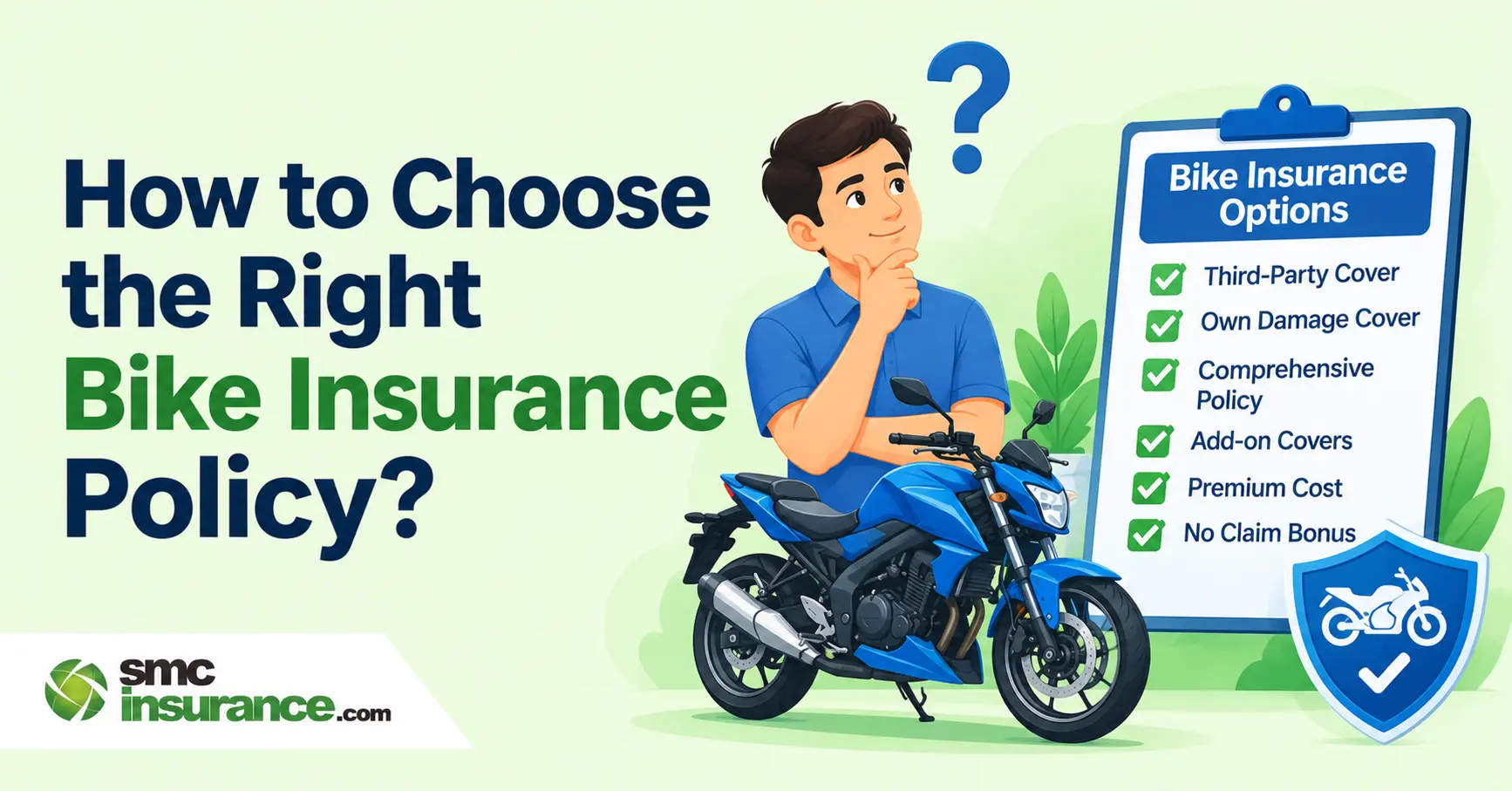
To choose the right bike insurance policy, start with the compulsory third-party and owner-driver personal accident cover, then add own-damage protection if the bike matters to your daily routine. Set the IDV close to the bike’s real market value, pick only the add-ons that match your roads and parking and compare insurers on cashless garages and claim handling instead of the lowest premium alone. Third-party premiums are fixed by the government at Rs. 538 to Rs. 2,804 a year before tax, depending on engine size, so any real price gap between two quotes comes from own-damage cover and add-ons. From 15 December 2026, your policy must also show each cover and its premium separately.
Table of Contents
- How to Choose the Right Bike Insurance Policy: Start With What the Law Already Decides
- Comprehensive vs Third-Party Bike Insurance
- Understanding IDV in Bike Insurance Before You Choose a Sum Insured
- Bike Insurance Premium Explained
- Best Add-Ons for Bike Insurance
- How to Choose the Right Bike Insurance Policy?
The renewal reminder pops up, the cheapest quote on screen is the third-party-only one at roughly Rs. 714 before tax for a 125cc scooter and a quiet voice says that will do. It will do for the law and for very little else, because that policy pays for the damage you cause to other people and nothing for your own bike. Learning how to choose the right bike insurance policy is mostly a matter of knowing which parts of the price the regulator fixes and which parts you can shape yourself and the rulebook itself changes on 15 December 2026. This guide walks through cover types, IDV, add-ons and insurer checks, so you finish knowing what to buy, what to skip and what to verify before you pay.
How to Choose the Right Bike Insurance Policy: Start With What the Law Already Decides
Before comparing a single quote, it helps to split the compulsory from the optional and from December that split will be printed on your policy itself. Section 146 of the Motor Vehicles Act, 1988 requires every vehicle on a public road to carry third-party liability insurance, which pays for injury, death or property damage you cause to someone else. Riding without it can cost you Rs. 2,000, up to three months in jail, or both for a first offence under Section 196 and the fine doubles to Rs. 4,000 for a repeat. Owner-drivers must also carry personal accident cover of Rs. 15 lakh, which a separate standalone policy can sometimes satisfy.
What Changes on 15 December 2026?
IRDAI’s circular IRDAI/CIR/MOT/10/2026, dated 2 November 2026, splits every private car and two-wheeler policy into four sections. Third-party liability stays compulsory, while legal liability towards a pillion rider becomes a separate optional section with its own premium. Personal accident has a compulsory part for the owner and optional parts for pillion riders and other drivers and own damage remains optional with pricing left to the insurer.
You will also sign a customer option form, online or offline and receive a customer information sheet and the policy schedule must show the premium for each section. Policies already in force stay valid and IRDAI has not announced any change in premiums under the new structure. In our view this is good news for buyers, because a bundled figure was always hard to question and an itemised one is not.
That pillion line deserves more thought than it will probably get. If someone rides behind you every day, whether a spouse, a child or a colleague, treat it as a real decision rather than a box to skip.
Six-Year Third-Party Cover for New Bikes
On 4 August 2026 the Supreme Court, in National Insurance Co. Ltd. v. Thungala Dhana Laxmi, directed that new two-wheelers carry six years of third-party cover instead of five and asked IRDAI to issue implementation instructions. Existing policies are untouched, but if you are buying a new bike, ask the dealer in writing whether the term is five or six years and what each part of the premium costs. Our explainer on the new bike insurance rules covers how this is being rolled out.
Comprehensive vs Third-Party Bike Insurance
With the legal floor settled, the real decision is how much of your own bike you want protected. Third-party cover looks after other people and their property, nothing more. If your bike is stolen from outside the office or damaged in a fall, a third-party-only policy pays you nothing, whereas a comprehensive policy adds own-damage cover for exactly those events, subject to its exclusions.
Third-party only can be a reasonable call for an old bike with a low market value that you rarely ride. For a bike that gets you to work every morning we would not take that gamble, since one bad skid can produce a repair bill that runs past a full year of comprehensive premium.
Buyers of new bikes often meet a third structure, the standalone own-damage policy, which you renew yearly while long-term third-party cover keeps running in the background. Diarise that date, because the third-party term outlasts the own-damage year and it is easy to assume you are covered when you are not. We have covered the gap in detail in our piece on why third-party cover alone is rarely enough for a bike.
Understanding IDV in Bike Insurance Before You Choose a Sum Insured
Insured Declared Value sounds technical, yet it is the one number that decides what you receive if the bike is stolen or written off.
IDV is your bike’s market value as agreed with the insurer, worked out from the ex-showroom price less a standard depreciation based on age. The schedule in the Indian Motor Tariff runs at 5 percent for a bike up to six months old, 15 percent up to a year, 20 percent in the second year, 30 percent in the third, 40 percent in the fourth and 50 percent in the fifth, after which the IDV is agreed between you and the insurer.
Take a bike with an ex-showroom price of Rs. 90,000 that is two and a half years old. It carries 30 percent depreciation, so the IDV works out to Rs. 63,000 and that is the most you can expect if it is stolen.
Pushing the IDV down at renewal to trim the premium saves a modest amount now and costs you the difference in the one claim where the number matters most. Pushing it above market value makes little sense either, since you pay a premium for worth the bike no longer has.
Bike Insurance Premium Explained
Price is where most riders begin, so it helps to know which slice of a quote nobody can negotiate.
Third-party premiums are not set by insurers at all. They follow engine-capacity slabs notified by the Ministry of Road Transport and Highways, which is why that part of any two quotes should match to the rupee.
Engine capacity |
1-year third-party premium |
5-year third-party premium (new bike) |
Up to 75cc | Rs. 538 | Rs. 2,901 |
75cc to 150cc | Rs. 714 | Rs. 3,851 |
150cc to 350cc | Rs. 1,366 | Rs. 7,365 |
Above 350cc | Rs. 2,804 | Rs. 15,117 |
Note: These are the base premiums notified by MoRTH with effect from 1 June 2022 and are shown before GST. We could not find a revised 2026-27 schedule or a notified six-year schedule, so confirm the applicable rate with your insurer before paying.
Everything above that line is own damage and add-ons and that is where quotes drift apart. The own-damage premium depends on IDV, make and model, the age of the bike, the city of registration and the add-ons you attach, as the factors that affect your bike insurance premium explains.
The biggest lever you control is the no claim bonus, a discount on the own-damage premium that starts at 20 percent after one claim-free year and steps up to 25, 35 and 45 percent before reaching 50 percent after five. The bonus belongs to you rather than the bike, so it travels when you switch insurers or buy a new one, though it is typically lost if the policy stays lapsed for more than 90 days. Do the sums before claiming for a Rs. 1,500 scratch, because the discount you give up can be worth more than the repair.
A quote that looks Rs. 600 cheaper often hides a lower IDV, a missing add-on, or both, so hold those constant before you judge.
Two quotes for the same bike can sit Rs. 800 apart and still mean very different things once you open the add-on list. Enter your registration number at SMC Insurance and compare insurers on the same IDV and add-ons, so the gap you see is a real one.
Best Add-Ons for Bike Insurance
Add-ons are where a sensible policy turns into an expensive one, so each should answer a specific risk you actually face.
Add-on |
Worth it when |
Probably skip when |
Zero depreciation | The bike is fairly new and replacement parts are costly | The bike is old, since many insurers stop offering it |
Engine protector | You ride through waterlogged roads in the monsoon | You ride in dry areas and park under cover |
Consumables cover | Your repairs involve oil, nuts, bolts and similar items billed separately | You rarely claim |
Return to invoice | The bike is new and financed and you could not easily replace it at invoice price | The bike is old and its invoice value sits far above market value |
Roadside assistance | You ride long routes away from a mechanic you know | You only make short trips around your own neighbourhood |
NCB protection | You hold 35 percent NCB or more and want one claim without losing it | You have little or no NCB to protect |
Pillion rider cover | Someone rides behind you often | You almost always ride alone |
Note: Availability, age limits and the number of claims allowed under each add-on differ by insurer, so read the policy wording before you pay.
Zero depreciation deserves the closest look. Without it, the insurer deducts depreciation on replaced parts such as fibre, plastic and rubber and you pay that gap from your pocket, while many policies also cap how many zero-depreciation claims you can make in a year. For a bike under five years old it is the add-on we would put first and everything else depends on your roads and where you park.
How to Choose the Right Bike Insurance Policy?
A policy is a promise to pay later, so the quality of an insurer shows up only on the day you claim.
Start with the cashless garage list that insurers publish on their websites and check whether a garage for your bike’s brand sits within a short ride of home or office. Then look at how claims are raised, whether intimation can be done on an app and how quickly a surveyor is assigned. Public disclosures on insurers’ websites and IRDAI’s annual reports carry claims data, which tells you more than star ratings from a handful of reviews. When you do read reviews, look for patterns such as repeated complaints about delayed surveys instead of the average score.
If a claim does go wrong, take it first to the insurer’s grievance officer, then to IRDAI’s Bima Bharosa portal and then to the Insurance Ombudsman if the reply still does not satisfy you. You can read the regulator’s own guidance for policyholders at irdai.gov.in .
A Five-Step Checklist Before You Pay
- Check when your current third-party term ends and whether your own-damage cover carries a separate date.
- Set the IDV close to the bike’s market value, using the depreciation schedule above as a sanity check.
- Ask for each section’s premium itemised, which becomes standard from 15 December 2026.
- Keep only the add-ons that match your roads, parking and riding hours, then drop the rest.
- Read the exclusions, including those for riding without a valid licence and for using a private bike for deliveries or hire.
Keep your registration certificate, previous policy and ID proof handy, since online purchase also asks for the registration number. And renew a week or two before expiry, because a lapse of more than about 90 days typically costs you your NCB and the insurer may ask for an inspection before restarting cover.
Summing Up,
Third-party cover is the legal minimum and its price is fixed, which means the real work in choosing a bike insurance policy sits in the own-damage part. Decide whether your bike earns comprehensive cover by how much you depend on it every week. Set an IDV near its true value and add only the covers that match your roads and parking. Judge insurers by their garages and claim handling, since a cheap premium means little if the claim drags on for months. The rules are also moving, with six-year third-party terms for new bikes under Supreme Court direction and an itemised four-section policy from 15 December 2026, so ask for every premium in writing. A practical path is to pull out your current policy, note both expiry dates, get one fresh quote with matching IDV and add-ons and then decide. Do it a couple of weeks before renewal rather than the night before.
Disclaimer: The information provided on this platform is intended for general awareness and educational purposes. While every effort is made to ensure accuracy, some details may change with policy updates, regulatory revisions, or insurer-specific modifications. Readers should verify current terms and conditions directly with relevant insurers or through professional consultation before making any decision.
All views and analyses presented are based on publicly available data, internal research and other sources considered reliable at the time of writing. These do not constitute professional advice, recommendations, or guarantees of any product’s performance. Readers are encouraged to assess the information independently and seek qualified guidance suited to their individual requirements. Customers are advised to review official sales brochures, policy documents and disclosures before proceeding with any purchase or commitment.
FAQs
Begin with the third-party term, which the Supreme Court has directed should be six years for new two-wheelers and confirm the implementation details with the dealer. Add own-damage cover for the first year, with an IDV close to the ex-showroom price less 5 percent depreciation. If the bike is financed, look at zero depreciation and return to invoice. Compare quotes outside the showroom before accepting the dealer’s bundle.
It satisfies the law, but it pays only for harm you cause to others. Theft, fire, flood and damage to your own bike fall outside it. We think it suits only an old, low-value bike that is rarely ridden. For a daily commute, comprehensive cover is the safer choice.
Aim for the bike’s real market value, using the Indian Motor Tariff depreciation schedule as your starting point. A lower IDV trims the premium but shrinks your payout on theft or total loss by the same margin. For bikes older than five years the figure is agreed with the insurer, so compare it with listings for similar used bikes.
It pays off most on newer bikes and many insurers restrict it by age or cap the number of claims per year. On an old bike with a low IDV, the extra premium can exceed what you would ever recover. Check the policy wording for age limits before you decide.
The bonus stays with you, so it carries over to a new insurer or a new bike as long as the policy has not lapsed for more than about 90 days. A single claim usually resets it unless you hold an NCB protection add-on. Keep your previous policy details ready, since the new insurer will ask for them.
Every private two-wheeler policy must be issued in four sections: third-party liability, pillion rider liability, personal accident and own damage. You will sign a customer option form and get a customer information sheet and each section’s premium will be shown separately. Policies already in force stay valid and no premium change has been announced.
Usually not, because private two-wheeler policies are written for personal use and exclude riding for hire or reward. If you plan to use your bike for deliveries, tell the insurer before you start and check the wording. A claim during commercial use under a private policy can be rejected.


