


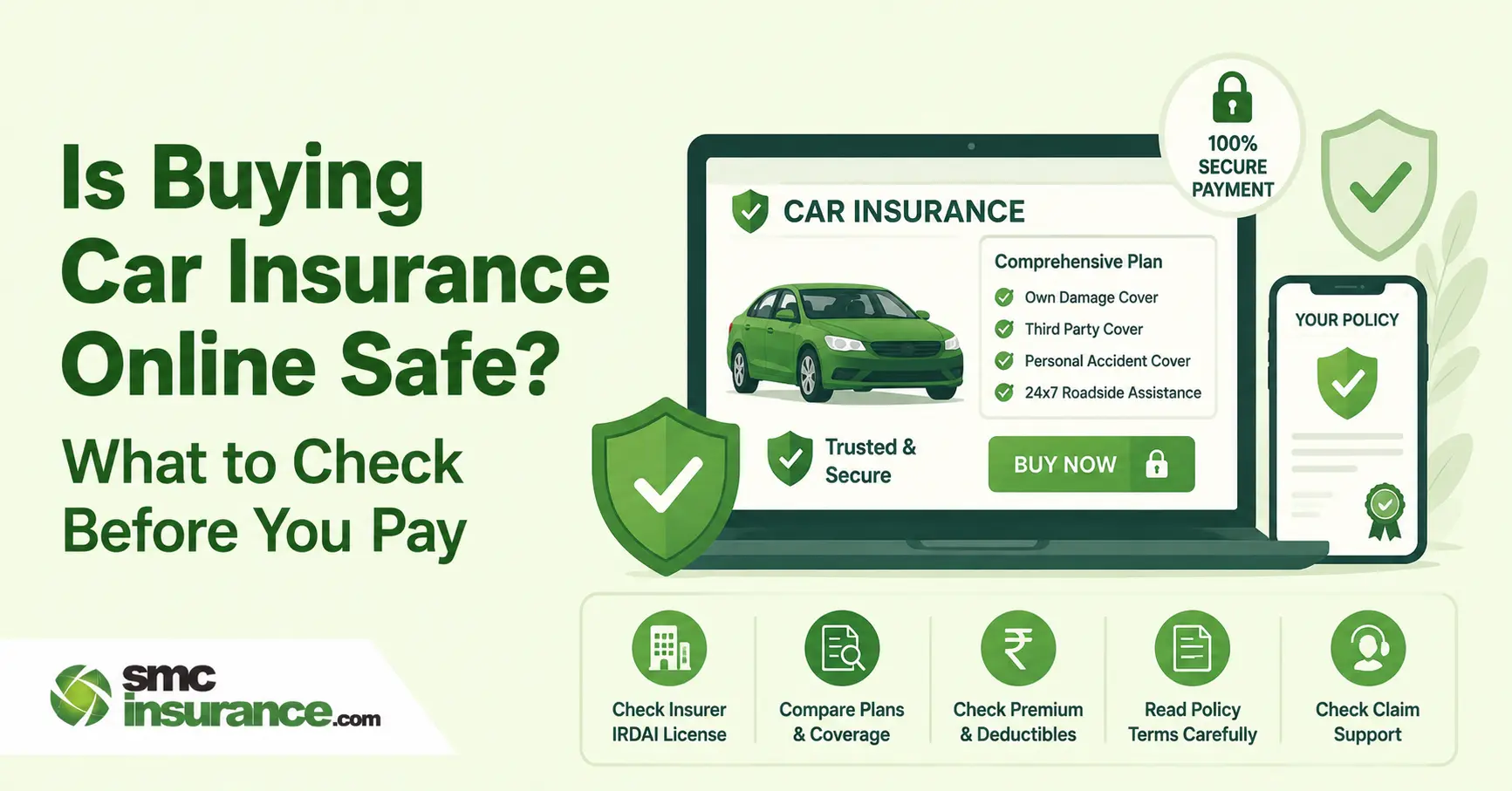
Yes, buying car insurance online in India is safe when an IRDAI-registered insurer or intermediary issues the policy and you pay into that business's own account. The real dangers are lookalike websites, payments to personal UPI IDs and quotes that fall below the fixed third-party premium, which starts at Rs. 2,094 before GST for a petrol or diesel private car up to 1000cc. Verify the seller on the IRDAI website before paying, then confirm the policy on VAHAN or the insurer's portal. If the policy cannot be found in either place, treat it as fake and report it.
Table of Contents
- Is Buying Car Insurance Online Safe in India?
- How Fake Car Insurance Websites Work and the Red Flags That Give Them Away
- Is Online Payment for Car Insurance Safe?
- What Does Genuine Car Insurance Cost?
- How to Buy Car Insurance Online Safely - Step by Step
- How to Verify Your Car Insurance Policy Online After Buying
- Buying Car Insurance Online vs Offline
- What Changes for Online Buyers From 15 December 2026
- What to Do If You Think You Bought a Fake Car Insurance Policy
A renewal reminder reaches your WhatsApp at 9 pm with a link and a quote that is Rs. 1,800 cheaper than last year. The page loads fine, the payment button is right there and a small voice asks whether buying car insurance online is actually safe or whether you are about to pay a stranger. The worry is fair, since fake motor policies exist and IRDAI has publicly named unlicensed websites that sold them.
Still, the worry is aimed at the wrong thing. Whether you buy online or at a showroom matters far less than who issues the policy and where your money lands. By the end of this guide you will know how to confirm an insurer in under five minutes, which price is too low to be real, how to verify the policy on VAHAN after paying and what the new IRDAI motor structure from 15 December 2026 changes for online buyers.
Is Buying Car Insurance Online Safe in India?
Let us start with why the online channel gets blamed for something it did not invent.
Safe, with one condition: the policy has to come from a licensed seller. Every insurer operating in India is regulated by IRDAI and the regulator advises buyers to purchase motor cover only from insurers and intermediaries registered with it. A policy issued that way is as legally valid as one handed over across a desk and digital copies held on DigiLocker or the mParivahan app are accepted as proof of insurance.
Fake motor policies are older than insurance apps. IRDAI's own year-wise figures showed fake motor policies rising from 823 in FY2018 to 1,192 in FY2019, a period when most car owners still bought through agents and dealers. Anyone who can print a policy can also forge one, which is why the sensible test is to judge the issuer and not the channel.
Where buying online genuinely helps is traceability. A purchase on a licensed insurer's site leaves a payment record, an email from the insurer's domain and a policy you can look up under your registration number, whereas a forged paper policy leaves none of that.
How Fake Car Insurance Websites Work and the Red Flags That Give Them Away
Scams in this space follow a pattern and the pattern is easy to spot once you know where to look. In February 2021 IRDAI told the public not to transact with Digital National Motor Insurance, a Bengaluru-based entity that sold motor policies without holding any licence and the contact email it used was a free Gmail address. The regulator has also cautioned against online offers of unusually low premiums from entities that do not exist on its registers.
What to check |
Red flag |
What a genuine seller shows |
Website address | Misspelt insurer name, extra words, odd endings, or a link that arrived through a forward | The insurer's own domain, typed by you or opened from its official app |
Contact details | Only a WhatsApp number or a free email ID | A toll-free helpline, a registered office address and grievance officer details |
IRDAI registration | No registration number, or one that does not match IRDAI's records | A number you can match against IRDAI's list of registered insurers and intermediaries |
Price | A quote far below every other seller for the same car | A third-party component identical to every other insurer's quote |
Payment | A personal UPI ID, wallet number or an individual's bank account | A payment page showing the insurer's or intermediary's registered business name |
Policy delivery | A PDF on WhatsApp, no login, nothing in any portal | An email from the insurer's domain and a policy you can retrieve in its portal or app |
Note: One red flag is a reason to pause, not proof of fraud. Two together are a reason to walk away.
Is Online Payment for Car Insurance Safe?
The payment page is where most losses happen, so it deserves more attention than the quote page.
Payment gateways used by licensed insurers add card encryption and OTP authentication, which makes the payment step itself reasonably safe. The weak link is where the money is going, not how it travels.
One popular piece of advice needs a correction. The padlock and https in the address bar only show that the connection is encrypted and a fraudulent site can have both, so treat them as a minimum and never as proof of honesty.
Before approving any payment, read the merchant name on the UPI or card confirmation screen, which should be the insurer or a registered intermediary and never a person's name. Skip public Wi-Fi for the transaction and open the insurer's site by typing the address yourself instead of tapping a link from an SMS.
What Does Genuine Car Insurance Cost?
Price is the cleanest fraud test an ordinary buyer has, because part of every private car premium is fixed by the government.
The third-party portion of a private car policy is set by the Ministry of Road Transport and Highways in consultation with IRDAI and it is identical at every insurer. These base rates have been held since the 2022 revision and a fresh revision has been under discussion, so check the figure in force on the day you buy.
Engine capacity (petrol or diesel private car) |
Annual third-party premium before GST |
Floor with 18% GST |
Up to 1000cc | Rs. 2,094 | About Rs. 2,471 |
1000cc to 1500cc | Rs. 3,416 | About Rs. 4,031 |
Above 1500cc | Rs. 7,897 | About Rs. 9,318 |
Note: Rates are for one-year third-party cover. Electric cars have a lower notified rate. Own damage premium sits on top of these figures and varies with the car, its IDV, the insurer and the add-ons you pick.
Here is how to use the table. If someone offers a full comprehensive policy for a 1.2-litre hatchback at Rs. 3,200, the arithmetic fails before you even open the website, because the third-party part alone costs about Rs. 4,031 with GST.
Genuine savings online usually come from the own damage side, through insurer discounts, a higher voluntary deductible or a clean no claim bonus, so a modest gap between two quotes is normal. A gap of thousands of rupees for identical cover is not.
Holding a quote that looks too good to be true? Put it next to live quotes from licensed insurers on SMC Insurance that lets you compare plans in minutes and see the third-party component for yourself before you pay a rupee.
How to Buy Car Insurance Online Safely - Step by Step
Follow these steps in order and most of the risk disappears before any money moves.
- Confirm the seller is licensed: Look up the insurer or intermediary on irdai.gov.in and match the registration number on the seller's site with IRDAI's record.
- Reach the site yourself: Type the address or use the insurer's official app instead of following a forwarded link.
- Keep your documents ready: A 2026 checklist of the documents required to buy car insurance in India saves you from rushing and pasting details into the wrong page.
- Compare like with like: Match IDV, add-ons and deductible across quotes, because a cheaper quote can simply mean less cover. It is best to compare car insurance policies online to get the best value for your money.
- Read the payee name, then pay: It should be the insurer's or the intermediary's registered business name.
- Download and cross-check the policy: Your name, registration number, engine and chassis numbers, IDV, policy period and add-ons should all match your RC and your selections.
If you are renewing, finish all of this before the old policy expires. A gap leaves you driving uninsured and can cost you the no claim bonus you have built up.
How to Verify Your Car Insurance Policy Online After Buying
Paying is not the last step, because a five-minute check afterwards settles whether the policy is real.
Where to check |
What you need |
What it confirms |
VAHAN or Parivahan Sewa (vahan.parivahan.gov.in), under Know Your Vehicle Details | Registration number | Insurer name, policy number and validity linked to your vehicle |
mParivahan app | Registration number | The same record on your phone, plus a digital copy you can show if stopped |
The insurer's website or app | Policy number or registration number | The policy schedule, premium paid and status, straight from the issuer |
Registration number | The active policy and insurer on record | |
IRDAI list of registered insurers | Insurer's name | Whether the insurer is licensed at all |
Note: A fresh policy can take a little while to show on VAHAN, so give it a day or two before worrying. If the insurer's own portal cannot find the policy either, stop treating it as valid.
You can also run a quick lookup with SMC's tool to check car insurance status using your registration number.
Buying Car Insurance Online vs Offline
Putting the channels side by side shows that the weak spot changes with the seller and not with the screen.
Where you buy |
Main risk |
Your safeguard |
Insurer's own website or app | A lookalike site copying it | Type the address yourself and confirm the domain |
Licensed broker or comparison website | A seller posing as one without being on IRDAI's list | Match the registration number with IRDAI's list and pay only to the registered entity |
Agent or point-of-sale person | A forged or unpaid policy | Ask for their IRDAI ID and check the policy on VAHAN and the insurer's portal the same day |
Dealer or showroom | Bundled add-ons you never asked for | Ask for an itemised quote, since you are not obliged to buy from the dealer |
Note: Claim settlement depends on the insurer and the policy wording, not on whether the policy was bought online.
For a renewal with an insurer you already know, its own site or app is the safest route. For a first purchase, comparing live quotes from several insurers matters more than the channel you pick.
What Changes for Online Buyers From 15 December 2026
A rule change arriving in about four weeks will alter what a genuine online policy looks like.
From 15 December 2026, IRDAI's new framework splits private car and two-wheeler policies into four sections: third-party liability, legal liability towards occupants, personal accident cover and own damage cover. Third-party liability stays mandatory, personal accident cover for the owner-driver continues under existing rules and the rest is optional.
As reported, every buyer will complete an option form online or offline, insurers will show the premium for each section in the policy schedule and policy wording becomes standard across insurers. Insurers remain free to price own damage cover and the new policies are meant to be available on the Bima Sugam platform from the same date.
That gives you a fresh test. After 15 December, an online policy that arrives without an option form or section-wise premiums deserves questions. Existing policyholders can also reportedly add occupant liability cover mid-term by paying an extra premium to their current insurer.
What to Do If You Think You Bought a Fake Car Insurance Policy
Acting within the first day improves your chances of recovering money and keeps you from driving uninsured.
- Confirm: If neither VAHAN nor the insurer's portal shows your policy, treat it as fake.
- Get valid cover immediately: Driving without valid insurance can bring a fine of up to Rs. 2,000, up to three months in jail, or both on a first offence under Section 196 of the Motor Vehicles Act and Rs. 4,000 on a repeat. You may also owe an accident victim's compensation from your own pocket.
- Flag the payment: Call your bank or UPI app straight away, then report on the National Cyber Crime Reporting Portal at cybercrime.gov.in or through helpline 1930.
- Tell the regulator: Register the case on Bima Bharosa, call 155255 or 1800 4254 732, or write to complaints@irdai.gov.in.
- File a police complaint: with screenshots, payment receipts and chat history attached.
If your dispute is with a genuine insurer and not a fraudster, take it to the insurer's grievance cell first and escalate to Bima Bharosa only if it stays unresolved.
Summing Up,
Buying car insurance online is safe in India, provided the seller is licensed and your money goes to a business account and not to a person. The fake policies that make headlines rely on lookalike websites, personal UPI IDs and prices that the fixed third-party premium makes impossible. Each of those can be caught in minutes. Check the seller against IRDAI's list, read the payee name before approving and hold the quote against the third-party floor for your engine size. Then confirm the policy on VAHAN or the insurer's portal and save the document on DigiLocker. With the four-layer structure arriving on 15 December 2026, expect an option form and section-wise premiums on genuine policies. If a quote fails any of these checks, walk away and report it, because a fake policy only reveals itself on the day you most need it.
Disclaimer: The information provided on this platform is intended for general awareness and educational purposes. While every effort is made to ensure accuracy, some details may change with policy updates, regulatory revisions, or insurer-specific modifications. Readers should verify current terms and conditions directly with relevant insurers or through professional consultation before making any decision.
All views and analyses presented are based on publicly available data, internal research and other sources considered reliable at the time of writing. These do not constitute professional advice, recommendations, or guarantees of any product’s performance. Readers are encouraged to assess the information independently and seek qualified guidance suited to their individual requirements. Customers are advised to review official sales brochures, policy documents and disclosures before proceeding with any purchase or commitment.
FAQs
Yes, as long as the policy comes from an IRDAI-registered insurer or intermediary and you pay into that business's own account. The channel is not the risk, the seller is. Verify the seller on IRDAI's website before paying and confirm the policy on VAHAN or the insurer's portal afterwards. Online purchases also leave a payment record and an insurer email, which helps if something goes wrong.
Yes, a policy issued by a licensed insurer is valid whether it sits on paper or on your phone and digital copies kept on DigiLocker or the mParivahan app are accepted as proof of insurance. Keep the PDF saved offline too, so a weak network never leaves you empty-handed at a check.
Search your registration number on VAHAN or Parivahan Sewa, then log in to the insurer's website or app and look for the same policy number. Match your name, registration number, engine and chassis numbers and policy dates against your RC. If either source cannot find the policy, assume it is fake and report it.
Not unless you can confirm who sent it. Reminders from your insurer are genuine, but fraudsters copy them, so open the insurer's app or type its address yourself and renew from your account. Never pay to a personal UPI ID, whatever the message says.
No, claims are decided on the policy wording, the cause of loss and your documents, whichever channel sold the policy. What can go wrong is a policy that was never issued by an insurer at all, which is exactly why verification matters. Read the exclusions and add-on terms before you pay.
Often, but not always. Online sales can skip intermediary costs and insurers sometimes offer online discounts on the own damage part, while the third-party premium is the same everywhere. Compare quotes with identical IDV and add-ons, because a lower price can simply mean less cover.
Buy valid cover at once so you are not driving uninsured, then call your bank or UPI app to flag the payment. Report the fraud on cybercrime.gov.in or helpline 1930 and register the case with IRDAI through Bima Bharosa or 155255. Keep every screenshot and receipt, since they support the police complaint.
From 15 December 2026, private car policies will have four sections and buyers will complete an option form, online or offline. Premiums for each section are to appear separately in the policy schedule, while own damage pricing stays with insurers. Third-party liability remains mandatory and no general premium increase has been announced as part of this change.


