


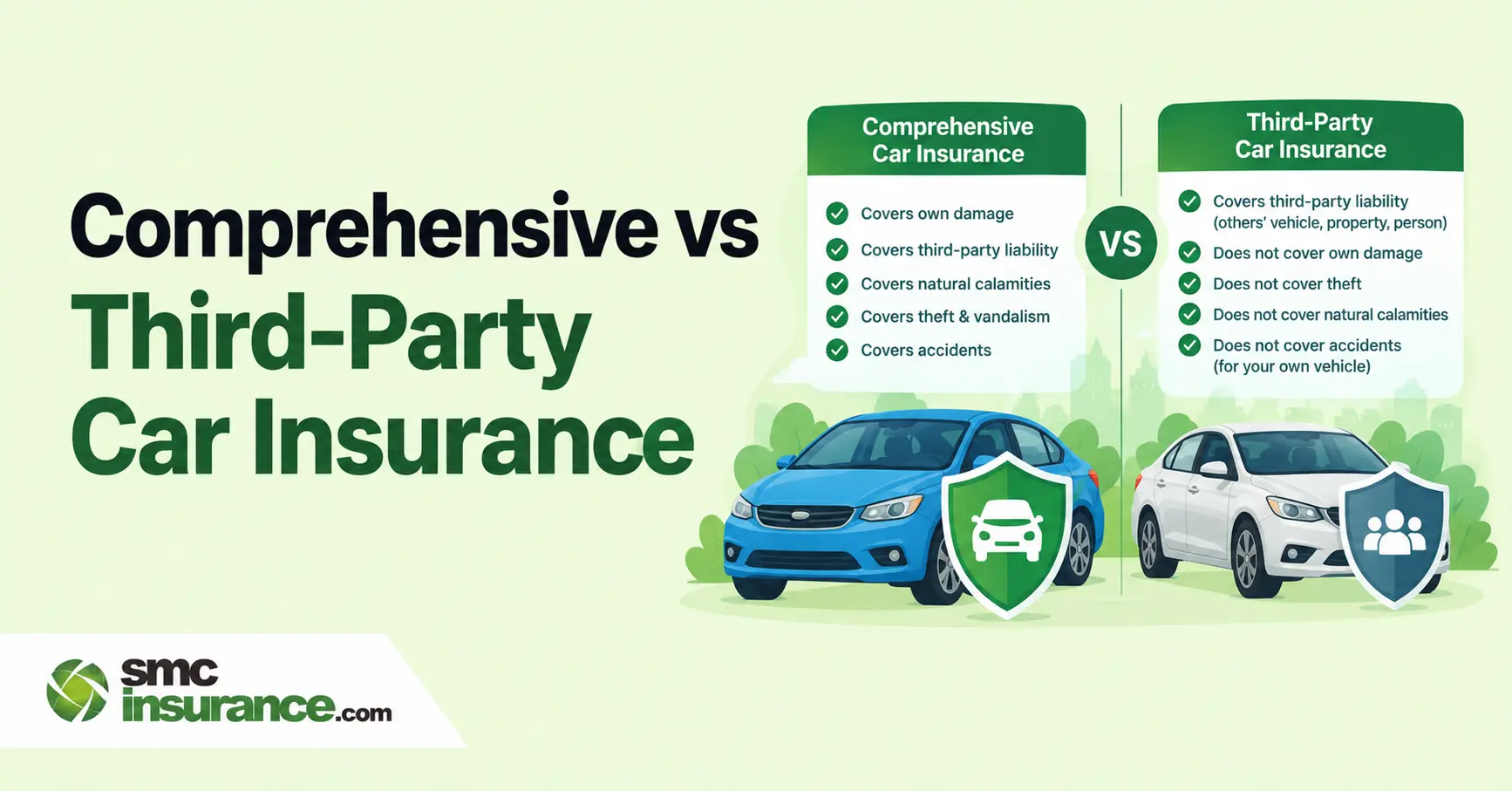
Third-party car insurance is the minimum cover required to legally drive on public roads in India. It covers your liability for third-party injury, death and property damage, with third-party property damage generally covered up to Rs. 7.5 lakh. Comprehensive/package insurance combines third-party liability with own-damage protection for the insured car, while standalone own-damage insurance is another option when liability cover is purchased separately. Third-party premiums are prescribed under the applicable regulatory framework, while own-damage premiums vary by insurer and policy details.
Table of Contents
- What Is Third-Party Car Insurance?
- What Does Comprehensive Car Insurance Cover?
- Comprehensive vs Third-Party Car Insurance: The Real Difference
- How Much Does Each Policy Cost?
- Switching From Third-Party to Comprehensive: What the Process Looks Like
- Which One Should You Buy: Comprehensive or Third-Party?
Renewal notices rarely explain themselves. You open the app, see two numbers sitting next to each other, one that looks reasonable and one that makes you wince and you're expected to pick it up in under a minute. Third-party car insurance costs a few thousand rupees a year and ticks the legal box. Comprehensive car insurance costs more, sometimes three or four times more and covers your own car too. Somewhere between those two numbers is a decision that affects what happens the day your car gets keyed in a parking lot, or worse, the day you're at fault in an accident that hurts someone else. This piece walks through the real difference between comprehensive and third-party car insurance, what each one actually pays for and how to decide without guessing.
What Is Third-Party Car Insurance?
Third-party car insurance, sometimes called an Act Only policy, covers your legal liability when your car causes injury, death, or property damage to someone else, their vehicle, or their property. It does not pay a single rupee toward repairing your own car.
Under Section 146 of the Motor Vehicles Act, 1988, every car owner in India must carry at least this cover to drive legally. There's no version of "I'll skip insurance this year" that holds up at a checkpoint or in an accident inquiry. Skip it entirely and you're looking at a fine of Rs. 2,000 for a first offence and Rs. 4,000 for a repeat one, on top of possible imprisonment.
The compensation a third-party policy pays out is uncapped for death or bodily injury, decided case by case by the Motor Accidents Claims Tribunal. A compulsory personal accident cover for the owner-driver is also provided under applicable motor insurance arrangements, with a minimum capital sum insured of Rs. 15 lakh. The cover applies to specified accidental death and disability situations involving the owner-driver while driving, mounting into or getting out of the insured vehicle, or travelling in it as a co-driver, subject to the policy terms. If the owner-driver already has qualifying personal accident cover of at least Rs. 15 lakh, the insurer's requirements for avoiding duplicate CPA cover should be checked.
What Does Comprehensive Car Insurance Cover?
Comprehensive car insurance, also marketed as a package policy or full coverage, bundles everything in third-party insurance with an own-damage (OD) component. That OD part is what pays for your car when a tree branch falls on it, when it's stolen, when it catches fire, or when you dent the bumper reversing out of a tight spot.
Here's the part that trips people up when they're comparing comprehensive insurance against the third-party version: comprehensive is not automatically "everything covered, no questions asked." It still excludes wear and tear, mechanical or electrical breakdown and any claim where you were driving without a valid licence or under the influence of alcohol. What it does give you is the ability to add riders, zero depreciation, engine protection, roadside assistance, that push the coverage closer to genuinely comprehensive.
No Claim Bonus applies to the own-damage component of motor insurance, not to the third-party liability premium. Under current norms, the discount can start at 20% and progressively increase to a maximum of 50% after successive claim-free years. A third-party-only policy has no own-damage premium to which an NCB can be applied.
Comprehensive vs Third-Party Car Insurance: The Real Difference
Reading definitions only gets you so far. The table below lines up both policies against the questions that actually decide a purchase.
Parameter |
Comprehensive Car Insurance |
Third-Party Car Insurance |
What it covers | Own car damage plus third-party liability | Only third-party liability (injury, death, property) |
Legally mandatory | No, but strongly recommended | Yes, under Section 146, Motor Vehicles Act 1988 |
Own car theft, fire, accident damage | Covered | Not covered |
Third-party bodily injury/death | Covered, unlimited liability | Covered, unlimited liability |
Third-party property damage | Covered, up to Rs. 7.5 lakh | Covered, up to Rs. 7.5 lakh |
No Claim Bonus | Available, up to 50% | Not applicable |
Add-on covers | Zero depreciation, engine protection, roadside assistance and more | None, standard cover only |
Premium | Higher, based on IDV, city, add-ons, NCB | Fixed by IRDAI based on engine cc, same across insurers |
Best suited for | Cars in daily use, newer vehicles, high-traffic cities | Very old cars, rarely driven vehicles, cars close to being sold |
Note: Property damage liability and NCB slabs are as commonly issued by insurers under current IRDAI norms and may vary slightly by policy wording. Always check the policy schedule before relying on these figures for a claim.
How Much Does Each Policy Cost?
Third-party premiums aren't something insurers set individually. IRDAI fixes them centrally, based on engine cubic capacity, so a Rs. 2,094 quote from one insurer and another quote from a different insurer for the same car should land at an identical number, before GST.
Engine Capacity |
Annual Third-Party Premium (before 18% GST) |
Up to 1000 cc | Rs. 2,094 |
1001 cc to 1500 cc | Rs. 3,416 |
Above 1500 cc | Rs. 7,897 |
These rates have stayed largely unchanged for a few years now, though MoRTH and IRDAI have had a hike under discussion, reportedly in the 10-25% range, for FY 2026-27. It hasn't been officially notified at the time of writing, so treat any "new rate" you see quoted online as provisional until IRDAI publishes the gazette notification and check the current figure on your renewal date.
Comprehensive premiums don't work off a fixed table. The own-damage portion depends on your car's Insured Declared Value (IDV), essentially its current market value, along with the city you drive in, your No Claim Bonus and whichever add-ons you pick. Two identical cars can carry different comprehensive premiums simply because one owner chose zero depreciation cover and the other didn't.
In our experience advising customers at renewal time, the gap that catches people off guard isn't the premium difference, it's the repair cost gap. A single front bumper and headlight replacement on a mid-size hatchback after a minor collision can run past Rs. 15,000-20,000 once you factor in current parts pricing, an amount that a third-party-only policy simply won't touch. That's usually the number that changes someone's mind faster than any brochure does.
Not sure which cover fits your car and your budget? Talk to an SMC Insurance advisor for a quick, no-obligation comparison before you renew. Visit SMC Insurance to get started.
Switching From Third-Party to Comprehensive: What the Process Looks Like
If you're currently on a third-party-only policy and want to move to comprehensive at renewal, here's how that typically plays out.
- Check your renewal date and current IDV
Avoid a break in insurance because an inspection may be required if the policy has already lapsed. - Get your car inspected if required
Depending on the insurer and the circumstances, a pre-insurance inspection may be required before own-damage cover is issued, particularly where there has been a break in insurance. - Compare IDV and add-ons across insurers
Since comprehensive pricing isn't fixed like third-party, get two or three quotes and check what IDV each one is offering; a lower IDV means a lower premium but also a lower payout if the car is totaled or stolen. - Choose add-ons based on the car's age and use
Check the insurer's eligibility criteria before selecting an add-on such as zero depreciation. Eligibility, vehicle-age limits and coverage terms can vary between insurers. - Pay and download the new policy document before the old one expires
Keep both the old and new policy PDFs until the fresh one is confirmed active in the insurer's system.
Which One Should You Buy: Comprehensive or Third-Party?
If your car is under seven or eight years old, sees regular daily use, or is parked outdoors or on the street, comprehensive insurance is worth the extra premium. The own-damage cover alone tends to pay for itself the first time you're in even a minor accident.
Third-party insurance makes more financial sense in narrower situations: a car you're planning to sell within the year, a second vehicle that's driven a handful of times a month, or a car old enough that its IDV has dropped low enough that comprehensive premiums no longer feel proportionate to what you'd recover in a claim.
Summing Up
Third-party car insurance is the legal floor, not a coverage strategy. It keeps you compliant with the Motor Vehicles Act and protects you against the financial fallout of hurting someone else on the road, but it leaves your own car completely exposed. Comprehensive insurance costs more upfront, yet it's the only one of the two that actually protects the asset you're paying premiums to insure in the first place. For most daily-driven cars in India, especially newer ones or those parked in high-traffic cities, comprehensive is the more sensible default, with third-party reserved for cars nearing the end of their useful life or ones you barely take out of the garage. Whichever you choose, renew on time, keep your IDV realistic and read the exclusions before you need them, not after.
Disclaimer: The information provided on this platform is intended for general awareness and educational purposes. While every effort is made to ensure accuracy, some details may change with policy updates, regulatory revisions, or insurer-specific modifications. Readers should verify current terms and conditions directly with relevant insurers or through professional consultation before making any decision.
All views and analyses presented are based on publicly available data, internal research and other sources considered reliable at the time of writing. These do not constitute professional advice, recommendations, or guarantees of any product’s performance. Readers are encouraged to assess the information independently and seek qualified guidance suited to their individual requirements. Customers are advised to review official sales brochures, policy documents and disclosures before proceeding with any purchase or commitment.
FAQs
Third-party insurance only covers legal liability for injury, death, or property damage you cause to someone else; it never pays for your own car. Comprehensive insurance covers that same third-party liability and adds own-damage protection for your car against accidents, theft, fire and natural or man-made calamities.
No, only third-party car insurance is legally mandatory under Section 146 of the Motor Vehicles Act, 1988. Comprehensive insurance is optional, though most owners choose it for the added protection to their own vehicle.
Comprehensive premiums include an own-damage component calculated on your car's IDV, city and chosen add-ons, on top of the fixed third-party premium set by IRDAI. Third-party premiums stay flat because IRDAI fixes them purely by engine cc, with no own-damage cost built in.
Yes, you can move from a third-party-only policy to a comprehensive one at any renewal date. Some insurers may ask for a pre-insurance inspection of the car before issuing the new comprehensive policy.
Driving without at least third-party insurance is an offence under the Motor Vehicles Act. It attracts a fine of Rs. 2,000 for a first offence and Rs. 4,000 for subsequent offences, along with possible imprisonment.
No, No Claim Bonus only applies to the own-damage component of a comprehensive policy. A third-party-only policy has no own-damage premium, so there's nothing for the bonus to discount.
Often, yes. If your car is more than eight to ten years old and its IDV has dropped significantly, the own-damage premium under comprehensive cover may not be worth it relative to what you'd recover in a claim. Third-party insurance keeps you legally compliant at a much lower cost in that case.
Only through the built-in personal accident cover for the owner-driver, up to Rs. 15 lakh and only while driving, boarding, or alighting from the insured car. It does not cover the driver's own vehicle damage or injuries to co-passengers unless a separate cover is added.


